How to Build Online Community: A Step-by-Step Guide to a Thriving Hub
If you boil it all down, building an online community really comes back to three things: a clear purpose, consistent value, and real connections between members. It's so much less about you and your brand, and so much more about creating a space where people genuinely feel like they belong.
The Foundation of a Thriving Online Community

Before you even think about choosing a platform or drafting that first welcome post, you have to get your head in the right space. The communities that truly succeed—from tiny, niche subreddits to massive brand forums—are all built on a two-way value exchange, not one-way marketing. Your job shifts from being a promoter to being a facilitator.
What that really means is your primary goal is to help members connect with each other and solve their own problems. When you, as a business, can make that happen, you build an incredible amount of trust and credibility. It’s the kind of trust we usually reserve for close friends.
Adopting a "Community First" Mindset
To build a community that actually lasts, you have to put what your members need ahead of your own brand’s goals. I know it sounds a bit backward, but it’s the only way to build real, long-term engagement.
So, what does a "community first" approach look like in practice?
- Listen more than you talk. Actionable Insight: Set up keyword alerts for your niche on platforms like Reddit or Twitter. What questions keep popping up? Use these as fodder for your first discussion prompts.
- Shine a spotlight on your members. Practical Example: Create a "Member of the Week" post. Interview an active member about their work, share their profile, and celebrate their contributions. This not only rewards them but also shows others what active participation looks like.
- Give, give, give. Share resources, answer questions, and offer up helpful content long before you ever think about mentioning your product.
Let's say a SaaS company is building a community for project managers. Instead of just posting product updates, they should be starting conversations about productivity hacks, sharing templates for dealing with difficult stakeholders, or hosting AMAs about career growth. The product will naturally come up in those conversations; it doesn't have to be the conversation.
It's not just a feel-good strategy. A study from the University of Michigan found that customers were likely to spend 19% more after joining a company's online community. Fostering that genuine connection has a real, measurable impact on the bottom line.
The Pillars of a Strong Community Foundation
Patience and authenticity are your greatest allies here. You have to grow a community; you can't just assemble it overnight. I’ve seen so many communities fail because the founders expected instant fireworks and bailed when the first few weeks were quiet.
Your entire strategy needs to rest on three foundational pillars:
- Authenticity: People can sniff out corporate-speak and sales pitches from a mile away. Practical Example: If you're the community manager, use your real name and photo. Share a personal story related to the community's topic. If you made a mistake, own it publicly. This humanizes the brand instantly.
- Patience: It takes time to build trust and get the flywheel spinning. Getting those first 100 members is the hardest part and requires the most hands-on effort. Actionable Insight: Create a simple spreadsheet to track your first 50 members. Note their interests and personally welcome each one with a customized message referencing something they've said.
- Genuine Helpfulness: Your mission, above all else, should be to solve your members' problems. Every piece of content, every event, every discussion prompt should be designed to help them get where they want to go.
When you focus on these principles from day one, you’re building for sustainable engagement, not just a short-term popularity contest. This is the foundation that ensures your community’s culture stays strong and welcoming, no matter how big it gets.
Defining Your Community's Purpose and People

Let's be honest: a community without a clear purpose is just a noisy, directionless chatroom. Before you write a single line of code or create a Slack channel, you have to get crystal clear on why it needs to exist and who it's for. This isn't just a box-ticking exercise; it's the foundation that separates a thriving hub from a ghost town.
The goal isn’t to vaguely “connect people.” It’s about solving a real, specific problem for a specific group. So, the first question to ask yourself is: what can my community offer that people can't easily get somewhere else?
Pinpoint Your Community's Unique Mission
Your mission is your North Star. It guides every decision you make, from the content you post to the moderation rules you set. It needs to be a simple, compelling answer to the question, "Why should I bother joining this?"
Practical Example: For a new photo-editing software, a weak mission is "A place for photographers to connect." A strong mission is "A community for amateur photographers to master post-processing by sharing presets, getting feedback on edits, and learning advanced techniques together." The second one is specific, value-driven, and immediately clear.
Here’s a quick-and-dirty framework to nail down your mission:
- For [Your Target Audience]... (e.g., freelance graphic designers)
- Who are struggling with [Specific Problem]... (e.g., finding high-quality clients and pricing their work)
- Our community provides [Unique Solution/Value]... (e.g., a private job board, weekly pricing feedback threads, and expert AMAs)
- So that they can [Achieve Desired Outcome]. (e.g., build a sustainable and profitable freelance business)
A well-defined mission acts as a natural filter. It pulls in the right people and gently nudges away those who wouldn't be a good fit, which is exactly what you want for building early momentum.
Create Your Ideal Community Member Profile
Once your mission is set, you have to get inside the heads of the people you're building for. This goes way beyond basic demographics. You need to create an "Ideal Community Member" (ICM) profile that outlines their goals, their biggest frustrations, and where they already hang out online.
It's absolutely vital to identify your target audience effectively before you launch, and that means truly understanding what makes them tick.
Ask yourself these questions to build out your ICM:
- Goals: What are they actually trying to accomplish in their life or work that relates to your niche?
- Challenges: What specific roadblocks are getting in their way?
- Watering Holes: Where are they already talking about this stuff? Think specific subreddits, niche forums, or active LinkedIn groups.
- Language: What jargon, slang, or acronyms do they use? Listen to how they talk to each other.
Actionable Insight: Spend one hour a day for a week "lurking" in a target subreddit. Don't post. Just read. Copy and paste the exact phrases people use to describe their problems into a document. This is your future content and copy, served on a silver platter.
Subreddit growth patterns offer a blueprint for scaling communities. The fastest-rising ones often see 7-9% monthly member gains by mastering niche relevance. In 2025, subs like r/law (+9.1%) and r/tattooadvice (+7.4%) grew by offering real user advice, a format Google increasingly favors.
Align Community Goals with Business Outcomes
Finally, let's talk business. Your community has to serve a purpose that ties back to tangible results. While fostering connections is great, you also need to prove its value to get the resources and buy-in you need to keep it going.
Your community goals should be clear, measurable, and directly connected to a business objective. No fluff.
| Business Model | Primary Community Goal | Key Metric to Track | Practical Example |
|---|---|---|---|
| SaaS Product | Increase product adoption & reduce churn. | Decrease in support ticket volume. | Create a "solutions" channel where users answer each other's questions. Track how many common support queries are resolved there. |
| DTC Brand | Build brand loyalty & drive repeat purchases. | Increase in member-exclusive sales. | Launch a new product flavor/color exclusively to the community first. Track sales from the unique link provided. |
| Startup Launch | Gather product feedback & build a user base. | Number of beta sign-ups from members. | Run a poll asking members to vote on the next feature to build. Track how many of those voters sign up for the beta when it's ready. |
Defining these goals from day one turns your community from a "nice-to-have" marketing channel into a strategic asset that actually moves the needle. It's how you ensure every bit of effort is both member-centric and commercially smart.
Choosing the Right Platform for Your Community
Picking a platform for your community is a huge decision, one that goes way beyond just the tech. It’s about building the house your members will live in. The platform’s architecture will define your culture—how people talk to each other, what content gets shared, and the overall vibe of the place.
The trick is to find that sweet spot between what you need as a community builder and where your ideal members already feel at home. Dedicated platforms give you incredible management tools, but sometimes the smartest move is to meet your audience where they already are.
Owned vs. Rented Platforms
Your first big fork in the road is deciding between an "owned" platform—your own turf, your rules—or a "rented" one, like a group on a social media site.
- Owned Platforms: Think of tools like Circle, Mighty Networks, or Discourse. These give you total control. You customize everything, integrate it with your site, and you own all the member data. This is the way to go for established brands or if you have a clear monetization plan.
- Rented Platforms: This is your Discord, Slack, Reddit, and Facebook Groups. The barrier to entry is super low because your people are probably already using them. You give up a lot of control, but you gain convenience and access to a massive built-in audience.
Actionable Insight: For many startups, a hybrid approach wins. Start a free Discord server to validate your idea and find your first 100 die-hard members. Once you have momentum and clear demand, you can migrate them to a paid, owned platform like Circle, offering them "founding member" status as a reward.
If you're still weighing your options, we've put together a guide on some of the best platforms for content creators that dives a bit deeper.
Community Platform Comparison
To help you visualize the trade-offs, here’s a quick breakdown of the most popular options and where they shine.
| Platform | Best For | Key Strengths | Potential Drawbacks |
|---|---|---|---|
| Early-stage validation, niche audience building, SaaS/DTC | Huge, engaged user base; powerful discovery; low barrier to entry. | No ownership; strict self-promotion rules; can be volatile. | |
| Discord/Slack | Real-time chat, gaming, tech, highly engaged groups | Instant communication; great for fostering tight-knit bonds; highly customizable. | Not great for searchable, long-form content; can feel chaotic. |
| Circle/Mighty | Premium communities, courses, established brands | Full ownership of data; monetization tools; integrates with your own brand. | Higher cost; requires you to bring your own audience (the "cold start" problem). |
| Facebook Groups | Broad consumer audiences, local groups, B2C brands | Massive user base; familiar interface; excellent for discovery within Facebook. | Noisy algorithm; limited customization; you don't own the member data. |
Ultimately, there's no single "best" platform—only the one that’s best for your audience and your goals right now.
The Reddit Launchpad Strategy
Forget trying to drag people to a brand-new, empty community. It's a hard sell. A much smarter play is to go where the conversations are already buzzing.
Reddit's growth has been absolutely explosive, making it a golden opportunity. The platform jumped from 57.5 million daily active users in 2022 to a staggering 116 million by Q3 2025—that's a 102% increase in just three years. With over 100,000 active subreddits, you can find a hyper-focused audience for almost anything. You can find more details on these Reddit statistics on ourownbrand.co.
The strategy here is to use Reddit as a launchpad, not just another place to drop links. It starts with finding the right subreddits and becoming a genuine, trusted member of that community long before you ever whisper a word about your own project.
Key Takeaway: The goal isn't to spam subreddits with links to your Discord. It's to build so much credibility and provide so much value that when you finally do mention your community, people are eager to follow you there.
How to Execute a Reddit Soft Launch
This pre-launch phase is all about testing your community idea and finding your first true fans organically, without spending a dime.
1. Find and Vet Your Target Subreddits
Start by identifying 3-5 subreddits where your ideal members hang out. Don't just look at subscriber counts. Actionable Insight: Use Reddit's search function with terms like "[your topic] help" or "[your topic] question". Look for subreddits where the comments are detailed and helpful, not just one-word answers. A subreddit with 50,000 truly engaged members is worth more than a generic one with 2 million lurkers.
2. Become a Real Contributor (The 90/10 Rule)
Live by this rule: for every 10 comments or posts you make, 9 of them should be purely helpful, with zero self-promotion. Answer questions. Share your expertise. Get involved in discussions. Your objective is to become a familiar, respected voice.
3. Create Posts That Actually Add Value
Don’t just reply to others; create your own original posts that resonate with the subreddit’s culture. Let’s say you’re building a community for SaaS founders and you’re active in r/SaaS.
- Bad Post: "Hey guys, I'm starting a community for SaaS founders, come join!" (This will get you downvoted into oblivion and maybe even banned.)
- Good Post: "I spent $5k on LinkedIn ads last month and got 0 leads. Here’s a full breakdown of my strategy, the ad creative, the mistakes I made, and what I learned. Hope this helps someone else avoid my costly error."
See the difference? The second approach builds trust and positions you as someone who knows their stuff. After you've been providing value like this for a few weeks, you can start to soft-sell. In a relevant comment, you might say, "I'm actually diving deeper into this with a few other founders in a small group I run. If you're interested, feel free to DM me."
This invitation-only approach feels exclusive and natural. It attracts the right kind of people—the ones who are genuinely invested and will become the foundation of your new community.
Crafting Your Content and Moderation Playbook
A great online community runs on two things: consistent, engaging content and fair, transparent moderation. One sparks the conversation, and the other protects it. Without a clear game plan for both, even the most promising community can either fizzle out into a ghost town or, even worse, devolve into a toxic mess.
The goal here is to create a rhythm that feels authentic, not robotic. Your content calendar shouldn't be some rigid, corporate schedule of press releases. Think of it more as a flexible framework of prompts and rituals that gets your members excited to share their own stories, expertise, and wins.
Designing a Content Calendar That Drives Engagement
Your content pillars are the recurring "shows" that members can look forward to each week. This consistency is what builds habits and gives people a real reason to keep coming back.
A simple but highly effective content mix usually includes:
- Weekly Discussion Prompts: These are the low-hanging fruit for getting people talking. Practical Example: For a community of remote workers, a great prompt is, "What's the one non-work-related purchase under $100 that has dramatically improved your home office?" It's specific, personal, and easy to answer.
- User-Generated Content (UGC) Showcases: Keep an eye out for insightful comments, killer tips, or cool projects shared by your members. Actionable Insight: Create a dedicated "#wins" or "#showcase" channel where members are encouraged to post their work. Then, you can easily pull from this channel for your weekly "Community Spotlight" post.
- Expert AMAs (Ask Me Anything): Bring in industry experts—or even your own company's leadership—for live Q&A sessions. This offers huge value and gives members exclusive access they can't get anywhere else. Schedule them monthly or quarterly to build some real anticipation.
A classic mistake is trying to do too much, too soon. Start with just 2-3 core content pillars. It's far better to nail a few things consistently than to burn yourself out with an over-engineered calendar.
The real magic, though, happens when member-to-member conversations take off. Just look at the engagement data on Reddit. Posts with tons of comments are the lifeblood of thriving communities, turning lurkers into loyal members. It’s no accident that subreddits like r/announcements can average 3,229 comments per post—they are masters at facilitating deep discussions. In 2025, an incredible 3.14 billion comments were logged on the platform because users are hungry for genuine connection. For B2B marketers, this means sparking real conversations in hubs like r/programming (6.8M members) or r/buildapc (7.9M). You can find more insights on subreddit growth at createandgrow.com.
Building a Moderation Strategy That Nurtures Culture
Great moderation isn't about policing; it's about shaping the culture you want to see. Think of your moderation playbook as a living document that outlines your community's values, rules, and how you handle disagreements. It’s less about wielding the ban hammer and more about building a safe, constructive space where people feel comfortable enough to be themselves.
Your strategy has to be proactive from the very beginning.
- Keep Your Guidelines Clear and Simple: Nobody wants to read a legal document. Write your rules in plain English and focus on behavior. Practical Example: Instead of a vague rule like "Be Nice," be specific: "Constructive Criticism is Welcome, Personal Attacks Are Not. Challenge ideas, not people."
- Create a Welcoming Workflow: Roll out the welcome mat for every single new member. Actionable Insight: Use a tool like Zapier or your platform's built-in automation to send an automated welcome DM that asks a simple icebreaker question, like "What's the #1 thing you're hoping to learn here?" This starts a conversation immediately.
- Have a Conflict Resolution Process: Sooner or later, disagreements will happen. You need a clear and consistent plan. A common escalation path is a "private warning -> temporary suspension -> permanent ban" model. Always handle disciplinary actions privately to avoid public drama. If the behavior affects the whole community, you can post a general reminder like, "Hey everyone, a quick note on our rules about respectful debate..."
The key to scaling moderation is empowering your members. As your community grows, you'll start to notice the super helpful, trusted people. These are your future moderators. Reach out to them privately and invite them to become "Community Champions." Giving them a special badge and a private channel to chat with you fosters a sense of ownership and lets you manage a much larger group without needing to be online 24/7.
Ultimately, your content and moderation should work together toward the same goal: making your community the most valuable place on the internet for your niche. For more detailed strategies, you can check out our guide on community engagement best practices.
How to Scale Your Community and Measure Its Impact
Growing a community isn’t about a one-time viral post; sustainable growth is a system. Once your community starts picking up steam, you need a solid framework for scaling your efforts and, more importantly, proving its value to the rest of the business. This means getting past the feel-good stories and focusing on hard data that shows real impact.
The first step is to stop obsessing over vanity metrics, like the total number of members. Sure, a big number looks great in a presentation, but it says nothing about the health of your community. A group of 10,000 silent lurkers is far less valuable than 500 die-hard advocates who are actively participating.
Designing Growth Loops That Scale
Instead of constantly pushing for new members through one-off marketing campaigns, the real secret is to build self-sustaining growth loops. These are clever systems where your current members naturally help you attract new, high-quality people. It’s about creating momentum that builds on itself.
Here are a few growth loops I’ve seen work wonders:
- Member Referral Programs: Don't just ask for referrals; incentivize them. Practical Example: The Hustle's newsletter grew to millions by offering high-quality rewards (like branded socks and hoodies) for referrals. For a community, offer an exclusive badge, a month of premium access, or a shout-out in the weekly newsletter for every 3 members they successfully invite.
- Content as a Growth Engine: Your community is a goldmine of user-generated content. Actionable Insight: Take the most upvoted question of the month and have an expert member write a detailed answer. Publish this Q&A as a blog post on your main site, crediting the members involved. This creates valuable SEO content that drives new, qualified traffic back to the community.
- Partnerships and Cross-Promotions: Find other communities that serve a similar audience but aren't direct competitors. Reach out and propose a content swap or a joint AMA (Ask Me Anything) session. This is a fantastic way to introduce your community to a pre-vetted, relevant audience in a way that feels organic, not spammy.
These kinds of systems are the backbone of many modern demand generation strategies because they create compounding returns over time without needing a ton of manual effort to keep them going.
A University of Michigan study found that customers are likely to spend 19% more after joining a company's online community. This is the kind of stat that proves your community isn't just a cost center—it's a powerful revenue driver.
Your community playbook should weave these growth loops right into your daily operations. This whole process becomes a continuous cycle where content, moderation, and engagement all feed into each other.
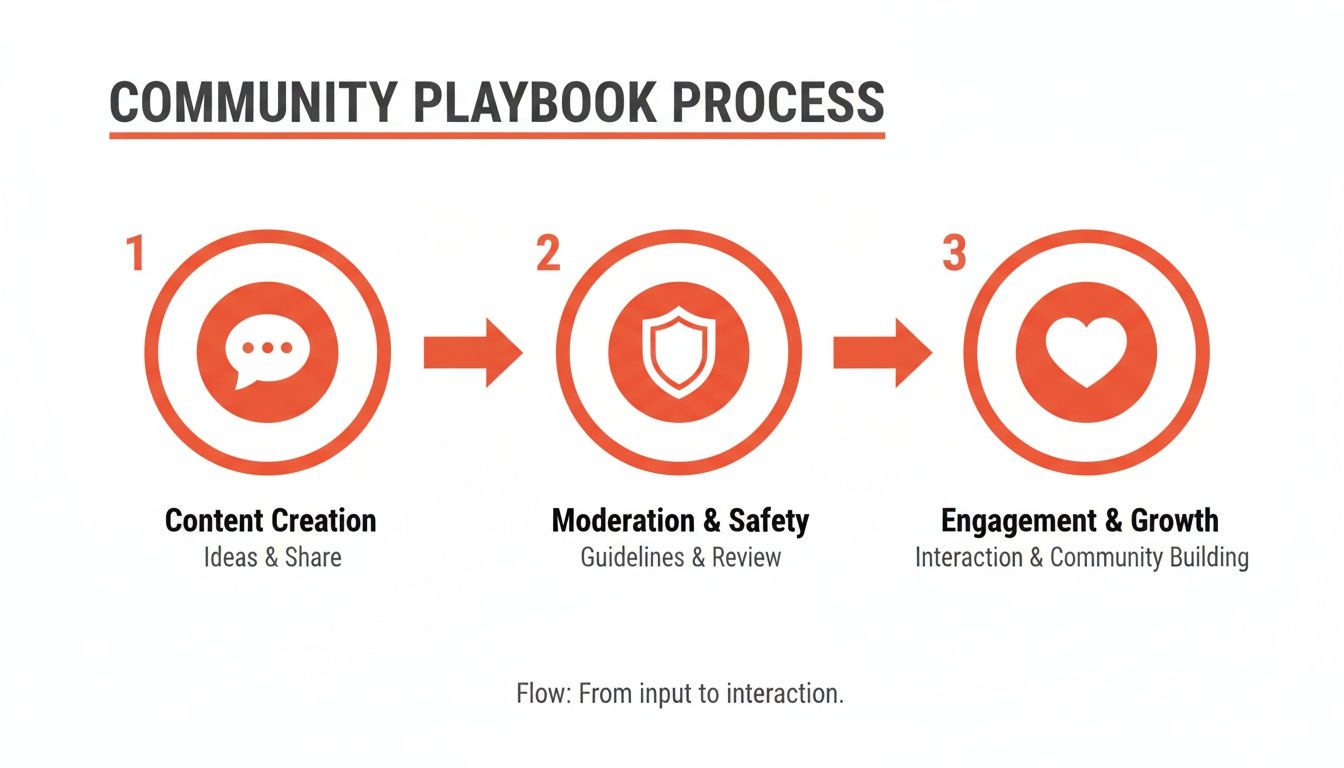
It’s a simple but powerful flow: great content sparks engagement, which needs good moderation to keep the space safe, which in turn encourages more high-quality conversations and growth.
Measuring What Matters Most
To get buy-in from leadership and prove your community's worth, you need to track KPIs that connect directly to your company's bigger goals. The metrics you focus on will vary a lot depending on your business model, but the objective is always the same: show how community activity is moving the needle on key business outcomes.
Practical Example: I once worked with a software company that saw a 28% drop in support ticket volume after getting its community off the ground. They achieved this by creating a "Community-Certified Solutions" program, where the best member answers were officially marked as correct, making them easy to find and trust. This directly slashed operational costs, providing a powerful ROI story.
To help you get started, here's a look at which KPIs you should be tracking based on your business type.
Community KPIs by Business Model
Tracking the right Key Performance Indicators (KPIs) is crucial for demonstrating the value of your online community. The metrics you choose should directly reflect your primary business goals, whether that's reducing support costs, increasing customer loyalty, or gathering product feedback. This table breaks down the most impactful KPIs for SaaS, DTC, and startup business models.
| Business Model | Primary Community Goal | Key KPIs to Track |
|---|---|---|
| SaaS/B2B Tech | Product Adoption & Retention | Deflected Support Tickets: Track the number of questions answered by the community versus support staff. Feature Request Volume: Measure how many product ideas originate from community discussions. User-Generated Solutions: Count the number of tutorials or workarounds created by members. |
| DTC/eCommerce | Brand Loyalty & Advocacy | Member-Exclusive Purchases: Track sales generated from discount codes shared only in the community. UGC Conversion Rate: Monitor how often user-generated photos or reviews are used in marketing and their impact on sales. Referral Revenue: Measure direct sales from member referral links. |
| Startup/Creator | Product-Market Fit & Audience Building | Beta Tester Sign-ups: Count how many new product testers are sourced from the community. Sentiment Analysis: Track the ratio of positive to negative mentions of your brand or product. Engagement Rate: Monitor the percentage of active members who post, comment, or react weekly. |
By focusing on these kinds of actionable metrics, you can shift the conversation from "How many members do we have?" to "How is the community impacting our bottom line?" This data-driven approach is absolutely essential for securing a budget, justifying your work, and making smarter decisions as you continue to build and scale your community.
Got Questions About Building Your Community? We've Got Answers.
Even the best-laid plans hit a snag or two once you're in the trenches. When you're busy building something from scratch, questions are inevitable. Getting the right answers can be the difference between a community that thrives and one that fizzles out.
This is your playbook for the day-to-day realities of community building. We'll get into the nitty-gritty, from how much time you really need to set aside at the beginning, to handling the occasional troublemaker, and coaxing those quiet members out of the shadows.
How Much Time Does a New Community Actually Take Per Week?
Let's be real: for a brand-new community, you need to block off at least 10-15 hours a week. This isn't just busy work; it's the critical foundation. You're setting the tone, sparking the first conversations, and personally welcoming every single person who walks through the digital door.
In the early days, you are the community engine. Your job is very hands-on and includes things like:
- Dropping daily discussion prompts so there's always something fresh to talk about.
- Replying to every single comment to show people you're listening and engaged.
- Keeping a close eye on all new posts to make sure everything aligns with your guidelines from day one.
- Personally reaching out to find and invite those first, crucial members.
As your community finds its footing and members start creating their own content, your role shifts. You'll move from being the main conversation starter to a facilitator. That’s when you can start thinking about bringing on member-moderators to help out. But skimping on time at the very beginning is one of the fastest ways to stall out before you've even started.
What's the Best Way to Deal With Conflict or Negativity?
The single best way to handle conflict is to have your community guidelines and moderation process figured out before you need them. When things get heated—and they will—you need to act fast, but you also have to be fair. That’s how you keep trust.
Actionable Insight: Create pre-written (but customizable) templates for common moderation actions: a friendly warning, a notification of a temporary ban, etc. This ensures consistency and saves you emotional energy when you have to act quickly.
First, always point back to the specific rule that was broken. If it's a small issue that the whole community could learn from, you might post a general reminder (like a quick note about respectful debate). But for anything that requires discipline, take it private. Deal with the members involved directly. This keeps drama and public shaming out of the main space.
A simple escalation ladder is your best friend here. Think: a private warning for a first slip-up, a temporary suspension if it happens again, and a permanent ban for repeat offenders. The key is consistency. When everyone sees you apply the rules fairly, it builds the trust needed for a safe and constructive environment.
How Can I Get Lurkers to Actually Participate?
Getting lurkers—the silent majority in any group—to join the conversation is all about creating easy, low-risk ways for them to contribute. You have to make that first post feel safe and simple.
Start with things like polls or super simple, open-ended questions. Instead of asking something complex like, "What's your advanced workflow for X?" try, "What's one tool you couldn't do your job without?" The second one is a much easier entry point for just about anyone.
Weekly rituals are another fantastic way to create a structured, safe space for people to chime in. A few ideas that always work well:
- "Weekly Wins" threads for sharing successes, no matter how small.
- "No-Stupid-Questions Tuesday" which immediately lowers the fear of looking inexperienced.
- A dedicated welcome thread where you personally tag new members and hit them with a fun icebreaker.
Practical Example: A community for writers could have a "First Line Friday" thread where people share the opening sentence of their current project. It's low-pressure, fun, and encourages participation without requiring a long, detailed post.
And when someone does post for the first time? Make a big deal out of it! Acknowledge their contribution and thank them. That little bit of positive reinforcement gives them the confidence they need to become a regular.
When Is the Right Time to Think About Monetizing My Community?
Monetization should be the last thing on your mind until your community is already buzzing with activity and members are getting a ton of value for free. Jumping the gun on this is a classic mistake that can instantly alienate your core members and kill your momentum.
Actionable Insight: Before you flip the switch on monetization, run a poll. Ask your members, "We're considering adding a premium tier with [X, Y, Z benefits]. Is this something you'd find valuable?" Their response will tell you if you're on the right track and also makes them feel included in the decision.
A good rule of thumb is to wait until you have a solid group of "power users" who are contributing all the time, and the conversations can carry on without you having to constantly jump-start them. When you finally do introduce a paid element, frame it as a way to make the community even better—maybe it funds exclusive content, live events, or better platform tools—not just as a way for you to make money.
Ready to build a powerful community on the one platform where authenticity wins? Reddit Agency helps brands turn conversations into customers. We'll find your ideal subreddits, craft content that resonates, and engage with your audience to drive real traffic and leads. Learn more about how we do it.
