How to Find the Best Keywords for Unlocking Reddit Growth
Finding the right keywords isn't about collecting a massive list of terms. It's about getting inside a user's head and figuring out why they're searching in the first place. This is what we call searcher intent, and it’s the secret sauce to creating content that actually resonates and gets results.
Reading Between the Lines: How to Decode Reddit Keyword Intent
Before you fire up any keyword tool, let's nail down the most crucial element: intent. Every single search, whether it’s on Google or typed into a subreddit's search bar, starts with a specific need. Grasping that need is the difference between clumsily interrupting a conversation and becoming a valued voice within it.
Think of a keyword as just the tip of the iceberg. The real meat is the massive, unseen part below the surface—the user's intent. It's their problem, their curiosity, or their readiness to pull out a credit card. On Reddit, this is magnified tenfold because people are there for real talk, not slick marketing.
The Main Flavors of Search Intent
To find the most valuable keywords, you first have to learn how to bucket them by their purpose. There are three main types of intent that will completely change how you engage in a Reddit discussion.
- Informational Intent: The user is hunting for answers, trying to learn something, or looking for a fix to a problem. They’re in research mode, not shopping mode. For example: A search for "how to fix a leaky faucet" is purely informational.
- Commercial Intent: Here, the user is actively exploring their options. They’re comparing different products or services and are much closer to making a decision. For example: A user searching "Moen vs. Delta kitchen faucets" is in the commercial stage.
- Navigational Intent: The user is simply trying to get to a specific site or find a known brand. This is less of a focus for Reddit keyword research, but it's good to know it exists. For example: Someone searching for "r/homeimprovement" is navigational.
Data from across the web shows a telling pattern: 52.65% of searches are purely informational. Only a small sliver are directly commercial. This proves you need a game plan that caters to people seeking knowledge first. If you want to dive deeper into these trends, check out the latest SEO statistics from Exploding Topics.
How Intent Plays Out in Actual Reddit Threads
So, how does this theory translate to a real Reddit conversation? It’s all about connecting the language of intent to the language of a specific community. The way a user phrases their question tells you everything you need to know about where their head is at.
Imagine you're a SaaS brand with a slick new CRM. Someone in r/smallbusiness posts, "How do I reduce customer churn?" This is pure informational intent. They have a pain point and need advice. If you jump in and drop a link to your pricing page, you're toast. You'll get downvoted into oblivion.
Actionable Insight: Instead of a sales pitch, offer a helpful framework. You could comment: "Great question. We've found a simple 3-step process helps: 1) Proactively check in with at-risk accounts, 2) Offer a small, unexpected perk, and 3) Ask for feedback on one thing you could improve. It shows you're listening and can turn a negative experience around." This provides real value without being promotional.
Now, flip the script. A different user posts, "Best CRM for a small real estate agency?" Bingo. That’s clear commercial intent. They’re in the market and actively evaluating solutions. This is your moment to gently step in and explain how your tool's features are perfect for managing client follow-ups in the real estate world.
Pro Tip: Your engagement style must match the user's intent. It's non-negotiable on Reddit. Answering an informational query with a hard sell is like trying to sell a steak to someone who just asked you for a salad recipe.
Mapping Keyword Intent to Reddit Engagement
Understanding intent helps you identify the right subreddits and frame your contributions effectively. Here’s a simple way to map different intent types to real opportunities on the platform.
| Intent Type | User Goal | Example Keyword | Ideal Subreddit Type |
|---|---|---|---|
| Informational | "I need to learn something or solve a problem." | "how to start a podcast" | Niche hobby communities (r/podcasting), Q&A hubs (r/NoStupidQuestions) |
| Commercial | "I need to decide which product/service to buy." | "best noise cancelling headphones 2024" | Product review subreddits (r/headphones), brand-agnostic communities (r/BuyItForLife) |
| Navigational | "I want to find a specific brand or community." | "r/notion subreddit" | Official brand subreddits, community-run fan subs (r/Notion) |
By categorizing keywords this way, you can anticipate what kind of content will be most welcomed by the community, turning a simple search term into a strategic entry point for engagement.
This foundational understanding of intent is the bedrock of a solid keyword strategy. It lets you filter out all the noise and zoom in on conversations where your brand can be a genuine, helpful resource. Not only does this build trust, but it also slots perfectly into a smarter, more effective Reddit marketing strategy. When you master intent, you stop just finding keywords and start finding opportunities.
Building Your Seed Keyword List from Customer Insights
It’s tempting to jump straight into a keyword research tool, but I’ve learned that’s a mistake. The very best keywords—the ones that unlock those high-value, authentic conversations on Reddit—come directly from your customers. Forget what a tool thinks they search for; you need to hear the exact language they use.
Your first job is to build a list of foundational seed keywords. These are the core, broad terms that describe what you offer. For example, if you sell a project management tool, a seed keyword is obviously "task management software." But your customers are probably using much more specific, problem-focused language like "how to stop missing deadlines" or "tools for better team collaboration." That's the gold you're digging for.
Uncover Keywords in Your Own Backyard
The most genuine and powerful phrases are usually hiding in plain sight, right inside your day-to-day operations. You just have to know where to look. By starting here, you ground your entire strategy in what your users actually need and say.
- Dive into Support Tickets: Your help desk is a treasure trove. Scan through those conversations and pinpoint the recurring issues. What specific words do customers use to describe their frustrations and what they’re trying to achieve? Practical Example: A user ticket might say, "My team keeps forgetting deadlines because notifications get lost in Slack." The keywords aren't just "notifications"; they're "lost in Slack," "forgetting deadlines," and "team reminders."
- Scour Sales Call Notes: Your sales team is on the front lines, talking to prospects every single day. Their notes are filled with unfiltered questions, objections, and the real pain points that drive people to look for a solution like yours. Actionable Insight: Look for direct quotes like, "We're currently using a spreadsheet for everything and it's a nightmare." The keyword here is "spreadsheet nightmare" or "alternative to spreadsheets."
- Read Every Testimonial and Review: Go through your reviews on G2, Capterra, or even your own website. Happy customers are fantastic at describing the "before and after" of using your product, and their language is packed with benefit-driven keywords.
This initial research helps you understand the intent behind the words. Are people just looking for information, are they comparing options, or are they ready to make a decision?
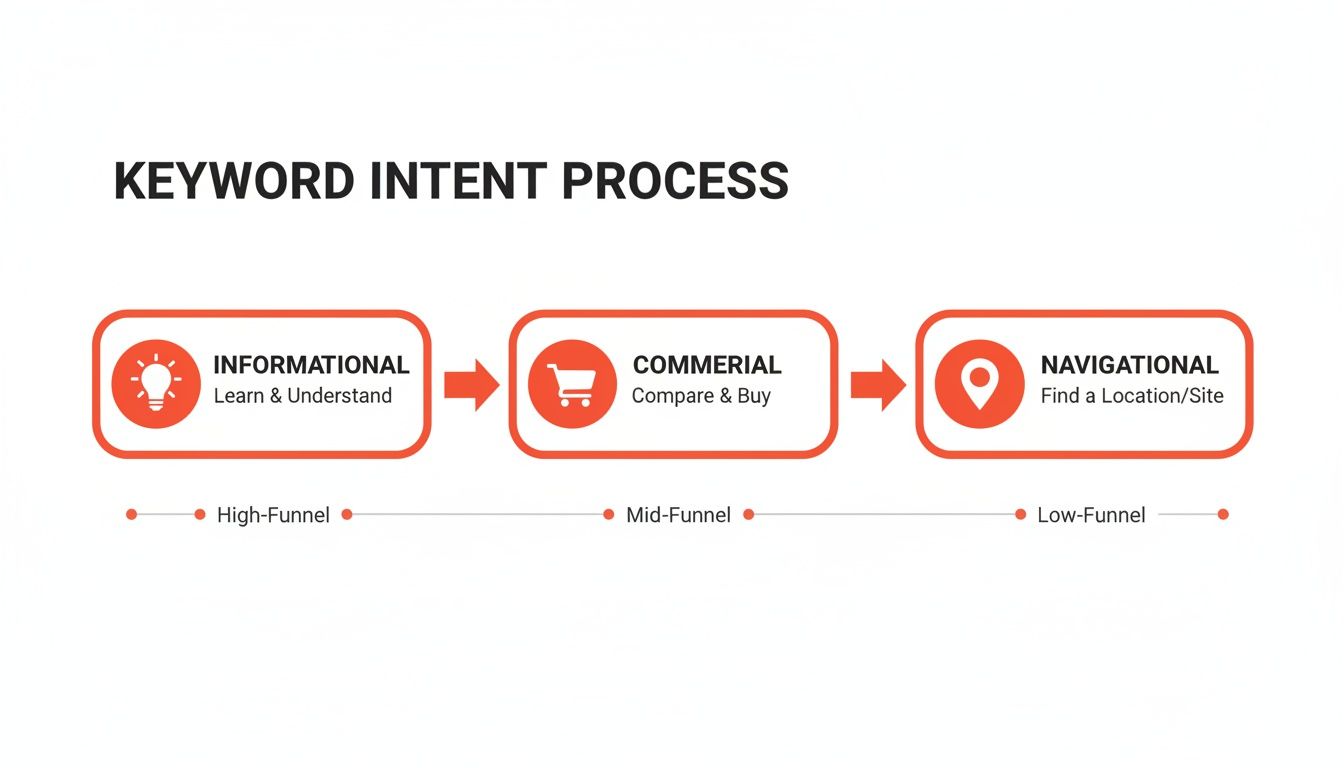
Mapping the language you find to these stages of intent is crucial. It dictates how you’ll engage with them on Reddit and what kind of content will actually resonate.
Talk Directly to Your Audience
Looking at existing data is great, but nothing beats a real conversation. The goal here is to get your customers talking openly about their challenges, because that’s where you’ll discover the keywords you would have never thought of on your own.
A simple shift in how you ask questions can make all the difference. Mastering the art of using open-ended questions is a game-changer for gathering rich feedback. Instead of asking a closed question like, "Do you like our new feature?" try something like, "Can you walk me through how you used to solve this problem before you found our tool?" The stories they tell will be overflowing with keyword ideas.
Your customers don't think in terms of SEO keywords; they think in terms of problems. When you solve their problems using their language, you win.
Once you’ve compiled this initial list from all these different sources, you'll have a rock-solid foundation. Now you're ready to find the ideal subreddits where people are already having these exact conversations. This customer-first approach ensures you're not just chasing keywords—you're finding your people.
Expanding Your Search with SEO and Reddit Tools
You’ve got your seed keyword list, built from what you know about your customers. That's your launchpad. Now, let’s blow that list wide open by pairing traditional SEO tools with the raw, unfiltered conversations happening on Reddit. This is how you get both the hard data and the crucial human context behind it.
Start by plugging those core seed keywords into a platform like Ahrefs or Semrush. If your seed term is something like "task management software," these tools will spit back a huge list of variations, questions, and related phrases you probably wouldn't have thought of on your own.
This is where you find the hidden gems. You’ll uncover long-tail keywords that signal very specific needs. For example, "task management software" might splinter into things like:
- "software for creative project management"
- "how to track team workload"
- "best Asana alternative for startups"
Each of these isn’t just a keyword; it’s a window into a distinct audience with a unique problem. Your potential topic pool just got a lot richer.

Uncovering Reddit Gold with Advanced Search
SEO tools give you the "what" people are searching for. Reddit tells you the "why." You need to see how your potential keywords actually show up in real conversations, and Google's advanced search operators are your secret weapon for this.
With a simple command, you can slice through Google's massive index and see results only from Reddit. This is a game-changer for validating your keyword list against genuine community discussions. Are people actually talking about these things?
A key takeaway from years of doing this: A keyword with high search volume but zero discussion on Reddit might be a dead end for community marketing. On the flip side, a low-volume keyword that pops up in dozens of passionate Reddit threads could be a massive, untapped opportunity.
Actionable Insight: Let's say your keyword is "best way to automate client onboarding." Pop this into Google:"best way to automate client onboarding" site:reddit.com
A quick search shows you threads in r/saas, r/smallbusiness, and r/entrepreneur where founders are actively debating tools and sharing workflows. This qualitative data is pure gold and just as valuable as any search volume metric. You can now go into those threads and see the exact language and pain points people are using.
Putting It All Together: A Practical Example
Let's walk through a real-world scenario. Imagine you run a DTC brand that sells high-end, ergonomic office chairs.
Seed Keyword: You start with "ergonomic office chair." Simple enough.
SEO Tool Expansion: You plug that into Ahrefs and it unearths a ton of related terms: "best office chair for back pain," "Herman Miller vs Steelcase," and "how to improve posture at desk."
Reddit Validation: Now, you take those new keywords and run them through your
site:reddit.comsearch."best office chair for back pain" site:reddit.comimmediately pulls up countless discussions in subreddits like r/OfficeChairs and r/BuyItForLife. You're seeing real users share frustrations and ask for recommendations."how to improve posture at desk" site:reddit.comleads you to threads in r/posture and r/WorkFromHome, where the conversation goes beyond just the chair to include topics like desk height and monitor placement. This is an opportunity to contribute to a broader conversation.
This combined method works so well because you’re piggybacking on Google’s incredible power. With Google commanding roughly 89.66% of the global search market and fielding over 5.6 billion searches a day, using its index to pinpoint specific Reddit conversations is an incredibly efficient research hack.
By blending the quantitative data from SEO tools with the qualitative insights from Reddit, you build a keyword list that's not just data-informed, but deeply rooted in the authentic language of your audience. If you want to get more advanced with collecting this data, you might even look into a step-by-step guide to a Reddit.com proxy scraper to automate some of the discovery.
Prioritizing Keywords for Maximum Impact
Okay, you’ve done the digging and now you're probably staring at a massive, messy spreadsheet of keywords. It’s a good start, but a giant list is just noise. The real work begins now: turning that raw data into a focused strategy.
The goal here isn't to just pick the keywords with the biggest search volumes. That's a rookie mistake. We need to filter this down to a manageable, prioritized list that actually aligns with your goals on Reddit—finding engaged communities where you can genuinely add value. It's all about relevance, user intent, and the potential for real discussion.
A Simple Scoring Framework for Clarity
To bring some order to the chaos, you need a simple way to evaluate each keyword objectively. This keeps you from chasing shiny objects—terms that look great on paper but deliver zero results in practice. I’ve found the best way to do this is to score each keyword against a few core criteria.
Think of it as a report card for your keywords. By assigning a score to each metric, you can quickly calculate a total priority score that makes the true contenders jump off the page.
Here are the three factors I always evaluate:
- Relevance Score (1-5): How tightly does this keyword connect to what you actually offer? For a CRM company, a term like "best CRM for sales teams" is a solid 5. Something broader like "how to increase sales" is more of a 3—it’s related, but not a direct hit.
- Intent Score (1-5): What's the user really trying to do? A keyword with clear buying intent, like "Asana vs Trello for small business," is a 5. An informational query like "what is project management" is closer to a 2 because that person is just starting their research.
- Discussion Potential (1-5): Is this something people are actually talking about on Reddit? Do a quick
site:reddit.comsearch. If you find dozens of threads with passionate debates and people asking for recommendations, that's a 5. If all you hear are crickets, it's a 1.
Why Low-Volume Keywords Can Be Your Secret Weapon
One of the biggest traps marketers fall into is ignoring keywords with low monthly search volumes. In my experience, these are often the gold mines. Why? Because they signal hyper-specific needs from users who are much, much closer to making a decision. We call these long-tail keywords.
Practical Example: A huge term like "project management" might get 50,000 searches a month, but you'll be fighting a bloody battle for visibility, and the intent is all over the place.
Now, compare that to a long-tail keyword like "best way to automate client onboarding." It might only get 50 searches a month. But you can bet that every single person searching that phrase has a specific, high-value problem they are desperate to solve right now. Finding a Reddit thread with that exact title is like striking gold.
This is where you find your edge. Roughly 70% of all search traffic actually comes from these long-tail keyword variations. That stat should tell you everything you need to know: most people search with incredibly specific, multi-word phrases that signal a clear and immediate need. You can find more SEO trends and data on Exploding Topics.
Targeting these long-tail keywords lets you jump into conversations where you can provide a precise, helpful solution. That makes your input feel a lot less like marketing and a lot more like a genuine contribution to the community.
Putting It All Together with a Scorecard
So, let's make this real. Imagine you're marketing a new AI-powered project management tool specifically for creative agencies. By scoring your raw keyword list, the best opportunities will quickly become obvious.
A simple scorecard is the perfect tool for this. It helps you systematically evaluate each keyword and spot the highest-potential terms at a glance, removing guesswork from the equation.
Here's an example of how you might fill it out.
Keyword Prioritization Scorecard Example
Use this scorecard to evaluate and rank your keywords based on key metrics relevant to Reddit marketing.
| Keyword | Monthly Volume (1-5) | Intent Score (1-5) | Relevance Score (1-5) | Total Priority Score |
|---|---|---|---|---|
| "project management software" | 5 | 3 | 4 | 12 |
| "how to improve team collaboration" | 4 | 2 | 3 | 9 |
| "best PM tool for creative agencies" | 2 | 5 | 5 | 12 |
| "Asana alternative for designers" | 2 | 5 | 5 | 12 |
Based on this scoring, you can see how terms that look great on paper, like "project management software," might not be the best fit. Instead, the hyper-specific terms like "Asana alternative for designers" and "best PM tool for creative agencies" rise to the top. Even with lower search volume, their combination of high intent and direct relevance makes them your best bet.
This is your green light. These are the conversations you need to build your Reddit strategy around. After this process, you should have a clean, prioritized list that’s ready for the next step: building out your content plan.
Organizing Keywords into Strategic Topic Clusters
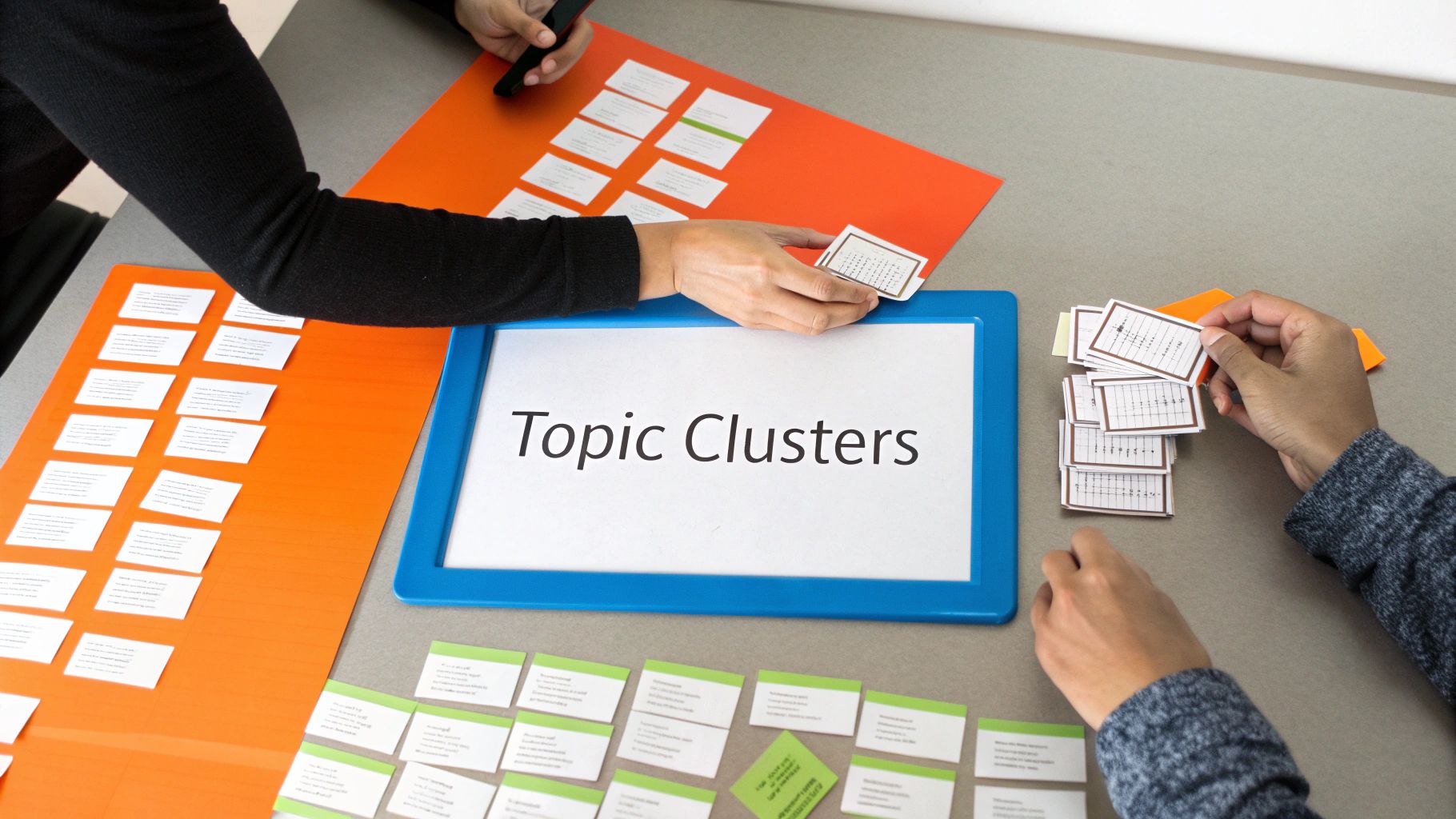
You've done the hard work and filtered your list down to a set of high-impact keywords. That’s a huge step, but the real magic begins when you stop looking at them as individual terms. To truly succeed on Reddit, you need to group them into topic clusters that reflect how real communities actually talk.
This isn't about just winning a single search term. It's about owning an entire conversation. When you think in clusters, you position yourself as a genuine expert who can add value across dozens of related threads, building real authority and trust along the way.
Pillar Topics and Cluster Keywords Explained
The topic cluster model is brilliantly simple. You organize your content around a central "pillar" topic, which is then supported by a handful of related "cluster" keywords. Picture a wheel: the pillar is the hub, and the clusters are the spokes.
- Pillar Topic: This is the big, broad subject you want to be known for. It’s the heart of the conversation and often a shorter, more competitive keyword.
- Cluster Keywords: These are the specific, long-tail keywords that explore the subtopics around your pillar. They answer very specific questions and speak to niche problems.
This structure doesn't just make sense to search algorithms; it’s a perfect mirror for how you'll engage on Reddit. Your pillar topic is your north star, while the cluster keywords become your entry points into highly specific, relevant discussions.
A Practical Example of Topic Clustering
Let's make this real. Imagine your company sells a B2B lead generation platform. Trying to rank or get noticed for "B2B lead generation" by itself is a slow, painful grind. A topic cluster approach is a much smarter play.
Pillar Topic: B2B lead generation
Supporting Cluster Keywords:
automating lead nurturing workflowscold email strategies that actually workbest CRM for B2B sales teamshow to calculate cost per leadLinkedIn prospecting tips for SaaS
Suddenly, you have a complete map of the conversation. Each cluster keyword represents a specific problem or question someone in your target audience is grappling with. This framework gives you a strategic blueprint for planning your Reddit engagement with incredible precision.
The global keyword research tools market has exploded, with web-based platforms becoming essential. This just underscores how critical data-driven strategies like topic clustering are now. As of 2025, the market continues to show massive growth potential. You can dig deeper into these trends over at Cognitive Market Research.
Mapping Clusters to Subreddit Communities
Here’s where your strategy really comes to life. The next step is to map your newly formed topic clusters to specific subreddits. This is how you turn a theoretical keyword list into a concrete engagement plan. Think of each cluster keyword as a breadcrumb leading you directly to a community that needs what you know.
By aligning your keyword clusters with relevant subreddits, you ensure you’re always showing up in the right place, at the right time, with the right answer. This systematic approach is the key to building authority and driving long-term growth.
Actionable Insight: Sticking with our B2B lead gen example, here’s a practical map of clusters to communities. This turns your keyword list into an action plan.
| Cluster Keyword | Target Subreddit(s) | Engagement Angle |
|---|---|---|
automating lead nurturing workflows |
r/marketing, r/saas | Share a simple framework for a 5-step nurture sequence that doesn't feel robotic. |
cold email strategies that work |
r/sales, r/Entrepreneur | Offer a critique of a user's cold email script and suggest data-backed improvements. |
best CRM for B2B sales teams |
r/smallbusiness, r/b2b | Provide an unbiased comparison of three popular CRMs, highlighting pros and cons for different use cases. |
LinkedIn prospecting tips for SaaS |
r/linkedin, r/SaaS | Detail a non-spammy outreach method that focuses on building connections before pitching. |
This methodical process transforms your keyword research from an abstract exercise into a practical roadmap. You're no longer just finding the best keywords; you’re building a system to own entire conversations, one helpful contribution at a time.
Testing and Measuring Your Reddit Keyword Strategy
All the keyword research in the world is just theory until you prove it in the wild. This is where the rubber meets the road—validating your keywords and measuring their actual impact on Reddit. We're not talking about getting lost in complex analytics. It’s about watching, listening, and tracking the right signals to see if your strategy is really connecting with people.
Before you even think about jumping into a conversation, spend some time lurking in your target subreddits. Think of it as a final validation check. Set up alerts or just manually scan the communities for your top-tier keywords. You want to see how often they actually pop up and get a feel for the sentiment around them. This simple reconnaissance mission can save you from pouring effort into topics nobody talks about or, worse, topics that are viewed negatively.
Setting Up Your Measurement Framework
Once you start participating, you have to track what actually matters. Forget about vanity metrics like impressions that don't tell you anything meaningful. The whole point is to see if your keyword-guided conversations are driving real business outcomes.
To get a clear picture of your impact, you’ll want to zero in on these key performance indicators (KPIs):
- Comment Engagement: Are people actually replying to your comments? High-quality engagement—think thoughtful questions or positive follow-ups—is a massive indicator that you're striking a chord.
- Referral Traffic: This is non-negotiable. Use UTM parameters on every single link you share. This is the only way to see exactly how many people are clicking from a specific Reddit comment over to your website. Practical Example: Create a UTM link like
yourwebsite.com?utm_source=reddit&utm_medium=comment&utm_campaign=crm-alternatives. Now you can see precisely how much traffic that one comment drove in Google Analytics. - Upvote Velocity: It's not just about the final number of upvotes. How quickly and consistently are they coming in? A steady stream of upvotes shows that the community at large finds what you're saying valuable.
Measuring the right KPIs is crucial. A single, highly engaged comment that drives two qualified leads is infinitely more valuable than a hundred upvotes on a post that generates zero website traffic.
Translating Reddit Activity into Business Results
Ultimately, you need to connect the dots between your time on Reddit and your bottom line. How can you be sure your keyword strategy is bringing in qualified leads or sales? It’s often simpler than you might think.
Imagine you sell a project management tool. One of your core keywords is "best Asana alternative." You spot a thread in r/projectmanagement where someone asks for recommendations. You jump in with a genuinely helpful, non-salesy comment, outlining a few options and casually mentioning how your tool solves a specific pain point that Asana users complain about.
Here’s what you track next:
- Direct Leads: Did anyone from that specific thread click your UTM link and sign up for a demo or free trial? Your analytics will tell you instantly.
- Assisted Conversions: Dig a little deeper into your analytics. Can you see users who first visited from that Reddit link, left, and then came back later to convert through another channel, like organic search? Actionable Insight: In Google Analytics, go to Conversions > Multi-Channel Funnels > Assisted Conversions. Filter by 'Source' and look for 'reddit.com'. This shows you how many sales Reddit influenced, even if it wasn't the final click.
This relentless focus on measurement is what turns effort into proven ROI. It shows you exactly which keywords and subreddits are goldmines, allowing you to double down on what works and refine your approach. In fact, effective measurement is a cornerstone of our community engagement best practices, because that data is what fuels a continuously improving strategy.
Common Questions About Reddit Keyword Research
When you start digging into Reddit for keyword ideas, a few questions always pop up. Let's clear the air on the most common ones so you can build a strategy that actually works for genuine community engagement.
How Often Should I Do Keyword Research?
People often wonder if this is a one-time thing. Definitely not. Think of it more like a quarterly health check for your strategy.
Communities change, slang evolves, and new trends or pain points constantly surface. A quick review every 3-4 months is a good rule of thumb. This keeps you tapped into what's happening now, not what was relevant last season. Actionable Insight: Set a recurring calendar event each quarter to spend half a day re-running your top keywords through site:reddit.com searches to spot new subreddits or changing language.
Google Keywords vs. Reddit Keywords: What's the Difference?
This is a big one. While there can be some overlap, the user's intent is completely different, and that changes everything.
Google keywords are usually direct, answer-seeking queries. Someone wants a specific piece of information or a product. On Reddit, keywords are conversation starters. They’re rooted in stories, opinions, and shared experiences.
Practical Example:
- Google Keyword: "best CRM for small business"
- Reddit Keyword (as seen in a post title): "My startup's contacts are a mess, what do you guys use to keep track of leads?"
The need is the same, but the language is conversational and seeks community input, not just a list of features.
The core difference is this: Google is a search engine for answers; Reddit is a search engine for discussions. Your keyword strategy has to reflect that shift from finding information to finding conversations.
This means you need to hunt for long-tail, problem-focused phrases that sound like how real people talk. Low-competition, high-intent keywords are your secret weapon for sparking the kind of engagement that leads to real results.
Ready to turn Reddit conversations into customers? Reddit Agency helps you find the right subreddits and keywords to generate measurable traffic, leads, and sales. Learn more about our process at our website.
