
A Guide to Planning a Promotion That Works
Promoting someone isn't just about giving them a new title and a bigger paycheck. It's a serious investment in your team and a powerful signal of your company's values. Get it right, and you boost morale, performance, and keep your best people around. Get it wrong? You risk creating resentment, confusion, and a whole lot of disruption.
The secret to success is laying the groundwork before you even think about making an announcement. This means ditching reactive, "who's next in line?" thinking and building a repeatable, strategic process. It all starts with tying the promotion directly to what the business is trying to achieve—a step that, frankly, gets missed far too often.
Building the Foundation for Your Promotion Plan
Every promotion needs a "why." It has to serve a clear business purpose. Are you trying to beef up leadership in a department that's exploding with growth? Or maybe you're desperate to keep a top performer who's the lynchpin for a massive upcoming project? Nailing down this purpose is your first move.
Practical Example: A software company is about to launch a new product line. They decide to promote a senior engineer to team lead. The business goal is a flawless product launch. The promotion directly supports this by putting a proven expert in charge to guide the development team. When you have that kind of clarity, the promotion’s value is undeniable to everyone.
A promotion without a clear link to business objectives is just a title change. A strategic promotion is a tool for growth, designed to solve a specific business problem or capitalize on an opportunity.
Getting this alignment right from the start makes every other step in the process fall into place.
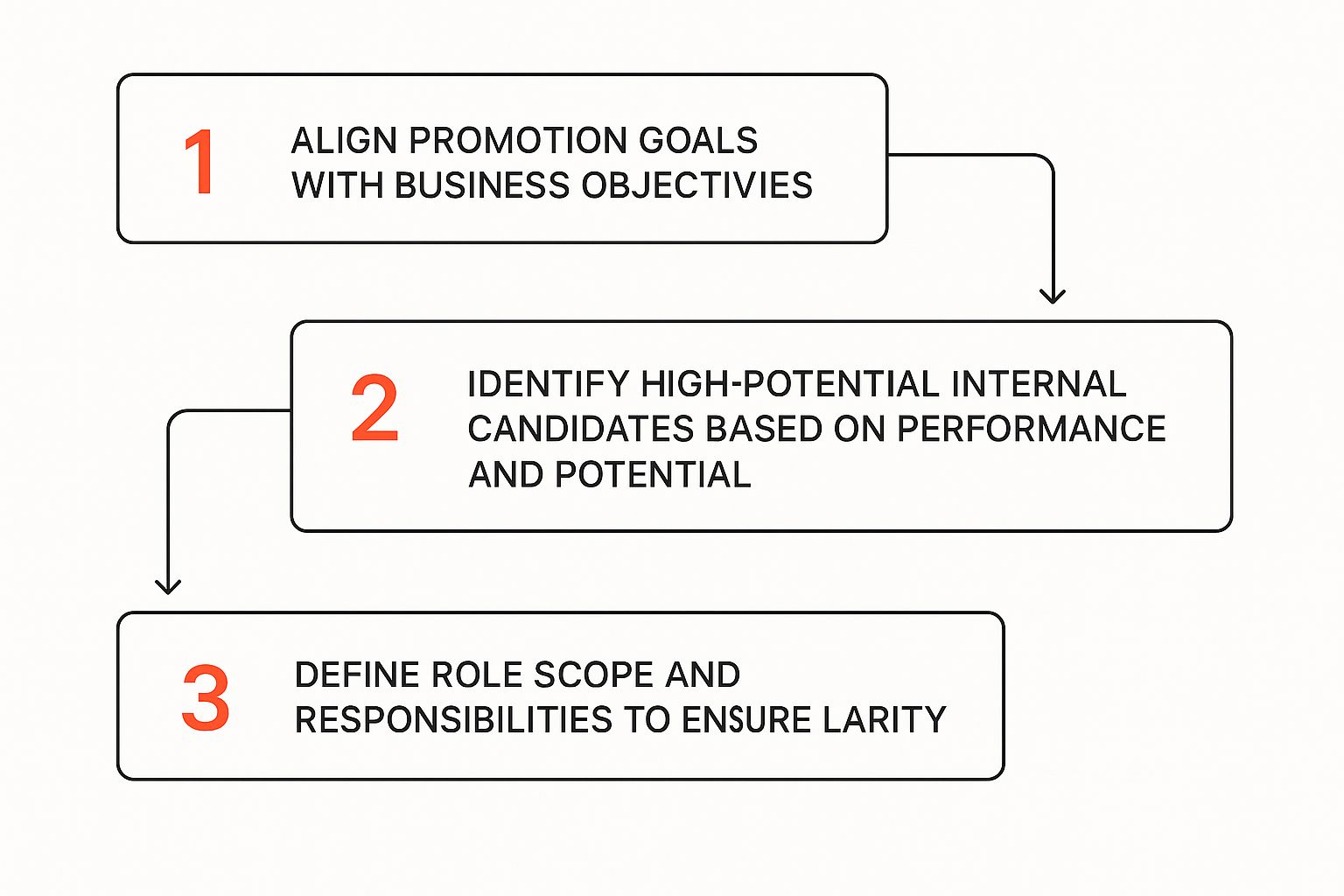
As the flow shows, you can't properly define the scope of the new role until you've set your goals and have a good idea of who might be a good fit.
Identifying and Nurturing Potential
Once your goals are crystal clear, you can start spotting internal candidates who have both the track record and the potential to crush it in the new role. This is about looking beyond the obvious or who’s been there the longest.
Actionable Insight: Dig into these areas with a specific lens:
- Performance Metrics: Go back through old performance reviews, project results, and specific wins. Don't just look at what they achieved, but how. Did they collaborate well? Did they solve unexpected problems?
- Demonstrated Skills: Look for people who show leadership, problem-solving, and great communication, even if they aren't in a formal leadership position now. For instance, who is the person the team naturally goes to for help when the manager is away?
- Growth Mindset: Who’s actively asking for feedback, learning new things on their own, and bouncing back from setbacks? This might be the employee who took an online course on a new software tool without being asked.
Building a strong pipeline of talent is all about nurturing employee growth before you even need to fill a role. You can get some fantastic ideas from these actionable employee development plan examples. This kind of forward-thinking is what sets successful companies apart.
The need for smart promotion planning isn't just about good vibes—it's about the bottom line. The average cost of losing an employee is about one-third of their annual salary. With a staggering 50.5 million people quitting their jobs in the U.S. in 2022, retention has become a financial imperative.
Companies with high turnover are a whopping 23% less profitable, which really drives home the impact of getting this wrong. This whole process is a key part of your company's bigger communication picture. If you're working on that, our guide to building an agency content strategy has some insights you might find useful.
To make sure you're covering all your bases, here’s a quick rundown of the core components you need to define.
Core Components of a Promotion Plan
This table breaks down the essential elements you must define before starting any promotion process. Getting these right ensures your approach is both strategic and fair.
| Component | Key Objective | Example Metric |
|---|---|---|
| Business Justification | To connect the promotion to a specific business need or goal. | Increased team productivity by 15% under new leadership. |
| Role Definition | To clearly outline the new responsibilities, expectations, and scope. | Job description with updated KPIs and reporting structure. |
| Candidate Criteria | To establish fair and objective qualifications for the role. | Required: 5+ years experience, demonstrated project management skills. |
| Success Metrics | To define what success looks like for the person in the new role. | Achieve 95% of project milestones in the first six months. |
Putting this framework in place transforms promotions from a source of potential conflict into a powerful engine for organizational growth.
Designing a Fair and Transparent Promotion Process
Nothing kills team morale faster than a promotion process that feels like a backroom deal. When people don't understand how decisions are made, it breeds resentment and distrust. The only way around this is to build a system grounded in fairness and transparency, where every single employee knows what it takes to move up.
Getting this right is crucial. You need to get past outdated, lazy metrics. I'm talking about things like "5 years of experience." That tells you nothing about a person's actual ability. A much stronger criterion is something like: "Demonstrated ability to independently lead a cross-functional project to completion, meeting or exceeding all primary KPIs." See the difference? One measures time in a seat; the other measures tangible impact.

Establishing Objective Advancement Criteria
Your promotion criteria should be a roadmap, not a riddle. It has to be specific, measurable, and tied directly to what the new role actually demands. This kills ambiguity and lets potential candidates see for themselves if they're ready.
Actionable Insight: Build a simple scorecard to evaluate candidates consistently. For example, to promote a Senior Account Executive, your scorecard might include:
- Skill Mastery (40%): Consistently exceeds sales quota by 20%+, proficiency in advanced CRM features.
- Leadership Potential (30%): Successfully mentored two junior AEs, leading to a 10% increase in their close rates.
- Cultural Contribution (30%): Actively participates in company initiatives, receives positive peer feedback on collaboration.
This method forces you to evaluate candidates on their total contribution, not just one or two standout metrics. It's a more complete, and fairer, way to assess someone.
Communicating Opportunities and Ensuring Objectivity
Okay, so you've got your criteria locked down. Now you have to get the word out. Don't fall into the trap of just tapping the "usual suspects" on the shoulder. Announce the opening everywhere—internal newsletters, all-hands meetings, the company intranet. This sends a powerful signal that growth is for everyone, not just a chosen few.
A transparent process isn't just about posting the rules. It's about giving everyone a legitimate chance to compete. When you open up the opportunity, you often uncover hidden talent and prove that you’re serious about building a meritocracy.
Practical Example: To keep interviews objective, create a standard set of behavioral questions you ask every single candidate, like "Tell me about a time a project went off-track. What did you do to get it back on course?" Then, use a practical test. For a content manager role, ask candidates to review a poorly-written blog post and provide specific edits and strategic suggestions. This gives you concrete proof of their skills.
Honestly, building a fair system here isn't all that different from the principles behind the best social media marketing best practices. It all comes down to clear communication, consistent standards, and genuine engagement. When you lay this groundwork, the entire promotion process becomes smoother and, most importantly, more credible to your team.
Connecting Skill Development to Career Advancement
Promotions shouldn't feel like a surprise lottery win. They should be the logical next step in a journey you've planned together with your employee. A truly effective promotion strategy is built on a foundation of skill development, creating a clear pathway where people see exactly how learning something new opens the door to their next role.
It all starts with looking ahead. What skills will your team need in six months or a year to crush your business goals? Figuring this out now helps you spot skill gaps before they become five-alarm fires. This way, you can start grooming high-potential employees for bigger things long before a leadership spot even opens up, building a strong bench of internal talent.

Creating Personalized Growth Roadmaps
Once you know the skills you need, it's time to build personalized development plans. This is where you connect the company's needs with an individual's career goals. A great first step is to utilize a skills gap analysis template to pinpoint specific areas for growth and get everyone on the same page.
This isn't about sending everyone to the same generic training seminar. It's about crafting a custom-fit mix of experiences that genuinely prepares someone for what's next.
Practical Examples:
- Mentorship Programs: There's no substitute for experience. Pair a promising team member with a senior leader who can offer real-world guidance. For example, an aspiring marketing lead could shadow the CMO during budget planning meetings.
- Targeted Training: Instead of broad courses, invest in specific certifications or workshops that fill a critical need. If a future role requires budget management, get them into a financial planning workshop, not a general "leadership" course.
- Stretch Assignments: Let them take the lead on a small, low-risk project. An engineer eyeing a promotion could be tasked with leading the next two-week sprint cycle to test and grow their management abilities in a real-world setting.
The most powerful retention tool isn't a pay raise; it's a clear, believable path for professional growth. When employees see you investing in their future, they invest their future in you.
This isn't just a hunch; the data backs it up. A 2025 global workforce survey revealed that only 19% of employees felt fully engaged at work in 2024. And here's the kicker: the promotion rate was a dismal 34% lower among employees who felt their company dropped the ball on supporting their skill development. That's a direct, measurable link between investing in your people and keeping them around. You can dig into all the numbers in the full workforce research findings.
Fostering a Culture of Continuous Learning
When you do this right, you build a culture where growth is the norm, not the exception. It sends a powerful message that you promote from within and will give your people the tools to get there. Suddenly, conversations about career paths become regular, transparent check-ins instead of awkward, once-a-year review meetings.
This mindset is how you build a team that lasts. Online communities dedicated to growth, like those you can explore in subreddits for learning, prove how motivating shared knowledge can be. By baking this philosophy into your promotion planning, you create an environment where everyone is constantly leveling up. Your whole team becomes more resilient, capable, and engaged—and promotions become earned achievements that set both the individual and the company up for success.
Executing the Promotion and Managing the Transition
Alright, all your careful planning has led to this moment. This is where the rubber meets the road—the actual execution. How you handle this phase will define the success of the promotion, not just for the individual stepping up, but for the entire team. A clumsy rollout can sour even the most well-deserved advancement.
It all starts with making a formal, compelling offer. Think of this as a complete package that clearly lays out the new role, updated compensation, any changes to benefits, and a detailed rundown of new responsibilities. Be ready to walk through every line item. You want the candidate to feel valued and have zero ambiguity about what they’re stepping into.

Announcing the News and Setting the Tone
The way you share the news is just as crucial as the promotion itself. Your goal is to build excitement and reinforce that you're all in this together, not to create a wave of resentment. Ditch the sterile, top-down email.
Actionable Insight: Frame the announcement around the team's future and how this change helps everyone win. Try something like: "To help us crush our ambitious Q4 goals, I'm thrilled to announce that Maria is stepping into the new role of Project Lead. Her knack for streamlining our workflow is going to be a massive asset for all of us as we move forward." See the difference? It connects the promotion directly to a shared benefit.
Timing is everything. A 2024 analysis revealed a surprising trend: companies with high internal promotion rates sometimes also had high turnover. Why? They were often promoting reactively, only after attrition started to sting, which created a sense of panic. This really drives home the need for proactive announcements that feel strategic, not desperate. You can dig deeper into these promotion and attrition insights yourself.
Announce promotions with a focus on collective gain. Frame the decision as a strategic move that benefits the entire team's mission. This simple shift helps sidestep feelings of individual loss or unfairness among colleagues.
Creating a Seamless Transition Checklist
A smooth handover is non-negotiable. It prevents operational gaps and, more importantly, sets your newly promoted team member up for success from day one. You need a solid transition plan.
Here’s a practical, actionable checklist:
- Map Out a 30-60-90 Day Plan: Sit down with the employee and define concrete goals. For example, a 30-day goal could be "Meet one-on-one with all direct reports," while a 90-day goal might be "Present a revised team strategy to leadership."
- Document Everything: Have the employee use a tool like Confluence or a shared Google Doc to create a "handover guide" for their old role, including key contacts, recurring tasks, and process workflows.
- Schedule a Knowledge Dump: Book dedicated time for the promoted employee to meet with the person (or people) taking over their former tasks. This is where the real handoff happens.
- Clarify New Communication Lines: Send a follow-up email or Slack message specifically detailing the new reporting structure to prevent confusion. For example: "For all future questions on Topic X, please now go to Sarah."
When you manage the execution with this level of care, you’re not just changing someone’s title. You’re turning a simple role change into a powerful catalyst for your whole team's growth and stability.
So, Did the Promotion Actually Work? Measuring Success and Refining Your Game Plan
Your job isn't done just because you sent the announcement email. The real work begins after the promotion, when you have to figure out if it was the right move. Without a clear way to measure what happened, you're just throwing darts in the dark, and you'll repeat the same mistakes next time.
This is where you have to move past gut feelings and dig into the cold, hard data. You need to define Key Performance Indicators (KPIs) that actually show the new leader's impact. These aren't vanity metrics; they're the numbers that tell you the real story about how the promotion is affecting the team and the business.
Tracking What Really Matters
To get an honest assessment, you need to focus on metrics that are directly tied to the newly promoted person's leadership. This gives you objective proof of whether the promotion is hitting the mark.
Practical Examples of KPIs to Track:
- Team Productivity: Is the team actually getting more done? Look at things like project completion rates, support tickets closed, or sales numbers before and after the change. A 10% jump in a key metric within the first quarter is a fantastic sign.
- Departmental Retention: Are people on the new leader's team sticking around? Keep a close eye on voluntary turnover in their department. If that number stays stable or, even better, drops, it tells you the team environment is probably healthy.
- Employee Engagement Scores: Use quick pulse surveys to check the team's morale and satisfaction. Ask pointed questions like, "On a scale of 1-5, how supported do you feel by your new manager?"
The whole point of this post-promotion analysis is to create a feedback loop. This isn't about passing judgment on the employee. It's about tweaking your process to make every future promotion even more successful.
Getting the Full Story with Feedback
Numbers tell you what is happening, but talking to people tells you why. You need to build structured ways to get honest feedback from everyone involved. This is non-negotiable if you want a promotion plan that actually learns and improves over time.
Actionable Insight: Use a 360-degree feedback approach with specific, structured check-ins:
- Check in with the New Leader (30 days in): Sit down with them and ask specific questions: "What is one thing that has surprised you?" and "What is the biggest roadblock you're facing right now?"
- Talk to Their Direct Reports (45 days in): Use an anonymous survey tool like Google Forms to ask what's going well under the new leadership and what could be better. Anonymity encourages honesty.
- Get Insights from Their Manager (60 days in): Have a candid conversation about what they're seeing. How is the new leader performing against their 30-60-90 day plan? Where do they need more coaching?
Gathering feedback from all three of these groups gives you a complete view. It shines a light on blind spots and helps you make specific adjustments to how you support and develop your next wave of leaders.
Navigating the Tricky Parts of a Promotion
Even with the best-laid plans, promotions can get complicated. Let's be honest, you're dealing with people's careers, ambitions, and feelings.
Here’s how to handle some of the most common—and frankly, toughest—situations that pop up.
How Do I Handle Multiple Qualified Candidates?
First off, congratulations. This is a good problem to have, but it's also one you have to manage carefully to avoid creating a morale issue. When you've got several fantastic internal candidates gunning for the same role, fairness and clear communication are everything.
This is where that scorecard you built earlier becomes your most valuable tool. Rely on it. It keeps the decision grounded in objective evidence, not just a gut feeling about who "seems" right.
Once the choice is made, the real work begins. You need to sit down, one-on-one, with each person who didn't get the role.
- Be direct, but kind. Get straight to the point and explain the decision. Highlight the specific skills or experiences that ultimately tipped the scales. For instance, "Both you and Sarah were exceptionally qualified, but the panel felt Sarah's recent experience leading the Alpha Project gave her a slight edge for this specific role's immediate needs."
- Give them a roadmap. Don't leave them hanging. Offer concrete, actionable feedback. Instead of a vague "you weren't a fit," try, "For the next leadership opportunity, the panel will be looking for someone who has managed a project budget end-to-end. Let's find a project for you to take that on."
- Show them they have a future. End the conversation by reaffirming their importance to the team. Talk about their growth path and what's next for them. This reframes a rejection into a development plan.
What If an Employee Is Unhappy About the Decision?
Someone is going to be disappointed. It’s inevitable. When an employee comes to you upset about being passed over, your first and most important job is to just listen.
Let them get it all out without jumping in to defend the decision. People need to feel heard and respected, and acknowledging their frustration goes a long way. Use active listening phrases like, "I understand why you're feeling disappointed."
Never dismiss an employee's feelings about being passed over. Instead, use the conversation as a chance to reinforce the fairness of your process and recommit to their professional development. It's an opportunity to build trust, not break it.
After they've had their say, gently walk them back to the promotion criteria you established from the start. Show them how the decision was made based on those specific, measurable qualifications. This isn't about proving them wrong; it's about showing that the process was fair and transparent, moving the focus from personal feelings to objective standards.
How Do I Prevent Resentment Among the Team?
You can't completely prevent jealousy, but you can definitely minimize team-wide resentment. The key is to start building transparency long before any announcement is made.
If everyone on the team understands the criteria and the process—the "rules of the game"—they're much more likely to accept the outcome, even if it's not the one they personally wanted. It removes the mystery and kills any rumors of favoritism before they can even start.
When you do make the announcement, frame it as a win for everyone. It’s not just about one person getting a new title. It’s about the team getting a new resource. For example, you could say, "With Alex's deep product knowledge now leading this team, we're in a much stronger position to hit our Q4 launch targets."
This subtle shift helps everyone see how the promotion benefits the collective goal, fostering a supportive environment for the new leader instead of an awkward or hostile one.
Ready to turn Reddit into a powerful growth engine for your brand? The team at Reddit Agency specializes in creating authentic campaigns that drive real results. We help you connect with your ideal customers in the communities they trust most. Learn how we can build your brand on Reddit.
