A Practical Guide to PPC Ad Campaign Management
At its core, PPC ad campaign management is the hands-on process of running and fine-tuning your paid ads to hit specific business goals. It’s the whole nine yards—from dreaming up the initial strategy and getting the campaigns live to constantly analyzing the data and making adjustments. It’s all about making sure every dollar you spend comes back with friends.
Building a Foundation for Profitable PPC Campaigns
Jumping into a PPC campaign without a solid plan is like sailing without a map. Sure, you’re moving, but you have no idea if you’re heading toward treasure or a storm. A well-thought-out strategy is what separates the campaigns that make money from the ones that just spend money. It all begins with defining what success actually looks like in real, measurable numbers.
Start With a Clear, Quantifiable Goal
The first instinct for many is to chase vague goals like "more traffic" or "better brand awareness." But effective PPC management is all about precision. A truly useful objective isn't just a wish; it's specific and has a number attached to it.
- Vague Goal: "Get more leads for our SaaS product."
- Actionable Objective: "Generate 50 qualified leads per month from LinkedIn Ads with a target cost-per-acquisition (CPA) under $100."
See the difference? This level of detail gives you a clear yardstick to measure performance against. Right from the get-go, you can make smarter decisions about your budget and tactics. For instance, with a $100 CPA target, you know immediately that a keyword costing $20 per click must convert at least 1 in 5 clicks to be profitable.
Setting the right goals depends entirely on what kind of business you're running. A SaaS company and an ecommerce store will measure success in completely different ways.
PPC Goal-Setting Framework for Different Business Models
| Business Type | Primary Goal | Key Performance Indicator (KPI) | Example Objective |
|---|---|---|---|
| SaaS | Lead Generation | Cost Per Acquisition (CPA), MQLs | Generate 75 demo requests per quarter at a CPA below $150. |
| Ecommerce | Sales | Return On Ad Spend (ROAS), Revenue | Achieve a 4:1 ROAS on Google Shopping campaigns for Q3. |
| Lead Gen (B2B) | Qualified Leads | Cost Per Lead (CPL), Lead Quality | Capture 200 qualified leads from a whitepaper download campaign. |
| Mobile App | Installs / In-App Actions | Cost Per Install (CPI), User LTV | Drive 10,000 app installs on iOS with a CPI under $2.50. |
This framework helps translate broad business needs into the concrete metrics that will actually guide your campaign decisions.
Aligning Your Audience with the Right Platform
Once your goals are locked in, you need to figure out exactly who you're talking to. Creating a detailed Ideal Customer Profile (ICP) is non-negotiable. This goes way beyond basic demographics—think pain points, what drives them, and where they hang out online. Knowing your ICP inside and out tells you where to put your ad spend.
For instance, if you're a B2B SaaS founder trying to reach enterprise CTOs, you'll find them on LinkedIn, talking shop about industry trends. But if you're a DTC brand selling sustainable activewear, your people are on visually-driven platforms like Instagram and TikTok, where community and lifestyle are everything. Putting your ads in the wrong place is one of the quickest ways to burn through your budget with nothing to show for it. This strategic alignment is a key part of many successful demand generation strategies.
This entire foundational process—from goals to audience to strategy—is a logical flow. You can't skip a step.
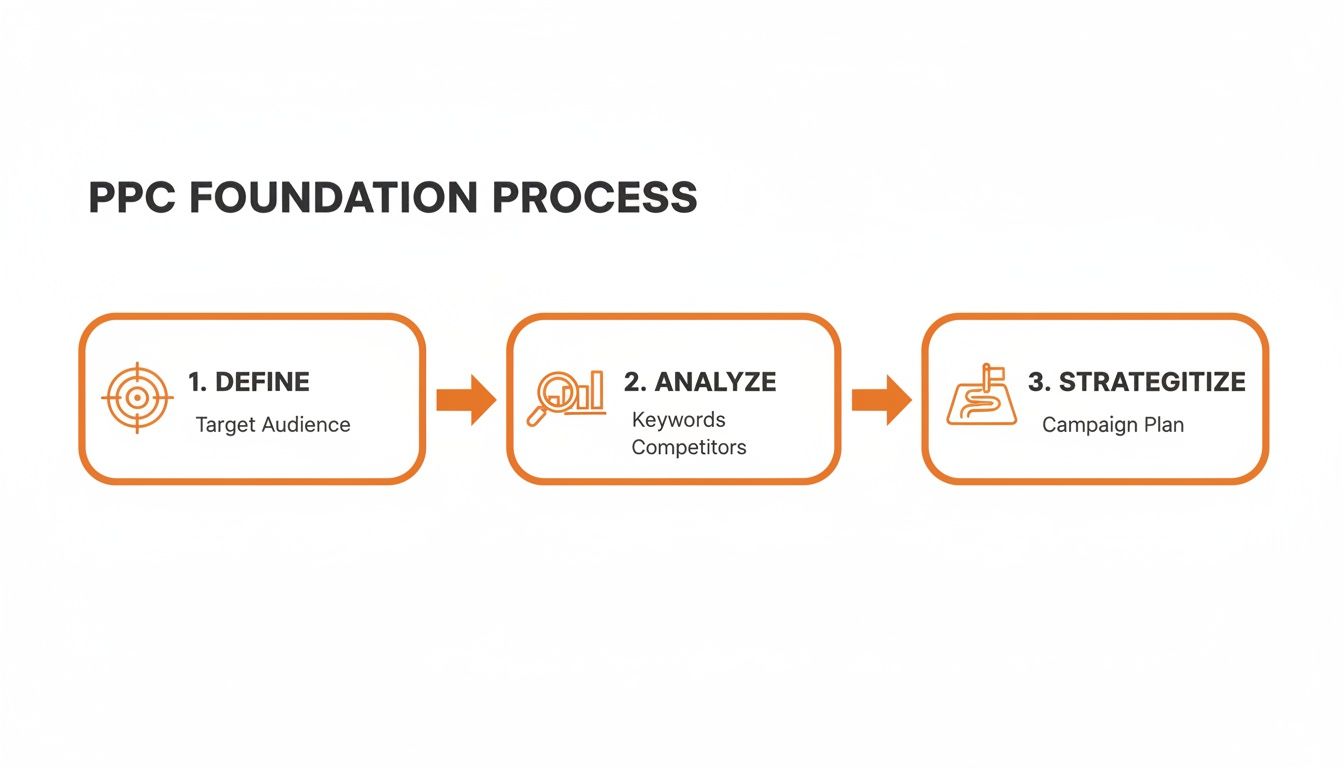
As you can see, defining your audience and goals has to come before you even think about analyzing the competitive landscape or building out your campaigns.
Uncovering Opportunities with Competitor Analysis
Finally, a smart strategy always involves a peek at what the competition is up to. The point isn't to copy them; it's to find gaps and opportunities they've missed. Using tools like Semrush or Ahrefs, you can see which keywords they're bidding on, what their ad copy looks like, and where they're sending their traffic.
By analyzing your competitors' PPC efforts, you can essentially reverse-engineer their funnels. This lets you spot high-intent keywords they might be ignoring or messaging angles you can improve upon, giving you a strategic advantage before you even spend your first dollar.
This kind of intelligence is priceless. You might find a competitor is spending big on expensive, broad keywords but is totally ignoring the long-tail keywords related to a new feature your product has. That's your opening. You can swoop in with a more targeted, cost-effective campaign. For example, a competitor might be bidding heavily on "CRM software," while you discover through their ad history they are not bidding on "CRM for solar installers"—a niche you serve perfectly.
The payoff for doing this upfront work is huge. On average, businesses make $2 for every $1 spent on PPC, and well-managed campaigns can do much, much better. This foundational planning ensures your budget goes where it will have the biggest impact.
Getting Your First PPC Campaign Off the Ground
Alright, this is where the rubber meets the road. All that strategy work is about to become a real, live campaign. A well-built account structure is the absolute foundation of successful PPC ad campaign management. Trust me, getting this right from the beginning will save you a world of headaches down the line.

Think of the initial setup as more than just clicking buttons in Google Ads. You’re translating your goals and audience research into a logical structure. This ensures your ads are hyper-relevant to the people seeing them, which is the secret sauce to getting clicks without breaking the bank.
Go Beyond Keywords and Think About Intent
Modern keyword research isn't just about chasing high search volumes anymore. The real magic happens when you understand the intent behind someone's search. You have to get inside their head and figure out why they're typing that query to serve them the perfect ad.
For instance, consider the massive difference between these two searches:
- "what is CRM software": This is pure research mode. The searcher wants information, not a hard sell. They're looking for an education.
- "best CRM for small business": Now we're talking. This person is much further down the funnel, actively comparing their options and ready to be persuaded by features, pricing, and benefits.
You can bid on both, of course, but they absolutely must live in different ad groups with their own unique ads and landing pages. The first searcher gets a blog post or a guide; the second gets a comparison page or a free trial offer.
Structure Your Ad Groups for Ultimate Relevance
Here's the golden rule I tell every new PPC manager: create tightly themed ad groups. Each ad group should be a small, focused cluster of keywords that all share the exact same user intent. This is what lets you write incredibly specific ad copy that feels like it’s reading the searcher's mind.
A rookie mistake is lumping all CRM-related keywords into one giant ad group. A pro, on the other hand, would structure it like this:
- Campaign: CRM Software - USA
- Ad Group 1: Small Business CRM (Keywords: "crm for small business," "smb crm solution")
- Ad Group 2: Real Estate CRM (Keywords: "crm for realtors," "real estate lead management")
- Ad Group 3: Competitor A Alternatives (Keywords: "salesforce alternative," "cheaper than hubspot")
This kind of hyper-specific structure is what drives up your Quality Score, which in turn lowers your cost-per-click and bumps up your ad position. It's a win-win.
Writing Ad Copy That Actually Gets Clicked
Your ad copy is the critical link between a user's problem (their search) and your solution (your landing page). It has to make a compelling promise and convince them that you hold the answer they've been looking for. The best ad copy is always clear, persuasive, and hits on a specific pain point.
Let's look at a couple of real-world examples:
Example 1: Micro-SaaS Tool (Project Management)
- Headline: Ditch the Cluttered Spreadsheets
- Description: Finally, a PM tool that’s simple to use. Track tasks, collaborate with your team, and hit deadlines without the bloat. Start your free trial today.
Example 2: DTC Brand (Sustainable Sneakers)
- Headline: Look Good, Feel Good, Do Good
- Description: Eco-friendly sneakers made from recycled materials. Comfortable, stylish, and sustainable. Free shipping & returns on all orders.
See how each ad speaks the native language of its target audience? It zeroes in on the most important value proposition for that specific person.
Building Landing Pages That Deliver on the Promise
Your landing page has exactly one job: to fulfill the promise you just made in your ad. If your ad screams "free trial," that landing page better have the free trial offer front and center. This principle is called message match, and it’s a non-negotiable for high conversion rates.
A high-performing landing page feels like a natural extension of the ad. The headline, the images, and the call-to-action should all mirror the ad's message, creating a smooth, frictionless journey from click to conversion.
As you set things up, don't forget to dial in your geographic targeting. For certain businesses, like those on Amazon, using specialized geo tools for Amazon sellers can give you a serious edge.
Set Up Conversion Tracking Before You Spend a Dime
Last but certainly not least: none of this matters if you can't measure the results. Setting up conversion tracking before your campaign goes live is absolutely mandatory. This means placing a small snippet of code (a "tag") on your site to track the actions you care about, like someone filling out a form, making a purchase, or calling your business.
Without accurate tracking, you’re just guessing. You have no real data on which keywords, ads, or campaigns are actually making you money. Effective PPC ad campaign management is simply impossible without it. This is the single most important technical step in the entire process—don't skip it.
Smart Bidding and Budget Allocation Strategies

Think of your budget as the fuel powering your entire PPC engine. How you manage it—from the overall allocation down to every single bid—is what separates campaigns that drive real returns from those that just burn cash. Effective PPC ad campaign management isn't about setting and forgetting; it’s about making smart, active decisions on bidding and spending.
This really boils down to choosing the right bidding strategy for each campaign's specific goal and, just as importantly, its maturity level. This is where you'll face the classic debate: should you take the wheel with manual control or let machine learning do the driving?
Choosing Between Manual and Automated Bidding
The two main approaches to bidding offer a trade-off. You're essentially choosing between granular, hands-on control and the sheer power of automated, real-time optimization. Knowing when to use each is a skill that can make or break your performance.
- Manual CPC Bidding: This puts you in the driver's seat. You set the absolute maximum you're willing to pay for a click on any given keyword. I always recommend this for brand-new campaigns. Why? Because you need to gather clean, initial performance data without an algorithm making wild guesses based on zero history.
- Automated "Smart" Bidding: Once you have some data, strategies like Target CPA (Cost Per Acquisition), Target ROAS (Return On Ad Spend), and Maximize Conversions are incredibly powerful. They use machine learning to adjust bids on the fly, optimizing for your specific goal in a way no human ever could.
Let's say you're launching a new e-commerce campaign. I'd start it on Manual CPC for the first few weeks to get a feel for which products are getting traction. Once you've clocked 15-30 conversions in a month, that's your green light. You can now confidently switch to a strategy like Maximize Conversions and let Google's AI go find more buyers for you.
Practical Budget Allocation and Pacing
Picking a budget isn't just about pulling a number out of thin air. You have to be strategic, allocating funds where they'll work hardest and pacing your spend to show up when it matters most.
A common rookie mistake is setting a daily budget that's too low to learn anything. If your average CPC is $2, a $10 daily budget gets you a measly five clicks. You can't draw any meaningful conclusions from that. As a rule of thumb, aim for a budget that allows at least 10-20 clicks per day for your most critical ad groups.
I see this all the time: a small budget spread thinly across way too many campaigns. It's so much more effective to focus your spend on one or two high-priority campaigns, get them running profitably, and then use those profits to scale up.
This level of strategic thinking is why 55% of companies end up hiring agencies to manage their PPC. When the average cost per lead on some platforms can soar to $70.11, you need an expert touch. This is especially true for SMBs spending $90,000-$120,000 annually on ads. A seasoned agency can deploy advanced tactics like Smart Bidding, which has been shown to slash CPA by up to 25%. If that's a route you're considering, getting a handle on digital marketing agency costs is a great place to start.
Using Ad Scheduling to Maximize ROI
Your customers aren't shopping 24/7, so why are your ads running all night? Ad scheduling, also known as "dayparting," is a simple but potent tactic for focusing your budget on the specific times and days your audience is most likely to convert.
You'll need to dive into your performance data to spot the patterns.
- B2B SaaS Company: You'll likely find that demo requests and sign-ups happen between 9 AM and 5 PM on weekdays. In that scenario, you could pause your ads entirely on weekends and overnight, instantly cutting out wasted spend on low-intent window shoppers.
- E-commerce Brand: Your data might show a huge sales spike between 7 PM and 10 PM when people are relaxing on the couch and scrolling. You can apply a positive bid adjustment during these peak hours to get more aggressive, ensuring your ads are front-and-center when people are ready to buy.
By layering the right bidding strategy with smart budget allocation and precise ad scheduling, you're building a highly efficient system. You're ensuring every dollar is aimed squarely at the clicks that are most likely to become customers.
Tapping into Reddit for Community-Driven Growth
While Google and Meta are the undisputed titans of PPC, Reddit is a completely different beast—and a powerful one for brands that get it. Effective PPC ad campaign management here isn't about interrupting people. It's about joining their conversations.
This platform is built on thousands of niche communities. Generic, hard-sell marketing doesn't just get ignored; it gets downvoted into oblivion.
Forget broad demographics. Success on Reddit means thinking in terms of communities, or subreddits. These are hyper-focused forums dedicated to everything from r/SaaS to r/skincareaddiction. Your first job is to become a detective and find the exact subreddits where your ideal customers are already hanging out, talking about the very problems you solve.
Finding and Targeting the Right Subreddits
Before you even think about spending money, you need to immerse yourself in the culture of these communities. Lurk in the threads. Read the top posts. Get a feel for the in-jokes, the common acronyms, and the general vibe. The goal is to pinpoint subreddits where your brand can genuinely add value, not just parachute in with an ad.
Let's say you're marketing a project management tool. The obvious choice is r/projectmanagement, but the real gold is often found in related communities where the pain points are more acute:
r/startups: Founders are constantly complaining about chaotic workflows.r/virtualassistants: Professionals are sharing the best tools for managing clients.r/solopreneur: Individuals are desperate for ways to stay organized and efficient.
This granular approach gets your ads in front of a highly qualified and receptive audience. To really dig into the data, you can use free Reddit analytics tools to analyze subreddit activity and user behavior before you commit your budget.
Crafting Ads That Feel Native
Once you've identified your communities, the next challenge is creating ads that don't feel like ads. The best-performing ads on Reddit blend right in with the organic content, offering a helpful tip or sparking an interesting discussion.
Keep your ad copy conversational, direct, and transparent. Redditors can smell corporate-speak a mile away and appreciate honesty. If you're running a sale, just say it. If you need feedback on a new feature, ask for it. Even your creative should feel native—a simple, low-fi image or even a text-only ad often crushes a slick, professionally designed banner.
Your north star on Reddit should be this: be seen as a helpful member of the community first, and an advertiser second. Your call-to-action shouldn't just be "Buy Now." Think more along the lines of "Join the discussion," "Let us know what you think," or "See how we built it."
This community-first mindset is the core of any solid campaign. In fact, a comprehensive Reddit marketing strategy must balance paid promotion with authentic, organic engagement.
Combining Paid Ads with Organic Engagement
This is where Reddit's true power is unlocked. The most effective strategy integrates your paid campaigns with genuine, day-to-day participation. It creates a flywheel effect that builds trust and can turn even the most skeptical Redditors into fans.
Here’s a practical workflow I've seen work wonders:
- Engage Organically First: Spend time in your target subreddits providing genuinely helpful comments. Answer questions, share your expertise, and don't even mention your product. Just be useful.
- Create a Valuable Resource: Write a high-quality blog post or create a free tool that directly solves a common problem you've seen discussed in the community.
- Run a Hyper-Targeted Ad: Launch a Reddit ad campaign that links directly to one of your helpful comments or promotes your valuable content piece to that specific subreddit.
This integrated approach feels less like an ad and more like a helpful recommendation from a fellow community member. You're not just some random brand shouting into the void; you're an active participant amplifying a valuable contribution. That synergy is what drives real, meaningful results on this platform.
Optimizing and Scaling Your Campaign Performance
Getting your PPC campaign live is just the first step. The real work—and where the real wins happen—is in the ongoing, data-driven optimization that follows. This is the heart and soul of PPC ad campaign management, turning those initial clicks into a predictable, profitable growth engine.
This isn't about making random changes and hoping for the best. It's a disciplined routine of monitoring your key metrics, running controlled experiments, and making smart decisions that build on each other week after week. Think of it as a weekly health checkup for your campaigns, ensuring they’re always performing at their absolute best.
Establishing a Weekly Optimization Rhythm
To really get a handle on performance, you need a consistent schedule. A weekly check-in is the perfect cadence. It’s frequent enough to catch problems before they burn through your budget but gives you enough data to spot meaningful trends.
Your weekly routine should be laser-focused on the vital signs of your campaign's health:
- Click-Through Rate (CTR): Are your ads actually resonating with people? A low CTR is a huge red flag that your messaging is missing the mark or your targeting is off.
- Conversion Rate: This tells you if your landing page is doing its job. A sudden dip could mean a broken form, a slow-loading page, or a serious disconnect between your ad's promise and the landing page's offer.
- Cost Per Acquisition (CPA): This is your bottom line. How much are you paying for each new customer? This number keeps your entire strategy grounded in profitability.
Tracking these metrics every week helps you establish a performance baseline. Once you know what "normal" looks like, you can immediately spot when something is going right—or terribly wrong.
The Art of Systematic A/B Testing
Guesswork is the enemy of great PPC. The only reliable way to figure out what works is to test it. This is where systematic A/B testing comes in, allowing you to make small, incremental improvements that eventually lead to massive performance gains.
The key is to test one thing at a time. If you change the headline, the ad copy, and the call-to-action all at once, you’ll never know what actually made the difference.
Start simple. Pit two different headlines against each other while keeping everything else identical. Once you have a clear winner (one with a statistically significant higher CTR or conversion rate), that headline becomes your new "control." Then, you can move on to testing another element, like the description text or the final URL.
The goal of A/B testing isn't to find some mythical "perfect" ad. It's to build a continuous feedback loop. You're constantly learning what your audience responds to and iterating your way to better and better results.
This same mindset applies to your landing pages. Test different layouts, button colors, forms, or value propositions. You’d be amazed at how much a simple headline change on a landing page can impact conversion rates.
Unearthing Gold in Your Search Term Reports
If I had to pick one report to look at every week, it would be the search term report. It's an absolute goldmine. This report shows you the actual search queries people typed into Google right before they clicked your ad. Reviewing this is non-negotiable, and here’s why.
First, it’s your best tool for finding negative keywords. You’ll always find irrelevant searches triggering your ads and wasting money. For example, if you sell "project management software," you might see clicks from people searching for "free project management templates." Adding "free" and "templates" as negative keywords instantly plugs that leak in your budget.
Second, you'll discover new keyword opportunities. People search in ways you'd never expect. You might uncover a hyper-specific, high-intent phrase like "CRM for small remote sales teams." That's a keyword you can pull out and build a dedicated, highly-targeted ad group around for incredible results.
Scaling Your Wins Without Sacrificing Efficiency
Once you've got a campaign or ad group that's consistently hitting its CPA or ROAS goals, it's time to pour some fuel on the fire. But scaling isn't as simple as just jacking up the budget. If you're not careful, you can destroy your efficiency.
The best approach is to increase your budget slowly—think 10-20% at a time. After each increase, watch your performance like a hawk for a few days. A huge, sudden budget increase can shock the ad platform's algorithm, resetting its learning phase and making your performance go haywire.
It’s worth the effort. PPC campaigns on Google's Search Network have average conversion rates of 4.40%, which blows the Display network's 0.57% out of the water. This is why 72% of companies see PPC as essential for their growth. For e-commerce brands, shopping ads get 40% more clicks and can hit an average ROAS of 400-800%. Even simple optimizations like testing new ad headlines can lift your CTR by 15-41%. You can dig into more of these PPC statistics on SEO.com.
By methodically scaling what works and cutting the fat from underperformers, you build a powerful, efficient, and profitable growth machine.
A structured weekly checklist can keep your optimization efforts on track and prevent anything from falling through the cracks. It turns a chaotic process into a manageable, repeatable routine.
Weekly PPC Campaign Optimization Checklist
| Task | Metric to Review | Action to Take | Goal |
|---|---|---|---|
| Budget Pacing | Spend vs. Target | Adjust daily budgets up or down to stay on pace for the month. | Hit monthly budget goal without overspending. |
| Keyword Performance | Clicks, Conversions, CPA | Pause or lower bids on high-cost, low-converting keywords. | Reduce wasted ad spend. |
| Search Term Report | Actual User Queries | Add irrelevant terms as negatives; identify new keyword opportunities. | Improve targeting and discover new ad groups. |
| Ad Copy Review | CTR, Conversion Rate | Pause underperforming ads; check for A/B test winners. | Continuously improve ad relevance and performance. |
| Landing Page Check | Conversion Rate, Bounce Rate | Ensure links and forms are working; verify message match with ads. | Maintain a smooth user path to conversion. |
| Device Performance | CPA by Device | Apply bid adjustments to mobile, desktop, or tablet. | Allocate budget to the most profitable devices. |
Following a checklist like this ensures you're consistently making the small, data-backed adjustments that lead to big, long-term success.
Frequently Asked Questions About PPC Campaign Management
Even with the best-laid plans, running paid ad campaigns always brings up questions. It's just part of the process. Let's tackle some of the most common ones I hear from clients and colleagues so you can manage your campaigns with more confidence.

Think of this as a quick-reference guide to help you make smarter decisions when you hit those inevitable roadblocks.
How Long Until I Actually See Results?
This is easily the most common question, and the answer has two parts. You can start seeing traffic almost immediately—that's the beauty of PPC. But meaningful results, like qualified leads and sales, take a little more time.
The first phase of any new campaign is purely about data collection. For the initial 1-2 weeks, don't expect miracles. The platform's algorithm is learning, and you're just getting a first glimpse of which ads, keywords, and audiences are showing promise.
After about a month, you'll have enough data to begin your first round of real optimizations—things like culling underperforming keywords and tweaking your bids. But from my experience, it takes a solid three months of consistent work to dial everything in and achieve a stable, positive return on your investment.
What’s a Good Return on Ad Spend (ROAS)?
Everyone wants to know the magic number for ROAS, but the honest answer is: it completely depends on your business. There’s no universal benchmark that works for everyone because profitability hinges entirely on your specific profit margins.
You’ll often hear a general benchmark of a 4:1 ratio—$4 in revenue for every $1 spent.
But that number is almost meaningless without context. A SaaS company with 90% margins might be wildly profitable at a 3:1 ROAS. On the other hand, an e-commerce store with tight margins might need a 10:1 ROAS just to break even after factoring in the cost of goods.
The only way to know what's "good" for you is to calculate your break-even point first. Once you have that, you can set a realistic ROAS target that actually aligns with your profit goals, not some arbitrary industry average.
Should I Manage PPC Myself or Hire an Agency?
This really boils down to a classic trade-off: time, budget, and expertise. Each path has its pros and cons.
- Doing It Yourself: This saves you the management fee, but it costs you something just as valuable—your time. The learning curve for PPC is steep, and simple mistakes, like forgetting to add negative keywords or messing up conversion tracking, can burn through your budget in a hurry.
- Hiring an Agency: When you bring in a specialized agency, you get instant access to seasoned experts, sophisticated tools, and years of hard-won experience. A great agency will almost always generate an ROI that more than covers their fee by avoiding those costly errors and scaling your campaigns efficiently.
If you don't have the bandwidth for daily monitoring, constant A/B testing, and deep strategic thinking, investing in an agency is often the quickest path to profitable growth.
How Do I Pick the Right Keywords?
Strong keyword selection isn't about finding individual words; it's about understanding the intent behind the search. You need to get inside the head of your ideal customer.
Start by brainstorming the exact phrases and questions they’d type into Google when they're actively looking for what you offer. Then, you can plug those ideas into keyword research tools to expand your list and get real data.
Here’s a practical way to think about it:
- Prioritize Intent: Know the difference between someone just gathering information ("what is project management") and someone ready to buy ("best project management software for remote teams"). You want to focus on the latter.
- Go for Long-Tail Keywords: Those longer, more specific phrases usually have less competition and attract far more qualified traffic. People who type in detailed queries know what they want.
- Spy on Your Competitors: See what keywords your competition is bidding on successfully. This is a great way to find proven, high-intent terms you might have missed.
Navigating Reddit's unique landscape is a powerful way to accelerate growth, but it requires a specialized approach. At Reddit Agency, we help brands build authentic connections and drive measurable results by integrating seamlessly into the communities that matter most.
