What is Organic Marketing: A Guide to Sustainable Growth
Organic marketing is the strategy of earning your audience's attention, not buying it. Think of it as the difference between someone discovering your business because you've built something genuinely useful and someone clicking a banner ad you paid for. It’s the slow-and-steady approach that focuses on creating real value through great content, smart search engine optimization (SEO), and authentic community building.
The Foundation of Sustainable Growth
Let's use a practical example. Imagine you've opened a specialty coffee shop. Instead of plastering billboards everywhere (paid marketing), you start a blog with posts like "5 Common Mistakes When Brewing French Press Coffee" or "How to Choose the Right Beans for Your Palate." Local coffee lovers find your articles on Google, learn from you, and decide to visit your shop because you've already proven your expertise. They trust you. Soon, they start telling their friends. That's the heart of organic marketing.
This approach isn't about scoring a quick win; it's about making a long-term investment in your brand's reputation and building assets that appreciate over time.
Instead of just renting space in someone's feed with an ad, you're creating foundational pieces that work for you around the clock. These assets are the pillars of a solid organic strategy:
- Valuable Content: Actionable insight: Create a "How-To" guide that solves a specific, nagging problem for your ideal customer. For a software company, this could be a "Definitive Guide to Automating Your Workflow."
- Search Engine Optimization (SEO): Actionable insight: Use a free tool like Google Keyword Planner to find a question-based keyword (e.g., "how to fix a leaky faucet") and create the most comprehensive answer to it on the internet.
- Authentic Engagement: Actionable insight: Find a relevant conversation on a forum like Reddit or a LinkedIn group. Instead of promoting your product, offer a genuinely helpful tip or answer someone's question in detail.
The most important thing to remember is that "organic" doesn't mean "free." It demands a serious investment of time, expertise, and creativity. But here’s the key difference: when you stop paying for an ad, it vanishes. A top-ranking article or a well-earned reputation in a community can continue to bring in leads and sales for years, delivering a fantastic return on that initial effort.
Why Going Organic Is a Game-Changer
Choosing the slow-and-steady path of organic marketing really pays off, mainly because the rewards you build are meant to last. We all know how skeptical people are of ads these days. An organic approach cuts through that noise by building genuine trust and credibility.
Think about it: when you consistently provide real value before ever asking for a sale, you stop being just another company trying to sell something. Instead, you become a helpful, trusted expert in your field. That trust is the bedrock of any solid, long-term customer relationship.
Another huge win is the incredible long-term return on investment (ROI). A paid ad is like renting a billboard—the second you stop paying, it’s gone. Organic assets, on the other hand, are things you own. Practical example: A single, well-researched blog post about "The Best Hiking Trails in California" can climb Google's ranks and sit there for years, pulling in thousands of visitors every month without you spending another dime on it. That’s how you build a growth engine that doesn’t need a constant infusion of cash to run.
Creating Authority and Traffic That Lasts
When you consistently put out valuable content, you naturally build up brand authority. You become the go-to resource in your space. When potential customers see your brand answering their questions everywhere they turn, they start to connect your name with expertise and reliability. That’s something competitors can't just buy with a bigger ad budget.
Better yet, this entire process helps you grow a loyal community of people who genuinely champion your brand. These fans become a marketing force of their own, spreading the word with authentic, trusted recommendations.
It’s this cost-effective, long-term model that makes organic such a priority. In fact, surveys show 49% of marketers believe organic search delivers the best ROI of any channel. We've seen agencies sustain thousands of organic visitors every single month just through SEO, proving you don't need a massive PPC budget to scale. You can dig into more of these organic marketing findings from GrowthRocks.
So, what's the single greatest benefit of organic marketing? It’s the creation of durable, valuable assets. Every article, every helpful comment, and every keyword you rank for is a small piece of digital real estate your brand owns forever. These assets keep compounding in value, driving predictable, sustainable growth for years to come.
The Three Pillars of a Winning Organic Strategy
A solid organic marketing plan isn’t about throwing one tactic at the wall and hoping it sticks. It’s built on three core pillars that support each other to create real, sustainable growth. Think of it like a three-legged stool—if you take one leg away, the whole thing topples over. To build a brand that people find and trust on their own, you need to get all three right.
This simple breakdown shows how these efforts pay off, starting with trust and leading to tangible business results.
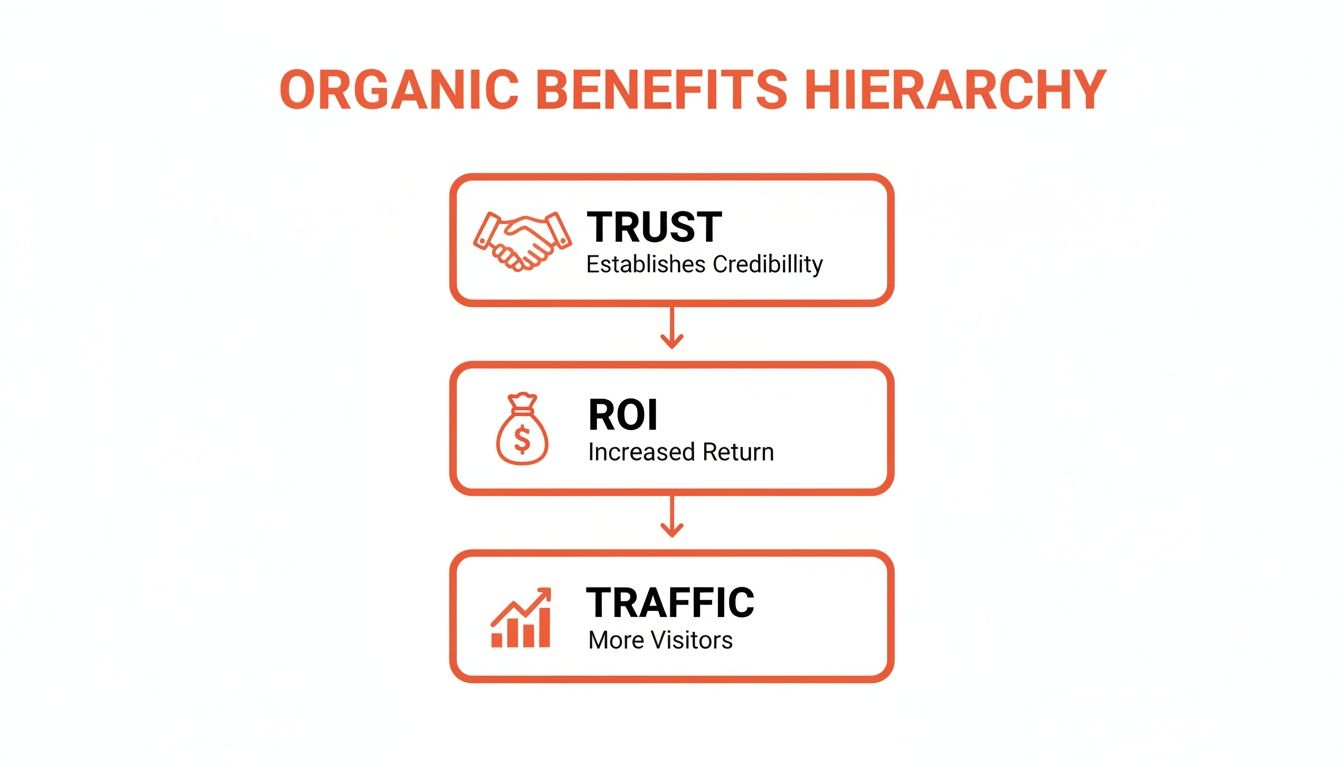
As you can see, it all starts with earning trust. That trust becomes the foundation for a much stronger return on investment and a consistent flow of organic traffic to your site.
Pillar 1: Search Engine Optimization (SEO)
First up is Search Engine Optimization (SEO). This is all about making sure your brand actually shows up when people search for things you offer on Google. When a potential customer types in a problem they have, good SEO makes your website appear as the solution. It’s not about gaming the system; it’s about making your site and its content easy for search engines to understand and value.
This breaks down into a few key areas:
- On-Page SEO: Actionable insight: For every blog post, ensure your target keyword is in your title, the first paragraph, and at least one subheading (H2). Write a compelling meta description that makes users want to click.
- Technical SEO: Actionable insight: Use Google's PageSpeed Insights tool to check your site's mobile loading time. If it's over 3 seconds, one of your highest priorities should be to improve it by compressing images or upgrading your hosting.
A great practical example is a local plumber optimizing their website for "emergency plumbing services in [Your City]." They’re not just getting traffic; they’re getting calls from people with a burst pipe who are ready to hire someone immediately.
Pillar 2: Content Marketing
Next, we have Content Marketing, which is the fuel for your SEO fire. This pillar is all about creating and sharing genuinely useful content that your ideal customers actually want. Practical example: A financial software company could create a free, downloadable budget template spreadsheet. This tool provides immediate value and builds trust, making the user more likely to consider their paid software later. A smart play here is focusing on evergreen content, and many brands are now leveraging Reddit posts for evergreen SEO that can drive traffic for years.
Actionable content is the currency of trust. When you give away value freely through blog posts, videos, or guides, you start building a relationship long before asking for a sale. We dive deeper into this in our guide to content marketing for startups.
Pillar 3: Organic Social Media
The final pillar is Organic Social Media, but it's not about racking up followers. It's about building a real community. Actionable insight: Instead of posting another product shot, ask an engaging question related to your industry. If you sell hiking gear, ask "What's the one piece of gear you never hike without?" Respond to every comment to spark real conversations. The goal is to be a participant in the community, not just a megaphone for your marketing messages.
But here’s the catch: the game has changed dramatically. Organic reach has plummeted, with most posts now reaching only 3-10% of your followers on average. This is exactly why you can't rely on social media alone and need a strong, multi-pillar strategy to keep growing.
How Winning Brands Nail Organic Marketing
It’s one thing to talk about organic marketing in theory, but seeing it in the wild is where the real lightbulb moments happen. The best brands don’t just pump out content; they build entire ecosystems that naturally pull in the right people. By looking beyond the instant gratification of paid ads, they create something far more valuable: genuine connections and growth that lasts.
Let's break down how some top-tier brands pull this off, turning authentic engagement into serious business wins. Each one gives us a different angle on what organic marketing can look like.

B2B Content Mastery
Take a B2B giant like HubSpot. Instead of just running ads for their CRM, they went all-in on building an unbelievably valuable marketing and sales blog. Their game plan is as simple as it is brilliant: give away incredible expertise for free.
Practical Example: They publish exhaustive guides, handy templates (like their "Free Editorial Calendar Template"), and even free tools that solve the real-world problems their audience wrestles with every day. By showing up in search results for thousands of terms like "how to write a blog post," they attract people who are actively looking for help. This content-first strategy cements them as the go-to authority, making their software the natural next step when it's time to upgrade.
The big takeaway? In the B2B world, organic marketing is all about expertise. When you become the most trusted educational resource in your space, you build a level of trust that no ad campaign can ever buy.
Authentic DTC Social Engagement
For direct-to-consumer (DTC) brands, authenticity is everything. The skincare brand Glossier is a masterclass in this. They didn't just build a brand; they cultivated a community. Their entire social strategy is built on the power of user-generated content (UGC).
Actionable Insight: Instead of an endless stream of glossy product photos, their feed is filled with real customers showing off their makeup looks. This creates a powerful sense of belonging and social proof. It turns their marketing from a one-way broadcast into a two-way conversation. Their posts on TikTok and Instagram feel fun, relatable, and human—never like a hard sell.
Startup Success on Reddit
Startups can find a massive advantage by getting involved in niche communities. Think about a new project management tool. The founders could yell into the social media void, or they could do something smarter: join subreddits like r/Productivity or r/startups.
Practical Example: They don't just show up and post a link to their tool. They spend weeks, even months, just being helpful. They answer questions about workflow challenges, offer solid advice on team management, and become a genuine part of the conversation. By the time they mention their tool in a relevant context, it’s not spam; it’s a helpful recommendation from a trusted community member. Nailing these community engagement best practices is what separates a welcome solution from a noisy promotion.
Measuring What Matters in Your Organic Efforts
So, you're putting in the work. But how can you tell if your organic marketing is actually moving the needle? The trick is to track the right things without getting bogged down in a swamp of meaningless data.
True success isn't just watching your follower count tick up. It’s about drawing a straight line from your efforts to real, tangible business results. That's where a few core key performance indicators (KPIs) come in—they’re the numbers that tell the real story.
Focusing on Actionable KPIs
It's easy to get distracted by "vanity metrics" that look good on paper but don't mean much. Instead, zero in on the data that shows genuine progress. Free tools like Google Search Console are brilliant for keeping an eye on your keyword rankings, while analyzing organic search performance in Google Analytics shows you exactly what people do once they land on your site.
To get started, focus your attention on these essential metrics:
- Organic Traffic Growth: Actionable insight: In Google Analytics, compare your organic traffic from this quarter to the previous quarter. Is it growing? If not, it's a signal to re-evaluate your content or SEO strategy.
- Keyword Ranking Improvements: Actionable insight: Use Google Search Console to identify keywords where you rank on positions 11-20 (page 2). These are high-potential targets. Focus on improving the content for these pages to push them onto page 1.
- Conversion Rate from Organic Channels: Actionable insight: Set up a "Goal" in Google Analytics for a key action, like a newsletter signup. Then, filter your reports to see the conversion rate specifically for visitors who arrived from organic search. This tells you if your content is attracting the right audience.
Ultimately, your goal is to prove that this investment is worthwhile. That means connecting your KPIs directly to business outcomes like new leads and sales, turning abstract numbers into a clear story of ROI.
The proof is in the pudding. A solid 61% of B2B marketers say SEO and organic traffic bring in more leads than any other channel. This really drives home why tracking these specific metrics is so crucial for building a growth engine that lasts.
Of course, numbers can be deceiving if you don't know what you're looking at. Be sure to check out our guide on how to spot misleading statistics examples to avoid common data interpretation traps.
Answering Your Lingering Questions About Organic Marketing
Even the clearest strategy can leave a few questions unanswered. Let's tackle some of the most common ones that pop up, so you can move forward with a solid understanding of what to expect.
How Long Until I Actually See Results?
This is probably the number one question, and the honest answer is: it’s a marathon, not a sprint. With organic marketing, you’re playing the long game. Unlike paid ads where you can flip a switch and see traffic, you're building a foundation.
Generally, you can expect to see significant, compounding results from things like SEO and content marketing within 6 to 12 months. Why so long? Because you’re earning trust—with both your audience and with search engines like Google. They need time to see that you’re a consistent, authoritative voice.
The timeline really hinges on how competitive your space is and, more importantly, how consistently you show up. Actionable insight: To speed things up, focus on "low-hanging fruit" first. Target less competitive, long-tail keywords (e.g., "best ceramic non-stick pan for induction cooktops" instead of just "best pans") to gain traction more quickly.
Is Organic Marketing Really "Free"?
Not exactly. A better way to think of it is as a strategic investment, not a recurring expense. While you aren't paying a platform like Google or Facebook directly for ad space, you are investing valuable resources.
This investment typically breaks down into three key areas:
- Time: The hours your team puts into research, creating content, and engaging with your community.
- Talent: The cost of hiring skilled writers, SEO pros, or community managers who know what they're doing.
- Tools: The subscriptions for software that helps with keyword research (like Ahrefs or Semrush), analytics, or social media scheduling.
The incredible ROI of organic marketing comes from the fact that your efforts build assets. A blog post that hits the first page of Google or a helpful YouTube video can keep generating traffic and leads for years, long after you’ve made that initial investment. They become permanent parts of your brand's engine.
Can a Small Business Actually Compete with the Goliaths?
Absolutely. It might feel like you're bringing a slingshot to a cannon fight, but small businesses have a secret weapon: agility and niche focus.
Practical example: A large national furniture chain might target broad keywords like "sofas." A small, local boutique can win by targeting "handmade mid-century modern sofas in Brooklyn." They can create content that speaks directly to that hyper-specific audience, engage authentically in local community forums, and build a tribe of loyal fans that larger, more generic brands can only dream of.
So, Which Is Better: Organic or Paid Marketing?
It's not an either/or question. They’re two different tools in your toolbox, and the smartest marketers use both.
Think of it this way: paid marketing is a booster rocket. It’s fantastic for getting immediate lift-off, running hyper-targeted campaigns for a specific sale, or A/B testing a new product idea fast.
Organic marketing, on the other hand, is your main engine. It’s what provides sustainable, long-term thrust. It builds the kind of brand authority and trust that keeps you flying steadily for years to come.
A truly powerful strategy uses them in tandem. Actionable insight: Use paid social ads to promote your best-performing blog post to a new, targeted audience. This introduces more people to your valuable organic content and can earn you new followers and subscribers, fueling your long-term engine.
Ready to turn Reddit's passionate communities into a reliable source of traffic and leads? At Reddit Agency, we specialize in crafting authentic organic marketing campaigns that resonate with users and drive measurable results. Discover how we can help you win on Reddit.
