Content Marketing Funnel: Turning Reddit Conversations into Leads
A content marketing funnel is more than just a marketing term—it's a roadmap. It’s how you guide someone who has never heard of you from being a complete stranger to becoming your biggest fan. Think of it less like random acts of content and more like a deliberate, thoughtful conversation that builds trust and nudges people toward a solution.
The whole point is to serve the right message at the right time. Get that right, and you've built a system that translates your hard work into real, measurable growth. For example, a potential customer just starting to learn about project management doesn't need a pricing page; they need a blog post explaining the "Agile vs. Waterfall" methodologies. That's the funnel in action.
Understanding The Content marketing Funnel
Imagine you're the curator of a museum. You wouldn't just dump all your priceless artifacts in a single room and hope for the best, right? Of course not. You’d carefully design a path for visitors to follow. The content marketing funnel is your brand's curated experience.
You start with a grand, eye-catching entrance (Awareness) to draw people in. From there, you guide them to fascinating, hands-on exhibits (Consideration) where their interest deepens. Finally, you lead them to the gift shop or the exclusive members-only area (Conversion), where they decide to make a commitment.
This planned journey is the heart and soul of great organic marketing. It turns chaotic online noise into a predictable way to attract the right audience and build genuine relationships. Without a funnel, your content is shouting into the void. With one, every single piece you create has a clear, strategic purpose. To get a better handle on this, you can learn more about https://redditagency.com/blog/what-is-organic-marketing and why it works.
Why A Funnel Structure Is So Important
A well-built funnel does more than just keep your content calendar tidy. It’s all about meeting your audience where they are, mentally and emotionally. This alignment is the secret sauce that transforms a casual browser into a qualified lead, and eventually, a loyal customer. It’s a core idea you’ll find in any ultimate guide to small business content marketing.
A structured funnel helps you:
- Build Trust Over Time: You provide genuine value before you ever ask for the sale, establishing yourself as a credible authority. Actionable insight: Start by publishing a guide that solves a common industry problem without ever mentioning your product.
- Boost Your Conversion Rates: By nurturing people with the right information, they’re far more likely to buy when the time is right. Practical example: A lead who reads three of your blog posts and then downloads a case study is far more likely to convert than someone who lands directly on your pricing page.
- Get More from Your Marketing Spend: Every piece of content has a job to do, so you stop wasting time and money on messaging that misses the mark.
- Create a Predictable Growth Engine: It gives you a repeatable framework to turn audience engagement into steady revenue.
The content marketing funnel is all about starting at the top. It's no surprise that 68% of businesses focus their energy on top-of-funnel activities—they know how critical it is to capture attention early. Even better, leads who are properly nurtured through a funnel make 47% larger purchases than those who aren't.
The Core Purpose Of Each Stage
To make this super clear, here’s a quick overview of what each funnel stage aims to accomplish.
The Content Marketing Funnel At a Glance
| Funnel Stage | Primary Goal | Key User Question |
|---|---|---|
| Awareness | Attract a broad audience and introduce your brand. | "What is my problem?" or "I'm curious about X." |
| Consideration | Educate and engage potential customers. | "What are all the possible solutions to my problem?" |
| Conversion | Persuade qualified leads to take a specific action. | "Which specific solution is the best one for me?" |
| Retention | Nurture existing customers to build loyalty. | "How do I get the most value out of this?" |
| Advocacy | Turn happy customers into brand promoters. | "I love this so much, who can I tell about it?" |
See the pattern? Each phase of the funnel is designed to answer the very next question your potential customer is asking. At first, they're just trying to define their problem. Then, they want to explore their options. Finally, they're ready to make a choice.
Your content's job is to be the best, most helpful answer at every single step. This turns your brand from just another company trying to sell something into a trusted guide, which is exactly how you win in the long run.
Attracting Your Ideal Audience with Top-Funnel Content

This is where your relationship with a potential customer begins. The top of the funnel (TOFU) is all about making a great first impression. Forget the sales pitch—your only job here is to be genuinely helpful.
At this early stage, people aren't even looking for your product. They’re just out there searching for answers, information, or maybe just a bit of entertainment. Many don't even realize they have a problem you can solve. Your content needs to meet them where they are, offering pure value that educates them and gently introduces a challenge they might be facing. This is how you start building trust and position your brand as the go-to expert.
To really pull people into your content marketing funnel, you have to get good at creating engaging content that connects. It’s about understanding their pain points before they do and presenting solutions in a way that truly clicks with them.
The Mindset of Top-Funnel Content
Think of yourself as a helpful guide, not a salesperson. Your goal is to educate, inform, and help out. The content you create here should be broad, easy to understand, and designed to catch the attention of a wide slice of your target audience.
Keep self-promotion to an absolute minimum—or better yet, leave it out entirely. A hard sell at this stage feels pushy and out of place, and it's the fastest way to break the fragile trust you're trying to build. There's a reason 82% of marketers are all-in on content marketing; they know that giving value away for free is what brings people to the table.
Actionable insight: Instead of writing "Our Product Solves X," write a post titled "5 Common Mistakes People Make When Trying to Solve X." The second option provides immediate value and establishes your expertise without a sales pitch.
Actionable Top-Funnel Content Types for Reddit
Reddit is the perfect place for top-funnel content because users there value authenticity and helpfulness more than anything else. Here are a few content types that consistently do well at this initial stage.
- Educational Posts and Guides: Share in-depth articles that solve a common problem. Practical example: A project management software company could post a guide on "How to Run Your First Remote Team Meeting Without Chaos" in a community like
r/remotework. The focus is on the process, not the tool. - Infographics: Redditors love seeing data presented in a clean, visual format. Practical example: A cybersecurity firm could create an infographic on "The Most Common Phishing Scams of 2024 and How to Spot Them" and share it in
r/cybersecurity. - Checklists and Templates: Giving away a free, useful tool is one of the quickest ways to provide value. Practical example: A SaaS company that serves startups could share a link to a Google Sheet template for a "Pre-launch Marketing Checklist" in
r/startups. - "How-To" Videos: Short, snappy videos that teach a new skill are huge. Practical example: A marketing agency could post a 2-minute screen recording on "Setting Up Your First Google Analytics 4 Goal" in a subreddit like
r/PPC.
The key is to match the content format to the subreddit’s culture. Some communities are all about long, detailed text posts, while others, like r/dataisbeautiful, are built entirely around compelling visuals.
Your top-funnel content isn't meant to make immediate sales. Its job is to build an audience, create brand awareness, and earn you the right to have a deeper conversation down the line. Success here is measured in engagement, not revenue.
Measuring Success at the Top of the Funnel
Since you aren't aiming for a direct sale, your Key Performance Indicators (KPIs) at the TOFU stage will be different. You're trying to measure reach and engagement to see if you're actually getting people's attention. A solid Reddit marketing strategy will tie these metrics back to your larger business goals.
Keep your eyes on these numbers:
- Traffic and Impressions: How many people are seeing your content and clicking through? Actionable insight: Use UTM parameters on your links (e.g.,
?utm_source=reddit&utm_medium=post&utm_campaign=tofu_guide) to track exactly how much traffic is coming from specific Reddit posts in Google Analytics. - Upvotes and Comments: These are your most direct feedback loop. They tell you exactly how well your content is landing with a specific community. High upvote counts get you more visibility by pushing your post to the top.
- Community Growth: Are people starting to follow your Reddit profile? Or maybe joining your brand's own subreddit? This shows you're building a loyal following that wants to hear more from you.
- Shares and Crossposts: When a user shares your content in another relevant subreddit, it's a huge vote of confidence. It means you’ve created something they found genuinely valuable.
By focusing on these TOFU metrics, you build a powerful foundation for your entire content marketing funnel. You’re creating an audience of interested, warmed-up people who will be much more open to what you have to say as they move to the next stage.
Time to Guide Prospects Ready for a Deeper Dive
Okay, so you’ve snagged their attention with some great top-of-funnel content. Now what? The conversation needs to shift. You've earned a bit of their trust, and it's time to gently guide them into the middle of the funnel (MOFU).
At this stage, your audience has moved past casual browsing. They're now in active problem-solving mode. They’re acutely aware of the challenge they face and are now seriously researching the best way to tackle it. Your job is to become their most trusted resource—the one providing the clearest, most valuable information to help them make a decision. This is where you go from being a helpful stranger to a credible expert, showing them not just what the solutions are, but why your way is better.
From Helpful Stranger to Go-To Expert
In the middle of your content marketing funnel, you can finally start talking more directly about your solutions, but it's still not the time for a hard sell. Think of it as showing your work. You're not just claiming to have the answers; you're actively demonstrating your expertise. The content here needs to be more detailed, targeted, and focused on solving a specific problem.
While top-of-funnel content is broad and welcoming, MOFU content gets specific. It should directly address the pain points and tough questions your audience is wrestling with as they weigh their options. The goal is to provide so much value that they start to see your brand as the undeniable leader in the field.
This focused approach pays off, big time. Statistics show that tailoring content by funnel stage can boost conversion rates by a staggering 73%. For B2B marketers, 49% now view content as their single most effective channel for driving revenue. By directly addressing specific objections and questions at this midway point, you can increase conversions by as much as 80%. You can dig into more data on how stage-based content drives results in this content marketing statistics roundup.
Getting Practical: MOFU Tactics for Reddit
Reddit is a goldmine for middle-funnel engagement because it’s a platform built for deep, nuanced conversations. People are already there asking tough questions and looking for genuine expert opinions. Here’s how you can step in and guide them forward.
- Host an Insightful AMA (Ask Me Anything): Team up with the moderators of a relevant subreddit to host an AMA. Practical example: The founder of a DevOps tool could run an AMA in
r/devopson a topic like "I scaled infrastructure from 0 to 10 million users in 12 months. AMA." This immediately positions you as a transparent expert. - Contribute to 'Weekly Question' Threads: Many subreddits have pinned weekly threads just for questions. Dive in and provide detailed, expert-level answers. Actionable insight: Don’t just drop a link. Write a 3-4 paragraph response that solves their problem, then add, "If you want to go deeper, we wrote a full guide on this here [link]."
- Share a Detailed Case Study: Find a discussion where users are complaining about a problem your product solves perfectly. In the comments, share a mini-case study. Practical example: "This is a tough problem. We actually helped a company just like yours cut their server costs by 30%. The key was [explain one tactic]. We detailed the full process here if you're curious."
The golden rule on Reddit is to always lead with value, not a sales pitch. Your contribution must be a helpful resource first and a brand mention second.
The middle of the funnel is where you prove your worth. Your content should be so useful that downloading your guide or signing up for your webinar feels like the most logical next step for the user. It’s an exchange of value—their contact information for your expertise.
Key Content Types for the Consideration Stage
As people move deeper into your funnel, their level of commitment naturally increases. They’re now willing to exchange something valuable—their email address—for high-value content that helps them make a smart decision.
Your content needs to match this by being more substantial and comprehensive.
- In-Depth Webinars: Host a live or on-demand webinar that tackles a complex topic head-on. Practical example: A B2B SaaS company could host one on "The 3 CRM Workflows That Saved Our Sales Team 10 Hours a Week."
- Detailed Comparison Guides: Create an honest, truly unbiased guide comparing different solutions in your market (including your own). This builds incredible trust because it shows you're confident enough to be transparent about the competition.
- Comprehensive Whitepapers and Ebooks: Offer a deep dive into an industry problem, backing up your points with solid data and research. This is your chance to really showcase your unique perspective and establish thought leadership.
- Email Courses: Put together a free 5-day email course that walks users through solving a specific problem. Each email delivers a tangible lesson while subtly positioning your product as the ultimate tool for putting it all into practice.
Measuring What Matters in the Middle Funnel
The metrics you watch here are totally different from the top of the funnel. Awareness was all about reach and impressions, but the middle of the funnel is about lead generation and the quality of engagement.
You’re no longer just counting eyeballs; you're counting genuinely interested people who have raised their hands to learn more from you.
Here’s what you should be measuring:
- Lead Magnet Downloads: How many people are actually downloading your ebooks, whitepapers, or checklists? This is a direct measure of how compelling your offers are.
- Webinar Sign-ups and Attendance: This tells you how many people are willing to give you an hour of their time to learn from you. Actionable insight: Track the attendance rate (attendees / sign-ups). A low rate might mean your topic is interesting, but your timing or reminders are off.
- Email Subscription Rate: When someone subscribes to your newsletter or email course after reading your content, it’s a powerful signal that they see you as a valuable source of information worth hearing from again.
- Time on Page and Bounce Rate: For your longer content like comparison guides and case studies, are people actually sticking around to read? High engagement times show your content is hitting the mark and meeting their needs.
When you nail this stage, you create a pool of qualified, educated leads who not only understand their problem inside and out but also see your brand as the most credible solution. This sets the stage perfectly for the final step in the content marketing funnel: conversion.
Turning Hot Leads into Happy Customers
Alright, we’ve made it to the bottom of the funnel. This is the moment of truth. Your potential customers have done their homework, they've compared their options, and now they're standing at the edge of a decision. Your job is to give them a confident and gentle nudge over the finish line.
The focus shifts dramatically here. You can finally stop being subtle and start talking directly about your product. Why? Because that’s exactly what your audience is looking for—proof that you’re the right choice. Every piece of content at this stage needs to answer one critical question: “Why you?”
Building Trust to Drive a Decision
Down here at the bottom of the funnel, the conversation gets very practical. People aren't just wondering if they need a solution; they're figuring out which solution to buy. They're looking for final details, confirmation from others like them, and a dead-simple way to get started.
Your content needs to anticipate and resolve their last-minute hesitations. This isn’t about listing features anymore; it’s about showcasing the real, tangible results they can expect. You want to make choosing you feel not just like a smart move, but a safe one.
Think of your bottom-funnel content as your closing argument in a trial. You’re presenting the final, compelling pieces of evidence that transform an interested prospect into a paying customer. It’s all about removing every last bit of friction.
We've explored the entire customer journey, from grabbing their attention to helping them make a choice. Now, let's tie it all together with a practical map.
The table below breaks down how different content types, Reddit tactics, and KPIs align with each stage of the funnel. It’s a handy cheat sheet for planning your campaigns.
Mapping Content and KPIs to the Funnel
| Funnel Stage | Example Content Types | Reddit Tactic Example | Primary KPIs |
|---|---|---|---|
| Awareness | Educational Blog Posts, Infographics, Short "How-To" Videos | Share a helpful infographic in a relevant subreddit to answer a common question. | Reach, Impressions, Website Clicks, Upvotes |
| Consideration | In-depth Guides, Webinars, Comparison Checklists, "Best of" Lists | Post a detailed guide comparing different tools in your niche (including your own). | Engagement Rate, Comments, Time on Page, Lead Magnet Downloads |
| Conversion | Customer Case Studies, Product Demos, Pricing Pages, Free Trials | Offer a community-exclusive discount code in a thread where users are discussing your product. | Conversion Rate, Demo Requests, Free Trial Sign-ups, Sales |
| Retention | User Guides, Advanced "Tips & Tricks," Customer-Only Webinars | Create a private subreddit for your customers to share tips and get exclusive support. | Churn Rate, Customer Lifetime Value (CLV), Repeat Purchase Rate |
This table gives you a clear framework, but remember that the real magic happens when you adapt these ideas to your specific audience and community.
Bottom-Funnel Tactics That Work on Reddit
The beauty of Reddit for this final stage is that user intent is often incredibly high. When someone posts, "Has anyone used [Your Product] to do [Specific Task]?" they are practically waving a buying signal in the air.
Here’s how you can step in without being pushy:
- Drop Exclusive Discounts: Keep an eye on subreddits where people are discussing your product or your competitors. Practical example: A simple comment like, "Hey, for anyone in
r/ecommercethinking of trying us out, here’s a 15% discount just for this community: REDDIT15. Happy to answer any questions!" feels generous and creates urgency. - Offer a Free Trial in the Right Context: See a thread where people are venting about a problem your product solves? Jump in with a helpful, low-pressure offer. Practical example: "That process sounds frustrating. If it helps, we built our tool to automate that. There's a free trial on our site—no credit card needed. Might save you a headache."
- Answer Product-Specific Questions: Become the go-to expert on your own offering. When someone asks a detailed question about a feature, give them a thorough, personal answer. This kind of hands-on support is a preview of your customer service, building immense trust before they’ve spent a dime.
The Content That Closes the Deal
Most of your bottom-funnel content will live on your website, where you can guide the user experience. These assets need to be easy to find and laser-focused on sealing the deal.
- Customer Testimonials and Case Studies: Nothing is more powerful than social proof. Let your happy customers do the selling for you through detailed case studies with real numbers and authentic testimonials. Actionable insight: Instead of a generic testimonial, use one that overcomes a common objection, like "I thought it would be hard to set up, but I was running in 15 minutes."
- Product Demos and Walkthroughs: A quick video showing exactly how your product crushes a common pain point can be the final "aha!" moment for a prospect. It makes the value crystal clear.
- Transparent Pricing Pages: Never make people hunt for your pricing. A simple, clear pricing page that explains the value at each level is essential. Confusion is the number one killer of conversions.
- Free Trials and Consultations: The ultimate offer is a risk-free way to test the waters. A free trial or a no-pressure consultation removes the final barrier between your prospect and a "yes."
How to Measure Success at the Decision Stage
At this point, your key performance indicators (KPIs) are all about business results. We’re past measuring clicks and views; we’re measuring revenue.
These are the numbers that truly matter:
- Conversion Rate: The most important metric. What percentage of your leads are actually making a purchase, signing up for a trial, or booking a demo?
- Demo Requests: This is a strong leading indicator of high-intent leads who are seriously considering your solution.
- Customer Acquisition Cost (CAC): How much do you have to spend to get one new customer? Actionable insight: Calculate this by dividing your total marketing spend (including time/salaries) by the number of new customers acquired in a period. This tells you if your funnel is profitable.
Turning Customers into Brand Advocates

It’s tempting to think the job is done once you’ve made a sale. But the smartest brands know that the real work—and the biggest opportunity—begins after the conversion. This is where you delight your customers so much that they don't just stay, they become your most authentic and enthusiastic marketers.
Real, sustainable growth doesn't come from a constant scramble for new leads. It’s built on the foundation of keeping the customers you’ve already earned. Think about it: a happy customer is your best marketing channel, generating powerful word-of-mouth that brings in high-quality referrals for a fraction of the cost.
Fostering a Thriving Customer Community
The secret to keeping customers around is making them feel like they're part of an exclusive club. Your job is to create content and spaces that give them ongoing value, reinforcing the fact that they made the right choice by picking you. The focus shifts from winning them over to nurturing the relationship.
A brilliant way to pull this off on Reddit is to create an exclusive, customer-only subreddit. This private community can quickly become a central hub for:
- Direct Feedback: A place where customers can share ideas and suggestions, making them feel heard and valued.
- Peer-to-Peer Support: Customers can answer each other's questions, share tips, and build a genuine sense of camaraderie.
- Exclusive Content: Give them early access to features, behind-the-scenes looks, or advanced tutorials that no one else gets to see.
This isn't just about customer service; it's about transforming a transaction into a long-term relationship. You're essentially building a protective moat around your customer base, making them far less likely to leave.
The goal of retention and advocacy content is to increase Customer Lifetime Value (LTV) and slash your churn rate. It reassures customers they made a smart choice, making them eager to tell others about their great experience.
Content That Turns Customers into Marketers
Beyond just building a community, your content should actively encourage people to shout your praises from the rooftops. You want to make it incredibly easy—and rewarding—for happy customers to spread the word.
Here are a few proven tactics that work:
- Launch a Referral Program: Nothing motivates like a good incentive. Practical example: Dropbox famously grew by offering existing users more free storage for every friend they referred. Offer a free month of service, a discount, or exclusive swag for successful referrals.
- Share User-Generated Content (UGC): Keep an eye out for customers sharing their wins. If someone posts about a great result they got with your product, ask if you can feature them on your channels (with full credit, of course!).
- Customer-Only Newsletters: Create a special email list just for paying customers. Actionable insight: Pack it with advanced tips, case studies from fellow users, and sneak peeks of upcoming features to make them feel like true insiders. Add a "Share this with a friend" link to encourage organic spread.
Imagine a project management tool featuring a customer’s brilliantly organized project board in its newsletter, breaking down the genius workflow they created. It’s a win-win. Other users get practical ideas, and the featured customer gets a huge dose of recognition, locking in their loyalty. This final stage is what closes the loop on the funnel, creating a self-powering engine for growth.
Building Your Reddit Content Funnel Step by Step
Alright, enough with the theory. Let's get our hands dirty and build something that actually works. A powerful Reddit content marketing funnel isn't built on luck; it's a methodical process, a blueprint you can follow and repeat.
This is how you turn Reddit from a chaotic source of random clicks into a reliable engine for growth. We’re going to walk through the exact steps to connect your business goals with the real conversations people are having in niche communities every single day.
Step 1: Define Your Ideal Redditor
Before you even think about writing a post, you need to know exactly who you're talking to. Forget generic demographics. We need to build a picture of your ideal customer as they actually exist on Reddit.
- Find Their Pain Points: Actionable insight: Use Reddit's search bar for keywords like "[your industry] problem," "annoyed with [competitor]," or "how do I fix [pain point]." This is a goldmine for content ideas.
- Learn Their Language: Pay close attention to the slang, acronyms, and general tone. Speaking their language is non-negotiable for fitting in. Practical example: If you're in the gaming space, you need to know what "GG," "nerf," and "meta" mean.
- Discover Their Hangouts: Where do they spend their time? Your perfect customer might browse
r/saasfor professional tips but also hang out inr/sideprojectfor weekend inspiration.
Getting this right means your content will feel like it belongs there, because it was made specifically for them.
Step 2: Map Your Content to Each Funnel Stage
Once you have a crystal-clear picture of your audience, it's time to plan the content that will meet them at each stage of their journey. The goal is to create a natural flow of posts and comments that guide people from "who are you?" to "take my money!"
A classic mistake is to dump all your energy into top-of-funnel content. You need a balanced diet. If you only attract eyeballs but never nurture them, you're just spinning your wheels.
Let's say you decide to create 20 pieces of content a month. A smart allocation might look like this:
- Awareness (12 pieces): Think helpful guides, genuinely interesting data, and "how-to" posts that don't ask for anything in return. Practical example: Four blog posts, four helpful infographics, and four short video tutorials.
- Consideration (6 pieces): This is where you drop mini-case studies in comments, link to your detailed comparison guides, or answer questions in weekly threads. Practical example: Dedicate time each week to find and answer 1-2 highly relevant questions with detailed responses.
- Conversion (2 pieces): Save the direct asks for when they really count. This could be a special discount just for a subreddit or a link to a free trial when it’s the perfect solution to a user’s problem.
This approach ensures you’re consistently building an audience while also nudging qualified leads closer to a decision. Making sure your contributions are welcome is key, which means mastering the art of genuine interaction, as we cover in these community engagement best practices.
Step 3: Allocate Resources and Measure Everything
Last but not least, you need a simple schedule and a clear way to measure what’s working. Consistency beats intensity every time. It doesn't matter if you commit to ten posts or 120 comments a month—just stick to the plan.
Actionable insight: Use a simple spreadsheet to plan your content. Columns should include: Target Subreddit, Funnel Stage, Content Title/Topic, Post Date, and a link to the live post. This keeps you organized and accountable.
And track your KPIs like a hawk. For the top of the funnel, keep an eye on upvotes and referral traffic. In the middle, look at how many people are downloading your lead magnets. At the bottom, it all comes down to trial sign-ups and final conversion rates.
This data-first mindset lets you spot what’s hitting the mark, double down on it, and fine-tune your Reddit funnel for the best possible return.
Frequently Asked Questions
When you start building a content marketing funnel on a platform as unique as Reddit, a few questions always seem to pop up. Let's tackle some of the most common ones so you can move forward with confidence.
How Long Does It Take to See Results from a Reddit Funnel?
This is a marathon, not a sprint. Unlike the instant feedback from paid ads, organic Reddit marketing is all about earning trust and becoming part of a community. You'll probably see some early signs of life—upvotes and comments—within the first month.
But for consistent traffic and leads? You should plan for at least three to six months of steady, valuable contributions. The real goal is to become a recognized and respected voice, not just a marketer passing through. Actionable insight: To speed this up, focus on being hyper-helpful in comment threads. Answering questions is often a faster way to build credibility than creating original posts.
Can I Promote My Product Directly on Reddit?
You can, but you have to walk a very fine line. Blatantly promotional posts are the fastest way to get downvoted into oblivion or even banned from a subreddit.
The best "promotions" don't look like promotions at all. They're solutions offered at the perfect time. Imagine finding a thread where users are desperate for a tool just like yours. Dropping a helpful comment with an exclusive discount code feels genuinely useful, not spammy. Always, always check the subreddit's rules on self-promotion before you even think about posting.
This diagram shows the simple, foundational process for planning your Reddit funnel.
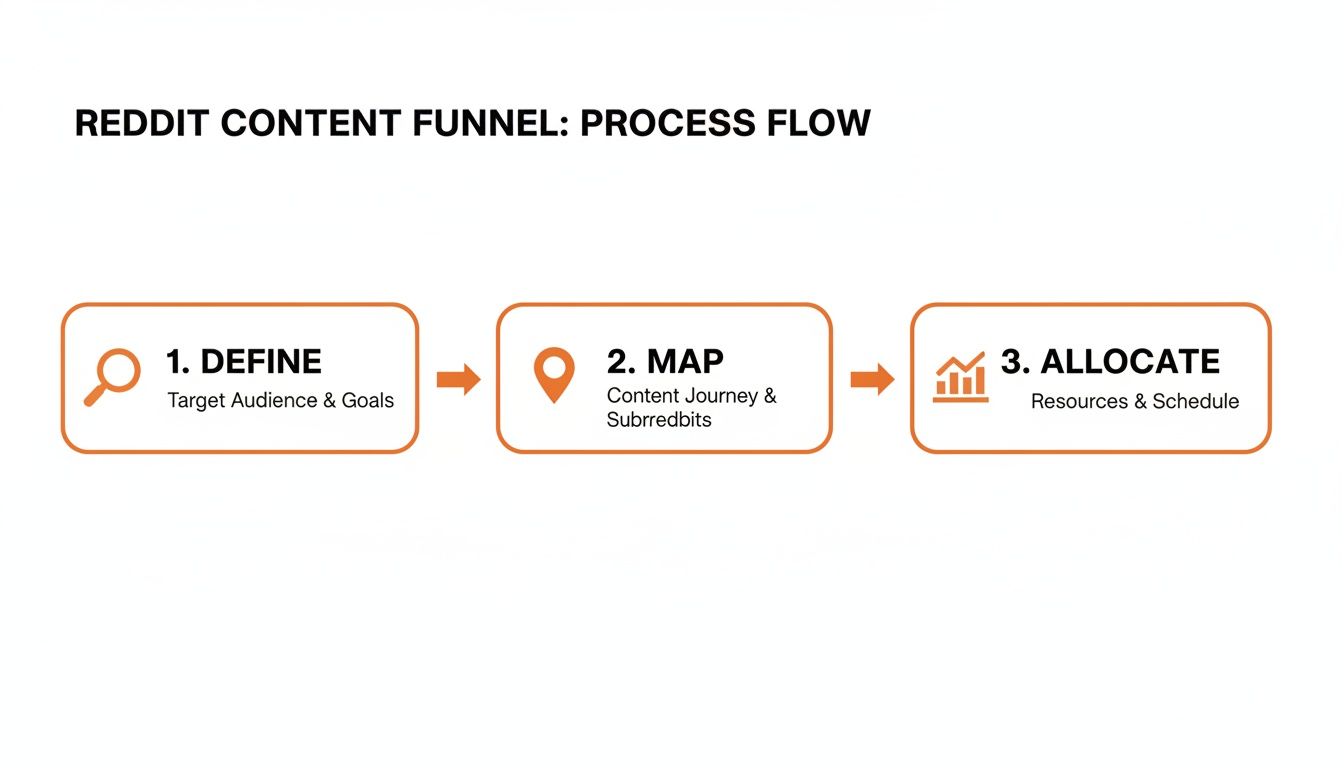
Following this Define, Map, and Allocate flow is what separates a strategic funnel from just throwing random content at the wall and hoping something sticks.
What’s the Most Common Mistake to Avoid?
The single biggest pitfall is treating Reddit like just another social media channel. You absolutely cannot copy and paste your content from LinkedIn or Twitter and expect it to work. It won't.
Every post, every comment, needs to be dialed into the specific culture, language, and inside jokes of the subreddit you’re targeting. If you get this wrong, you'll immediately be flagged as an outsider, and any trust you hoped to build will evaporate. Spend time lurking and learning the ropes before you make your first post.
Ready to turn Reddit's passionate communities into a reliable source of traffic and leads? The team at Reddit Agency specializes in building and running organic content funnels that drive real business results. We'll handle the strategy, content, and engagement, so you can focus on what you do best. Learn more about our services.
