Facebook Groups Marketing: Your Complete Growth Playbook
Marketing with Facebook Groups is all about creating a dedicated community space to connect with people, spark real conversations, and gently guide them toward your business. It’s a total shift from the one-way broadcast of a public Page. Instead, you're building a two-way dialogue that can turn passive followers into your most dedicated fans.
Why Facebook Groups Are Your Untapped Marketing Channel
Let's get past the vanity metrics. A Facebook Group isn't just another social media checkbox; it's a strategic powerhouse and a direct line to your ideal customer.
While public Pages are constantly fighting a losing battle with organic reach, groups are literally built for the authentic conversations that algorithms now reward. Think of it as creating the go-to hub for your niche—a place where people can connect, get help, and become genuine champions for your brand. For example, a SaaS company selling project management software could create a group called "Productivity Hacks for Agency Owners," providing a space for their target audience to share tips and solve problems.
A Direct Line to Your Audience
When you run it right, a group becomes this incredible, self-sustaining engine for customer insights and organic growth. It’s a space you control, where you set the tone and share exclusive content away from the chaos of the main news feed.
This direct access is gold. You get to hear about your customers' biggest challenges firsthand, test new ideas before a big launch, and collect testimonials without even having to ask. Creating this kind of value-first space is the heart of what makes community marketing so effective. You can learn more by checking out our deep dive into what is community marketing.
A public page is like shouting in a crowded stadium, hoping someone hears you. A Facebook Group is like hosting a VIP dinner party where you have meaningful conversations with every single guest.
To really see the difference, let’s compare them side-by-side.
Public Page vs Private Group Comparison
| Feature | Facebook Public Page | Facebook Private Group |
|---|---|---|
| Communication Style | One-way broadcast (brand to audience) | Two-way dialogue (community conversation) |
| Organic Reach | Often low due to algorithm changes | High visibility within the group, prioritized notifications |
| Audience Relationship | Followers are often passive observers | Members are active participants |
| Content Focus | Brand announcements, promotions, public updates | Exclusive content, Q&As, peer-to-peer support |
| Lead Quality | Broad and untargeted | High-intent, pre-qualified leads |
| Control | Open to the public, anyone can comment | Gated access, you set the rules and approve members |
This table makes it clear: if you're after deep engagement and high-quality leads, a group is the strategic choice.
Built for Modern Engagement
Facebook Groups are a huge part of Meta's long-term vision. They want to keep people interacting on the platform, which is great news for us. It means group content naturally gets a leg up in terms of visibility and engagement.
With Facebook's user base expected to hit 3.15 billion by 2026 and the 25–34-year-old demographic dominating the platform, it's the perfect environment for B2B and SaaS brands trying to reach decision-makers. This structure fundamentally changes your marketing from a monologue into a thriving community dialogue.
Building Your Group's Foundation for Lasting Success
A great Facebook Group isn't just a happy accident; it's built on a solid blueprint. Before you even think about inviting people, you need to lock down a clear purpose—one that’s about more than just shilling your products. Your group needs to be a real destination, a go-to spot where people can solve a specific problem or just find their tribe.
This core purpose is the DNA of your group. It's what shapes your group's name and description. You'll want a name that’s not only catchy but also easy for people to find when they're searching on Facebook. For example, instead of a generic name like "[Your Brand's] Community," try something like "SaaS Founders Growth & Networking." That name instantly tells people who it’s for and what they'll get out of it.
Crafting Your Group's Identity
Think of your group's description as your elevator pitch. It needs to sell potential members on why they should click "Join." Lay out the benefits, be crystal clear about who the group is for, and give them a taste of the conversations they can expect. Being specific here is key—it pulls in the right crowd and keeps the wrong one out.
Next up, your rules. Don’t just grab some generic template and call it a day. Spend some time thinking about the kind of vibe you want to create and write rules that actually support that culture. For instance, a actionable rule could be: "Rule #1: No Self-Promotion. Do not post links to your blog, social channels, or products. You can, however, include one link in your bio when you introduce yourself." This is clearer than just "No spam." These rules are your best defense against the endless tide of spam and self-promo, making sure the group stays a valuable place for genuine members. To really get this right, it helps to understand the proven strategies to build an online community.
Using Membership Questions for Insights
This might be the most powerful, yet most overlooked, tool in your entire arsenal: membership questions. They do way more than just screen people. They're a goldmine for vetting new members and gathering priceless market research.
Instead of asking basic yes/no questions, use this as your first chance to qualify leads and get a direct line into their biggest challenges. Suddenly, an admin task becomes a powerful data-gathering machine. For example, a CRM company could ask, "What's the most frustrating part about managing your sales pipeline right now?" The answers are pure gold for their marketing and product teams.
This whole process—from creating the right foundation to gathering insights—is what sparks real growth. It all starts with conversations, which build trust, which in turn fuels the growth of your community.
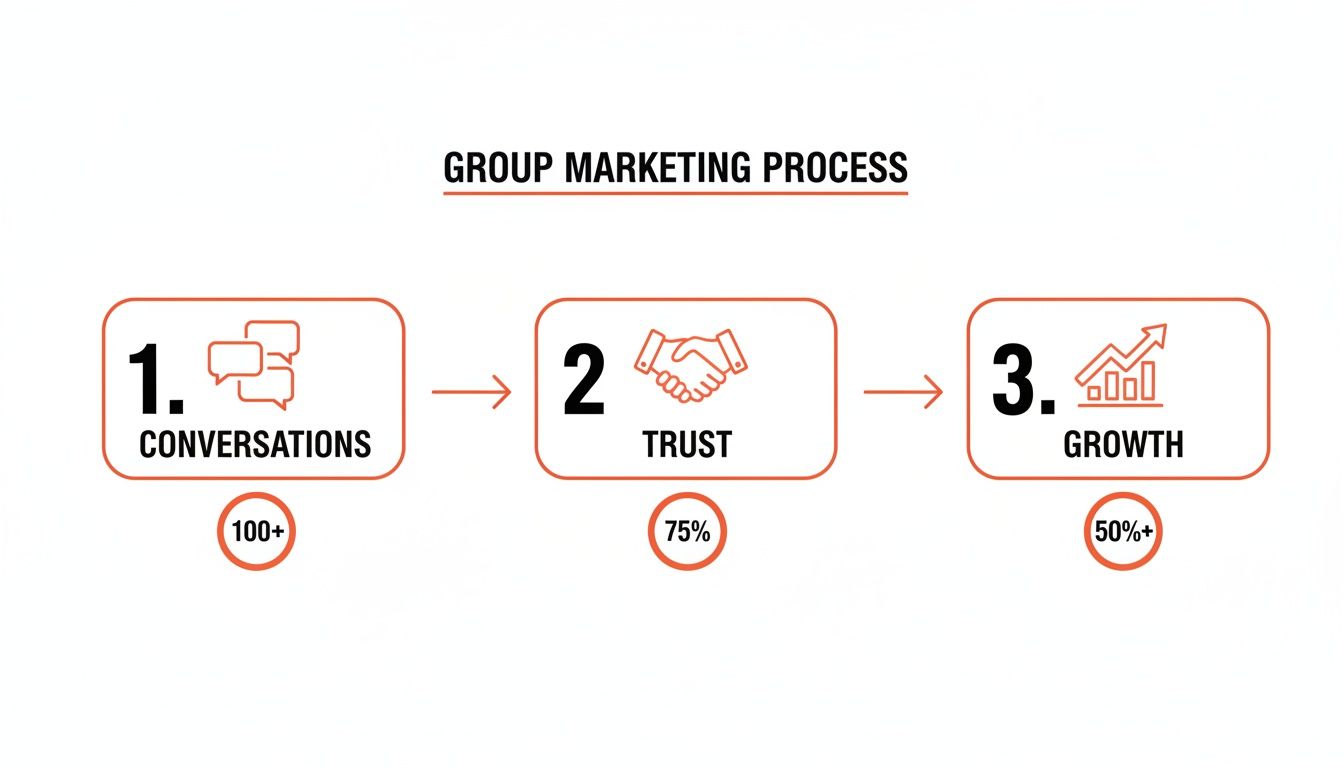
The idea is simple: meaningful conversations are the bedrock. Get those right, and you'll earn the trust you need for the community to truly take off.
Just look at the difference a good question makes:
Weak Question: "Do you agree to the group rules?"
Strong Question: "To confirm you've read them, what is our rule #1 about self-promotion?"
Weak Question: "Why do you want to join?"
Strong Question: "What is the single biggest challenge you're facing right now with [your industry topic]?"
By asking better questions, you’re not just filtering out spammers; you're building a repository of customer language and pain points that can inform your entire content and product strategy. Every application becomes a mini-interview.
How to Actually Get People to Join Your Facebook Group
Alright, you've built the foundation. Now comes the real work: getting the right people in the door. The trick to sustainable growth isn't just about blasting links everywhere. It's about weaving your group into everything you already do, making it the obvious next step for anyone who interacts with your brand.
You want people to go from reading a blog post or signing up for your newsletter to thinking, "I need to be in this group." It’s about meeting them where they are and giving them a compelling reason to stick around.
Start with Your Inner Circle
Your best first members are the people who already know, like, and trust you. These are your true fans, your email subscribers, your existing customers. They are the ones who will provide the initial spark and make the group feel alive from day one.
Don't overcomplicate this. Here are actionable first steps:
- Hit up your email list. This is your warmest audience. Send them a personal-sounding email explaining why you started the group and what's in it for them. Think exclusive content, direct access to you, or first dibs on new stuff. A simple "P.S. Join the conversation in our new community" in your regular email signature is also a fantastic, low-effort way to keep a steady trickle of new members coming in.
- Update your social bios. Pop the group link into your bio on LinkedIn, X, Instagram—wherever you hang out. It's a simple, set-it-and-forget-it tactic that turns profile lurkers into potential community members.
These first 50-100 members are your foundation. They'll start conversations, ask questions, and make the place feel welcoming for everyone who follows. For a deeper dive on getting these initial members, check out our full guide on how to grow a group on Facebook.
Weave Your Group into Your Marketing
To get a steady flow of new members, you need to bake the group into your existing marketing channels. Think about where people interact with you and find the natural places to invite them in.
A perfect spot is the "thank you" page someone sees after subscribing to your newsletter. They've just taken an action that shows they're interested. Hit them with a simple, "Thanks for subscribing! For daily tips and real-time discussions, come join our free Facebook Group." It works because the timing is perfect. Another actionable tip: add a call-to-action (CTA) box at the end of relevant blog posts. If you have an article on email marketing, include a CTA that says, "Enjoyed this article? Join our Facebook Group for 200+ other email marketers to discuss strategies like this every day."
My Favorite Pro-Tip: Talk about your group organically in your other content. If you have a podcast, mention a great question someone asked in the group last week. This is so much more powerful than a generic CTA because it shows the value instead of just telling people about it.
Partner Up to Reach New Audiences
One of the fastest ways to grow is to tap into someone else's established audience. Find people or brands who serve the same type of person you do, but in a non-competitive way.
Let’s say you run a group for founders who need help with marketing. A perfect partner would be someone who writes a newsletter for founders about product development. You're both talking to the same people but solving different problems.
Here’s a quick-and-dirty playbook for partnerships:
- Find your people. Look for complementary newsletters, podcasts, or influencers in your space. Make a list of 10 potential partners.
- Make it a win-win. Don't just ask for a shoutout. Offer to promote their newsletter to your group or feature them in an expert Q&A. Your opening email could be: "Hi [Name], I run a community of 500 SaaS founders and would love to feature your insights on product development in an exclusive Q&A. In return, I'd appreciate a mention of our group in your newsletter."
- Keep it real. The promotion should feel like a genuine recommendation. Your partner could say something like, "If you're trying to figure out growth marketing, my friends at [Your Company] run an amazing community. I highly recommend you check it out."
This feels less like a cold ad and more like a warm introduction, which means you'll attract people who are genuinely a good fit and ready to participate.
Crafting a Powerful Community Engagement Strategy
An empty, silent group is worse than having no group at all. Once you've got people through the door, the real work of building a community begins. The success of your Facebook Group marketing boils down to one thing: sparking real conversations that make people want to jump in.
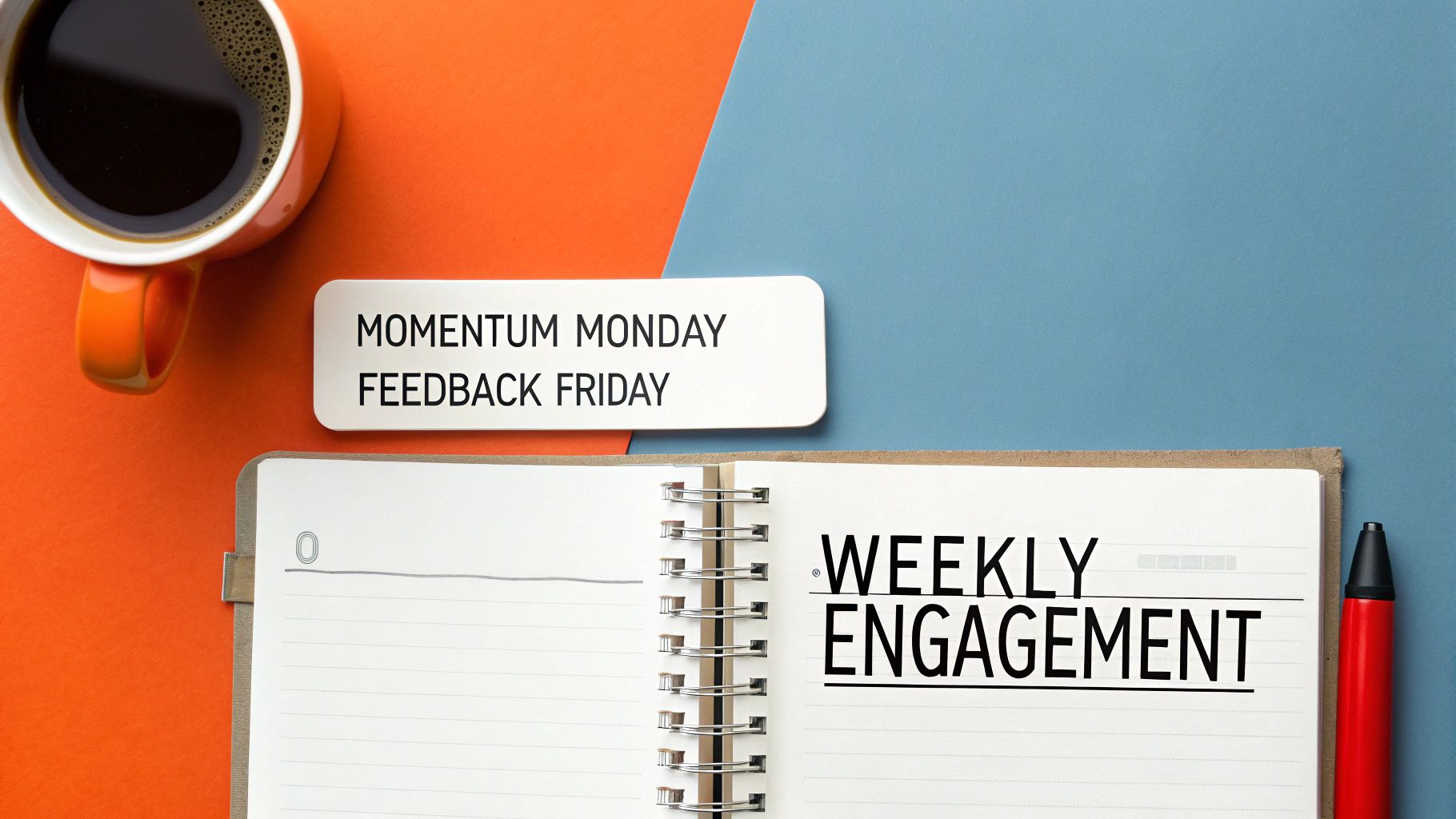
This doesn't just happen on its own. It takes a solid plan to create consistency and make it dead simple for your members to participate. Building a thriving group is all about mastering how to improve customer engagement and nurturing genuine connections.
Design a Simple Content Calendar
Consistency is your secret weapon. A weekly content calendar with daily themes takes the guesswork out of posting, creating predictable and fun ways for members to interact. This structure gives people a reason to check back on certain days because they know what to expect.
Here’s a simple but effective weekly schedule you can steal and adapt for your own group. It’s designed to keep the conversation flowing without you having to constantly rack your brain for new ideas.
Weekly Engagement Content Calendar Template
| Day | Theme | Example Post Prompt |
|---|---|---|
| Monday | Momentum Monday | "Happy Monday! What's the #1 thing you're focused on crushing this week? Let's hold each other accountable!" |
| Tuesday | Tool Tuesday | "What's one tool, app, or resource you couldn't do your job without? Share the link below!" |
| Wednesday | Wins Wednesday | "Time to celebrate! Share a win from this week—big or small, we want to hear it." |
| Thursday | Think Tank Thursday | "I'm stuck on [a specific problem]. How would you approach this? Looking for all your brilliant ideas!" |
| Friday | Feedback Friday | "Working on a new [idea, blog post, product concept]. Can I get your honest feedback on it?" |
| Saturday | Social Saturday | "What are you up to this weekend? Share a GIF that perfectly describes your plans!" |
| Sunday | Strategy Sunday | "What's your game plan for the week ahead? Let's get prepped for success together." |
A framework like this ensures your group stays active and valuable, turning it into a reliable resource your members will love.
Master the Art of Conversation Starters
The difference between a post that gets crickets and one that blows up with comments is all in the prompt. Your mission is to ask open-ended questions that are easy and inviting to answer.
Ditch the lazy "Any questions?" and start asking things that pull out real stories and opinions.
The best engagement prompts feel less like a survey and more like a conversation you'd have with a friend over coffee. They tap into experiences, wins, and challenges that people are genuinely eager to share.
Here are a few practical prompts that work like a charm:
- "What's one tool you started using this year that you absolutely can't live without now?"
- "Share a recent 'aha!' moment you had related to [your industry topic]."
- "What's a common piece of advice in our industry that you completely disagree with? (Spicy takes welcome!)"
- "If you could go back and give your younger self one piece of professional advice, what would it be?"
These questions get people talking because they’re specific, personal, and require more than a one-word answer. They naturally lead to much deeper discussions.
Active Moderation Is Proactive Facilitation
Great moderation isn't just about deleting spam and policing the rules. It's about actively shaping the culture of your community. Think of yourself as the group's biggest cheerleader and chief facilitator.
This means you’re in there personally welcoming new members by name in a weekly roundup post. For example: "A huge welcome to our newest members this week: @Jane Doe, @John Smith, and @Sarah Bell! We're so glad to have you. To get started, tell us what you're working on in the comments!" It means you’re publicly celebrating your most active contributors to inspire others.
When a member asks a question, go the extra mile and tag another member you know has the perfect answer. These small, intentional acts of facilitation make people feel seen and valued, transforming a simple group into a true community.
How To Turn Engagement Into Revenue
Having a loyal, fired-up community is a marketer's dream. But let's be honest—the real goal is to connect that incredible energy back to your business. The trick is to bridge the gap between community engagement and revenue so smoothly that it feels like the next logical step for your members, not a jarring sales pitch.
The entire foundation of this approach is built on good old-fashioned reciprocity. You need to give, give, and give some more. When you've provided an overwhelming amount of value, your members will want to find ways to support you when you finally make an offer. This isn't about manipulation; it's about earning the right to sell by being ridiculously helpful first.
Offer Exclusive Lead Magnets
One of the cleanest ways to guide a member from the group onto your email list is with a lead magnet they can't get anywhere else. I'm not talking about some generic PDF you have floating around. This needs to be a high-value resource crafted specifically to solve the problems your group members are talking about every single day.
Pay close attention to the questions that pop up over and over. Let's say you run a group for new podcasters, and you constantly see people asking how to prep for interviews.
- The Offer: Create something like a "Podcast Guest Prep Checklist" or a "Pre-Interview Questionnaire Template."
- The Execution: Post about it in the group, saying something like, "I've seen a lot of questions about preparing for guest interviews lately. I put together a quick checklist that covers my entire process. Drop a 'me' in the comments if you want it!" Then, privately message the link to everyone who comments.
This works so well because it's a direct solution to a known problem within your community. You're not just begging for an email address; you're offering the answer they were already looking for.
Host Group-Only Webinars and Workshops
Webinars and live workshops let you connect with your audience on a much deeper level than a simple post. By making them exclusive to your group, you instantly make them feel more valuable and reward your members for being part of the community.
The key is picking a topic that tackles a major challenge and naturally tees up your product or service as the solution. For instance, a company selling project management software could host a workshop on "How to Streamline Your Team's Workflow and Finally Eliminate Missed Deadlines."
The magic formula here is 90% pure value and 10% product showcase. Spend the vast majority of the time teaching a practical, actionable framework. For example, teach them three specific methods for prioritizing tasks. Only at the very end should you introduce your software as the perfect tool to implement everything they just learned.
This educational-first approach builds massive trust. Your members walk away with real knowledge, and they start to see your product as an essential part of the solution you just taught them.
Run a Community-First Product Launch
When you're ready to launch something new, your Facebook Group is your VIP lounge. These are your ride-or-die fans, and you need to treat them that way. A "community-first" launch gives them special treatment, exclusive access, and perks that nobody else gets.
Here’s a simple launch sequence I've seen work time and again:
- Early Access: Let your group know about the new product 24-48 hours before the public announcement. A post could say: "Hey everyone, as a thank you for being part of this community, you're the first to know about our new [Product]. You can check it out here before anyone else." This small gesture makes them feel like true insiders.
- Exclusive Discount: Give them a special "community-only" discount code like
COMMUNITY20. It's a tangible way to thank them for all the loyalty and feedback they've given you. - Direct Q&A: Schedule a live Q&A session right inside the group to answer every single one of their questions about the launch in real-time.
This strategy does more than just drive your first wave of sales; it creates a groundswell of authentic social proof. When your most dedicated members start buying and then raving about the product inside the group, their excitement becomes contagious and fuels your entire public launch.
Measuring Success and Ensuring Your Group's Long-Term Health
It’s easy to get caught up in the day-to-day buzz of running a Facebook group, but busyness doesn't equal results. If you want your group to be a real asset, you have to look past vanity metrics like the total member count and dig into the data that shows what’s actually moving the needle.

Think about it: a group with 10,000 members but only 100 who ever post or comment is just an empty stadium. A much smaller group of 1,000 members with 800 people actively participating is where the real magic happens. This is the kind of engaged community that drives business.
Your go-to tool for this is Facebook’s own Group Insights. Honestly, it's a goldmine of information that tells the true story of your community’s health.
What to Look for in Your Group Insights
The data in Group Insights isn't just a bunch of numbers; it's direct feedback on your strategy. Start by zeroing in on your engagement rate, which is the sum of all comments, posts, and reactions. A practical goal is to aim for a 10% engagement rate (meaning if you have 1,000 members, an average post should get at least 100 interactions).
Next, find your top-performing posts. Are they simple questions? In-depth polls? Or maybe the long, value-packed posts are the ones getting all the love? This is your roadmap. If polls are consistently lighting up your group, it’s a clear sign to weave more of them into your content plan.
Don't forget to check out the "Top Contributors" list. These are your superfans. Acknowledging them—maybe with a simple shout-out like, "Huge thanks to @John Doe for sharing so much wisdom this month!"—can encourage them and motivate others to step up their participation.
Finally, pay attention to when your members are actually online. The "Popular Days & Times" chart is invaluable. Why post your most important announcement at a time when most of your audience is offline? Scheduling your key content for these peak hours is a simple tweak that can dramatically increase its reach and impact.
Staying Compliant for Sustainable Growth
All this growth is exciting, but it’s worthless if your group gets shut down because you accidentally broke a rule. Staying on the right side of Facebook’s policies is absolutely non-negotiable. And let's be real, navigating the rules around commercial activity can be a bit of a minefield.
The golden rule here is transparency. If you're running a giveaway, using an affiliate link, or promoting a product, your members should instantly understand what's going on. No sneaky business.
To keep your community safe and thriving, stick to these actionable practices:
- Contests and Giveaways: Always post the official rules, who's eligible, and a clear statement that Facebook isn't sponsoring the promotion. For instance, you could add: "To enter, comment below with your favorite feature. A winner will be chosen at random on Friday at 5 PM EST. This giveaway is not affiliated with Facebook."
- Affiliate Disclosures: You absolutely must disclose affiliate links. A simple, clear disclaimer like
(As an affiliate, I may earn from qualifying purchases)at the beginning of the post keeps you transparent and compliant. - Medical and Financial Claims: This is a big one. Steer clear of making unverified health claims or promising guaranteed financial returns. Your content should be educational, not prescriptive. It’s the difference between sharing helpful information and giving advice that could get you into hot water.
By keeping a close eye on your metrics and playing by the rules, you’re not just running a group—you’re building a sustainable, valuable asset for your business.
Ready to grow your brand on one of the internet's largest communities? Reddit Agency can help you tap into niche subreddits, spark authentic conversations, and drive measurable results. Find out how we turn Reddit engagement into loyal customers at https://redditagency.com.
