What is Community Marketing: A Clear Guide to Building Your Brand's Superfans
Community marketing isn't about shouting from the rooftops; it’s about pulling up a chair and joining the conversation. It’s the art of engaging with customers in the places they already love to hang out, built around shared interests and genuine connection. Forget the hard sell. This is about building relationships that turn casual followers into passionate fans.
From Buzzword to Business Staple

Think about it like this: imagine you're at a gathering of fellow coffee enthusiasts. Instead of storming in and yelling about your new espresso machine, you chat about brewing methods, debate the best beans, and share tips for getting the perfect crema. You become a trusted voice in that circle. That's community marketing in a nutshell. It swaps one-way broadcasting for two-way dialogue.
This entire strategy hinges on a fundamental human need: we all want to belong. Rather than trying to interrupt people with ads, you become an active, contributing member of an ecosystem—like a dedicated Slack channel for product managers or a bustling subreddit for gardeners—where your ideal customers already are.
The immediate goal isn't to rack up sales; it's to build unshakable trust. By consistently offering help, sharing what you know, and just being present in the conversation, your brand earns a reputation as a valuable member of the group. This completely flips the traditional marketing funnel on its head.
The Foundation: Value Before Volume
At its core, community marketing is a promise to deliver value first, ask later. This isn't just theory; it's a series of practical actions.
- Answering questions on a forum in your niche without even mentioning your product. For example: A representative from an SEO software company might spend 15 minutes a day in r/SEO answering technical questions about canonical tags or site speed, building a reputation as an expert.
- Creating genuinely useful content—like a step-by-step guide or video tutorial—that solves a real problem for the community. Actionable Insight: Create a short, screen-recorded video showing how to solve a common problem your audience faces and share it in a relevant Facebook group, simply stating, "Saw a few people asking about this, so I made a quick video to help."
- Sparking conversations that help members connect and learn from one another. Instead of asking, "What do you think of our product?" ask, "What's the biggest challenge you're facing with [topic] this month?"
For instance, a company that makes project management software might hang out in a subreddit for small business owners. Instead of dropping links to their homepage, they could offer battle-tested advice on managing remote teams or share a downloadable template for a project kickoff meeting. That kind of participation builds real credibility. When someone in that group finally needs a project management tool, who do you think they'll remember? The helpful expert, not the faceless vendor.
The guiding principle is simple: you earn the right to be heard by first being a valuable participant. This creates a powerful, self-sustaining loop of trust, loyalty, and organic growth that paid ads struggle to match.
This is especially effective today. People are craving real interactions online. A staggering statistic brings this home: as of 2025, over 5 billion people—that's 65.7% of the global population—are on social media, actively using an average of 6.84 platforms every month. This creates an enormous opportunity for brands to connect. You can find more fascinating social media marketing statistics that highlight the power of these community-focused approaches.
Community Marketing vs Traditional Marketing At a Glance
To really see the difference, it helps to put the two approaches side-by-side. Traditional marketing is a monologue; community marketing is a conversation.
| Aspect | Traditional Marketing | Community Marketing |
|---|---|---|
| Primary Goal | Drive immediate sales, lead generation | Build long-term trust and loyalty |
| Communication Style | One-to-many (broadcast) | Many-to-many (dialogue) |
| Key Metric | ROI, Conversion Rate, Reach | Engagement, Retention, Sentiment |
| Customer Role | Passive Audience | Active Participant, Co-creator |
| Brand Position | Authority, Broadcaster | Facilitator, Member, Resource |
As you can see, the entire mindset shifts from "selling to" an audience to "building with" a community. It’s a long-term play, but the payoff is a resilient, loyal customer base that champions your brand for you.
Why Community Is Your Ultimate Growth Engine
Think of community marketing less as a "nice to have" and more as a direct pipeline to real business results. It’s a strategic shift that turns marketing from a simple cost center into an engine for creating genuine value. When you successfully build a community, you aren’t just getting customers—you're nurturing a self-sustaining ecosystem for growth.
This approach builds what we call a brand moat, a defensive barrier that competitors will find nearly impossible to cross. Sure, a rival can copy your product's features or even slash their prices, but they can't replicate the authentic loyalty and sense of belonging your members feel. That connection pays off directly in higher retention rates and a much healthier customer lifetime value.
Lowering Your Customer Acquisition Costs
One of the first and most tangible benefits you'll see is a serious drop in your customer acquisition cost (CAC). A healthy community essentially becomes a referral machine, powered by authentic word-of-mouth from people who truly believe in what you're doing.
Instead of burning cash on ads that most people are conditioned to ignore, you’re investing in relationships. Let's look at how this plays out in the real world:
- For a B2B SaaS company: Imagine needing beta testers for a new feature. Instead of dropping thousands on ads, they simply post in their dedicated subreddit or Slack community. Practical Example: "Hey everyone, we're testing a new integration with Salesforce and need 10 volunteers to try it out. You'll get early access and a $50 gift card for your feedback." They get immediate sign-ups from their most dedicated users and receive incredibly high-quality feedback, all for a tiny fraction of the cost.
- For a DTC brand: A brand could use its Instagram followers as a kind of co-creation team. By polling their audience on new product colors or designs, they make people feel like they're part of the process. Actionable Insight: Use Instagram Stories' poll or question sticker to ask, "We're launching a new hoodie for fall. Should we go with Forest Green or Burnt Orange?" The launch then has built-in demand and organic buzz, which drastically cuts down the need for a huge ad spend.
This isn't just a niche tactic; it’s part of a much bigger movement. The worldwide online communities market, a cornerstone of this strategy, exploded from $392.95 million in 2014 to a projected $1.2 billion by 2019—and it hasn't slowed down since.
Creating an Invaluable Product Feedback Loop
Your community is the best focus group you could ever ask for. It provides a constant, unfiltered stream of insights that can supercharge your product development. We're not talking about bland survey answers here; this is about real-world use cases, honest frustrations, and brilliant ideas coming directly from your most passionate users.
By actually listening, you can spot pain points before they escalate and uncover opportunities for innovation that you would have otherwise completely missed. This direct line to your audience is a massive competitive advantage.
Picture a software startup that hangs out in a Discord server with its power users. A bug pops up, and within minutes, the community reports it with detailed steps on how to reproduce it. Developers can then ship a fix in hours, not weeks. This kind of rapid, community-driven improvement builds a far stronger product and even deeper user loyalty. To really get this flywheel spinning, it's worth exploring practical strategies to boost social media engagement and cultivate a strong community.
Ultimately, this cycle of listening and building with your audience changes everything. It’s a core piece of any smart organic marketing plan, which is all about earning attention instead of buying it. You can dive deeper by reading our guide on what is organic marketing. This approach doesn't just bring in customers; it creates genuine partners who are invested in seeing you succeed.
The Three Pillars of a Winning Community Strategy
Building a community that actually feels alive and self-sufficient doesn't just happen. It’s not about luck; it’s about a deliberate strategy built on three core pillars that feed into one another: Listen, Engage, and Empower.
Think of it like tending a garden. First, you have to listen to the land—understand the soil, the sunlight, and what will actually grow there. Then, you engage by planting the seeds and watering them. Finally, you empower the garden to thrive on its own, creating a healthy ecosystem.
When these efforts work together, they directly fuel business growth. You'll see loyalty skyrocket, acquisition costs drop, and a flood of invaluable product feedback come your way.
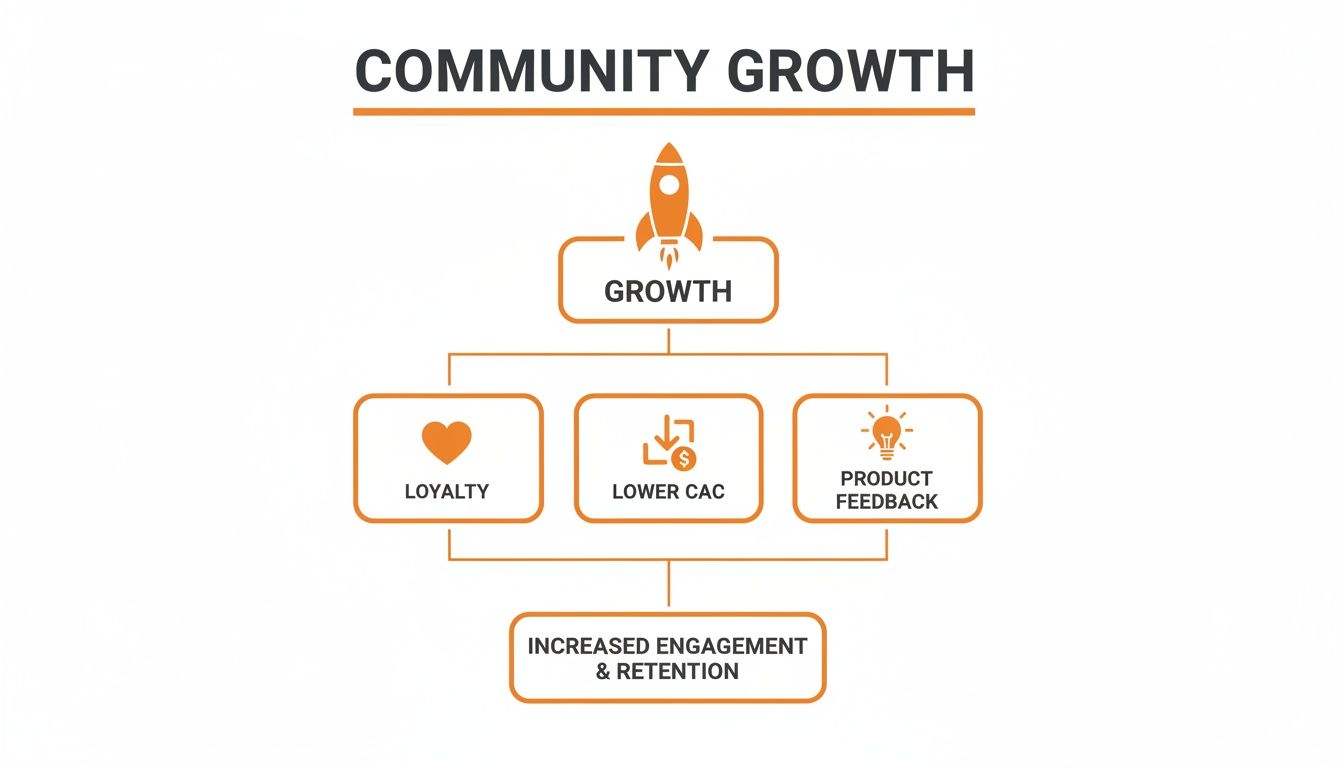
This isn't about chasing vanity metrics. As you can see, a healthy community is a direct driver of the core outcomes that give a business a real, sustainable advantage.
Pillar 1: Listen Before You Speak
The first and most important pillar is listening. Before you can even think about adding value to a conversation, you have to understand what people are already talking about. What do they care about? What are their biggest headaches?
This isn’t about passive eavesdropping. It’s active intelligence gathering.
Actionable Insight: Set up keyword alerts using a free tool like Google Alerts or a social listening tool for terms related to your industry's pain points (not just your brand name). This delivers relevant conversations directly to your inbox. Spend time on Reddit, in niche forums, or on industry Slack channels. But don't post—just read. Look for the questions that keep popping up, the common frustrations, and the exact language people use to describe their problems.
For example, a B2B SaaS company could lurk in subreddits like r/sysadmin or r/sales. Just by observing the day-to-day chatter, they can spot unmet needs their product could solve or get a killer idea for a blog post that speaks directly to a real-world pain point. Practical Example: After seeing three posts in a week about the difficulty of tracking sales commissions, they could write a definitive guide titled "How to Build a Commission Tracker in Google Sheets (Template Included)" and share it with the community.
Listening provides the blueprint for your entire engagement strategy. It ensures that when you finally do speak, your contribution is relevant, valuable, and welcomed by the community.
Pillar 2: Engage to Add Value
Once you have a real sense of the community’s pulse, it's time to move to the second pillar: engaging. This is your transition from a silent observer to an active participant.
But there’s one golden rule: your goal is to help, not to sell.
Dropping salesy, self-promotional comments is the fastest way to get ignored or downvoted into oblivion. Instead, your engagement should focus on offering genuine expertise and support. The goal is to become a trusted, go-to resource in that space.
Here are a few actionable ways to do that authentically:
- Answer Questions in Detail: When you spot a question you can answer, give a thorough, genuinely helpful response without pitching your product. Practical Example: If you sell project management software and see a question about scope creep, offer a detailed framework for preventing it based on your own experience, complete with bullet points and action steps.
- Share Third-Party Resources: Post links to great articles, tools, or studies from other sources. It shows you’re there to add to the collective knowledge, not just push your own stuff. Actionable Insight: Start a thread like, "What's the best article you've read this week on [your industry]?" to spark discussion and position yourself as a helpful curator.
- Acknowledge and Validate: Sometimes, the best engagement is simply letting someone know you hear their frustration or celebrating a win with them. It proves there’s a human on the other side of the screen.
This kind of interaction is what lays the groundwork for powerful referral systems. These genuine moments build the trust needed for people to recommend your brand organically, which is a key part of the most effective word-of-mouth marketing strategies.
Pillar 3: Empower Your Advocates
The final pillar, empowering, is where the magic really happens. This is about turning passive community members into active brand advocates, creating the momentum that helps your community grow on its own. You've listened to them and engaged with them; now you give them the tools and recognition to become your champions.
Empowerment creates an incredible feedback loop. Your most passionate users start helping you grow the community and even improve your product. In fact, many of the strategies used in effective Partner Relationship Management (PRM) offer a great blueprint here, as they focus on collaboration and mutual success.
Try putting these empowerment tactics into play:
- Launch User-Generated Content (UGC) Campaigns: Ask your users to share their own stories, projects, or results from using your product. Practical Example: A fitness app could run a monthly contest for the best transformation story, featuring the winner on its main social channels and giving them a free year of premium access.
- Create an Ambassador Program: Identify your most active and helpful members and give them a special status. Actionable Insight: Offer perks like early access to new features, exclusive content, a dedicated Slack channel with your product team, and official swag to make them feel like valued insiders.
- Establish a Feedback Council: Formally invite a small group of power users to join regular feedback sessions. Not only will you get amazing insights, but you'll also make your best customers feel deeply valued and invested in where you're headed.
By systematically listening, engaging, and empowering, you build something far more valuable than an audience. You cultivate a thriving, resilient community that can become your single greatest marketing asset.
Your Community Playbook for Reddit and Beyond
A killer community marketing strategy starts with a simple idea: go where your people are. The core principles—listening, adding real value, and empowering your users—are the same everywhere. But a platform like Reddit, with its millions of hyper-focused sub-communities, gives you one of the most direct and potent ways to put those principles to the test.
Here’s the catch, though. You can't just barge in and start spamming links. Reddit is a culture-first platform, and its users can sniff out a marketer from a mile away. Success requires a thoughtful approach, not a bullhorn. The same goes for those niche Slack channels, industry-specific Discord servers, and specialized forums where your ideal customers hang out.
This playbook will give you a practical framework for finding the right communities, engaging in a way that actually builds trust, and turning genuine conversations into business momentum.
Mastering Reddit: Finding Your Subreddit Goldmines
Your first job isn't to create content. It’s to do some detective work. The mission is to find the subreddits where your ideal customers are already talking—sharing frustrations, asking for advice, and celebrating wins related to your field.
Think of yourself as a scout looking for the perfect spot. Here’s a practical approach:
- Hunt for Problems, Not Solutions: Don't just search for your product category (e.g., "project management software"). Instead, look for the problems people are trying to solve. Think subreddits like r/smallbusiness, r/startups, or r/productivity. Actionable Insight: Use Reddit's search bar for phrases like "how do I manage," "I'm struggling with," or "any tools for" to find relevant discussions.
- Gauge the Vibe and Activity: A subreddit with a million members but only five comments per post is a ghost town. You want communities with lively daily discussions. A healthy comment-to-post ratio is a fantastic sign that people are actually engaged and helping each other.
- Read the Room (and the Rules): Before you even think about posting, read the sidebar rules. Is self-promotion an instant ban? Get a feel for the local etiquette. Lurk for a week to understand the tone—is it supportive, cynical, highly technical?
The goal is to find communities where you can become a valuable member, not just another marketer. A great subreddit is one where your expertise is a natural fit for the members' needs.
Crafting Posts That Connect, Not Alienate
Once you've found your target subreddits, the real challenge begins: contributing in a way that adds value. Redditors have a finely tuned radar for inauthentic, salesy content. Your posts and comments need to feel like they belong there.
The secret? Give away your best advice for free. Community marketing is built on trust, which means joining conversations, not dominating them. This isn't just a hunch; 44% of online adults now use social media to research brands. Younger audiences, especially those aged 16-34, overwhelmingly prefer information vetted by a community over a slick ad. On a platform like Reddit, this means dropping into comment threads in your ideal subreddits can drive 2-5 times more qualified traffic than a paid post because users trust peer insights. You can find more data on the global trends shaping social media from wearesocial.com.
To do this right, you need to focus on high-signal content—posts that scream "I know what I'm talking about, and I'm here to help."
Actionable Tip: Try a "problem-solution" post. Find a common question you noticed while lurking and write a detailed, step-by-step guide to solving it. For example, if you sell email marketing software, you could write a post titled, "My 5-Step Framework for Writing Subject Lines That Actually Get Opened." Then, share the entire framework right there in the post, no strings attached. At the end, you can add a soft CTA like, "I've built tools to automate this, but this manual framework is a great starting point for anyone."
Adapting Your Playbook for Other Platforms
The fundamentals you master on Reddit are your passport to other community-heavy platforms like Slack, Discord, and niche forums. The strategy is the same, but the tactics need a little tweaking for each environment.
- Niche Slack Channels: These are often more intimate and professional. The game here is to become a familiar, helpful face. Practical Example: Actively participate in the #introductions channel, then make a habit of sharing one high-value, non-promotional article in the #general channel each week with a brief summary of why you found it useful.
- Discord Servers: Often built around specific interests like gaming, software development, or crypto, Discord is a fast-paced, real-time world. Actionable Insight: Host a weekly "Office Hours" in a voice channel where community members can drop in to ask you questions directly. This builds strong personal connections and establishes your expertise.
- Industry Forums: They may seem old-school, but forums are still goldmines for specific niches (think web development or automotive repair). The audience is often deeply knowledgeable and appreciates detailed, technical answers. A long, well-researched response that solves a tough problem will earn you serious credibility.
No matter the platform, the game plan doesn't change: listen first, provide overwhelming value, and engage with a genuine desire to help. If you want to go deeper on fostering these interactions, check out our guide on community engagement best practices. This isn't just about brand awareness; it's about building real relationships that lead to lasting growth.
Real-World Examples of Community Marketing in Action
All the theory in the world doesn't mean much until you see it in action. Seeing a community marketing strategy fire on all cylinders is what really makes the concept click. The best part is, this approach isn't boxed into one industry or platform. It works for B2B software, direct-to-consumer fashion, and everything in between because the core idea is universal: listen, engage, and empower.
Let's dive into three very different brands that built incredible communities by truly understanding their people and becoming part of the conversation.
Figma: From Niche Subreddit to Design Powerhouse
Before Figma became the giant it is today, it was just another new tool trying to find its footing in a very crowded design market. A huge piece of their early success puzzle was built around a small but incredibly passionate community on Reddit, specifically in subreddits like r/userexperience and r/uidesign.
They didn't just show up and post ads. Instead, the Figma team, including its founder, became genuine, helpful members of these groups. They participated, they didn't just market.
- The Strategy: They invested countless hours answering technical questions, giving feedback on user designs, and weighing in on debates about the future of UI/UX. Practical Example: A designer would post a screenshot asking for feedback on a mobile app layout, and a Figma employee would jump in with a detailed critique, even creating a quick alternative mockup in Figma to illustrate their point.
- The Platform: Niche, highly engaged subreddits were their playground. This gave them a direct line to the power users and pros who were actually shaping the industry's trends.
- The Result: This hands-on approach built a foundation of rock-solid trust. Designers felt like Figma was a partner in their work, not just another vendor trying to sell them something. That authentic connection sparked the word-of-mouth fire that helped them completely take over the market.
Outdoor Voices and the Power of #DoingThings
Outdoor Voices, an athletic apparel brand, absolutely nailed community building on a completely different field: Instagram. Their magic wasn't just in posting beautiful photos of their clothes; it was in creating a movement people were excited to join.
Their entire community was built around one simple, brilliant hashtag: #DoingThings. It wasn't about being an elite athlete or crushing a brutal workout. It was about celebrating everyday movement, whether that was walking the dog or going for a casual hike.
By focusing on the shared experience of movement rather than the product itself, Outdoor Voices built a community that was both aspirational and accessible. The hashtag became a rallying cry for their audience.
This simple idea empowered their customers to become the brand's most powerful storytellers.
- The Strategy: They built a user-generated content (UGC) campaign around the hashtag, encouraging customers to share photos of themselves "doing things" while wearing the gear. Then, they’d shine a spotlight on the best posts by featuring them on their own official channels.
- The Platform: Instagram was the perfect visual stage for this kind of UGC-focused strategy. It made sharing, tagging, and discovering new content a breeze.
- The Result: The #DoingThings hashtag became a phenomenon, used hundreds of thousands of times. This created an enormous, ever-growing library of authentic social proof and turned regular customers into enthusiastic brand advocates, driving loyalty and fueling incredible growth.
A Tech Startup Launching on Discord
For so many modern tech companies—especially in gaming, Web3, or developer tools—Discord has become the default headquarters for building a community from day one. Picture a small startup getting ready to launch a new productivity app for remote teams.
Instead of holding their breath for a big, splashy launch day, they could create a Discord server months ahead of time and invite a small, curated group of early adopters to join.
- The Strategy: The founders jump into real-time chats with these first members. They share sneak peeks of new features, ask for unfiltered feedback on UI mockups, and set up channels specifically for bug reports and feature requests. Practical Example: They host a weekly "Design Jam" on a voice channel where they screenshare a new feature design and get live reactions and ideas from their earliest users.
- The Platform: The instant, conversational vibe of Discord is perfect for this kind of high-touch, pre-launch community building. It feels less like a marketing channel and more like a collaborative workshop.
- The Result: By the time launch day rolls around, the startup doesn't just have a product; it has a battle-tested product that was shaped by its most dedicated users. Better yet, they have an army of 100+ passionate advocates ready to shout it from the rooftops. This core group seeds the initial reviews, testimonials, and social media buzz, delivering massive impact for a tiny fraction of a traditional marketing budget.
How to Measure Your Community Marketing ROI
Proving the value of community marketing can feel a bit like trying to measure the ROI of a friendship. How do you possibly put a dollar value on trust, loyalty, and genuine connection? It's tricky, but it's not impossible. While it’s certainly not as straightforward as tracking ad clicks, you can absolutely connect your community activities to the bottom-line results your leadership team actually cares about.
The secret is to look past the easy, surface-level numbers like follower counts or the number of comments on a post. Those are "vanity metrics." Instead, you need a solid framework that maps what people do in your community to tangible business outcomes—things like qualified leads, website traffic, and a higher customer lifetime value. It takes a little setup, but it's the only real way to justify the investment and prove your work is making a difference.
Linking Community Activity to Business Goals
First things first: you have to connect what’s happening inside the community to the metrics that matter outside of it. This means building a clear bridge between a great conversation on Reddit or Discord and the actions you want people to take on your website. If you don't build that bridge, you're just guessing at your impact.
The best way to build these connections is through meticulous tracking. This doesn't have to be complicated, but it does require some discipline.
- UTM Parameters are Non-Negotiable: Every single link you share in a community—whether it’s in a post, a comment, or your profile bio—needs its own unique UTM parameters. Actionable Insight: Use Google's free Campaign URL Builder to create links. A link for Reddit could have
utm_source=reddit,utm_medium=social, andutm_campaign=q1-launch. This is how you'll see in your analytics exactly how much traffic is coming from a specific subreddit or a particular Slack channel. - Create Dedicated Landing Pages: Got a special offer or a new resource for a community? Don't just send them to your homepage. Create a unique landing page just for them. This makes tracking conversions from that specific group incredibly simple.
- Use Community-Specific Discount Codes: If you're an e-commerce brand, this is a no-brainer. Offering a unique discount code like "REDDIT15" is a dead-simple way to tie sales directly back to your community efforts.
Tracking isn't just about proving your worth; it's about getting smarter. When you can see which communities are sending you the most valuable traffic, you know exactly where to double down on your time and resources for the biggest impact.
Key Metrics for Tracking Community Marketing ROI
To build a report that gets your team excited, you need to focus on a handful of key performance indicators (KPIs) that tell a clear, compelling story. It's all about demonstrating how your community directly feeds into the sales pipeline and supports the business as a whole.
Here’s a practical guide to the metrics that truly matter, how you can track them, and why they’re so important for proving your community’s business value.
Key Metrics for Tracking Community Marketing ROI
| Metric | What It Measures | How to Track It | Why It Matters |
|---|---|---|---|
| Community-Sourced Traffic | The volume and quality of visitors coming to your site from your community channels. | Google Analytics (using UTM-tagged URLs). | Shows that your community is a powerful engine for discovery and drives direct interest in your brand. |
| Community-Qualified Leads (CQLs) | The number of leads generated directly from your community activities. | Dedicated landing pages, unique demo forms, or tags in your CRM. | This is a direct line to revenue, proving the community isn't just a chatroom—it's a source of potential customers. |
| Customer Lifetime Value (CLV) | The total revenue a customer from the community generates over their entire relationship with you. | Your CRM data. Compare the CLV of community members against customers from other channels. | This demonstrates that community builds more loyal, higher-value customers over the long run. |
| Reduced Support Tickets | A decrease in common support questions because community members are helping each other out. | Your helpdesk software analytics. Track ticket volume and common topics over time. | This highlights direct cost savings and shows how a self-supporting user base makes the whole company more efficient. |
Ultimately, tracking these metrics does more than just justify your budget. It transforms the perception of community from a "nice-to-have" engagement function into a core, strategic driver of business growth. When you can walk into a meeting with this kind of data, you’re not just talking about community—you’re talking about revenue.
Still Have Questions About Community Marketing?
Let's be honest, diving into community marketing for the first time can feel a little fuzzy. A few key questions always come up, and getting clear on them from the start will help you build a solid foundation instead of just spinning your wheels.
How Long Does This Actually Take?
This is the big one. Unlike a paid ad campaign where you can see traffic almost instantly, community is a long-term investment. Think of it like planting a garden, not flipping a switch.
You'll likely see the first sprouts of real engagement within 1-3 months. This looks like people recognizing your username and responding to your comments. But for the kind of results that make a difference to your bottom line—like a steady stream of qualified leads or a real drop in customer support tickets—you need to give it 6-12 months of consistent effort. Patience here isn't just a virtue; it's a strategy.
Isn't This Just Social Media Marketing?
It's a fair question, but the answer is a firm no. The difference is fundamental.
Social media marketing is typically a broadcast model—one voice (the brand) talking to many people. It's about pushing out messages. Community marketing, on the other hand, is about creating a space for many-to-many conversations. You're not the star of the show; you're the host of the party.
Social media marketing helps you build an audience. Community marketing helps you cultivate belonging.
Practical Example: A social media post might say, "Check out our new spring collection!" A community marketing post would ask, "What's the one piece you're most excited to wear this spring? Show us your looks!" The first is an announcement; the second invites interaction and connection between members.
What Do I Do About Negative Feedback?
The thought of someone complaining in your public community can be terrifying. But here’s the secret: negative feedback is a gift. It’s a massive opportunity to build trust, not a crisis to be managed.
The key is to handle it publicly, transparently, and with genuine empathy. Jump into the conversation, thank the person for being honest, acknowledge their frustration, and explain what you’re doing about it.
Actionable Insight: Use a simple framework: Acknowledge, Align, Action.
- Acknowledge: "Thanks so much for sharing this feedback. I'm sorry you're having a frustrating experience."
- Align: "I can see why that would be a major headache. Our goal is to make this process seamless, and we've clearly missed the mark here."
- Action: "I've passed this directly to our product team, and we're looking into it. I'll post an update here as soon as I have one."
This simple act accomplishes two critical things:
- It proves to that specific person that you're actually listening.
- More importantly, it shows everyone else in the community that you’re accountable and not afraid of tough conversations. That’s how real trust is built.
Ready to build a real community and drive growth on one of the internet's most powerful platforms? Reddit Agency helps brands win on Reddit by turning authentic conversations into measurable traffic, leads, and customers. Find out how we can build your community playbook at https://redditagency.com.
