
How to find your target audience: Quick strategies to grow your brand
Stop guessing. If you want to find your target audience, you have to start by looking at the customers you already have.
Too many brands build their personas in a conference room, based on assumptions. The real magic happens when you interview your best clients, survey your user base, and dig into your sales data. This is how you build an Ideal Customer Profile (ICP) based on actual human beings with real-world problems and motivations.
Move Beyond Guesswork and Define Your Real Audience
Building a customer persona in a vacuum is a waste of time. The single most effective way to figure out who to target is to listen to the people who are already paying you. This foundational work—diving deep into your existing customer base—is what lets you build an Ideal Customer Profile (ICP) that’s actually backed by data.
This isn’t about some abstract brainstorming session. It's about tangible analysis to uncover who your best customers truly are, what problems keep them up at night, and why they chose you over everyone else. This data is the bedrock of any successful marketing strategy, especially on a platform like Reddit where inauthenticity gets spotted a mile away.
Start with Your Best Customers
Your most powerful insights will come from the people who already love what you do. These are your champions—the ones who renew without a second thought, refer their friends, and use your product to its fullest potential. Don't just look at who spends the most; find out who gets the most value.
- Conduct simple interviews. Reach out to 5-10 of these top customers. Ask for just 15 minutes of their time. Keep the questions open-ended: "What was going on in your world that led you to look for a solution like ours?" or "What does a great day at work look like for you?"
- Analyze sales data for common threads. Look for patterns. Are there common job titles? Company sizes? Industries? Geographic locations? For example, a CRM company might find that 70% of its highest LTV customers are real estate agencies with 10-50 employees. That’s a powerful, actionable insight.
- Survey for quantitative insights. Use a simple survey with tools like Typeform or Google Forms to get a broader view of their challenges, goals, and the other tools in their stack. This is a great way to validate the qualitative feedback you gathered from your interviews.
Key Takeaway: The goal here is to get specific. You want to move from a vague persona like "Marketer Mark" to a razor-sharp ICP like, "A B2B marketing manager at a 50-200 person SaaS company struggling with lead attribution." This level of detail makes everything that comes next so much more effective.
Uncover the Real Pain Points
Once you have this data, the profile of your actual best customer starts to emerge. A SaaS founder might have thought their target user was a senior enterprise architect, only to discover their most loyal customers are actually junior developers at fast-growing startups who just want something that works right out of the box.
This kind of understanding is absolutely critical for finding https://redditagency.com/blog/product-market-fit-validation and crafting messaging that truly connects. To really nail this down, you can use advanced customer segmentation strategies to organize what you've learned.
Doing this foundational work ensures your marketing isn't just shouting into the void. You'll be talking to real people, setting the stage for genuine engagement down the line.
Pinpoint Your Niche Using Reddit's Demographics
Okay, so you've put in the work and have a data-backed Ideal Customer Profile (ICP). That's a huge step. But an ICP on paper is just theory. The real challenge is finding where these people actually live online.
Instead of shouting your message from the digital rooftops and hoping it lands, you can use demographic and psychographic data to find the exact digital campfires where your audience is already gathered. And honestly, there’s no better place to start this hunt than Reddit, with its maze of passionate, hyper-specific communities.
This is where your abstract profile becomes a concrete list of potential subreddits. You're moving past guesswork and making educated decisions, matching your ICP’s traits to the real, breathing user base of one of the internet's most engaged platforms.
First, you need to get a handle on who actually uses Reddit. Then, you can see how that overlaps with your ICP. The methods you used to build your profile—things like interviews, surveys, and data analysis—are the foundation for this next phase.
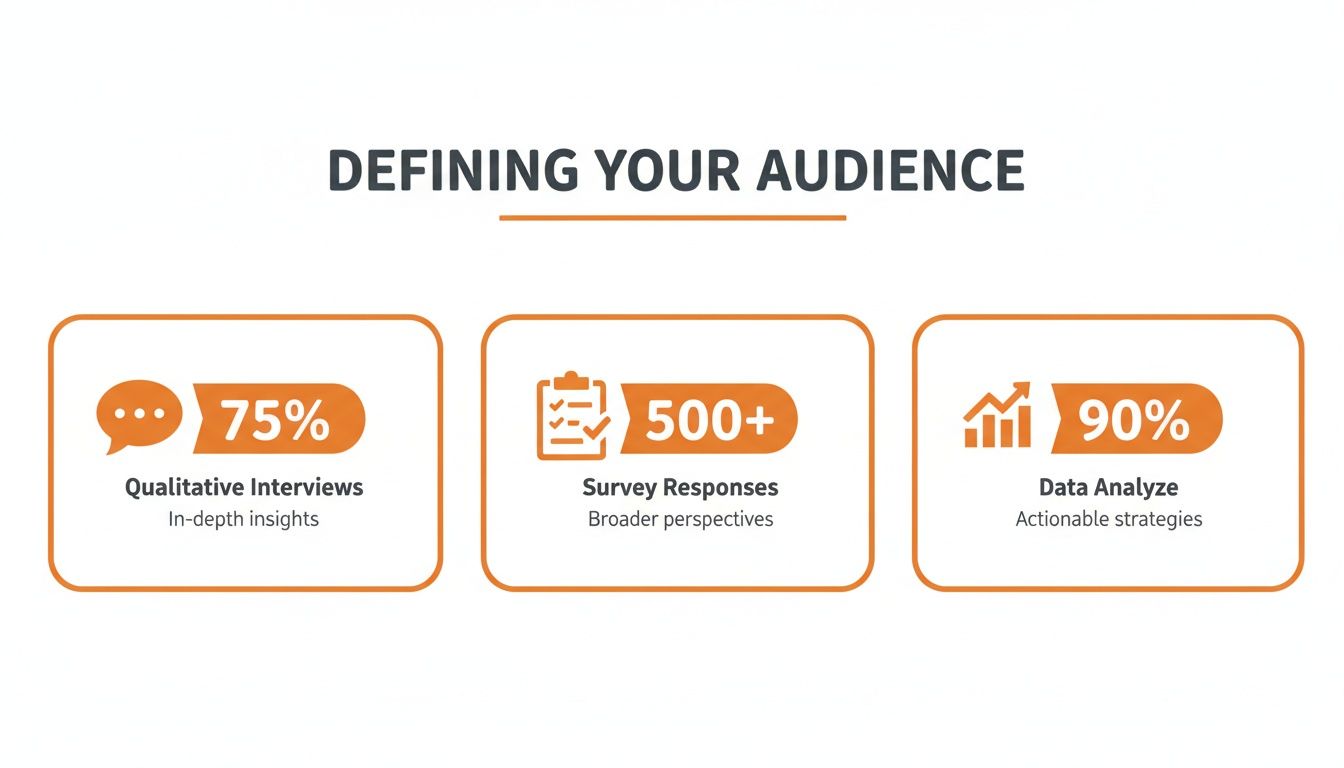
Think of it this way: your profile is the map. Now it's time to find the treasure.
Align Your ICP with Reddit's User Base
Your first filter is simple demographics. A quick dive into Reddit's user stats tells a very clear story. In 2025, its massive 1.1 billion monthly user base is dominated by millennials and Gen Z—we're talking over 70%. The average Redditor is just 23 years old.
This makes the platform an absolute goldmine if you’re targeting a younger, tech-fluent crowd.
For instance, in the U.S., a whopping 44% of 18-29-year-olds use Reddit. That number plummets to just 11% for the 50-64 age bracket. This kind of skew is precisely why B2B growth teams often find fertile ground in subreddits like r/SaaS or r/startups—they're packed with these young professionals. For a deeper look, you can explore the full research on Reddit users here.
Let’s make this real. Imagine your ICP is a 28-year-old marketing manager in the US, making over $75,000. You know from the data that Reddit is a go-to platform for their age and professional demographic. Just like that, you’ve narrowed your search from "the entire internet" down to a much more manageable (and relevant) corner of it.
From Demographics to Subreddits
With this demographic alignment as your starting point, you can begin to build a preliminary list of subreddits. The goal is to find where conversations about your ICP’s professional challenges, personal interests, and biggest pain points are already happening organically.
Let's stick with our 28-year-old marketing manager. The search would probably look something like this:
- The Obvious Hubs: Start where you know they'll be. Subreddits like
r/marketingandr/PPCare direct matches for their job title. It's a no-brainer. - Drill Down by Industry: If they work in B2B tech, then communities like
r/SaaSand evenr/salesbecome incredibly relevant places to listen in. - Follow Their Interests: What do they do when they're not thinking about marketing? If they're a productivity nerd,
r/productivitycould be a hidden gem. If they're always up on the latest trends, they might hang out inr/technology.
This approach turns your ICP from a static document into a dynamic compass, pointing you straight to the communities where your future customers are already talking. The next job, of course, is to just shut up and listen.
Dive Deep into Your Target Subreddits
Okay, so you've found a few subreddits that look promising. Great start. But now comes the real work: becoming a digital anthropologist. You need to immerse yourself in the culture of each community to truly understand the people you want to reach.
This isn't just about avoiding a marketing fail. It's about genuine connection. Reddit users have a finely tuned radar for inauthentic, salesy posts, and they will call you out in a heartbeat. The goal here is to learn the language, get the inside jokes, and understand the unwritten rules before you even think about posting.
Lurk With a Purpose
"Lurking"—just reading and observing—is perfectly normal on Reddit. But you can't just scroll mindlessly. You need a plan. Your mission is to figure out what makes these communities tick.
A great way to start is by analyzing the top-voted posts of all time, the last month, and the past week. Look for patterns.
- Top Posts: What do the most popular posts have in common? Are they hilarious memes, in-depth tutorials, personal success stories, or cathartic rants?
- Common Complaints: What problems and frustrations pop up over and over again? For example, in
r/freelance, you'll see constant posts about "scope creep" and "clients not paying on time." These are gold mines for understanding your audience's pain points. - Recurring Questions: What are the "newbie" questions that everyone asks? Answering these can quickly position you as a helpful expert.
- Inside Jokes & Slang: Pay attention to the unique acronyms, memes, and phrases they use. Using their language shows you're one of them.
Key Insight: Think of it as creating a 'community cheat sheet' for each subreddit. Note the posting rules, popular topics, moderator behavior, and the types of content that always do well. This becomes your playbook for authentic engagement.
Use Advanced Search to Find Gold
Don't underestimate Reddit's search bar. It's a surprisingly powerful tool if you know how to use it. With a few advanced search tricks, you can cut through the noise and find conversations that are incredibly relevant to your brand.
While more advanced methods like social media scraping can pull massive amounts of data, you can uncover a ton just with Reddit’s own tools.
Try searching for specific phrases like:
- Your competitor’s name: Find out what people really think about them—the good, the bad, and the ugly. Actionable tip: search
subreddit:SaaS "YourCompetitorName"to see every mention within that specific community. - "Any good alternatives to [competitor]?": This is a direct signal from users who are actively looking for a solution like yours.
- The problem you solve: Use the exact words your customers would use. Think "best way to track marketing attribution" or "project management tool for a small team."
By digging into these threads, you’re not just guessing what your audience cares about; you’re hearing it directly from them, in their own words. This is how you ensure that when you finally contribute, you’ll be seen as a valuable member of the community, not just another marketer.
If you need more help finding the right communities to research, check out this guide on how to find top subreddits for your niche.
Audience Research Methods Comparison
Choosing the right research method depends entirely on your goals. A quick survey might give you broad strokes, but deep lurking in a community provides context and nuance you can't get anywhere else. Here’s a quick breakdown of some common methods to help you decide what's best for your situation.
| Method | Best For | Pros | Cons |
|---|---|---|---|
| Community Lurking | Understanding authentic language, pain points, and cultural nuances. | Unfiltered, honest insights. Low cost. | Time-consuming. Qualitative, not quantitative. |
| Surveys & Polls | Gathering quantitative data on specific questions. | Easy to scale. Provides clear statistics. | Lacks context. Can have low response rates. |
| User Interviews | Deep-diving into individual motivations and user journeys. | Rich, detailed qualitative feedback. | Requires significant time and resources. Small sample size. |
| Competitor Analysis | Identifying gaps in the market and learning from others' successes/failures. | Actionable strategic insights. Quick to start. | Only shows what's already being done. Can be a trailing indicator. |
Ultimately, a mix of these methods will give you the most complete picture. Start by lurking to form your hypotheses, then use surveys or interviews to validate them.
Validate Your Audience Through Authentic Engagement
Alright, you've done your homework. Your research has given you a solid hypothesis about where your people hang out online. You've scouted some promising subreddits and you've got a feel for their culture. Now comes the fun part: moving from lurking in the shadows to actually participating. This is where you test your theory and see if you’ve truly found your audience.
This isn't about barging in with a megaphone and a sales pitch. Far from it. The goal here is to test the waters with low-risk, high-value interactions. You're looking for direct feedback that confirms you're in the right place before you sink a ton of time and resources into a full-blown content strategy.

Start by Adding Value, Not Noise
Want to get instantly downvoted into oblivion? Show up and immediately start talking about your brand. Your first and only goal should be to become a known, helpful member of the community. That means your initial comments and posts need to be all about adding to the conversation, not hijacking it.
Think about why people are on platforms like Reddit in the first place. Sure, 72% of users are there for a good laugh, but a massive 60% of new members join because someone they trust recommended a community. That tells you everything you need to know about the power of genuine word-of-mouth. By showing up to help, you plug right into that dynamic. For a deeper dive, Sprout Social has some great data on this.
Let’s look at a real-world example:
- The Cringey, Low-Signal Comment: "Great point! Our tool actually solves this exact problem. Check it out here: [link]." This isn't a comment; it's an ad, and everyone sees it for what it is.
- The Helpful, High-Signal Comment: "I ran into this same issue last year. What worked for me was re-framing the problem by focusing on [specific insight]. I also found that using a simple spreadsheet to track [key metric] daily helped clarify the root cause. Have you tried that approach?"
See the difference? The second one offers a real solution with no strings attached. It builds trust, shows you know your stuff, and lays the groundwork for every meaningful interaction that follows.
Turn Your Expertise Into Engagement
Genuine engagement happens when you spot a chance for your unique knowledge to actually help someone. It's about being on the lookout for those threads where people are asking the very questions you're equipped to answer.
Here’s how to put that into practice:
- Answer Specific Questions: Find someone asking for advice on a topic you could talk about for hours. Give them a detailed, thoughtful answer that solves their problem right then and there.
- Share a Relevant Story: If a discussion hits on a challenge you've personally overcome, tell that story. For example: a founder of a productivity app could share a post titled, "How I stopped procrastinating by using the '2-minute rule' - a breakdown of my system." This is valuable content that also subtly aligns with their product.
- Offer a Contrarian View (Respectfully): Don't be afraid to disagree with the popular opinion, as long as you can back it up. A well-reasoned counterpoint can ignite a fantastic discussion and position you as someone who thinks critically.
Every time you post a helpful reply, you're making a small deposit in your credibility bank. The feedback you get—the upvotes, the follow-up questions—is real-time data telling you you're in the right place, talking to the right people. For more ideas on how to do this effectively, take a look at our guide on community engagement best practices. This is how you turn a potential audience into a proven one.
Analyze Feedback to Continuously Refine Your Approach
Finding your target audience isn’t a one-and-done task you can just check off a list. Think of it as a living, breathing process of listening, engaging, and—most importantly—adapting your strategy. Every single interaction you have on a platform like Reddit is a breadcrumb, a clue telling you whether you're on the right track.
The real goal here is to build a feedback loop. You’re constantly sharpening your understanding of who these people are and what makes them tick. When you do this right, Reddit stops being just another marketing channel and becomes a powerful engine for real-time customer discovery.
Decode the Signals from Your Engagement
Every upvote, downvote, comment, and DM is a piece of the puzzle. At first, it all might feel like random noise, but once you learn what to look for, clear patterns will start to emerge. This is raw, unfiltered market research handed to you on a silver platter.
Sure, upvotes and glowing comments feel great. They’re a clear sign that your message and tone hit the mark with that community. But honestly, the downvotes and critical comments? That’s where the real learning happens. They show you exactly where your assumptions missed the mark.
- Upvotes are basically saying, "Yes, this is relevant and helpful."
- Downvotes can mean anything from, "This feels like a sales pitch," to "You clearly don't get our culture here."
- Detailed Comments tell you, "You've hit on a genuine pain point and sparked a real conversation."
- Direct Messages (DMs) are a huge signal: "I'm interested enough to talk one-on-one, maybe even about what you're selling."
This feedback cycle is what separates a theoretical strategy from one that's actually proven to work. It’s the secret sauce for figuring out how to find your target audience in the wild.
Key Takeaway: Don't get caught up in vanity metrics like upvotes. The real gold is in the comments, the DMs, and even the downvotes. The most direct—and sometimes most critical—feedback is often the most insightful.
Distinguish Constructive Criticism from Noise
Let's be real: not all feedback is useful. Some of it is just noise from internet trolls. But genuine, constructive feedback? That’s pure gold. The trick is learning to tell the two apart so you can adjust your course without getting derailed by negativity.
Constructive criticism is specific. It’ll point out a flaw in your argument, a community norm you accidentally broke, or a gap in your knowledge. Noise, on the other hand, is usually just vague, personal, and gives you nothing to work with.
For instance, imagine you’re in r/SaaS and someone comments, "Your analysis of churn is a bit dated; you're not considering the impact of X." That's incredibly useful. It's a direct signal to update your talking points. A comment that just says, "This is dumb," is noise. Ignore it and move on.
By filtering feedback this way, you can start refining everything:
- Product Messaging: Tweak how you describe your product’s benefits based on what actually connects with people.
- Content Strategy: Create more content around the topics that spark thoughtful discussions and positive engagement.
- Product Roadmap: Are people constantly complaining about the same thing or requesting a specific feature? That’s direct input for your development team.
Suddenly, every interaction becomes a chance to learn. By systematically tracking what’s working—which subreddits are receptive, which talking points get the best reactions—you turn every post and comment into another step toward perfecting your audience profile.
Even with a solid plan, jumping into Reddit can feel like you're crashing a party where you don't know anyone. The platform has its own vibe and its own set of rules, both written and unwritten. Getting a feel for that culture is your first real job.
To help you navigate it, let's walk through a few of the most common questions I hear from founders and marketers who are just getting started.
How Many Subreddits Should I Actually Focus On?
It’s tempting to spray and pray, posting everywhere you can think of. But trust me, that's a recipe for getting ignored. You'll make a much bigger impact by going deep, not wide.
My advice? Start with three to five subreddits that feel like a perfect fit. This tight focus lets you really get to know the community—you'll pick up on the inside jokes, learn who the key players are, and start building a real reputation. Trying to juggle ten or more communities just spreads you too thin, and you never become a familiar face anywhere.
Once you’re a known and trusted member in those core groups, then you can start branching out.
A Quick Tip from Experience: I like to find one big, broad subreddit (like
r/marketingwith 1.2 million members) and then a couple of smaller, more focused ones (liker/B2BMarketingwith 18k members). The smaller communities are often where the real magic happens. They're usually more engaged, less noisy, and it’s way easier to build genuine connections.
Is It Ever Okay to Post About My Own Product?
Yes, absolutely—but how you do it is everything. Redditors can smell a sales pitch a mile away and are fiercely protective of their communities from spammy self-promotion.
You have to earn the right to talk about your product. That means showing up first as a helpful member of the community, not as a salesperson.
Don't just drop a link and run. That's the fastest way to get downvoted or banned. Instead, think about adding value first.
- Jump into a thread and give a genuinely helpful, detailed answer to someone's question. If your product is a natural fit for their problem, you can mention it as part of the solution.
- Tell a story. Share a personal experience or a case study about a challenge you solved that the community can relate to.
- Be humble and ask for input. A post that says something like, "Hey everyone, my team and I built this tool to help with [problem X]. I'd be incredibly grateful for this community's honest feedback," can work wonders. It’s transparent and invites people to be part of the process.
What if I Get a Bunch of Downvotes or Negative Comments?
First, don't panic. It’s going to happen.
Think of a downvote not as a personal attack, but as feedback. It's the community's way of saying your content didn't quite land right. Maybe it felt too promotional, broke a subtle rule you didn't know about, or just wasn't the right fit for the conversation.
Instead of getting defensive or deleting the post in a huff, use it as a chance to learn. Seriously. Go back and re-read the subreddit's rules and browse the all-time top posts to get a better feel for what works. Some of the best lessons I've learned about how to find your target audience came from a post that completely flopped. It forces you to recalibrate and come back stronger next time.
Ready to stop guessing and start engaging the right communities on Reddit? The team at Reddit Agency specializes in mapping your ideal customers to the subreddits where they live online. We craft authentic, high-signal content that builds trust and drives measurable results. Turn Reddit conversations into customers today.
