How to Generate B2B Leads and Fill Your Sales Pipeline
Generating high-quality B2B leads isn't about throwing tactics at a wall and seeing what sticks. It’s about building a repeatable system that consistently attracts, engages, and converts the right customers. The most effective programs I've seen seamlessly blend inbound marketing—pulling prospects in with valuable content—with smart, targeted outbound outreach.
This combination is key. It ensures you’re not just making noise, but that every marketing dollar is spent reaching the people who can actually become your best customers. It's the difference between a random trickle of leads and a predictable sales pipeline.
Building Your B2B Lead Generation Foundation
Do your lead generation efforts feel a bit scattered? One month is great, the next is a ghost town? You're not alone. The B2B buyer has changed. They do their own homework now, often completing most of the buying journey before ever speaking to a salesperson.
Because of this, the old playbook of just hammering out cold emails or making endless dials just doesn't cut it anymore. Real success comes from a unified, multi-channel strategy built around the customer's problems and needs.
To get started on the right foot, it’s worth reviewing some foundational strategies on how to generate B2B leads that actually convert. The first—and most important—step isn't a tactic at all. It’s about getting crystal clear on who you're trying to reach.
Define Your Ideal Customer Profile
Before you write a single blog post or launch an ad campaign, you absolutely must have a laser-focused Ideal Customer Profile (ICP). An ICP isn't just a buyer persona; it's a detailed description of the perfect company for your product or service.
It goes way beyond simple demographics. A solid ICP gets into the nitty-gritty:
- Industry: Be specific. Instead of "Tech," try "FinTech" or "HealthTech."
- Company Size & Revenue: e.g., "50-500 employees," "Annual Recurring Revenue between $5M and $50M."
- Technology Stack: Which tools do they already use that integrate with yours or indicate a need for your solution? (e.g., "Uses Salesforce and HubSpot").
- Pain Points: What specific business challenges keep their leadership up at night? (e.g., "Struggles with high customer churn" or "Lacks visibility into their sales pipeline").
Actionable Example: Imagine you sell project management software. A vague target like "tech companies" isn't good enough. A sharp ICP would be: "US-based SaaS companies with 50-200 employees, using Slack and Jira, who frequently mention 'missed deadlines' or 'scope creep' in online discussions." Now that's a target you can build a campaign around.
This process is really the first domino to fall. You have to define who you're after before you can figure out how to attract and engage them.
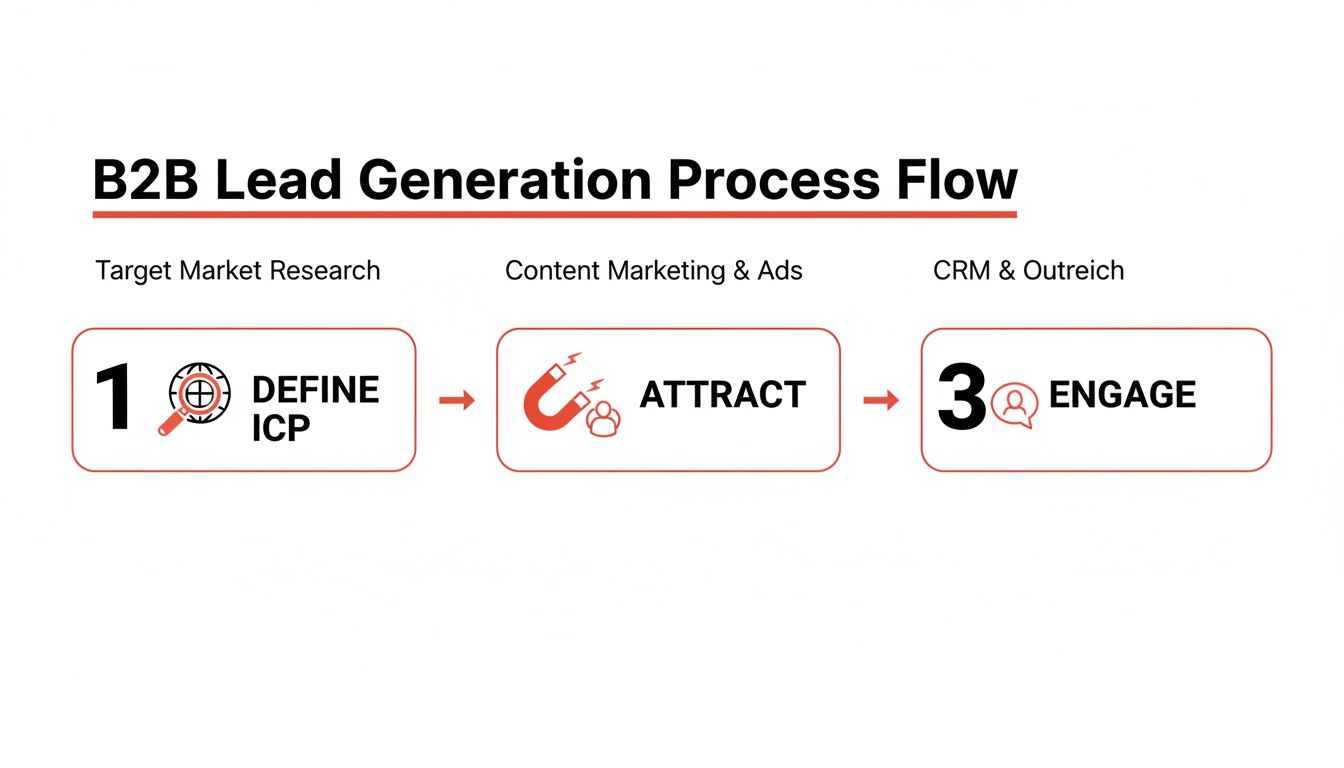
Without a clearly defined ICP, all your marketing efforts will be diluted and lack the punch needed to get results.
Marrying Inbound and Outbound Strategies
Once you know exactly who you're targeting, it's time to build a strategy that combines the magnetic pull of inbound with the targeted push of outbound. Think of them as two sides of the same coin—they work best together.
Inbound marketing earns a prospect's attention, while outbound marketing actively seeks it. A powerful B2B lead generation machine needs both engines running in sync to build awareness and drive direct action.
Actionable Example: An inbound blog post titled "5 Ways to Reduce SaaS Customer Churn" attracts a VP of Customer Success (your ICP). A week later, your outbound strategy kicks in: a sales rep sends a personalized LinkedIn message to that VP, referencing a point from the article and asking about their specific challenges with churn. This creates a warm, context-aware conversation.
This approach is fundamental to creating buzz and interest, and you can explore more about these demand generation strategies in our comprehensive guide. When you combine these two, you create a powerful, reliable lead-generation machine.
To wrap up this foundational section, let's summarize these core components in a simple table.
Core B2B Lead Generation Pillars
| Pillar | Core Objective | Example Tactic |
|---|---|---|
| Ideal Customer Profile (ICP) | To define the perfect company you're targeting with laser focus. | Analyze your top 10 customers for common firmographics and pain points. Create a shared document detailing these attributes for the entire marketing and sales team. |
| Inbound Marketing | To attract prospects by providing valuable, problem-solving content. | Write a comprehensive blog post titled "The Ultimate Guide to SOC 2 Compliance for SaaS Startups," targeting a key industry challenge for your ICP. |
| Outbound Marketing | To proactively engage specific, high-value accounts directly. | Send a personalized LinkedIn connection request to a CTO at a target company, referencing a recent funding announcement they made. |
Nailing these three pillars gives you a solid base to build all of your more advanced lead generation tactics upon.
Turning LinkedIn into a High-Quality Lead Engine

Most B2B professionals are on LinkedIn, but very few use it to its full potential. Just having a profile isn't a strategy. To turn the platform into a genuine lead engine, you have to stop treating your personal and company pages like digital resumes and start operating them like strategic assets.
The shift is simple: move from being a passive observer to an active, helpful expert in your field. This means consistently sharing content that solves the real, nagging problems your ideal customers face every day. When you zero in on their pain points, you naturally position yourself as the authority they want to talk to.
Don't just take my word for it. The data shows that 80% of B2B leads come from LinkedIn, according to QuickSprout. There's a reason 89% of B2B marketers lean on it for lead gen—it’s a staggering 277% more effective than other major social platforms. It’s a goldmine if you know how to work it.
Optimize Your Profile for Discovery and Conversion
Think of your personal LinkedIn profile as the first handshake. It’s often the first impression a potential client has of you, so it needs to do more than just list your work history. It has to work for you as a high-converting landing page.
It all starts with your headline. "CEO at Reddit Agency" is fine, but it doesn't tell anyone what you do for them. A much stronger approach is a value proposition.
Actionable Example: Change your headline from "Founder at SaaSCo" to "Helping B2B SaaS Founders Reduce Churn & Increase LTV with [Your Solution Category]." That one sentence instantly qualifies you and speaks directly to your ideal client.
Next, give your "About" section a complete overhaul. Ditch the long, formal paragraphs and create a compelling story.
- Hook: Start with a question like, "Struggling to generate predictable leads for your SaaS business?"
- Explain: Briefly describe how you solve that problem with your methodology or service. Use bullet points to highlight key outcomes (e.g., "✓ Double your qualified demos in 90 days").
- Call-to-Action (CTA): End with a clear next step. "DM me 'LEADS' to chat about your strategy" or "Book a free strategy call here: [link]."
With just a few tweaks, your profile transforms from a static page into an active lead-generation tool.
Master Content That Solves Problems
Content is the fuel that makes your LinkedIn engine run. Forget the fluffy corporate announcements and start creating posts that deliver genuine value. This is how you build a powerful inbound lead flow on the platform.
A winning content mix usually includes a few key formats:
- Text-only Posts: Share a sharp insight or a contrarian take on an industry trend. Example: "Everyone says you need more content. I disagree. You need better distribution. Here are 3 ways to get more eyes on a single blog post..." This sparks conversation.
- Case Studies: Don't just brag about results; tell the story. Example: "Our client went from 10 to 50 demos/month. Here’s the 3-step playbook we used: 1. Refined their ICP. 2. Launched targeted LinkedIn Ads. 3. Built a 5-email nurture sequence. The result? 400% increase in pipeline."
- Quick Tips: Give away actionable advice your audience can use right now. Example: "Tired of generic LinkedIn outreach? Try this: Find a post your prospect commented on and reference it in your connection request. 'Saw your comment on [Topic]...'. Personalization wins."
The key to LinkedIn content is generosity. When you consistently give away your best insights without asking for anything in return, you build incredible trust. High-quality prospects start seeing you as the expert worth talking to.
Aim to post three to five times a week to build momentum and stay top-of-mind with your network.
Execute Personalized Outreach That Gets Replies
While great content brings leads to you, targeted outbound messaging on LinkedIn Sales Navigator lets you go directly to high-value accounts. The key to making this work is genuine personalization, not spammy automation.
Please, stop sending generic, copy-pasted connection requests. They rarely work. A simple, human approach is far more effective. Before you ever hit "connect," do a little homework to find a "hook"—a recent article they shared, a company milestone, or even a mutual connection.
Here’s a practical, non-salesy template that actually gets replies:
"Hi [Name], I saw your recent post about the challenges of scaling content marketing for B2B. Your point about maintaining quality at volume really resonated. My team specializes in tapping into niche communities like Reddit to solve this exact problem for SaaS companies. Open to connecting and sharing some ideas?"
This message works because it’s relevant, short, and focused on them, not you. You're starting a real conversation, not making a cold pitch. This simple shift will dramatically improve your connection and reply rates.
To make sure you never miss an opportunity, consider using LinkedIn mention tracker tools to monitor conversations. By keeping an eye on these interactions, you can jump in at the perfect moment and ensure no potential lead ever slips through the cracks.
Driving Inbound Leads with Content and SEO

Imagine generating qualified leads around the clock, even while you sleep. That’s the real magic of a smart inbound strategy built on great content and solid Search Engine Optimization (SEO). While direct outreach gets you immediate conversations, building an inbound engine creates a long-term asset that pulls your ideal customers toward you, 24/7.
It’s all about becoming a magnet for your Ideal Customer Profile (ICP). Instead of you chasing them down, they find you because you’ve already provided the exact answers they’re searching for. And people are definitely searching—research shows 93% of B2B buying processes kick off with a simple online search.
Your goal here is to build a library of genuinely useful content that not only shows up on Google but also cements your brand as the go-to expert in your field.
Create Content That Solves Real Problems
To get B2B leads from your content, you have to think bigger than generic blog posts. Your prospects aren't looking for quick, surface-level articles. They're hunting for deep, authoritative resources that help them tackle complex business challenges. The content that works best is almost always the most substantial.
We've seen the best results when we focus on creating these high-impact content types:
- In-Depth Guides: Think of these as cornerstone resources that cover a topic from A to Z. Actionable Example: A cybersecurity firm might create "The Ultimate Guide to SOC 2 Compliance for SaaS Startups," complete with downloadable checklists and policy templates. This becomes a go-to piece that attracts traffic and links for years.
- Original Research Reports: Polling your industry and publishing the findings is an incredible way to generate unique insights. Actionable Example: A marketing agency could survey 500 B2B marketers, publish a report on "The State of B2B Reddit Marketing in 2024," and create an infographic with key stats to promote it. This kind of content gets shared and positions you as a true thought leader.
- Compelling Case Studies: Don't just post a testimonial. Craft detailed stories that walk through the Problem-Agitate-Solution framework, using real data to show the tangible ROI you delivered for a client.
Content like this builds trust and credibility long before a prospect ever hops on a call with your sales team.
The core principle of inbound marketing is simple: be the best and most helpful answer to your ideal customer's most pressing questions. When you achieve this, high-quality leads will naturally follow.
Consistently publishing this kind of material creates a powerful inbound pull that perfectly complements your direct outreach. It’s a core tenet of organic marketing, a concept you can explore further by reading about what is organic marketing and how it drives long-term growth.
Master B2B Keyword Research
Of course, creating world-class content is only half the battle. People have to actually find it. This is where B2B keyword research becomes your best friend. The goal is to pinpoint the exact phrases and questions your ICP is typing into Google when they're stuck.
I always recommend starting with what I call "pain-point keywords." These are terms that directly mirror a problem your service solves. Forget a broad term like "project management software." A much better, high-intent keyword would be something like "how to improve cross-departmental project visibility."
Actionable Insight: Use tools like AnswerThePublic or browse forums like Reddit and Quora to find the literal questions your audience is asking. If you see multiple people asking, "How can I integrate Salesforce with our billing system?" that's a perfect keyword to build a guide around.
Once you have a list of ideas, you can use SEO tools to check a few key metrics:
- Search Volume: How many people are searching for this each month?
- Keyword Difficulty: How hard will it be to rank on the first page?
- Search Intent: Is the user looking for information ("what is..."), a comparison ("best software for..."), or a purchase ("...pricing")?
For B2B, going after long-tail keywords (those longer, more specific phrases) is almost always the winning move. A term like "best CRM for small manufacturing companies" is going to attract far more qualified traffic than just "CRM," even with lower search volume. That precision is what makes an inbound strategy work.
Promote Your Content and Build Authority
Heads up: hitting "publish" isn't the finish line—it's the starting gun. For your content to get seen and build authority, you need a promotion plan. A big part of that is earning backlinks (links from other websites to yours), which are a massive signal to Google that your content is credible.
Here’s an actionable game plan to get started:
- Share on Social Channels: Post your new guide on LinkedIn. Don't just drop a link—pull out a key statistic or quote and ask your network for their take on it to spark a conversation.
- Email Newsletter: Send your new report to your email list with a personal note explaining why it's valuable and encouraging them to forward it to a colleague who might benefit.
- Community Engagement: Find a relevant subreddit (like r/SaaS) where people are discussing the problem your content solves. Write a helpful comment and add a link to your guide as a resource, but only if it genuinely adds value.
By building this sustainable inbound engine, you create a steady flow of warm, qualified leads right into your pipeline. It’s the foundation for predictable, long-term growth.
Accelerating Growth with Paid Advertising

While organic marketing builds a powerful, long-term asset, sometimes you just can't wait. That's where paid advertising comes in—it's your accelerator. It’s the fastest way to get your message directly in front of key decision-makers and inject a burst of qualified leads right into your sales funnel.
Think of it this way: you’re not just buying clicks; you’re purchasing conversations. With platforms like Google Ads and LinkedIn Ads, you can bypass the long ramp-up time for organic traction and start talking to potential B2B customers today. The secret sauce is a sharp focus on targeting, genuinely compelling messaging, and a conversion experience that’s completely frictionless.
Design Laser-Targeted Ad Campaigns
The real magic of B2B paid advertising is its incredible targeting precision. You can go so far beyond broad demographics and reach individuals based on their professional DNA—what they do, where they work, and what their company is struggling with right now.
Actionable Example (LinkedIn): Imagine you're a cybersecurity firm. You could build a campaign that only targets "IT Directors" and "CISOs" at "Healthcare organizations" with "1,000+" employees in the Northeast U.S. This level of granularity means your ad spend isn’t wasted on anyone who can't buy from you.
On LinkedIn, for example, the targeting options are a B2B marketer's dream. You can build audiences using filters like:
- Job Title: "Chief Marketing Officer," "VP of Sales."
- Company Size: "51-200 employees."
- Industry: "Computer Software," "Financial Services."
- Company Name: Run account-based marketing (ABM) campaigns by uploading a specific list of your top 50 target accounts.
This precision ensures every ad dollar is spent reaching a potential buyer.
Craft Compelling Ad Copy and Landing Pages
Once you've zeroed in on your audience, your ad copy needs to speak directly to their biggest headache. Let's be honest, B2B buyers aren't scrolling through their feeds for entertainment; they're looking for solutions. Your ad has to grab their attention by immediately hitting on a problem they recognize.
An effective B2B ad doesn't sell a product; it sells a solution to a costly problem. Your headline should promise a clear outcome, and your copy should provide a logical path to achieving it.
But the ad is just the handshake. The real business happens on your landing page. This page needs to have one job, and one job only: to convert that visitor into a lead.
- Message Match: If your ad says "Download the Ultimate SOC 2 Compliance Checklist," the landing page headline must say the exact same thing.
- Minimize Distractions: Remove the main navigation menu, footer links, and anything else that could tempt them to click away from the form.
- Clear Call-to-Action (CTA): Use a prominent button with actionable, value-driven text. "Get My Free Checklist" is much better than "Submit."
One of the most common—and costly—mistakes I see is sending expensive paid traffic to a generic homepage. Don't do it. Always use a dedicated landing page built specifically for that campaign to get the most out of every click.
B2B Paid Advertising Channel Comparison
Choosing the right platform is critical. While Google and LinkedIn are the heavyweights, other channels can be incredibly effective depending on your goals and audience. Here’s a quick breakdown to help you decide where to place your bets.
| Channel | Best For | Key Strength | Actionable Tip |
|---|---|---|---|
| LinkedIn Ads | Reaching specific job titles, industries, and company sizes. | Unmatched professional targeting data and high-quality lead potential. | Start with a campaign targeting a small, hyper-specific audience (e.g., VPs of Marketing at SaaS companies with 50-200 employees). |
| Google Ads | Capturing high-intent leads who are actively searching for a solution. | Targeting users based on specific keywords they are searching for right now. | Bid on "long-tail" keywords like "best accounting software for construction companies" to attract highly qualified traffic. |
| Reddit Ads | Niche B2B communities and engaging with tech-savvy audiences. | Access to highly specific, interest-based communities (subreddits). | Run ads in subreddits like r/sysadmin or r/sales, but ensure your creative feels native and not overly corporate. |
| Facebook Ads | Broader B2B audiences and cost-effective brand awareness. | Massive user base and powerful lookalike audience capabilities. | Upload your customer list to create a "lookalike audience" to find new prospects with similar profiles. |
Each channel has its place. We often start with LinkedIn for hyper-targeted campaigns and use Google Ads to catch active searchers. The key is to test and find the right mix for your specific business.
Manage Your Budget and Maximize ROI
Running successful paid campaigns requires a disciplined approach to your budget and a relentless focus on optimization. I always recommend starting with a modest daily budget to gather data. Once you see what's working, you can confidently scale up.
An A/B testing framework is non-negotiable. You should constantly be testing variables, even small ones:
- Headlines: Test a benefit-driven headline ("Generate More Leads") vs. a pain-point headline ("Stop Wasting Your Ad Spend").
- Ad Creative: Test a static image with a bold statistic against a short video testimonial.
- CTA Button Text: What's the click-through difference between "Learn More" and "Get Your Free Demo"?
Finally, make sure you have retargeting set up from day one. It lets you re-engage visitors who checked you out but didn't convert. By showing a different ad—maybe a compelling case study or a special offer—to this warm audience, you can often bring them back and recover those potential leads at a much lower cost. This simple step ensures every dollar you spend has the maximum possible impact on your pipeline.
Don't Sleep on Email—It's Still a B2B Powerhouse
Even with all the social platforms and fancy new channels, a well-written email is still one of the most direct and powerful ways to reach a B2B prospect. It’s perfect for nurturing leads who already know you and just as effective for starting cold conversations that actually lead somewhere.
The trick is to stop thinking about "blasting" lists and start thinking about building real relationships, just at a larger scale. When you get this right, your email strategy goes from a tedious marketing chore to a reliable engine that drives revenue. It all begins with building a list of people who want to hear from you.
Build a High-Quality List With "Can't-Resist" Lead Magnets
Before you can even think about sending emails, you need a list. And not just any list—a high-quality one. The absolute best way to do that is by offering something genuinely valuable in return for an email address. This is where lead magnets come in.
A great lead magnet solves a very specific, nagging problem for your ideal customer. Ditch the generic "sign up for our newsletter" CTA and create resources that give them an immediate win.
Actionable Examples:
- Checklist: A marketing agency could offer a "10-Point LinkedIn Profile Optimization Checklist" for B2B founders.
- Template: A software company might provide a "Plug-and-Play Project Kickoff Google Doc Template" that saves managers hours of work.
- Report: A financial services firm could publish an "Annual B2B SaaS Funding Report" packed with unique industry data and analysis.
You want to create something so useful that prospects are happy to give you their email for it. This simple exchange is how you fill your list with high-intent people from day one.
Writing Cold Emails That People Actually Reply To
Cold email gets a bad rap, and for good reason—most of it is terrible. A successful cold email is never about you, your company, or your product. It's about the person you're emailing and a problem you think they have. The only goal of that first message is to start a conversation, not to book a demo.
To earn an open and a reply, your email needs to be short, personal, and genuinely helpful. Here's an actionable framework:
- Personalized Hook: "Hi [Name], I saw your post on LinkedIn about the challenges of remote team collaboration."
- Problem Hypothesis: "Many SaaS leaders I speak with are finding it tough to maintain project visibility with distributed teams."
- Gentle Connection: "We built a lightweight tool that helps teams at companies like [Client] get a single source of truth for their projects."
- No-Pressure Question: "Curious if improving project visibility is on your radar for Q3?"
A great cold email feels less like a sales pitch and more like a helpful observation from a peer. It shows you understand their world and are reaching out with a relevant idea, not just another copy-pasted template.
This respectful, recipient-first approach is your ticket to breaking through the noise and getting positive responses.
Automate Your Follow-Ups (Without Sounding Like a Robot)
Here’s a hard truth: the real results are in the follow-up. In fact, research consistently shows that 80% of sales require at least five follow-ups, but most people give up after one or two emails. This is where automation is a game-changer, letting you stay persistent without living in your inbox.
But "automated" can't mean "robotic." Your follow-up sequence should feel just as personal as the first email. The key is to add value with every message, not just to send another "just checking in" email.
Actionable Follow-up Sequence:
- Email 2 (2 days later): "Hi [Name], following up on my last note. Thought you might find this case study on how [Similar Company] solved their project visibility issues interesting. [Link]"
- Email 3 (4 days later): "Hi [Name], one quick tip we've seen work well is standardizing project briefs. Here's a simple template our clients use. Hope it helps!"
- Email 4 (5 days later): "Hi [Name], looks like now might not be the best time. I'll reach back out next quarter unless you'd prefer I didn't. All the best."
This multi-touch strategy positions you as a helpful expert, not a persistent pest. For a deeper look at turning your email program into a lead generation machine, check out our guide on the connection between email marketing and lead generation. By blending smart automation with a genuine desire to help, you can build relationships at scale and stay top-of-mind for when your prospect is finally ready to talk.
Common Questions About B2B Lead Generation
Diving into B2B lead generation always brings up a ton of questions. As you start putting strategies into practice, you'll inevitably run into challenges and new opportunities that need straight answers.
We hear a lot of the same questions from founders and marketing leaders. This section breaks down the most common ones to give you a quick reference for making smarter decisions and building a lead gen engine that actually works.
What Is the Most Effective Channel for B2B Lead Generation?
Everyone wants to know the "best" channel, but the honest answer is it always circles back to your industry and your specific Ideal Customer Profile (ICP). That said, the data consistently shows one platform towering above the rest for most B2B companies: LinkedIn.
It's an absolute powerhouse. A staggering 80% of all B2B social media leads come from LinkedIn. The reason it works so well is simple: its entire context is professional, and its targeting is incredibly granular. You can get your message directly in front of the decision-makers you need to reach.
But here’s the thing—a truly effective strategy is never about just one channel. The companies that win are the ones that build a multi-channel system where everything works together.
- LinkedIn is your go-to for surgical outreach and establishing your authority.
- Content and SEO build a sustainable inbound machine that works for you 24/7.
- Paid Ads on platforms like Google or LinkedIn give you a burst of speed for high-priority campaigns.
When you combine these, you create a robust system that captures leads from all angles, giving you a much more consistent and predictable pipeline.
How Long Does It Take to See Results?
This is a big one. The time it takes to see a real return from your lead generation efforts depends entirely on the channel you’re using. Setting the right expectations from the start is crucial.
Paid advertising, whether it's Google Ads or a well-oiled LinkedIn campaign, can start bringing in leads within days or weeks. If you need to inject some immediate momentum into your sales pipeline, this is often the fastest way to do it.
On the other hand, inbound strategies like content marketing and SEO are a marathon, not a sprint. Think of them as long-term assets that build compounding value over time.
You're typically looking at 6 to 12 months of consistent work—publishing quality content, building backlinks—before you see a significant lift in organic traffic and a steady stream of inbound leads. The key is to have both short-term and long-term plays running at the same time.
How Do I Measure the Success of My Efforts?
Measuring success in B2B is about so much more than just counting leads. To really understand if what you're doing is working, you need to track the metrics that connect directly to revenue.
Focus your attention on these Key Performance Indicators (KPIs):
- Cost Per Lead (CPL): Total campaign spend divided by the number of leads generated. This tells you efficiency.
- Lead-to-Customer Conversion Rate: What percentage of qualified leads become paying customers? This tells you lead quality.
- Customer Lifetime Value (CLV): How much revenue does an average customer generate over their entire relationship with you? This tells you the long-term value of your efforts.
Alongside these core business metrics, you should absolutely keep an eye on channel-specific data—like click-through rates (CTR) on your ads, organic keyword rankings, and open rates on your emails. But at the end of the day, the only true measure of success is how many of your qualified leads turn into paying customers.
What Are Common B2B Lead Generation Mistakes to Avoid?
I see so many companies struggle with lead generation, and it's rarely because their product is bad. More often than not, they're falling into a few common traps.
The single biggest mistake is not having a crystal-clear Ideal Customer Profile (ICP). If you don't know exactly who you're talking to, every marketing dollar you spend is a gamble. Your messaging becomes generic, and your outreach falls flat.
Another huge error is focusing only on the sale instead of delivering real value. B2B buyers today are smart. They want to partner with experts who can solve their problems, not just listen to a sales pitch. Your first job is to be helpful.
A few other common mistakes to watch out for:
- Neglecting lead nurturing: Most people aren't ready to buy the second they meet you. You need a process to build that relationship over time.
- Relying on a single channel: Putting all your eggs in one basket makes your entire pipeline fragile.
- Ignoring the data: You can't improve what you don't measure. You have to be constantly reviewing performance to see what's working and what's not.
Just by steering clear of these pitfalls, you'll be miles ahead of most of your competition and well on your way to building a lead generation engine you can count on.
At Reddit Agency, we specialize in turning one of the world's largest online communities into a predictable source of high-quality B2B leads. We help you connect with your ideal customers through authentic, value-driven engagement.
