How to grow podcast audience: Proven strategies that work
Want to grow your podcast? The real work starts long before you ever hit the record button. It all begins with defining your ideal listener with pinpoint accuracy. When you build your entire show around their specific needs, problems, and habits, every episode lands with impact and pulls in the right kind of people from day one.
Building Your Foundation for Sustainable Growth

So many podcasts fail to get traction because they try to be for "everyone." That's a recipe for attracting no one. If you want to build a show with a loyal, dedicated following, you have to pour a rock-solid foundation first. And that foundation has nothing to do with expensive gear—it’s all about deeply understanding who you're talking to.
This means getting way more specific than basic demographics. The goal is to create a detailed Ideal Listener Persona (ILP), which is essentially a fictional character who represents the one person you're trying to reach. Give this person a name, a job, and real-life struggles. Trust me, it makes every content decision after that incredibly clear.
Defining Your Ideal Listener Persona
A powerful ILP is born from empathy and real research, not just wishful thinking. You want to understand your listener’s world so well that your podcast becomes the one thing they can't afford to miss. It’s not about their age or where they live; it’s about knowing what keeps them up at night.
To flesh out your ILP, dig into these key areas:
- Frustrations and Pain Points: What specific, nagging problems are they trying to solve? Actionable Example: Instead of "wants more money," a better pain point is "struggles to find high-paying clients and is tired of competing on price on platforms like Upwork."
- Aspirations and Goals: What are they really trying to achieve? What does a "win" look like for them? Actionable Example: A goal isn't just "be successful," it's "build a freelance business that generates $10k/month so I can quit my 9-to-5."
- Digital Habits: Where do they actually spend their time online? Are they scrolling through Reddit, networking on LinkedIn, or active in niche Facebook groups? What other podcasts or blogs are already in their rotation?
- Language and Terminology: How do they talk about their problems? Using their exact phrasing in your titles and show notes makes your content feel like it was made just for them. Actionable Example: If they say "I feel stuck in a content hamster wheel," use that exact phrase in an episode title.
Let's say you're creating a podcast for freelance graphic designers. Your ILP could be "Creative Carla." She's 28, struggling to find high-value clients, feels the sting of isolation working from home, and dreams of building a truly sustainable business. Her pain point isn't just "finding work"—it's "how to stop competing on price and finally land premium clients." That level of specificity is where you win.
Key Takeaway: Stop talking to a crowd and start speaking to one person. When you obsess over solving the specific problems of your Ideal Listener Persona, you create content that feels personal, urgent, and completely unmissable.
Conducting Targeted Research
Once you have a rough draft of your ILP, you need to get out there and see if it holds up in the real world. This step is crucial for making sure your persona is based on reality, not just your own assumptions. Forget generic surveys; you're hunting for qualitative gold.
- Community Listening: Become a fly on the wall in the online communities where your ILP hangs out. If you're targeting early-stage SaaS founders, immerse yourself in subreddits like r/SaaS and r/startups. Actionable Insight: Look for threads with high engagement (many comments). The original post is a proven pain point, and the top-voted comments reveal the solutions your audience already trusts.
- "Review Mining": This is a killer tactic. Go read the reviews for books, courses, and competitor podcasts in your niche. What do people rave about? More importantly, what do they complain is missing? Actionable Example: Search for a top-rated book on "freelancing" on Amazon. Filter for 3-star reviews. You'll find comments like, "Great on theory, but I wish it had more practical templates for client proposals." That's your next episode topic: "Actionable Client Proposal Templates That Win Business."
- Informal Interviews: Find a handful of people who fit your ILP and ask for a quick 15-minute chat. Keep it casual and ask open-ended questions like, "What's the single biggest challenge you're wrestling with right now when it comes to [your topic]?" The insights from these direct conversations are priceless.
This deep research will inform everything from your episode topics to your promotional posts. When you know your ILP is desperately searching for "how to get my first 100 users with no budget," you can create an episode with that exact title. This alignment makes your podcast the obvious choice in a sea of vague "marketing tips."
For an even deeper dive into growing your show, check out this excellent guide on how to get more podcast listeners. Taking these foundational steps is the first move toward building a truly dedicated audience, and you can learn more about how to build online community in our detailed guide.
Optimizing Your Podcast for Maximum Discoverability
Let's be real: you can create the most incredible, life-changing content, but if your ideal listeners can’t find it, it's just collecting digital dust. This is where Podcast SEO comes in. It's your secret weapon for getting discovered on Apple Podcasts, Spotify, and even in Google search results, turning your show into a magnet for new listeners.
The whole point is to show up exactly where potential fans are already looking. It all starts with thinking like your audience and speaking their language right from the get-go.
Crafting Magnetic Titles and Descriptions
Think of your podcast title and show description as your digital storefront. They need to be crystal clear, compelling, and packed with the same keywords your Ideal Listener Persona is typing into search bars. This isn't the place for vague, clever names that don't immediately signal what you're about.
- Show Title: Your main title should be a promise. If your show is about bootstrapping a business, a title like "The Bootstrapper's Playbook" is a hundred times more effective than something abstract like "The Founder's Journey." Actionable Example: A podcast for new parents struggling with sleep could be called "Sleepy Baby, Happy Parents" instead of "The Parenthood Journey." The benefit is right there in the title.
- Show Description: This is your hook. The first few sentences are absolutely critical, since they’re often all someone sees in a podcast directory. You need to clearly state who the show is for, what problems you solve, and what they'll get out of listening—all while weaving in those important keywords naturally.
Key Insight: Treat your episode titles like headlines. A generic title like "Episode 23 - Let's Talk Money" is going to be ignored. But a specific, searchable title like "How to Build Your First Emergency Fund on a Tight Budget" gives someone a powerful reason to click play.
Conducting Keyword Research for Podcasters
Keyword research isn't just for bloggers. Figuring out what your audience is searching for allows you to strategically place those exact terms in your episode titles, show notes, and descriptions. This has a direct impact on how your podcast grows through search.
Instead of just guessing, try these practical methods:
- Listen to Your Listeners: Go back to the communities where your ideal listener hangs out (think Reddit subs or Facebook groups). What phrases are they using? What specific questions are they asking? Those are your keywords, served on a silver platter.
- Use the Search Bar: Start typing phrases related to your niche into the search bars on Spotify, Apple Podcasts, and Google. The autocomplete suggestions are a goldmine—they show you exactly what real people are looking for. Actionable Example: Type "how to start investing" into Spotify's search. You might see autocomplete suggestions like "how to start investing for beginners" or "how to start investing with little money." These are perfect episode titles.
- Spy on the Competition: Check out the top-ranking podcasts in your category. What keywords are they consistently using in their episode titles? That's a clear roadmap of what's already working.
Writing Show Notes That Convert and Rank
Show notes are probably the single most underutilized asset for podcast growth. They do two crucial things at once: they give immense value to your current listeners, and they’re an absolute powerhouse for SEO. Rich, detailed show notes get indexed by search engines, turning every single episode into a long-term discovery tool.
For podcasters, learning efficient methods on how to transcribe audio to text is a game-changer. It's the key to unlocking the SEO potential of your content and making your show more accessible.
To make your show notes work harder for you, make sure they include:
- A Compelling Summary: Kick things off with a short, punchy paragraph that sums up the episode's biggest takeaways. Hook the reader right away and include your primary keyword for that episode.
- Timestamped Highlights: Break the episode down with clickable timestamps. This not only improves the listener experience but also gives you more opportunities to naturally include keywords for specific sub-topics. For instance:
(12:45) - The exact email template for landing high-value clients. - Key Resources and Links: Don't forget to list any books, tools, or articles you mentioned. This turns your show notes into a valuable resource hub that people will bookmark, come back to, and share with others.
When you turn your audio into well-structured text, you make it discoverable. For a deeper dive into boosting visibility, check out our guide on https://redditagency.com/blog/how-to-increase-organic-traffic.
Before you hit publish on any new episode, running through a quick SEO checklist can make a huge difference in its long-term reach.
Podcast SEO Checklist for Every Episode
Here's a simple checklist to follow for every single episode you produce. It ensures you're consistently optimizing for search and giving each piece of content the best possible chance to be found.
| SEO Element | Action Item | Example |
|---|---|---|
| Episode Title | Include a primary keyword or phrase that listeners would search for. | Instead of "Episode 55," use "How to Pitch Your First SaaS Client." |
| Episode Description | Write a unique, keyword-rich summary of the episode's content. | "In this episode, we break down the 3-step framework for cold outreach..." |
| Show Notes | Add detailed notes with timestamps and relevant secondary keywords. | (08:15) - Crafting a follow-up sequence that gets replies. |
| Transcription | Publish a full episode transcript on your website/show notes page. | Link to the full text version for accessibility and Google indexing. |
| Internal Links | Link to relevant past episodes or blog posts in your show notes. | "We talked more about this in our episode on building a sales pipeline." |
Following these steps for each episode might seem like a small thing, but over time, it compounds to create a powerful, searchable archive that constantly attracts new listeners to your show.
Designing Unskippable Cover Art
In a crowded podcast app, your cover art is your first impression—and sometimes the only one you'll get. It needs to grab someone's attention and instantly tell them what your show is all about. Think of it like a book cover on a packed shelf; it has to stand out.
A strong cover art design is:
- Readable at a small size, since it will mostly be seen as a tiny thumbnail on a phone. Actionable Tip: Open your cover art on your phone and hold it at arm's length. Can you still easily read the title? If not, the font is too small or too complex.
- Visually on-brand and in line with what your target audience expects to see. A true-crime podcast should have a different feel than a meditation podcast.
- Simple and uncluttered, with a clear, bold font for the podcast title. Don't try to cram in a tagline, your host name, and complex imagery.
Your cover art, when combined with a keyword-optimized title and a compelling description, creates a powerful discovery package that pulls the right listeners in and convinces them to hit play.
Mastering Distribution and Platform-Specific Tactics
Hitting ‘publish’ is the starting gun, not the finish line. A great podcast without a smart distribution plan is like a billboard in the desert. You have to meet listeners where they already are, which means ditching the "upload and pray" approach and getting strategic with how you show up on different platforms.
Think of Apple Podcasts, Spotify, and YouTube as their own unique ecosystems. Each has its own rules for discovery, its own algorithm, and its own audience behaviors. A one-size-fits-all strategy will just get you lost in the noise. To really break through, you need to tailor your tactics for each one.
Winning on Apple Podcasts and Spotify
Apple Podcasts and Spotify are still the undisputed titans of audio. Getting featured on either platform can be a massive win for your show, but you can’t just sit back and hope for the best. You have to stack the deck in your favor.
The secret is to create a surge of listener activity the moment an episode goes live. The algorithms on both platforms are laser-focused on what happens in the first 24-48 hours—they're looking for downloads, new followers, ratings, and reviews. This initial burst of engagement signals that your content is hot.
Here's how to create that buzz:
- Ask for Ratings with Purpose: Don't just say, "please rate and review." Tie it to the value you just provided. Actionable Script: At the end of an episode, say: "If that tip on client proposals is going to save you hours of work, the best way to say thanks is by leaving a quick rating on Spotify. It literally takes 5 seconds and helps us reach more freelancers just like you."
- Drill Down into Niche Categories: It’s tempting to just list your show under a broad category like "Business," but that's a mistake. Get specific. If your podcast is about B2B marketing, choose subcategories like "Marketing" and "Management." This puts you in a smaller, more relevant pond where you're more likely to get noticed by your ideal listener.
Key Takeaway: A concentrated burst of positive signals—downloads, follows, and ratings—right after you publish tells platform algorithms that your content is valuable and worth showing to a wider audience.
Turning YouTube Into a Growth Engine
YouTube is more than a video platform; it's the second-largest search engine in the world and a phenomenal tool for podcast discovery. Simply putting a video version of your podcast on YouTube opens up an entirely new way for people to find you.
You can start with a simple static image of your cover art, but filming yourself while recording creates a much more personal connection. Actionable Example: A podcaster discussing personal finance could clip out the 5-minute section where they explain the "50/30/20 budget rule" and upload it to YouTube with the title "The 50/30/20 Budget Rule Explained in 5 Minutes." This is highly searchable and serves as a perfect entry point to their full-length episodes.
This goes beyond just uploading an audio file. In a world with over 4.52 million podcasts but only 15% actively publishing, consistency is your superpower. Podcasters who stick to a schedule grow their audience 3-5x faster. With 83% of U.S. listeners tuning in for over 9 hours a week, they favor shows that deliver without fail. Platforms reward this, too: YouTube, the top platform for 33% of weekly U.S. listeners, gives a discoverability boost to channels that upload frequently.
The Power of a Consistent Release Schedule
A reliable release schedule is one of the most powerful—and underrated—growth tools you have. When your audience knows a new episode will be waiting for them every Tuesday morning, your show becomes part of their weekly routine. This is how you turn casual listeners into die-hard fans.
Consistency signals reliability, not just to your audience, but to the platform algorithms. It shows you're committed to your show, which builds trust and makes the platforms more likely to recommend your content to new people.
So how do you stay consistent without burning out? Batching. Record several episodes in one go. Actionable Insight: Block out one full day per month and aim to record four episodes. This creates a content buffer that ensures you always have something ready to publish, turning your podcast from a weekly scramble into a well-oiled machine. For more ideas, you might be interested in our guide on content distribution strategies.
Finding Your Audience in Niche Online Communities
Stop shouting into the promotional void. If you really want to grow your podcast, you have to go where your ideal listeners are already hanging out and talking. Niche online communities, especially platforms like Reddit, are absolute goldmines for making real connections—but only if you show up with the right attitude.
Forget about just dropping links to your latest episode. That's the quickest way to get ignored, downvoted into oblivion, or even flat-out banned. The real goal here is to become a valued member of the community first and a podcaster second. This simple shift in mindset changes you from an outsider trying to sell something into a trusted insider who genuinely helps people.
Identify Where Your Ideal Listeners Congregate
So, where do you start? Your Ideal Listener Persona (ILP) isn't just a fluffy marketing exercise; it's your treasure map. It leads you directly to the subreddits, forums, or Facebook groups where your people spend their time.
Let's say your podcast is for freelance graphic designers. Your ILP, "Creative Carla," is probably a regular in places like r/graphic_design or r/freelance. If you host a show about sustainable living, you’d start poking around communities like r/ZeroWaste or r/sustainability. The trick is to find active groups where people are asking the exact questions your podcast was made to answer.
- Search for keywords related to your niche on Reddit and other community-based sites.
- Get a feel for the culture. Lurk for a bit. Is the vibe supportive? Is it super technical? Is it all memes?
- Spot the top contributors and see what kind of content gets the most upvotes and positive comments. This is a dead giveaway for what the community actually values.
Earn Trust by Adding Value First
Once you’ve found a few promising communities, your mission is simple: contribute. Seriously, don't even think about mentioning your podcast yet. For the first few weeks, your entire focus should be on being a helpful, engaged member.
This means jumping in to answer questions, offering thoughtful advice from your own experience, and participating in discussions. You're trying to build a reputation as someone who knows their stuff. When you consistently provide value, people get curious about you on their own.
The Community-First Mindset: The single biggest mistake podcasters make is treating communities like distribution channels. They are not billboards. They are digital campfires where people gather to share stories and solve problems. You have to add to the conversation before you ever ask for a listen.
Actionable Example: Someone in r/SaaS might post, "I'm struggling to get my first 10 paying customers. Any advice?" Instead of dropping a link, a podcaster with a B2B show could leave a detailed, actionable comment: "Great question. The tactic that worked for me early on was... [explains a 3-step process in detail]. The key mistake to avoid is... [adds more value]. Hope that helps!" This high-signal contribution earns immediate trust and positions them as an expert worth listening to.
Here’s a snapshot of the r/podcasts subreddit, which is a great hub for both creators and listeners.
This shows the kind of active discussions that happen every single day, creating the perfect opportunity to engage authentically by answering questions or sharing your own hard-won insights.
The Art of the High-Signal Post
Okay, so you've put in the time and established yourself as a genuine contributor. Now you can start to subtly weave your podcast into the conversation. The key is to do it in a way that continues to add value, not just self-promote. This is what we call a "high-signal" post.
Instead of a generic "Check out my new episode!" post that everyone will scroll past, share a single, powerful takeaway from an episode and use it to kickstart a real discussion. This approach respects the community’s unwritten rules by leading with value.
Here are a few ways to pull this off:
- Share a "Micro-Case Study": "I recently interviewed a founder who grew her email list from 0 to 10k in six months. Her #1 tactic was surprisingly simple: [explain the tactic]. Has anyone here tried a similar approach? What were your results?"
- Pose a Provocative Question: "My latest podcast guest argued that cold emailing is dead for B2B lead gen. We broke down why she believes [X, Y, Z]. What's this community's take on that? Is she right?"
- Offer a Free Resource: "We put together a free checklist based on our episode about preparing for a seed funding round. It covers the 10 documents every founder needs. Happy to share it here if it's helpful for anyone."
Notice the pattern? Each example focuses on giving something to the community—an idea, a debate, or a tool. The podcast is simply mentioned as the source of that value, not the main event. This subtle shift makes all the difference. It pulls people toward your show organically because they've already gotten a taste of what you have to offer. This is how you turn skeptical community members into your most loyal fans.
Scaling Your Reach Through Collaboration and Repurposing
Look, creating a fantastic podcast is a huge accomplishment. But it's only half the job. If you really want to grow, you have to get that great content in front of more people. This is where the real work—and the real growth—begins.
The fastest way to grow isn't always about finding brand new listeners one by one. It's about tapping into existing communities and making every single episode work harder for you. This means getting strategic with collaborations and becoming a master of content repurposing.
The Power of Strategic Guesting
Appearing as a guest on other podcasts is, without a doubt, one of the most effective ways to find a fresh, engaged audience. The trick is to be selective. Don't just jump at any opportunity; your goal is to find shows where the listeners are a perfect match for your own Ideal Listener Persona.
- Find Your People: Hunt for podcasts in your niche or a complementary one. If you host a show about B2B marketing, a guest spot on a podcast for SaaS founders is a home run. Their audience is your audience.
- Write a Pitch That Actually Gets Read: Hosts are drowning in generic, copy-paste pitches. Make yours stand out. Mention a specific episode you loved and why. Then, pitch 3 concrete, compelling topic ideas you could bring to their audience. Make it about them, not you.
Pro Tip: Your pitch should be a value proposition. You aren't asking for a favor; you're offering your unique expertise to help their listeners solve a real problem. Actionable Example Pitch: "Hi [Host Name], Loved your recent episode with [Guest Name] on content marketing. I'm the host of [Your Podcast Name] and I'd love to share three actionable strategies your audience can use to double their website traffic from LinkedIn. Topics could be: 1) The 'Comment-First' strategy for virality, 2) How to write posts that get C-level engagement, or 3) Turning LinkedIn connections into sales calls. Let me know if that sounds valuable for your listeners."
The same logic applies when you invite guests onto your show. Find people with an active, engaged audience and a unique perspective. A great guest not only brings fresh ideas but also cross-promotes the episode to their network, giving you an instant and valuable visibility boost.
It's all part of a simple, repeatable process: identify the right communities, engage with them authentically, and convert them into your listeners.
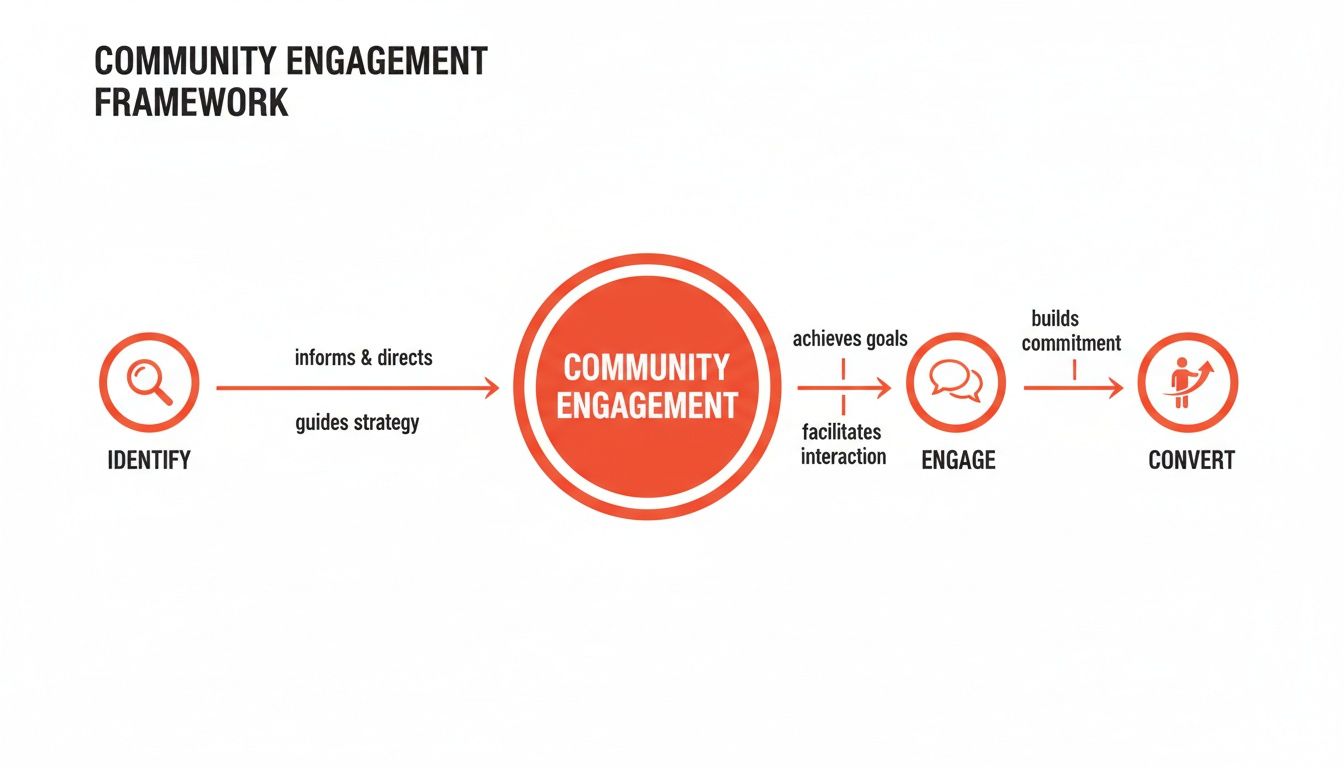
This workflow isn't just about random promotion. It’s a deliberate strategy of targeted identification, genuine engagement, and thoughtful conversion.
Create Once, Distribute Forever
Here’s a secret the best podcasters know: they don't just create episodes. They create content assets. The "create once, distribute forever" model is all about taking a single podcast episode and slicing it into dozens of smaller pieces of content tailor-made for different platforms.
This is how you maximize your reach and ensure every episode keeps working for you long after it’s published. Think about it—one 45-minute interview can fuel your content calendar for weeks, attracting new listeners from every corner of the internet.
Your Content Repurposing Playbook
Getting started with repurposing isn't as daunting as it sounds. The goal is simple: meet people where they are with content designed for the platform they're on.
I’ve used this matrix countless times to map out how a single episode can be spun into gold across the web.
| Original Content (Podcast Episode) | Repurposed Asset | Target Platform | Goal |
|---|---|---|---|
| 45-min Interview | 1-2 min Video Clip (Key Takeaway) | TikTok, Instagram Reels, YouTube Shorts | Attract new followers, drive curiosity |
| 45-min Interview | 60-sec Audiogram (Powerful Quote) | Instagram Feed, LinkedIn, Facebook | Share audio snippet, encourage click-through |
| 45-min Interview | Static Quote Graphic (Insightful Line) | Twitter, Instagram Stories, Pinterest | Increase shareability, build brand authority |
| 45-min Interview | 1,500-word Blog Post (from Transcript) | Your Website / Blog | Capture search traffic (SEO), provide in-depth value |
| 45-min Interview | 8-10 Tweet Thread (Key Highlights) | Spark conversation, drive traffic to full episode | |
| 45-min Interview | Email Newsletter (Summary & Insights) | Your Email List | Nurture your core audience, deepen engagement |
By breaking it down like this, you create a system. It's no longer about reinventing the wheel for every platform; it's about efficiently extracting value from the hard work you've already done.
This approach—combining smart collaborations with a robust repurposing strategy—is how you build a powerful growth engine that continuously brings new, dedicated listeners into your world.
Burning Questions About Growing Your Podcast
As you work to grow your show, you're bound to run into some common questions. I get asked these all the time, so let's clear up a few of the big ones.
How Long Until I Actually See Some Growth?
Look, there's no magic switch for podcast growth, but you can generally expect to see real, meaningful traction after about 6 to 12 months of putting out episodes consistently. It’s a slow burn.
In those early days, don't get obsessed with download numbers. Instead, focus on what you can control. Actionable Insight: Set process-based goals, not outcome-based ones. For example, your goal isn't "get 1,000 downloads." It's "publish one episode every week" and "send one guest pitch every month." These are the wins that build momentum. Growth isn't a sudden viral hit; it's the result of showing up, week after week, and building loyalty.
Do I Really Need to Bother with Video?
It's not strictly mandatory, but if you're serious about growth, adding a video component is one of the smartest moves you can make. Think about it: platforms like YouTube, TikTok, and Instagram Reels are built for discovery. An audio-only show is invisible there.
A single, killer video clip can introduce your show to thousands of people who would have never stumbled upon it otherwise. You don't need a fancy studio, either. Just recording yourself on a webcam while you talk gives you a ton of visual content you can slice and dice for social media.
Actionable Example: Record your next podcast on Zoom or Riverside. After, find a 30-60 second segment where you share a powerful tip. Use a simple tool like CapCut to add captions and post it as an Instagram Reel. That's your first piece of video content, done in under 15 minutes. It's a free sample that gives people a real taste of what you offer.
Should I Be Running Paid Ads for My Show?
Paid ads can definitely work, but only if you've done the prep work. It's like pouring water into a bucket—you want to make sure there are no holes first. Before you even think about spending money, you need to have your house in order.
Make sure you have:
- A crystal-clear picture of your ideal listener. You can't hit a target you can't see.
- A solid back catalog of episodes. Give new listeners at least 10-15 episodes to dive into.
- A professional-sounding show. That means clean audio, good cover art, and well-written show notes.
If you don't have these things locked down, you're just paying to send people to a show they won't stick with. But once you're confident in your product, running targeted ads on platforms like Spotify, Reddit, or other podcast apps can be a fantastic way to get in front of the right people.
What’s the Right Publishing Frequency?
Consistency will always trump frequency. A show that comes out reliably every single week will build a much stronger, more loyal audience than a daily show that fizzles out after a couple of months from burnout.
Pick a schedule you know you can stick with for the long haul. Your listeners start to build a habit around your show. When they know a fresh episode is waiting for them every Tuesday on their commute, you become part of their routine. That's how you turn a casual listener into a true fan. Actionable Insight: If a weekly schedule feels too demanding, start with a bi-weekly (every two weeks) schedule. It's better to publish consistently every two weeks than to miss episodes on a weekly schedule.
Ready to tap into niche communities and turn engaged conversations into loyal listeners? Reddit Agency specializes in finding your ideal audience on Reddit and crafting authentic strategies that drive real growth for your podcast. Discover how we can help you win on Reddit.
