
A Modern Playbook on How to Increase Organic Traffic
Driving more organic traffic isn’t about chasing a single keyword or using some secret SEO trick. It's a methodical process built on a solid foundation of technical health, genuinely helpful content, and building real authority in your space. Think of it less as a checklist and more as a complete system for creating an experience that Google and your customers will both love.
Let's dive into the blueprint for making that happen.
Your Blueprint for Sustainable Traffic Growth

This isn't another generic SEO guide. It’s a practical blueprint designed for SaaS founders, B2B marketers, and DTC brands who need more than just visitors—you need qualified traffic that turns into revenue. We're skipping the fluffy advice to give you actionable frameworks that actually move the needle.
This is more important than ever because relying solely on traditional search is becoming a risky bet. While organic search still drives a massive 46.98% of all website traffic, the ground is shifting, especially in B2B. For B2B companies, organic traffic's share of the pie has fallen from 39% in 2019 to just 27% by 2024.
Why You Need a Modern Game Plan
The battle for the top spot on Google is fierce. The number one result gets a staggering 39.8% of all clicks, and we all know less than 1% of users ever bother with the second page. It’s a winner-take-all game, which means you can't just "do SEO" anymore. You need a diversified, modern approach to compete.
So, what does that look like?
- A rock-solid technical foundation: Your site needs to be fast, secure, and easy for search engines to crawl and index. No exceptions.
- An authority-building content engine: This means consistently creating high-impact content that answers your audience's real questions and establishes you as a trusted resource.
- Smart channel diversification: We’ll show you how to tap into active communities on platforms like Reddit to drive immediate, highly relevant traffic.
To give you a clearer picture of how these pieces fit together, I've broken down the core strategies we'll be covering.
The Four Pillars of Organic Traffic Growth
This table summarizes the main strategies this guide is built on and shows how each one directly contributes to your bottom line.
| Pillar | Core Focus | Primary Business Impact |
|---|---|---|
| Technical SEO | Site speed, mobile-friendliness, crawlability, and security. | Improves user experience, boosts search engine rankings. |
| Content & On-Page SEO | High-value articles, keyword targeting, and user intent. | Attracts qualified visitors, builds brand trust and authority. |
| Authority Building | Link building and strategic digital PR. | Increases domain authority, amplifies content reach. |
| Growth Channels | Leveraging platforms like Reddit for targeted outreach. | Drives immediate traffic, engages niche communities directly. |
Each pillar works with the others to create a resilient system that generates consistent, high-quality traffic for your business.
This guide is your executive summary, laying out these core pillars before we get into the nitty-gritty. For an even more detailed look, this comprehensive guide on increasing organic traffic is an excellent resource.
The takeaway: Winning today isn't just about keywords. It's about building a recognizable brand, delivering an amazing user experience, and meeting your audience where they already spend their time.
Before we jump in, it's worth having a solid grasp on the fundamentals. If you're new to this, our breakdown of what organic marketing truly means is a great place to start.
Building a Rock-Solid Technical SEO Foundation

Before you write a single blog post or build a single backlink, you need to get your technical house in order. Think of technical SEO as the foundation of your website. If it’s cracked and unstable, everything you build on top of it will eventually crumble.
This is the behind-the-scenes work that ensures search engines can actually find, crawl, and understand what your site is about. It's not about chasing a perfect 100/100 score on some tool. It’s about methodically removing the roadblocks that stop Google from showing your content to the right people.
Prioritize Blazing-Fast Site Speed
Site speed isn’t just a nice-to-have; it’s a critical part of the user experience. A slow site bleeds visitors and tells Google that your page isn’t worth a user's time. This is where Google's Core Web Vitals (CWV) come into play—they’re specific benchmarks for loading speed, interactivity, and visual stability.
Nailing these metrics involves a few key moves:
- Optimize Your Images: Compress every single image before you upload it. If you're a DTC brand with gorgeous product photos, this is non-negotiable. Save them as next-gen formats like WebP to keep the quality high while slashing the file size.
- Minify Your Code: Strip out all the unnecessary characters from your HTML, CSS, and JavaScript files. It cleans up the code without breaking anything, and many CMS platforms have plugins that do this for you automatically.
- Enable Browser Caching: Caching tells a visitor's browser to save parts of your site. The next time they visit, the page loads instantly because it doesn't have to re-download everything. It's a huge win for returning users.
For instance, I once worked with a SaaS company whose feature-heavy homepage was taking forever to load. We implemented "lazy loading" for all the images and videos below the fold. This meant media only loaded as a user scrolled down, which drastically improved the initial page load time and boosted their CWV scores.
Ensure Flawless Mobile-Friendliness
It's 2024. Google uses mobile-first indexing. This means it primarily looks at the mobile version of your site to decide how to rank you. If your website is a mess on a smartphone, your rankings will suffer. Period.
This is about more than just a responsive design that scales down. You need to actively test the mobile experience. Can people easily tap your buttons? Is the text readable without pinching and zooming? Is the navigation actually usable on a small touchscreen? Run your site through Google’s Mobile-Friendly Test for a quick reality check.
Key Takeaway: A website that is difficult to use on mobile is, in Google's eyes, a broken website. There's no middle ground here; mobile optimization is a non-negotiable part of modern SEO.
To really dig in and make sure your foundation is solid, it helps to follow a clear process. Using something like a Master Framework for Technical SEO Audits can give you a blueprint to systematically find and squash the issues holding you back.
Master Your On-Page Elements
Your on-page elements are the signposts that tell both people and search engines what your content is about. They need to be clear, compelling, and optimized for clicks—not just stuffed with keywords.
Title Tags and Meta Descriptions
The title tag is the clickable blue link in the search results, and the meta description is the snippet of text underneath. This is your thirty-second elevator pitch on the SERP. Make it count.
- SaaS Feature Page Title: "Project Management Software for Remote Teams | BrandName"
- DTC Product Category Title: "Organic Cotton T-Shirts for Women | BrandName"
URL Structure
Keep your URLs clean and descriptive. They should be easy for a human to read and understand, which means they'll be easy for a search engine to understand, too.
- Good URL:
yourbrand.com/blog/how-to-increase-organic-traffic - Bad URL:
yourbrand.com/index.php?p=123
By locking in these fundamental technical pieces, you create a site that’s stable, fast, and easy for search engines to crawl. This sets the stage for all your future content efforts to actually deliver results, instead of getting lost due to preventable errors.
Building Your Content and Authority Engine
Great content is the absolute bedrock of organic growth, but simply hitting "publish" on a blog post won't cut it. You need a system—a well-oiled engine designed to attract the right people, pull them in, and ultimately turn your website into the go-to resource in your space.
It all starts with getting inside your customer's head. Before you write a single word, you have to understand the "why" behind their search. Forget chasing vanity metrics like massive search volume. The real gold is in user intent—what problem are they actually trying to solve?
From Keywords to Conversations: Decoding User Intent
Old-school keyword research was all about finding terms with the highest monthly searches. That's a trap. A keyword like "project management" is a black hole of ambiguity. The person searching could be a college student writing a paper, someone looking for a new job, or a COO ready to drop six figures on enterprise software. The intent is all over the map.
Your job is to dig deeper and find the long-tail keywords that tell you a story.
- "I need information" intent: These are the "how-to" and "what is" queries. Think: "how to create a project timeline."
- "I'm weighing my options" intent: They're comparing solutions. For example: "best project management software for startups."
- "I'm ready to buy" intent: They know what they want and are close to a decision. Something like: "BrandName pricing plans."
One of the best shortcuts to finding these gems is to spy on your competition. Jump into a tool like Ahrefs or Semrush and see what your competitors are ranking for. Filter out the high-difficulty, broad terms and look for the low-hanging fruit—those specific, high-intent phrases that are driving qualified traffic right to their doorstep.
For instance, instead of targeting "project management," you might uncover a keyword like "asana vs monday for small agency." That query is dripping with commercial intent. The person searching is deep in the buying cycle, making them a perfect audience for a detailed comparison article.
Mapping Your Content to the Buyer's Journey
Once you've got a solid list of intent-driven keywords, it's time to give them a home. The most powerful way to structure your content is with topic clusters. This is where you create a massive, foundational "pillar page" on a broad topic and then support it with smaller, more specific "cluster" articles that link back to it.
Why this works: Topic clusters scream "expertise" to Google. The pillar page acts as the central authority, and the cluster content proves you have comprehensive knowledge on the subject. All those internal links create a web of relevance that search engines love.
Let's imagine you're a DTC brand selling eco-friendly cleaning supplies. Here’s what a topic cluster could look like:
| Content Type | Keyword Focus | Buyer's Journey Stage |
|---|---|---|
| Pillar Page | "ultimate guide to non-toxic cleaning" | Awareness |
| Cluster Post | "diy vinegar cleaning solutions" | Awareness/Consideration |
| Cluster Post | "best eco-friendly all-purpose cleaner" | Consideration |
| Product Page | "buy organic multi-surface cleaner" | Decision |
This framework doesn't just organize your content; it creates a natural path for your visitors to follow. It’s a fundamental strategy for any serious business, which is why we break down exactly how to build this system in our guide on content marketing for startups.
Earning Authority, Not Just Building Links
Let's be clear: incredible content will only get you so far. To really compete for top rankings, you need authority. In the SEO world, authority is still largely measured by backlinks. But the game has changed dramatically. It's no longer about quantity; it's 100% about quality.
Your entire focus should be on earning editorially placed links from relevant, respected websites in your niche. Forget about spammy tactics.
One of the most sustainable ways to do this is by creating original, data-driven content. Think about it: what do journalists and bloggers need? They need sources. They need data to back up their claims.
Conduct a small survey in your industry, analyze your own platform's usage data, or compile unique statistics into a report. This kind of content becomes a linkable asset. For example, a SaaS company could publish a "State of Remote Work Productivity" report. It’s packed with fresh stats that other publications will jump at the chance to cite, linking back to you as the original source.
Targeted guest posting is another fantastic, and often misunderstood, tactic. This isn't about blasting out generic pitches to low-quality blogs. It’s a surgical process. You identify the key publications where your ideal customers are already hanging out, and you contribute a genuinely valuable, non-promotional article. The link back to your site becomes a natural byproduct of you providing real expertise.
Ultimately, a winning organic strategy comes down to creating purposeful content that solves real problems and refreshing it every 6-12 months to keep it relevant. Foundational keyword research, an obsession with user intent, and a smart backlink strategy are the cornerstones of sustainable growth.
The Reddit Playbook for Targeted Traffic
While a solid technical SEO foundation and a powerful content engine are your long game, sometimes you just need to get the right people to your site now. This is where Reddit shines.
If your perception of Reddit is just memes and endless arguments, it’s time to look again. It’s actually a massive collection of hyper-niche communities where your ideal customers hang out, actively asking for advice and looking for solutions. With over 1.6 billion monthly visits, it's a goldmine for traffic—if you know how to play the game.
The secret? Help first, sell second. People on Reddit can spot a lazy sales pitch from a mile away, and it'll get downvoted into oblivion. But if you provide genuine value, the community will reward you with clicks from highly motivated visitors.
Finding Your Goldmine Subreddits
First things first, you need to find where your people are. Forget about massive, generic communities like r/business; they're usually too broad to be effective. The real magic happens in the focused subreddits where people are talking about the specific problems your product solves, day in and day out.
Think beyond your product category and search for the problems your customers face.
- If you run a project management SaaS, don't just search for "project management." Try searching for "team collaboration issues," "missed deadlines," or "client communication tools." This will lead you to active communities like
r/projectmanagement,r/startups, and maybe even niche professional hubs liker/consulting. - For a DTC brand selling ergonomic office chairs, searching "wfh back pain," "home office setup," or "best office chair for long hours" will uncover treasure troves like
r/WorkFromHome,r/OfficeChairs, andr/battlestations.
Once you've found a subreddit that looks promising, just hang out for a while. Read the rules, see what kinds of posts hit the top, and get a feel for the culture. Is the vibe helpful and supportive? Sarcastic? Highly technical? This intel is critical. It’s the difference between blending in and getting called out.
Crafting High-Value Native Posts
A "native" post is one that feels like it truly belongs on Reddit. It’s not a press release or a thinly veiled ad. It’s a genuinely useful piece of content that offers value on its own, with your product mentioned naturally as part of the solution.
Your entire Reddit strategy should revolve around a simple, repeatable process: research what the community needs, create something genuinely helpful, and build your authority through real engagement.
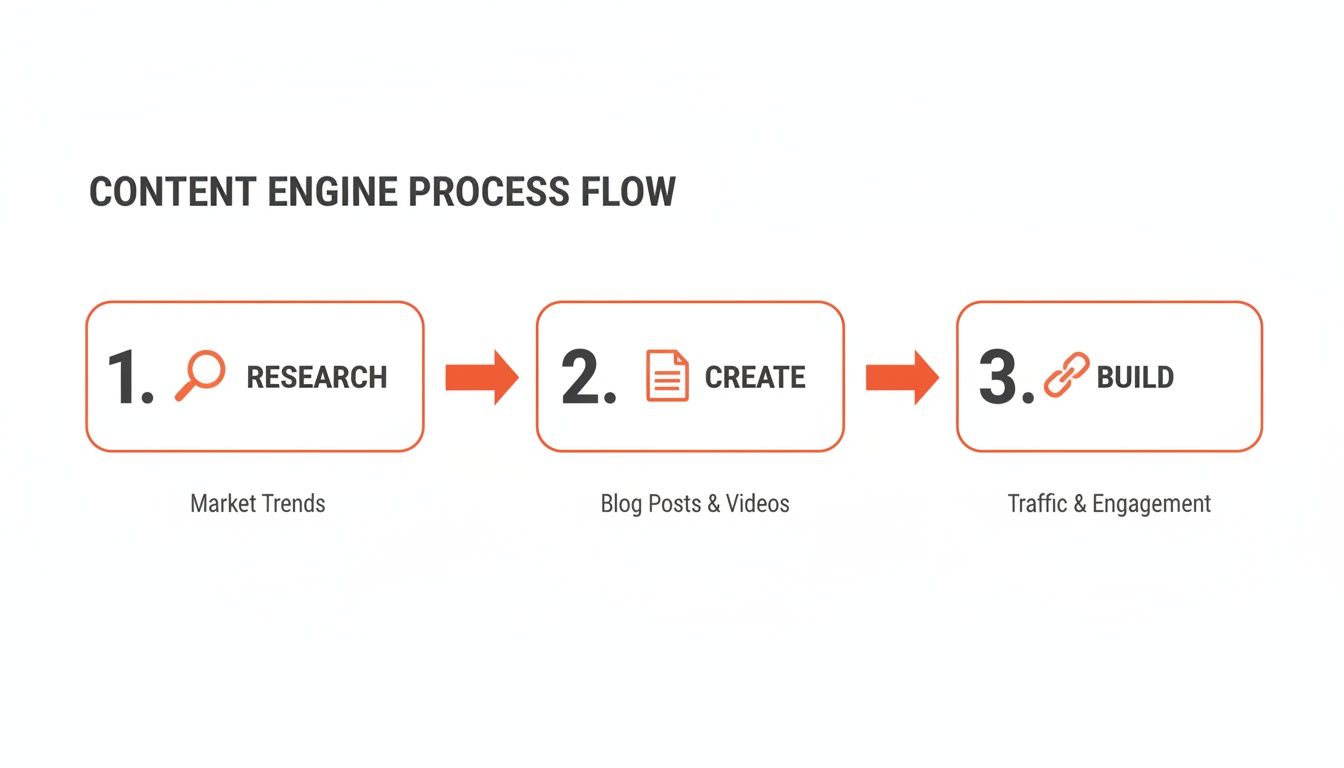
This loop is how you turn Reddit from a time-sink into a reliable traffic machine.
Let’s make this real. Imagine your startup built a tool that automates social media scheduling. A terrible post would be: "Check out our new tool!" Instead, you could go to r/socialmedia with a post titled: "I analyzed 1,000 top-performing social media posts. Here's a breakdown of what works."
Inside that post, you’d share actual data, actionable tips, and real insights. Then, toward the end, you could drop in something like, "I actually built a small tool to help automate this process and save time. You can check it out here if you're interested." Because you led with massive value, the promotion feels earned and helpful, not spammy.
Key Takeaway: Your goal on Reddit is to become a trusted resource, not a persistent advertiser. Solve a problem for the community first, and they will be far more receptive to learning about your solution.
Engaging in Comments to Build Credibility
Sometimes, the biggest wins aren't in creating new threads but in jumping into existing conversations. You can set up alerts for keywords in your industry and find people who are literally asking for the help you can provide.
Your comment strategy needs to be surgical. Don't just drop a link and run. That never works.
- Acknowledge their problem. Start by showing you actually read their question.
- Give a real answer. Provide a direct, helpful tip or solution right there in your comment.
- Introduce your solution (subtly). If it makes sense, you can mention your product as a way to solve their problem more easily. For example: "I ran into this exact same issue a while back and ended up writing a detailed guide on how to fix it step-by-step. Might be useful for you."
This approach builds trust and positions you as an expert before you ever ask for a click. To really master this, check out these community engagement best practices for building authentic connections.
To help you plan your content, think about what you want to achieve. Different post formats are better suited for different goals.
Reddit Post Type vs. Business Goal
| Post Type | Best For | Example for a SaaS Company |
|---|---|---|
| Case Study/Success Story | Demonstrating value, driving conversions. | "How our agency used Tool X to cut client reporting time by 50%." |
| Educational Guide/Tutorial | Building authority, generating leads. | "A complete guide to A/B testing landing pages for higher conversions." |
| Ask Me Anything (AMA) | Building community, getting feedback. | "I'm the founder of a CRM for small businesses. Ask me anything!" |
| Data-Driven Analysis | Earning backlinks, establishing expertise. | "We analyzed 10,000 sales emails. Here's what the top 1% do differently." |
Mixing up your post types and consistently showing up to help is how you transform Reddit into a powerful engine for organic traffic. It definitely takes patience and a genuine desire to be part of the community, but the payoff is huge: a steady stream of highly-qualified visitors who already trust you before they even hit your homepage.
Measuring Success and Setting Realistic Timelines
Driving traffic is great, but it’s completely pointless if you can't tell whether it's actually helping your business. Success isn't just watching a number go up on a chart; it's about attracting the right people who eventually sign up, buy, or subscribe. We need to get past those vanity metrics and focus on what really moves the needle.
Your two best friends for this job are Google Analytics 4 (GA4) and Google Search Console (GSC). Think of it this way: GSC tells you what's happening before someone clicks—things like your keyword rankings, impressions, and click-through rates. GA4 picks up the story after they land on your site, showing you what they actually do.
Tracking What Actually Matters
First things first, you need to set up conversion tracking in GA4. A conversion is simply any valuable action you want a visitor to take. This is how you draw a direct line from your organic traffic to real business outcomes.
So, what should you be tracking? It depends on your business model:
- SaaS Business: Your bread and butter is probably demo requests, free trial sign-ups, or even just a simple contact form submission.
- DTC Brand: The big one is obviously a completed purchase. But don't forget smaller wins like newsletter sign-ups or new account creations.
- Creator: You might track newsletter subscriptions, downloads of a freebie, or clicks on an important affiliate link.
Once you have this tracking in place, the magic happens. You’ll start to see which blog posts and landing pages are pulling in the most valuable traffic. You might even find that a quiet, low-traffic article is secretly a lead-generation powerhouse, giving you a crystal-clear signal of what content your audience really wants.
Here’s a look at a user acquisition dashboard in GA4.
This is where you can quickly see which channels—like Organic Search—are bringing you the most engaged new users, helping you decide where to double down on your efforts.
Setting Realistic Growth Timelines
I've seen it a hundred times: founders and marketers get frustrated when SEO doesn't produce results overnight. You have to understand that organic growth is a long game. It's like a flywheel—you put in a ton of effort upfront to get it spinning, and then it starts to build its own momentum and compound over time.
For most businesses, you'll start to see some early signs of life between months 4 and 6. Real, solid growth usually kicks in between months 7 and 9, which is what I call the 'compounding growth phase.' By the time you hit months 10-12, things can really start to accelerate. You can read more about what to expect in this breakdown of SEO timelines.
That timeline can feel agonizingly slow, especially when you need to show results now. This is precisely why a balanced strategy is non-negotiable.
SEO is your long-term, sustainable growth engine. Community-driven channels like Reddit are your short-term accelerators. You need both to build a resilient traffic strategy.
While you're waiting for your SEO flywheel to get up to speed, smart campaigns on Reddit can bring in qualified traffic and leads in a matter of weeks, not months. This gives you a much faster feedback loop to test your messaging, validate an offer, and get immediate sign-ups while your content strategy matures in the background.
Here’s how to think about blending these two timelines:
- Months 1-3: Go all-in on foundational work. Fix your technical SEO, nail your keyword research, and launch targeted Reddit campaigns to get some initial traffic and user feedback.
- Months 4-6: Keep publishing pillar and cluster content consistently. Use what you're learning from Reddit to refine your approach. You should start seeing some of your first keyword rankings pop up.
- Months 7-12: As your SEO starts compounding, you can find a better balance. Your organic traffic should be trending up, and you can use community engagement to create periodic spikes in interest and traffic.
By understanding these timelines, you can build a strategy that is both patient and proactive. You get the immediate wins from Reddit to keep everyone happy and the data-backed confidence that your long-term SEO investment is well on its way to paying off big.
Common Questions About Increasing Organic Traffic
When you're deep in the weeds of SEO, it’s easy to get stuck. Everyone hits similar roadblocks and asks the same questions along the way. I've heard them all over the years.
This section is all about tackling those common hurdles head-on with straight, practical answers. Think of it as a quick troubleshooting guide to keep you moving in the right direction.
How Long Until I See Real SEO Results?
This is the million-dollar question, and the honest-to-goodness answer is... it depends. But I know that's not helpful, so let's break it down into a realistic timeline. You should start seeing some glimmers of hope—a few keywords popping up, a slight traffic increase—within 3-6 months.
However, the real, game-changing growth, the kind that starts to compound on itself, typically takes a solid 6-12 months of consistent work.
Here’s how I think about the journey:
- Months 1-3: This is all about pouring the foundation. You're busy fixing technical gremlins and publishing your first batch of well-researched content.
- Months 4-6: You'll start to see your early content get indexed and maybe even rank for some long-tail keywords. The traffic needle will begin to twitch upwards.
- Months 7-12+: This is where the magic happens. The flywheel starts spinning faster. Your site's authority is growing, which helps you rank for tougher keywords and pulls in much more significant traffic.
SEO is a long game, no doubt. But while you're waiting for that organic flywheel to gain momentum, channels like Reddit can give you some quick wins and invaluable feedback from your target audience.
Should I Focus on High-Volume or High-Intent Keywords?
It's tempting to chase those big, flashy keywords with huge search volumes. But here's the reality: they are often brutally competitive and the user's intent is all over the map. A much smarter play, especially when you're starting out, is to go after high-intent, lower-difficulty keywords.
These are the longer, more specific phrases people type in when they're much closer to making a decision.
For instance, instead of trying to rank for "SaaS marketing" (massive volume, vague intent), you’d be far better off targeting something like "best crm for small real estate agencies" (lower volume, laser-focused intent). You'll attract a smaller but much more qualified audience—the kind that actually converts.
My advice is always to win the smaller battles first. Zero in on those bottom-of-the-funnel keywords that are directly tied to what you sell. As your domain authority builds up, you can start aiming for the bigger, broader terms.
How Do I Promote My Content Effectively?
Let's be clear: creating amazing content is only half the job. Hitting "publish" and then just waiting for the world to discover your genius is a recipe for failure. You have to actively push it out there.
A good promotion strategy isn't about spamming links everywhere; it's about being smart and strategic across a few key channels:
- Your Email List: Your newsletter subscribers are your most captive audience. Always share your new content with them first.
- Social Media: Don't just drop a link. Repurpose your content. Turn a blog post into a LinkedIn carousel, pull out a compelling statistic for a graphic, or chop up a section into a short video.
- Community Engagement: Just like we talked about earlier, find relevant subreddits, forums, or Slack groups where your content can genuinely solve a problem or answer a question.
The whole idea is to meet your audience where they already are and add real value to the conversations they're having.
Ready to tap into one of the most powerful and immediate sources of qualified traffic? Reddit Agency helps brands win on Reddit by turning authentic conversations into measurable growth. We handle the strategy, content creation, and community engagement to drive real leads and customers. Learn how we can build your Reddit traffic engine.
