How to Measure Marketing ROI for Real Business Growth
When you boil it down, the formula for marketing ROI is pretty straightforward: (Sales Growth – Marketing Cost) / Marketing Cost.
If you run the numbers and get 400%, that's fantastic—it means for every $1 you put in, you got $5 back. This one calculation is what shifts marketing from being seen as just another expense to a real, proven engine for revenue.
Why Mastering Marketing ROI Is a Game Changer
Let's be honest, proving your marketing's worth can feel like an uphill battle, especially when every dollar in the budget is scrutinized. But getting a handle on your marketing ROI is about so much more than just justifying your team's existence. It's the key to making smarter decisions, knowing exactly which channels deserve more funding, and building a foundation for long-term growth.
For anyone running a SaaS company or a DTC brand, this isn't just a nice-to-have skill. It's a survival tactic. When you can measure precisely, you draw a direct line from a specific action—like a savvy Reddit comment or a carefully crafted email sequence—straight to a tangible business outcome. You stop guessing and start knowing what actually moves the needle.
Connecting Actions to Outcomes
The real challenge has always been bridging that gap between your marketing efforts and the bottom line. You need to be able to see how your campaigns translate into qualified leads, trial sign-ups, and, ultimately, sales. Without that clear connection, you're essentially flying blind, unable to fix what’s broken or pour fuel on what's working.
This isn’t just a personal frustration; it’s an industry-wide shift. By 2025, a massive 83% of marketing leaders say that demonstrating ROI will be their absolute top priority. We're already seeing the effects, with 64% of companies now basing their future budgets on past ROI performance. This puts pressure on everyone, from in-house teams to partners like a Reddit Agency, to prove their strategies deliver cold, hard returns. You can dig deeper into these marketing ROI statistics to see just how much budget allocation is changing.
Key Takeaway: Measuring marketing ROI changes the entire conversation. Instead of asking for more budget based on a gut feeling, you can walk into a meeting with data-backed proof of how your investments will generate predictable revenue.
This simple shift builds incredible credibility. When you can confidently show the financial impact of your work, you don't just get a bigger budget—you earn a seat at the strategic table where the real decisions are made.
Setting Up Your Tracking for Accurate Measurement
Before you can calculate anything, you need clean data. Let's be honest: an accurate ROI calculation is built on solid tracking, not guesswork. This means we have to look past vanity metrics and get serious about the key performance indicators (KPIs) that actually reflect business health, like conversions and cost per lead.
Building this foundation requires a clear path from every marketing action to a measurable outcome. Without this, your ROI figures will always be a bit fuzzy. So, let's walk through how to set up the essential tracking mechanisms.
The whole process is simpler than it sounds. You take an action, it produces an outcome, and that outcome drives growth.
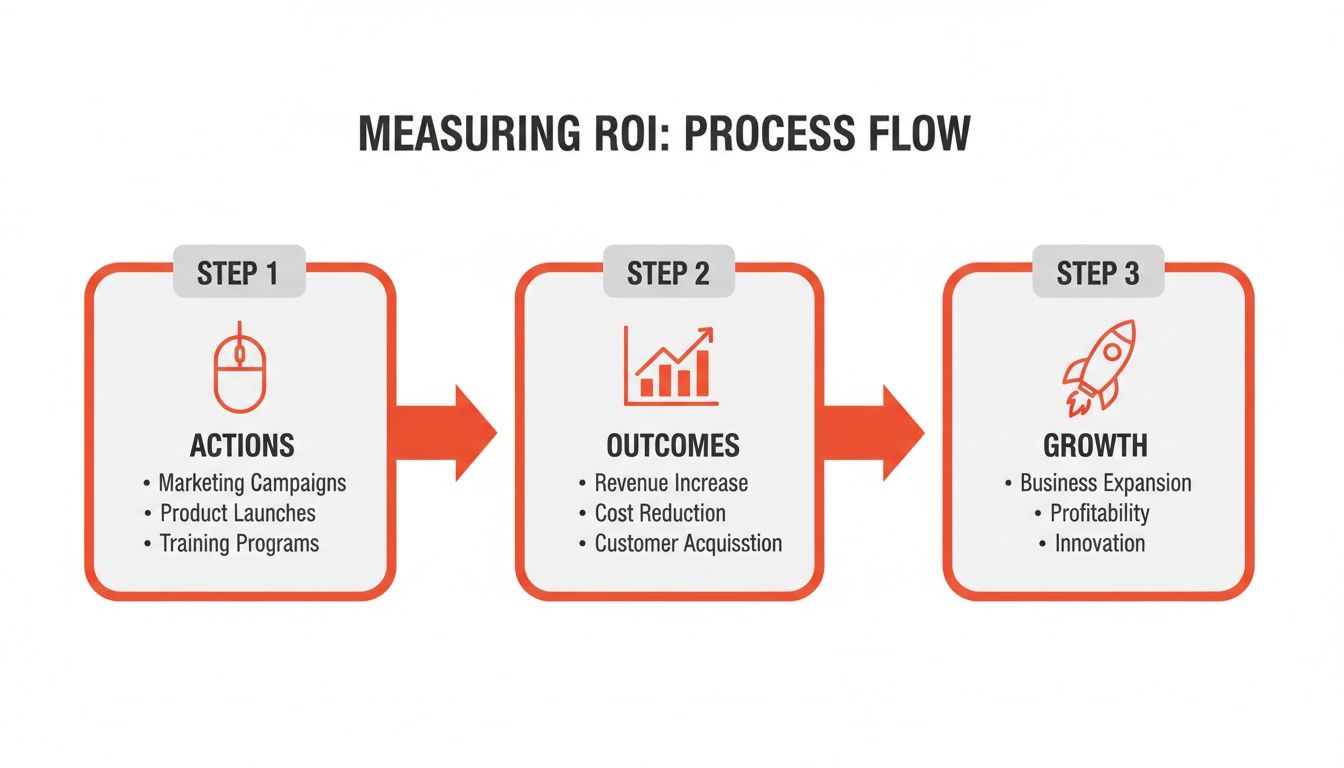
This flow really boils down the core idea of measurement: every single click or engagement must be tracked as an outcome to understand its true impact.
Mastering UTM Parameters for Granular Insights
One of the most powerful—and surprisingly simple—tools in your tracking arsenal is the UTM parameter. Think of them as little breadcrumbs you add to a URL to track the performance of your campaigns and content. They tell your analytics platform exactly where your traffic is coming from.
Instead of just seeing "Reddit" as a generic source, you can pinpoint the exact subreddit, the specific post, or even a single comment that drove a conversion. That's the level of detail we're after.
Actionable Example: Imagine a SaaS company is launching a new feature and promoting it in the /r/SaaS subreddit. A properly tagged link would look something like this:yourwebsite.com/new-feature?utm_source=reddit&utm_medium=organic_post&utm_campaign=feature_launch_q3&utm_content=saas_subreddit
This kind of detail is non-negotiable if you want to know how to measure marketing ROI effectively, because it directly connects your outreach efforts to tangible results.
Defining and Tracking Your Conversion Goals
Once you can trace where your traffic is coming from, you have to define what a "conversion" actually means for your business. It's not always a direct sale. A conversion is simply any valuable action a user takes on your site.
For a B2B marketer, some of the most valuable conversion goals might be:
- Demo Request: A classic high-intent action that shows a user is seriously interested.
- Whitepaper Download: This captures a lead for your nurturing funnel while providing genuine value.
- Newsletter Sign-Up: A great way to build your audience for long-term communication.
Setting these up as "Goals" in a tool like Google Analytics is pretty straightforward. Once they're configured, every time a user completes one of these actions after clicking your campaign link, it gets attributed correctly. This allows you to assign a real dollar value to activities that aren't immediate sales.
Expert Tip: Let's say you know that historically, 1 out of every 50 whitepaper downloads turns into a customer with a lifetime value of $5,000. You can then assign a value of $100 to each and every download. This simple math transforms a top-of-funnel activity into a measurable ROI driver.
When you combine granular UTM tracking with clearly defined conversion goals, you create a system that captures the true impact of your marketing. This accurate data is the essential first step—without it, you're just guessing when it comes time to plug numbers into an ROI formula.
Choosing the Right Formula to Calculate Marketing ROI
Alright, with your tracking in place, it’s time to get down to the numbers. Figuring out how to measure marketing ROI really hinges on using the right formula—one that paints an honest, fluff-free picture of your campaign's performance.
The classic formula is where most people start. It's simple, direct, and gives you a quick baseline.

This foundational calculation is: (Sales Growth – Marketing Cost) / Marketing Cost. But while it’s straightforward, it has one major blind spot: it acts as if your marketing is the only reason for new growth. What about the sales you would have made anyway, just by being in business?
A More Insightful ROI Formula
To get a much truer sense of your impact, experienced marketers use a slightly tweaked formula. This one accounts for your typical organic sales growth, which stops you from accidentally giving a campaign all the credit for revenue that was already coming in.
Here’s the more accurate formula: (Sales Growth – Average Organic Sales Growth – Marketing Cost) / Marketing Cost.
That small adjustment makes a massive difference. It isolates the actual lift your marketing delivered, separating it from your normal business momentum. It's a crucial distinction, especially when you consider that only about half of marketers feel confident in their ability to track ROI in the first place. Mastering a precise formula like this gives you a serious leg up.
Key Takeaway: By subtracting your average organic growth, you're not just measuring activity; you're measuring the incremental impact of your marketing investment. This is the number that truly proves your value.
This approach gives you a much more defensible and realistic ROI figure—exactly what you need when you're asking for more budget or making big strategic bets.
A Practical Example From Start to Finish
Let's walk through how this works with a real-world scenario. Imagine a B2B SaaS company wants to measure the ROI from a three-month campaign on Reddit and LinkedIn designed to drive demo requests.
First things first, we need to add up the total marketing investment. This is more than just ad spend; it's every cost associated with the effort.
- Ad Spend: $15,000 on LinkedIn Ads.
- Agency Fees: $10,000 for a specialized team to manage the campaign.
- Content Creation: $3,000 for designing visuals and writing copy.
- Total Marketing Cost: $28,000
Next, we look at the sales growth. Let's say the campaign generated $150,000 in new revenue from closed deals. The company also knows from its own data that its average organic sales growth for a normal three-month period is $40,000.
Now, let's plug these numbers into our improved formula:
- Sales Growth: $150,000
- Average Organic Sales Growth: $40,000
- Marketing Cost: $28,000
ROI = ($150,000 - $40,000 - $28,000) / $28,000
ROI = $82,000 / $28,000
ROI = 2.93
To turn this into a percentage, just multiply by 100. The final ROI is 293%. This tells us that for every single dollar invested, the campaign generated $2.93 in profit after covering both the campaign costs and the business's natural growth. If you want to dive deeper, this resource offers clear formulas and real-world examples for calculating Marketing ROI.
Looking Beyond ROI to See the Full Picture
Getting a positive ROI is great. It's the green light every marketer wants to see. But here’s the thing: a simple ROI calculation is just a snapshot. It tells you that you made your money back on a specific campaign, but it doesn't tell you the whole story.
True, sustainable growth isn’t just about a one-time win. It's about bringing in the right kind of customers—the ones who stick around, buy again, and become advocates for your brand. To understand that, we need to look at a couple of other metrics that give us that crucial long-term context.
The two most important metrics for this are Customer Acquisition Cost (CAC) and Customer Lifetime Value (LTV). When you put them together, they paint a much more vivid picture of your marketing's real impact on the business.
Understanding Customer Acquisition Cost
First up is your CAC. In simple terms, this is what it costs you to get one new customer through the door. It’s a straightforward but absolutely essential calculation.
You figure it out by taking your total sales and marketing costs over a certain period and dividing it by the number of new customers you brought in during that time.
CAC = Total Sales & Marketing Costs / Number of New Customers Acquired
This isn't just your ad spend. It includes everything—agency fees, the salaries for your marketing team, software costs, you name it. A low CAC might look good initially, but it's only half the equation. It means nothing without its partner, LTV.
Key Takeaway: While a high ROI proves a campaign was profitable, CAC reveals how efficiently you spent your money to get there. It’s the "cost" side of your growth formula.
The Power of Customer Lifetime Value
This is where things get really interesting. Customer Lifetime Value (CLTV) (LTV) is a prediction of the total revenue you can expect from a single customer over the entire time they do business with you.
Calculating a basic LTV isn't too complicated. You just need a few key pieces of information:
- Average Purchase Value: How much does a customer typically spend per transaction?
- Purchase Frequency: How often do they come back to buy?
- Customer Lifespan: How long do they usually stay a customer?
The formula is pretty simple: LTV = Average Purchase Value x Purchase Frequency x Customer Lifespan. This metric is your window into the long-term health of your customer relationships.
The LTV to CAC Ratio: Your True North Star
Now, let's put it all together. The ratio of LTV to CAC is arguably one of the most critical metrics for any growing business. It answers the one question that truly matters: Are we spending more to get customers than they're actually worth to us?
As a rule of thumb, a healthy LTV:CAC ratio is 3:1 or higher. For every dollar you spend to acquire a customer, you should be getting at least three dollars back over their lifetime. If your ratio is 1:1, you're just treading water. Anything less, and you're actively losing money with every new sale.
Practical Example: Imagine a B2B software company is running two different campaigns. They find that leads from paid ads have a low CAC of $300. At the same time, they're engaging in niche subreddits to find customers, which is more time-intensive and results in a higher CAC of $500.
On the surface, paid ads look like the obvious winner, right? Cheaper is better.
But once they dig into the data, they find that customers sourced from Reddit have an incredible LTV of $5,000, while the ad-sourced customers top out at an LTV of just $1,200. It turns out that the strategies they use to generate B2B leads from Reddit attract a much more qualified and loyal audience.
Let's look at the ratios:
- Paid Ads LTV:CAC Ratio: $1,200 / $300 = 4:1
- Reddit LTV:CAC Ratio: $5,000 / $500 = 10:1
Suddenly, the picture is completely different. The acquisition channel that seemed more "expensive" is actually more than twice as profitable in the long run. This is exactly why you have to look beyond a simple ROI calculation to build a truly resilient and scalable business.
Don't Just Measure ROI — Act On It
Getting a clear ROI number feels great, but it’s just the starting point. The real magic happens when you use that number to make smarter, faster decisions for your business. This is the moment you graduate from just tracking metrics to actively shaping your marketing success.

Think of your ROI data as a detailed roadmap. It points out your high-performing all-stars and shines a harsh light on the channels that are just burning through your budget.
What if you discovered your organic posts in /r/B2Bsales deliver a 3x higher ROI than paid ads targeting the exact same audience? That’s a game-changing insight. This is the kind of data that gives you the green light to double down on what’s working and the confidence to cut what isn’t.
Find Your Winners (and Ditch the Losers)
The first step is to get granular. Slice and dice your ROI by channel, by individual campaign, and even by specific ad creative. This is how you pinpoint what’s really moving the needle.
Actionable Example: A direct-to-consumer brand might look at their data and see a story emerge:
- The Winner: An organic post in
/r/skincareaddictionfilled with genuine user-generated content is crushing it with a 750% ROI. - The Underperformer: A generic, broad-targeting ad campaign on another social platform is barely breaking even, limping along with a 50% ROI.
With this kind of clarity, the next move is obvious. You can confidently shift your budget away from those low-performing ads and funnel it directly into creating more of the authentic, community-driven content that your audience actually loves. It’s a simple, direct path to boosting your overall marketing efficiency without spending a single extra dollar.
Key Takeaway: Stop looking at your blended, overall ROI. The real opportunities are hidden in the details. True optimization happens when you get specific and analyze performance at the campaign level.
Fix Your Underperforming Campaigns
When a campaign isn't hitting its ROI targets, your first instinct might be to kill it. Hold on. Before you pull the plug, play detective and diagnose the problem. A low ROI could be the result of a weak creative, targeting the wrong people, or a confusing offer.
Actionable Insight: If a campaign has a low ROI but a high click-through rate, the problem isn't the ad—it's likely the landing page. Run an A/B test on your landing page headline or call-to-action. If a campaign has a low click-through rate, the creative or targeting is the culprit. Test a new image or a more specific audience segment. Small, targeted tests can turn a failing campaign into a winner. Reviewing common reasons for failed ad campaigns can give you fresh ideas for your next test.
Get the Right Balance in Your Marketing Mix
Finally, measuring ROI helps you understand how every channel fits into the bigger picture. Not every marketing activity is designed for an immediate sale, and that’s okay.
Some efforts, like nurturing a community in a subreddit, are all about long-term brand building. Others, like a highly targeted ad, are about direct response. Both are vital for sustainable growth.
A balanced marketing mix is key. Many experts suggest aiming for a split of 50-60% brand building and 40-50% performance tactics. By understanding this balance and measuring ROI for both where possible, you can build a strategy where brand-building and direct-response campaigns fuel each other for long-term success.
Common Questions About Measuring Marketing ROI
Even with the right formulas and tools at your fingertips, you're bound to run into some tricky questions when you start digging into your marketing ROI. Let's walk through some of the most common hurdles marketers face so you can get clear on the details and present your findings like a pro.
How Often Should I Be Measuring ROI?
The honest answer? It depends. The right rhythm for measuring ROI is really tied to your business model and, more importantly, your sales cycle. There’s no magic one-size-fits-all schedule, but we can look at some common scenarios to find what works.
Practical Examples:
- For a fast-paced DTC brand where a customer might see an ad and buy within a week, a monthly ROI check-in makes perfect sense. It gives you a tight feedback loop to tweak campaigns and react quickly.
- For a B2B SaaS company with a sales cycle that takes three to six months, a quarterly calculation is far more realistic. You need to give those leads enough time to actually move through the funnel and become customers before you can measure success.
No matter your official reporting schedule, you should still keep a close eye on leading indicators—things like website traffic, lead quality, and micro-conversions. I recommend checking these weekly or bi-weekly. This lets you spot trends early and make course corrections before they throw off your bigger ROI numbers down the line.
What Is a Good Marketing ROI, Anyway?
This is probably the question I hear most often, and the answer is always frustratingly vague: "good" is completely relative. It can swing wildly depending on your industry, profit margins, and what you’re trying to achieve as a business.
That said, a generally accepted benchmark to shoot for is a 5:1 ratio. This works out to a 400% ROI, meaning you get five dollars back for every one dollar you put in. But context is king. A startup in aggressive growth mode might be thrilled with a 2:1 ratio if it means capturing massive market share. Meanwhile, a well-established company with high-margin products might not even get out of bed for anything less than a 10:1 ratio.
Key Takeaway: The bottom line is that your ROI needs to be positive. But more than that, it has to cover not just your ad spend, but also the cost of the goods you sold (COGS) and all the other operational costs that go into running your business. That's when you're truly profitable.
How Do I Even Begin to Measure ROI for Brand Building?
This is a tough one. Trying to draw a straight line from a single Reddit comment or a blog post to a final sale is nearly impossible. For top-of-funnel activities like content marketing or organic social media, you have to change how you think about measurement. The key is to shift from direct revenue to what I call "proxy metrics" and look at the customer journey as a whole.
Instead of obsessing over tying a specific Reddit post to a specific purchase, look for signals that show you're building momentum. Are you seeing an uptick in:
- Branded search volume? (People Googling your company name)
- Direct website traffic? (People typing your URL straight into their browser)
- Newsletter or email sign-ups?
From there, you can start to assign a tangible value to these "micro-conversions." For example, let's say you know from your data that 1 out of every 50 newsletter subscribers eventually becomes a paying customer with an average lifetime value of $1,000. That means every single new subscriber is worth $20 to your business. Suddenly, you have a way to calculate an estimated ROI for your brand campaigns and connect them to real business value.
Ready to turn authentic Reddit conversations into measurable traffic and leads? At Reddit Agency, we specialize in crafting strategies that deliver real ROI. Find out how we can help you win on Reddit.
