How to Reduce Customer Acquisition Cost That Actually Works
If you're spending more to get each new customer, you're not just imagining it. Your Customer Acquisition Cost (CAC) is more than a metric on a dashboard; it’s a vital sign for your business. When that number starts climbing, it's a clear signal that your growth engine is losing steam and burning cash faster than it should.
This isn't happening in a vacuum. A few powerful forces are at play. For one, major ad platforms like Google and Meta have become incredibly competitive, turning ad auctions into expensive bidding wars. On top of that, new privacy regulations and the slow death of third-party cookies make it tougher than ever to track and target the right people, which often means more wasted ad spend.
Many businesses are finding that the old playbook just doesn't work anymore, leaving them in a constant uphill battle. The first step to fixing this is understanding exactly why it's happening.
The Soaring Cost of Acquiring Customers
The numbers don't lie. Over the past decade, the cost of acquiring customers has skyrocketed, forcing companies to find smarter ways to grow instead of just throwing more money at ads.
Research shows that between 2013 and the early 2020s, the average eCommerce CAC shot up by a staggering 222%. Brands went from losing $9 per new customer to a massive $29 loss after factoring in things like returns and marketing inefficiencies. Some eCommerce businesses are now seeing CAC as high as $68–$78 per customer.
It's a similar story for SaaS companies. Median benchmarks show it costs about $2.00 to acquire $1 of new annual recurring revenue (ARR). Think about that—it can take two full years just to break even on a new customer. These rising costs make getting a handle on your acquisition strategy more critical than ever.
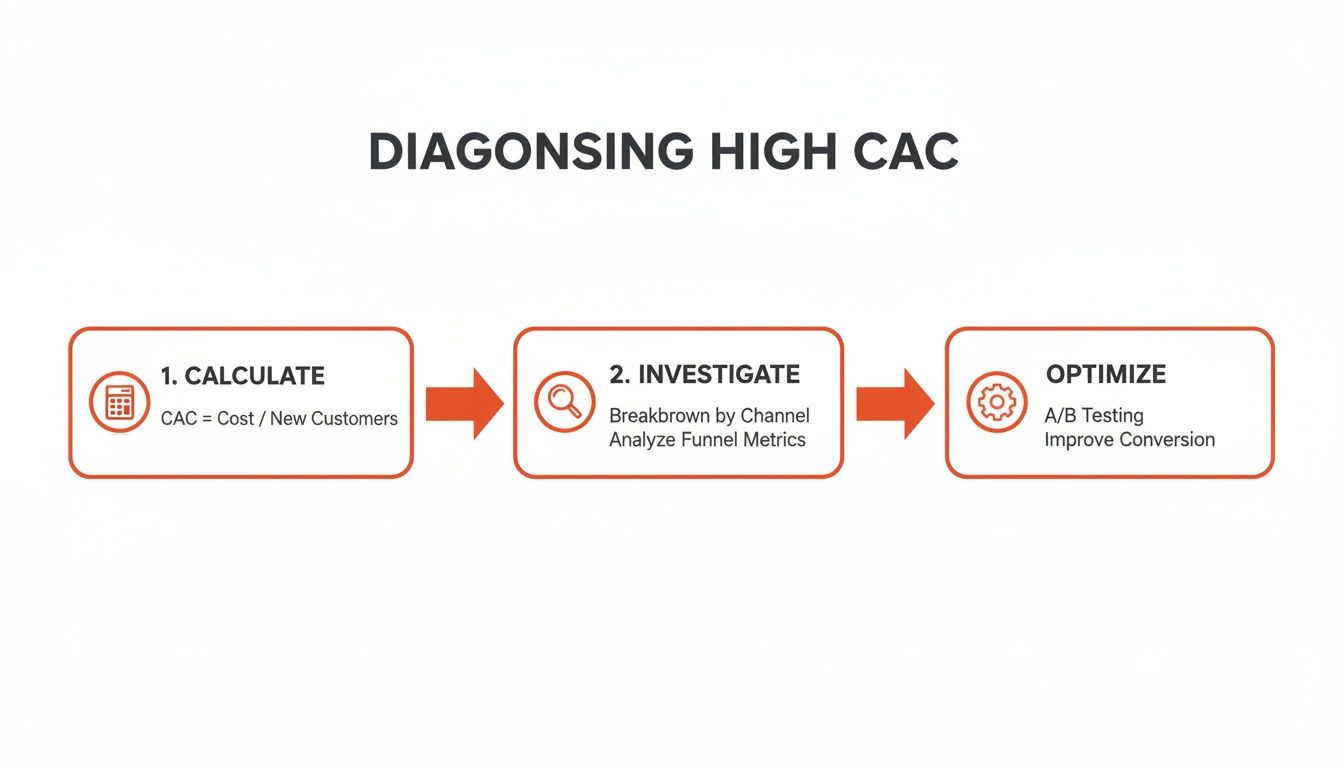
This simple flowchart breaks down the process for diagnosing and fixing a high CAC. It's a continuous loop of calculating your baseline, finding the weak spots, and methodically optimizing your strategy.
Calculating Your Baseline CAC
Before you can fix your CAC, you need to know exactly what it is. The formula itself is simple, but this number is the starting point for everything else you'll do.
CAC Formula: (Total Cost of Sales + Total Cost of Marketing) / Number of New Customers Acquired
Let's walk through a real-world example. Imagine a SaaS company spent $15,000 on marketing (ad spend, content, tools) and $10,000 on sales salaries and commissions last quarter. In that time, they brought in 50 new customers.
- Total Costs: $15,000 + $10,000 = $25,000
- New Customers: 50
- CAC: $25,000 / 50 = $500 per customer
This $500 is your baseline. It's the benchmark you'll measure all your optimization efforts against. Without it, you're flying blind, with no real way to know if your changes are actually making a difference.
Skipping this foundational step is a surprisingly common mistake and a fast track to the kinds of problems you see in these examples of failed ad campaigns. This guide will give you a framework to make sure your efforts are both measurable and effective.
Your Quick CAC Diagnostic Framework
When your CAC is too high, it's easy to feel overwhelmed. Where do you even start? This quick diagnostic framework helps you pinpoint the most likely problem areas so you can focus your energy where it will have the biggest impact.
| Area of Investigation | Key Question to Ask | Example Metric to Track |
|---|---|---|
| Channel Mix | Are we spending money on the channels our best customers actually use? | CAC by Channel |
| Audience Targeting | Are we reaching the right people, or are we casting too wide a net? | Lead-to-Customer Conversion Rate |
| Creative & Messaging | Does our ad creative resonate and clearly communicate our value? | Click-Through Rate (CTR) |
| Funnel Conversion | Where are people dropping off between the first click and the final purchase? | Landing Page Conversion Rate |
| Retention & LTV | Are we acquiring customers who stick around and become profitable? | LTV:CAC Ratio |
Think of this table as your initial checklist. By answering these core questions, you can quickly identify the leaks in your acquisition funnel and start plugging them one by one.
Pinpoint Your Most Profitable Marketing Channels
Putting all your marketing eggs in one or two baskets, like Google Ads or Meta, is a recipe for an unsustainable Customer Acquisition Cost. It’s like building a house on a single pillar; the moment it cracks, the whole thing comes crashing down. The real secret to a lower, more resilient CAC isn't just about slashing your budget—it's about spending smarter by diversifying your channel mix and moving money to where it actually performs.
Let's be honest, not all marketing channels are created equal. Paid social ads are often the default, but they're also usually the most expensive and crowded. On the flip side, channels like organic search, email marketing, and community-led platforms like Reddit can deliver much higher-intent customers for a fraction of the cost. The goal is to build out a portfolio of channels where your most efficient ones get the biggest slice of the pie.
Run a Channel Performance Audit
So, where do you start? You need to figure out where your money is best spent with a quick channel performance audit. This isn't about getting lost in complex spreadsheets. It’s about asking one simple question for every channel you use: "How much did we spend here, and what did we actually get back?"
First, list out every channel where you invest time or money. Then, do the back-of-the-napkin math to calculate the CAC for each one.
- Google Ads CAC: Total Google Ads Spend / New Customers from Google Ads
- Reddit Organic CAC: (Time Spent x Employee Cost) / New Customers from Reddit
- Email Marketing CAC: Email Tool Cost / New Customers from Email Campaigns
Actionable Example: An e-commerce brand selling eco-friendly cleaning supplies discovers their Meta Ads CAC is $65. Meanwhile, customers acquired through their SEO-optimized blog posts on "non-toxic cleaning hacks" have an effective CAC of just $15. This data provides a clear directive: double down on content marketing.
This simple exercise is incredibly revealing. You might find your Google Ads CAC is a hefty $450, while the effective CAC from your team’s organic efforts on Reddit is just $80. That’s a bright, flashing sign telling you exactly where to shift your focus.
Strategically Reallocate Your Budget
Once you've identified your winners and losers, it's time to make a move. This doesn't mean you should kill your expensive channels overnight. Instead, start by shifting a small, experimental chunk of your budget—say, 10-15%—from a high-cost channel to a proven, low-cost performer.
Practical Example: A B2B SaaS company spends $20,000/month on LinkedIn Ads, acquiring customers at a $700 CAC. Their content manager’s time on niche Slack communities organically brings in leads at an effective CAC of only $120. They reallocate just 15% of their LinkedIn budget ($3,000) to sponsor those Slack communities and produce more high-value content for them. This strategic shift can acquire more customers for the same spend and systematically lower their overall blended CAC. This is a core tenet of modern demand generation strategies, which prioritize efficiency over sheer volume.
Today, channel intelligence—not just a bigger budget—is what truly drives down CAC. A smart mix of channels, especially those with high-intent audiences like organic search and community forums, will consistently outperform a strategy that leans on a single, expensive platform.
The data backs this up. Average digital channel CACs have shot up by 40-60% in recent years, punishing companies that haven't diversified. Research shows that integrated, data-informed approaches to channel management can boost results by up to 35%. For a platform like Reddit, this means finding the top 10-20 subreddits driving quality leads and focusing all your efforts there, instead of using a scattergun approach.
By moving budget from underperforming ads to high-intent communities and tracking the results meticulously, brands can realistically achieve 20-50% improvements in their CAC. To see just how much channel mix is shaping success across industries, dive into the latest customer acquisition cost trends.
Ultimately, this is about building a resilient, multi-channel acquisition engine. You’re no longer vulnerable when one platform's costs inevitably spike. Your marketing becomes an adaptable system that consistently finds the most cost-effective path to new customers.
Sharpen Your Targeting to Attract Better Customers
Pouring money into a poorly targeted campaign is like trying to sell ice to Eskimos—it’s a massive waste of time and cash. When you use broad targeting and generic messaging, you're essentially paying to reach people who will never buy from you. It’s a quiet but deadly budget killer that steadily inflates your customer acquisition cost.
The solution? Get laser-focused. You need to connect with the right people using a message that hits home, speaking directly to the problems they're actually trying to solve. This goes way beyond basic demographics like age or location. We're talking about building a detailed Ideal Customer Profile (ICP) that truly captures their real-world challenges, their online habits, and what makes them tick. When you know exactly who you're talking to, every single ad dollar works harder.

Go Beyond Demographics to Build a Real ICP
A truly effective ICP isn't just some spreadsheet with job titles and company sizes. It should be a living, breathing document that gets to the human side of your ideal buyer. To build one that will actually help you slash your CAC, you need to dig deep and answer some tough questions:
- What are their biggest pain points? I mean the real ones, not just surface-level stuff. What’s keeping them up at night? What are they complaining about to their colleagues over Slack?
- What does success look like for them? Are they trying to nail a promotion, make their team's life easier, or just stop putting out fires all day?
- Where do they get their information? Do they religiously follow industry blogs, hang on every word of certain LinkedIn influencers, or are they active in niche online forums?
- What’s their digital "watering hole"? Where do they go to vent, ask for advice, and find solutions? For a surprising number of professionals, this is a platform like Reddit.
Actionable Insight: Conduct five 15-minute interviews with your best customers. Ask them, "What was going on in your business the day you decided you needed a tool like ours?" The language they use to describe their problems is pure gold for your ad copy and landing pages.
Getting answers to these questions turns your targeting from a vague guessing game into a sharp, data-driven strategy. You stop shouting into the void and start having meaningful conversations where your best potential customers are already hanging out.
Map Your ICP to High-Intent Reddit Communities
Once you've got a crystal-clear ICP, your next move is to find where these people congregate online. This is where Reddit becomes an absolute goldmine for lowering your CAC. It’s essentially a massive collection of niche communities (subreddits) where people are having incredibly detailed, honest conversations about the exact problems your product solves.
Your job is to connect the dots between your ICP's pain points and these specific subreddits.
Practical Example: A Project Management SaaS
Imagine your ICP is a stressed-out project manager at a mid-sized tech company. Their daily headaches are missed deadlines, messy communication between departments, and zero visibility into who’s doing what.
Instead of running generic ads targeting "project managers," you can pinpoint the exact subreddits where these conversations are already happening:
r/projectmanagement: Perfect for general industry chatter and high-level advice.r/agile: A hotbed for managers grappling with the frustrations of specific methodologies.r/startups: Full of founders and PMs wearing a dozen hats, all desperate for efficiency hacks.r/sysadmin: You’ll find IT managers here whose projects are constantly being derailed by last-minute, "urgent" requests.
By engaging thoughtfully in these communities, you’re not just finding leads—you’re finding people who are actively searching for a solution. The buying intent is already baked in, which dramatically lowers the cost and effort it takes to win them over.
The most expensive customer is the one you have to convince they have a problem. The cheapest is the one who’s already looking for a solution. Refining your targeting is all about finding more of the latter.
Systematically Test Your Creative and Messaging
Okay, so you've found the right audience. That's only half the battle. Now you have to speak their language. The perfect person will scroll right past the wrong message, which means more wasted ad spend. This is why having a repeatable framework for testing your creative is absolutely non-negotiable if you're serious about reducing CAC.
Don't just throw things at the wall and see what sticks. Use A/B testing to let the data tell you what works. My advice? Start by testing the big, high-impact elements first.
- Test Outcomes vs. Features: Do they care more about what your product does (e.g., "AI-powered dashboard") or what it helps them achieve (e.g., "Never miss a deadline again")?
- Test Different Pain Points: Create ad copy that speaks to different core frustrations your ICP faces. See which one gets the strongest reaction.
- Test Visual Formats: Pit a crisp static image against a short, punchy video or an eye-catching GIF. The winner might surprise you.
- Test Your Call-to-Action (CTA): Is a direct CTA like "Start Free Trial" more effective than a softer approach like "See How It Works"? Test it.
Practical Example: A company selling a video editing software tested two ad headlines. Ad A: "Powerful 4K Video Editing Suite." Ad B: "Create Viral TikToks in Under 5 Minutes." Ad B, which focused on a specific, desirable outcome, outperformed Ad A by 300% among their target demographic of social media managers, slashing their cost-per-lead.
This is the power of a systematic, repeatable process for refining your message.
Optimize Your Funnel to Stop Losing Leads
Getting the right people to your website is a huge win, but it's really just the starting line. If your conversion funnel is full of holes, you’re not just losing potential customers—you're actively burning marketing cash with every person who drops off.
This is where you can make a massive impact on your CAC without spending another dime on ads. By smoothing out every step of the customer journey, from that first ad click to the final checkout, you make sure more of your hard-won traffic actually becomes revenue.
Fix Your Landing Page First
I’ve seen it a hundred times: a great ad campaign sends traffic to a landing page that completely misses the mark. This is often the first real handshake between you and a potential customer. If it's weak, you’ve lost them for good. Your one and only job here is to remove friction and build instant trust.
Start with your value proposition. It needs to be the very first thing people see, stated so clearly that a five-year-old could understand it. Don't list features; promise an outcome.
Next, you need real social proof. Forget plastering generic client logos everywhere. I'm talking about specific testimonials that mention a tangible result, or even better, user-generated content from actual customers. This kind of authentic proof is infinitely more powerful than your own marketing claims.
And please, simplify your forms. Every extra field is a new reason for someone to give up. Just ask for the absolute bare minimum you need to start a conversation.
Actionable Insight: Use a tool like Hotjar or Crazy Egg to watch session recordings of users on your landing page. You’ll quickly see where they get stuck, hesitate, or drop off. If 80% of users abandon the page when they see your 10-field form, that's your cue to cut it down to just "Name" and "Email."
Nurture Leads Without Being Pushy
Once you have that lead, the absolute worst thing you can do is hammer them with a hard sell. That’s an express ticket to the unsubscribe list. Instead, think of your job as guiding them. A simple, automated email sequence can do this beautifully by providing genuine value first.
Here's a low-pressure, three-part sequence I've seen work wonders:
- Email 1 (The Case Study): The day after sign-up, send a short, punchy case study. Show them how a customer just like them solved a major pain point using your solution.
- Email 2 (The Objection Buster): A few days later, tackle a common objection head-on. If people worry about a complicated setup, send an email with the subject line, "Can you really be up and running in 30 minutes?" then show them how.
- Email 3 (The Soft Offer): Finally, make a gentle offer. Instead of a demanding "Buy Now!" button, try something more conversational: "Ready to see how [Your Product] can tackle [Their Problem]? Let's find 15 minutes to chat this week."
This approach builds trust and positions you as an expert who's there to help, not just another vendor trying to make a sale. You're warming them up, so when they are ready to buy, you’re their first choice.
A leaky funnel means you're paying to acquire prospects who never become customers. Fixing the friction points between the first click and the final sale is one of the most cost-effective ways to reduce your overall CAC.
Re-Engage Interested Visitors with Smart Retargeting
It's completely normal for someone not to buy on their first visit. The big mistake is letting them walk away and forget you exist. This is exactly what retargeting was made for—staying top-of-mind and bringing interested people back when the time is right.
While Facebook and Google are the defaults, think about getting more creative on a platform like Reddit. Instead of just showing the same generic banner ad to everyone who visited your site, you can meet them where they already are.
For instance, say a developer checks out the pricing page for your API monitoring tool but doesn't sign up. You could retarget them with a helpful, native-looking post right inside r/devops or r/programming. This post isn't a direct ad; it’s a mini-case study or a quick technical tip about API monitoring. It feels like a valuable contribution to the community, not an interruption, which makes it far more effective and keeps your CAC from creeping up.
Your Funnel Leakage Audit Checklist
Before you can plug the leaks in your funnel, you have to find them. This checklist is a great starting point for a self-audit. Go through each stage and be brutally honest about where friction might be costing you customers.
| Funnel Stage | Common Leakage Point | Actionable Fix |
|---|---|---|
| Top of Funnel (Awareness) | Ad creative doesn't match landing page message | Ensure headline, copy, and imagery are consistent from ad to page. |
| Middle of Funnel (Consideration) | Unclear value proposition or CTA | A/B test headlines and button text. State the benefit, not the feature. |
| Middle of Funnel (Consideration) | Complicated or long sign-up forms | Remove all non-essential fields. Only ask for what you absolutely need. |
| Bottom of Funnel (Conversion) | No social proof or trust signals | Add specific customer testimonials, case study links, or security badges. |
| Bottom of Funnel (Conversion) | Surprise costs or fees at checkout | Be transparent about all costs, including shipping and taxes, upfront. |
| Post-Conversion (Onboarding) | Confusing or non-existent onboarding process | Create a simple welcome email series or an in-app tutorial. |
By systematically identifying and fixing these common friction points, you can significantly improve your conversion rates and, in turn, lower your CAC without increasing your ad spend.
Boost LTV and Referrals to Lower Net CAC
Chasing new customers is an expensive way to grow. I've seen countless companies fixate on top-of-funnel metrics while a massive opportunity sits right under their nose: the customers they already have.
One of the most powerful ways to slash your net CAC is to get more value from the customers you’ve already paid to acquire. The logic is dead simple. If you can get more revenue out of each customer, that initial acquisition cost starts to look a lot more efficient. It’s about shifting from a transactional mindset to building a profitable, long-term relationship.
Increase Customer Lifetime Value
When you focus on proven strategies to increase customer lifetime value (LTV), you make every dollar you spent on acquisition work harder. A higher LTV justifies your original CAC and lets you generate more revenue from your existing base instead of constantly hunting for new leads.
Here are a few practical ways to do this:
- Smart Upselling: When a customer is at the checkout, offer a premium version of their product. For a SaaS tool, this could be a small pop-up showing how the next tier solves a bigger problem they'll inevitably face down the line.
- Strategic Cross-selling: Look at their purchase history and recommend things that actually make sense. If someone just bought a high-end camera, send a follow-up email showcasing compatible lenses or a professional tripod. It feels helpful, not pushy.
- Loyalty Programs: Reward your repeat buyers. A simple point system, exclusive discounts, or early access to new products can dramatically increase purchase frequency and make people feel appreciated.
Actionable Example: A meal kit delivery service noticed that customers who bought at least one "premium" meal add-on in their first month had a 50% higher LTV. They created a targeted pop-up for new users, offering them their first premium add-on for free. This small incentive significantly increased LTV and made their initial acquisition spend far more profitable.
These aren't just tricks; they're relationship-builders that increase the total revenue each customer generates. That makes the initial cost to acquire them a much sounder investment.
Build a Low-Cost Acquisition Engine with Referrals
While boosting LTV makes your past spending more efficient, a referral program actively cuts your future CAC. It turns your happiest customers into a ridiculously effective, low-cost sales team. Think about it: a recommendation from a friend carries far more weight than any ad you could ever run.
But a successful referral program doesn't happen by accident. Just slapping a "Refer a Friend" link in your website footer won't cut it. You need a compelling offer and a process so smooth it feels effortless.
The real goal here is to create a growth flywheel. Each new customer you acquire helps you get the next one, often for a fraction of the cost. This is how you build a truly scalable and cost-effective acquisition machine.
Actionable Example: The investing app Acorns built a viral referral loop by offering both the referrer and the new user $5 of free investment money. It was simple, mutually beneficial, and perfectly aligned with their product. The "give $5, get $5" model was so effective it became one of their primary growth drivers, leading to a much lower blended CAC than relying on paid ads alone.
Creating a Referral Program That Converts
A great referral program lives or dies by how easy and rewarding it is to use. The less friction, the more people will actually do it.
Here’s a simple framework for a referral email that works:
- A Clear, Catchy Subject Line: Something direct like, "Share [Your Brand] and Get $20." Lead with the benefit.
- Simple, Benefit-Oriented Body Copy: Get straight to the point. "Love our product? Share it with a friend! They get 20% off their first order, and you get a $20 credit when they buy."
- A Single, Obvious Call-to-Action (CTA): Use a big, bold button that says "Get My Referral Link." This should lead them directly to a page with their unique, shareable link.
By turning your customer base into an active marketing channel, you tap into the most trusted form of advertising there is. These are the kinds of word-of-mouth marketing strategies that drive sustainable growth and dramatically reduce your reliance on expensive paid ads.
A Few Common Questions About Lowering Your CAC
Even with a solid game plan, you're bound to run into some specific questions when you start digging into customer acquisition costs. Let's tackle a few of the most common ones I hear from founders and marketing teams.
What Is a Good Customer Acquisition Cost?
Honestly, there’s no magic number. A “good” CAC is completely relative to your business model, your industry, and—most importantly—your Customer Lifetime Value (LTV). Forget about arbitrary benchmarks; the real metric you need to obsess over is the LTV:CAC ratio.
This simple ratio tells you how much a customer is worth to you over their lifetime compared to what you paid to get them through the door.
A healthy target that most successful businesses aim for is 3:1. In plain English, for every dollar you spend bringing in a new customer, you should be getting at least three dollars back.
- A 1:1 ratio is a treadmill to nowhere. You're breaking even on every new customer, which makes real growth almost impossible.
- Anything below 1:1 is a serious red flag. You're actively losing money with every single sign-up or sale.
Practical Example: A SaaS company has a CAC of $400 and an LTV of $1,600. Their LTV:CAC ratio is 4:1, which is excellent. An e-commerce brand has a CAC of $50 and an LTV of $75. Their ratio is 1.5:1, which is dangerously low and signals they need to either lower their CAC or increase repeat purchases.
To get started, you'll need a clear picture of where you stand today, and using a practical customer acquisition cost calculator is the best way to establish that baseline.
How Long Does It Take to See a Reduction in CAC?
That really depends on the levers you pull. Some fixes can make a difference almost overnight, while other, more powerful strategies are more of a slow burn.
I like to think about it in two buckets:
- Short-Term Wins (Weeks): Things like tightening up your ad targeting, A/B testing a new headline on your landing page, or removing a few fields from your checkout form can drop your CAC within weeks. These are about plugging the obvious leaks in your funnel.
- Long-Term Strategies (Months): Building a real organic presence through SEO, launching a referral program that gets traction, or becoming a trusted voice in relevant Reddit communities takes time. You might not see a huge impact for 3-6 months, but these plays build a sustainable, cost-effective acquisition engine for the long haul.
The best approach is to do both. Tackle the low-hanging fruit for some quick wins while you lay the foundation for more durable, long-term growth.
The most effective ways to lower CAC often have nothing to do with your ad budget. It's about working smarter—optimizing, testing, and improving efficiency—not just spending more.
Which Marketing Channels Typically Have the Lowest CAC?
Historically, the channels with the lowest CAC are the ones where you earn attention instead of just buying it. Think organic growth, word-of-mouth, and building on existing relationships.
From my experience, these are often the most cost-effective channels:
- Referral Programs: There's nothing better than turning your happiest customers into your best salespeople. The cost is usually just the referral bonus, which is a fraction of what you'd pay for a cold lead.
- SEO and Content Marketing: This requires an upfront investment of time and effort, but once you start ranking for high-intent keywords, you get a steady stream of highly qualified, "free" traffic for months or even years.
- Email Marketing: It's incredibly cheap to market to people who already know you. Your main cost is the software, so converting leads from your existing email list has an exceptionally low CAC.
- Community-Led Marketing (Reddit): By showing up authentically in subreddits where your target audience hangs out and providing genuine value, you attract people who are already looking for what you offer. It's a world away from the cost of fighting for attention on noisy ad platforms.
Actionable Insight: Don't just guess which channels are best. Create a simple spreadsheet to track your monthly spend and new customers from each channel (Paid Social, SEO, Email, etc.). After two months, you'll have real data showing your actual CAC-by-channel, revealing your most efficient path to growth.
The only way to know for sure is to track your CAC for every single channel. That data will tell you exactly which channels are most efficient for your business and where you should be doubling down.
Ready to tap into one of the most cost-effective acquisition channels available? Reddit Agency helps you build a powerful presence on Reddit, turning high-intent conversations into measurable traffic and leads. Stop overspending on ads and start building a real community.
