
Master Your SaaS Go-to-Market Strategy: A Guide to Growth
A SaaS go-to-market (GTM) strategy is the operational blueprint for how you'll bring your product to the right people. It’s far more than just a marketing plan; it’s the strategic glue holding your product, sales, and marketing teams together to carve out a competitive advantage and fuel real, sustainable growth.
Why Your SaaS GTM Strategy Is Your Growth Engine
Think of your GTM strategy as the operating system for your entire company. It’s the connective tissue that makes sure your product team builds features that solve actual customer problems, your marketing team speaks directly to the right audience, and your sales team can close deals without friction.
A solid GTM plan forces you to answer the hard questions early. Who exactly is your ideal customer? What’s the one burning problem you solve better than anyone else? Where do those customers actually hang out, and how can you reach them? Getting these answers right brings incredible focus to every decision you make down the line.
Without this clarity, even brilliant software fizzles out. You end up wasting time, burning through cash, and missing your window of opportunity.
Aligning Teams for Maximum Impact
The true magic of a GTM strategy lies in its power to get every customer-facing team rowing in the same direction. When marketing, sales, and product are all reading from the same script, you create a smooth, consistent customer journey that naturally accelerates growth.
This alignment isn't just a nice-to-have; it delivers tangible results:
- Efficient Resource Allocation: You stop throwing money at marketing channels that your ideal customer profile (ICP) completely ignores. For example, instead of running generic LinkedIn ads, you can sponsor a niche newsletter that every one of your target buyers reads.
- Lower Customer Acquisition Costs (CAC): A focused message and targeted outreach mean your conversion rates go up. It's that simple.
- Reduced Churn: When you attract the right-fit customers from day one, they're far more likely to see the value in your product and stick around for the long haul.
This process can be broken down into three core stages—defining your foundation, positioning your product, and executing your plan.
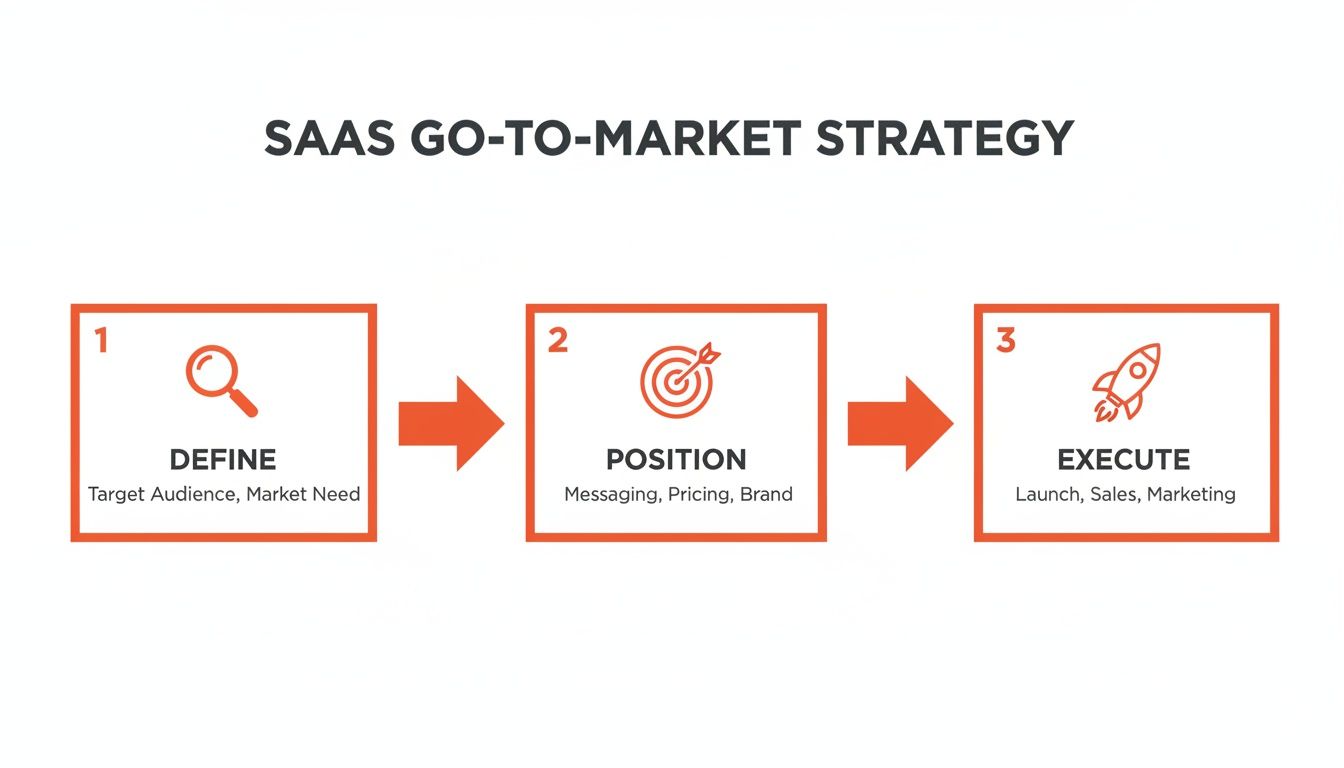
As the visual shows, a winning GTM isn't a single event but a sequence of deliberate choices, each one building on the last.
Before we dive into the nitty-gritty of each stage, here's a high-level overview of the decisions you'll be making. This table breaks down the core components of a GTM strategy.
Core GTM Stages and Decisions
| GTM Stage | Core Focus | Key Decisions |
|---|---|---|
| Foundation | Understanding your market and ideal customer. | Who is our Ideal Customer Profile (ICP)? What core pain points are we solving? Who are our main competitors? |
| Positioning | Defining how your product fits into the market. | What is our unique value proposition? What is our pricing model (e.g., freemium, tiered)? What is our core messaging? |
| Execution | Bringing the product to market and scaling. | Which acquisition channels will we prioritize? What is our sales motion (PLG vs. sales-led)? What does our onboarding look like? |
This framework helps you organize your thinking and ensures you cover all the critical bases as you build out your launch plan.
The Foundation of a Scalable Business
Ultimately, your GTM strategy is what separates a cool product from a great business. Companies like Slack and HubSpot didn't just get lucky; they executed brilliant GTM plans. Slack, for instance, leaned into a product-led GTM with a viral freemium model, famously racking up 8,000 sign-ups within 24 hours of its launch.
Your GTM strategy isn’t a "set it and forget it" document. Treat it as a living plan that you revisit and tweak every quarter as new customer and market data rolls in.
Building this out can feel complex, but it's the most important work you'll do in the early stages. To dig deeper into the fundamentals, check out this essential guide to go-to-market strategy. It provides the roadmap you need to turn your idea into a predictable growth machine.
Defining Your Ideal Customer and Value Proposition
Before you even think about a landing page, an ad campaign, or a new feature, your go-to-market strategy needs to start with two brutally simple questions: Who are you actually selling to? And why on earth should they care?
Getting this right isn't just some marketing checklist item. It's the absolute foundation for everything that follows.
If you don't have a crystal-clear picture of your audience, you're just screaming into the wind. Your messaging will be bland, your product will feel slightly off, and your marketing budget will disappear faster than free pizza in the breakroom. It all begins with digging in and building a real Ideal Customer Profile (ICP).

And I'm not talking about basic demographics like company size or industry. We need to go much deeper—into the psychology, the daily grind, and the hidden frustrations that keep your perfect customer up at night.
Moving Beyond Demographics to Uncover True Pain Points
A truly effective ICP is less about what a company is and more about what it struggles with. Saying you target "tech startups with 50-100 employees" is lazy. You need to pinpoint the exact triggers and operational headaches that make your solution a must-have, not a nice-to-have.
Actionable Insight: Set a goal to have five 15-minute conversations with potential customers each week. Don't sell. Use these questions to guide the discovery:
- What specific event kicked off their search for a fix? Was it a botched audit? Did a star employee just quit out of frustration? A sudden flood of angry customer support tickets?
- What's their current "solution"? Are they wrestling with a frankenstein of spreadsheets and free tools, or are they fed up with an expensive, clunky competitor?
- What does a "win" actually look like for them? Are they trying to shave 10 hours of manual data entry off their week? Or are they desperate to slash their team's response time by 50%?
The goal is to find the “hair on fire” problem. A mild inconvenience gets you a "maybe later." A burning, urgent problem gets you a customer who is actively looking to buy.
The only way to get these answers is to talk to people. Jump on 15-minute calls and just listen. Don't pitch. Focus entirely on their world and their problems. This qualitative data is absolute gold for honing your ICP.
Using Reddit to Validate Your ICP and Find Your Audience
Once you have a working theory about your ICP, it's time to see if it holds up in the real world. This is where a platform like Reddit becomes an incredible, often overlooked, tool. Reddit isn't just for memes; it’s a massive collection of niche communities where professionals vent, ask for help, and share what works.
Let’s run through a quick example. Imagine you're a B2B SaaS selling a new developer productivity tool.
- Map the ICP to Subreddits: Your ICP is a Senior DevOps Engineer at a mid-sized tech company. You'd immediately start hanging out in places like
r/devops,r/sysadmin, andr/kubernetes. - Listen for Pain Points: Next, you'd search those subreddits for the exact language your target audience uses to describe their problems. Think: "CI/CD pipeline slow," "deployment nightmare," or "on-call burnout." This is your messaging, handed to you on a silver platter.
- Identify Buying Signals: Keep an eye out for posts where people are asking for recommendations, like "What tool are you using for X?" or "Any good alternatives to Y?" This is pure, unfiltered proof that a market for your solution exists.
This simple process takes your ICP from a theoretical document to a living, breathing profile of a real person with real problems. It's a critical early step toward building a solid product-market fit framework. If you want to go deeper on this, check out this guide on achieving product-market fit.
Crafting a Value Proposition That Actually Converts
With a validated ICP, you can finally build a value proposition that hits home. This isn't just a catchy tagline. It's a clear, simple statement that explains the specific benefit you deliver, for a specific audience, and what makes you the best choice.
A strong value proposition needs to be:
- Specific: It has to promise a tangible result. Don't say "Improve your marketing." Say "Create high-converting landing pages in minutes without a developer."
- Pain-Focused: It should directly mirror the "hair on fire" problem you discovered in your research.
- Differentiated: It needs to subtly signal what makes you different. Are you faster? Easier? More affordable?
This value proposition becomes the heart of all your messaging. It should be the first thing a visitor reads on your homepage, the hook in your ads, and the core of your sales conversations. When you align it perfectly with the needs of your ICP, your message doesn't just get heard—it resonates.
Choosing Your Customer Acquisition Channels
Alright, you’ve figured out who you're selling to and what makes your product a must-have for them. Now comes the big question: how do you actually get in front of these people? This is where you decide on your primary sales motion—the engine that will power your entire SaaS go-to-market strategy.
This choice isn't just a marketing decision; it shapes everything from how you build your product to the kind of support you offer. In the SaaS world, two models dominate the conversation: Product-Led Growth (PLG) and Sales-Led Growth (SLG).

Picking the right path—or even a hybrid of the two—comes down to your product's complexity, its price, and the market you’re targeting. Let's dig into how to make that call.
The Power of Product-Led Growth
Product-Led Growth is exactly what it sounds like: the product itself is your main tool for acquiring, converting, and growing customer accounts. We've all seen this in action with companies like Slack, Loom, or Asana. You never have to talk to a salesperson. You just sign up, often for free, and start exploring.
This model is a fantastic fit for products that are:
- Easy to adopt: A user can jump in and get to that "aha!" moment on their own, without needing a formal demo or a ton of hand-holding. Example: Calendly. You connect your calendar, share your link, and get your first meeting booked within minutes. The value is immediate.
- Naturally viral or collaborative: The tool becomes more valuable as more people join. You can't really use Slack by yourself, right? You have to invite your team, creating a natural growth loop.
- Priced relatively low: When the Annual Contract Value (ACV) is on the lower side, a self-serve model is the only way to be profitable. You can't afford a high-touch sales process for a $20/month subscription.
Slack’s launch back in 2013 is the stuff of PLG legend. They proved that an incredible user experience could drive insane adoption without a traditional sales force. Just 24 hours after their beta went live, they had 8,000 sign-ups.
When Sales-Led Growth Is Non-Negotiable
On the other side of the coin, we have Sales-Led Growth. This is the more traditional model where a dedicated sales team is responsible for finding leads, nurturing them, and closing deals. This approach is absolutely essential when your product is complex, expensive, or being sold into the enterprise maze.
You'll know SLG is the right fit if your product has:
- A high ACV: If you’re closing deals worth tens or hundreds of thousands of dollars, you need a person to build that relationship and justify the investment.
- A complex implementation: Does your customer need help migrating data, setting up tricky integrations, or training their entire department? You’ll need a sales and customer success team to guide them. Example: A company migrating to a new ERP system like Workday needs extensive support.
- A top-down buying process: Selling to big companies is a whole different ballgame. It involves multiple stakeholders, security reviews, and procurement hurdles that a simple self-serve funnel just can't navigate.
Think about enterprise giants like Workday or Salesforce. You can't just swipe a credit card and get started. The sales cycle is long and consultative because the commitment—both in cost and company-wide adoption—is massive.
Testing Your Channels with Community-Led Tactics
So, how do you start testing these channels without blowing your budget? One of the most effective, low-cost strategies I've seen is to go where your Ideal Customer Profile (ICP) already hangs out online—places like Reddit.
And I don't mean spamming links. This is about becoming a real, valuable member of a community.
Practical Example: A B2B SaaS for Project Managers Let's say your ICP is a project manager at a small agency. Instead of burning cash on ads, you could try this:
- Identify Subreddits: Find their digital water coolers, like
r/projectmanagementorr/agile. - Add Value First: For a few weeks, just be helpful. Answer questions. Share your own experiences and advice. Build a reputation as someone who knows their stuff.
- Create a "Native" Post: Once you've established some credibility, create a post that genuinely solves a problem you've seen people discussing. Something like, "I was tired of manual client reporting, so I built a simple tool to automate it and wanted to share it for free." You’re positioning your product as a solution, not a sales pitch.
The key is to lead with generosity. Your goal is to be seen as a helpful member of the community who also happens to have built a useful product. This approach generates high-quality, early-adopter feedback and leads.
For B2B founders, this community-driven approach can be a goldmine. You get unfiltered access to your audience's biggest pain points and honest opinions. If you want to dive deeper into this playbook, our guide on how to generate B2B leads from online communities breaks it down even further.
The early traction and feedback you get here will be invaluable, telling you whether a PLG or SLG motion makes the most sense for scaling your SaaS go-to-market strategy long-term.
Nailing Your Pricing and Turning Signups into Power Users
Let's talk about one of the most nerve-wracking parts of any SaaS go-to-market strategy: pricing. It's not just a number on a page. It’s a core part of your product, your brand, and your entire growth engine. Get it wrong, and you're either undervaluing your work or scaring off the very customers you need.
So many founders get this wrong. They glance at a few competitors, pluck a number out of the air that feels right, and call it a day. This is a huge mistake. Pricing based on your costs or what others are doing ignores the only thing that actually matters: the value your customer gets from your product.
How to Choose a SaaS Pricing Model That Works
The best pricing strategy is one that grows with your customers. When they find more success using your tool, your revenue should grow right alongside them. This is the whole idea behind value-based pricing.
Instead of thinking about your own costs, you anchor your price to the tangible results you deliver. For example, if your software helps an e-commerce store recover $5,000 a month in abandoned carts, a $500/month price tag suddenly looks like an absolute steal.
Here are a few common ways to structure this:
- Tiered Pricing: You've seen this everywhere. It involves creating distinct packages (e.g., Starter, Growth, Enterprise) with different features and limits. It’s a great way to serve everyone from solo founders to massive corporations.
- Usage-Based Pricing: Here, customers pay for what they consume—think API calls, gigabytes of storage, or contacts in a list. This is perfect for infrastructure tools like AWS or communication platforms like Twilio.
- Per-User Pricing: Simple and easy to understand. You charge a flat fee for every person on the team. It’s a classic model used by giants like Salesforce.
It helps to see what others are doing. Spend some time browsing through different examples, like the ones on saasydb.com's pricing models, to get a feel for how different companies tie their pricing to a specific value metric.
Turning a Fresh Signup into an Activated User
The moment someone signs up for your free trial or freemium plan, a clock starts ticking. Loudly. You have a tiny window to get them to that "aha!" moment—the instant they see how your product solves their problem and makes their life better. This journey is called activation.
A clunky, confusing onboarding process is the number one killer of growth. Users get lost, get frustrated, and they bounce. Forever. But a well-designed activation funnel does the opposite: it systematically guides a curious user into becoming a paying customer who can't imagine their workflow without you.
Your job isn't to give them a grand tour of every single feature. It's to help them perform the one or two key actions that deliver that initial hit of value.
The goal of onboarding isn't to create an expert user overnight. It's to create a successful user who gets a quick win and is excited to see what else is possible.
Building Your Activation Funnel, Step by Step
First things first: you have to define what "activation" even means for your product. It must be a specific, measurable action that directly correlates with a user sticking around for the long haul.
Look at these real-world examples:
- For Slack, the magic number was a team sending 2,000 messages. They found that once a team hit that threshold, they were almost certain to become a long-term customer.
- For a tool like Buffer, activation is getting a user to connect a social media account and schedule their very first post.
- For an analytics product, it might be installing the tracking code and seeing that first chart populate with data.
Actionable Insight: Once you know your activation metric, design a "Golden Path" for new users. Use in-app checklists (e.g., "Step 1: Create a project," "Step 2: Invite a teammate") to guide them directly to that "aha!" moment. This simple tactic can dramatically improve your activation rate.
Everything should be designed to eliminate friction and guide them straight to that first taste of success. Do that, and you'll see your trial-to-paid conversion rate skyrocket.
Measuring Success with an Experimentation Loop
Your go-to-market strategy isn't a "set it and forget it" document you write once and file away. Think of it as a living, breathing framework that has to adapt to what the real world—and your data—is telling you. Without a clear way to measure what’s working, you're just guessing. And in a crowded SaaS market, guessing is a fast way to burn through cash.
This is where you switch from planning mode to iterating. True success comes from building a tight feedback loop: you measure performance against key metrics, cook up a hypothesis, run a small experiment, and then double down on whatever works. It's this cycle of testing and learning that separates the companies that stall from the ones that hit that rapid, sustainable growth curve.
Your GTM gives you the initial roadmap. Your metrics tell you where the road is smooth and where you need to start paving.
The North Star Metrics for SaaS Growth
You could track dozens of different metrics, but most of them are noise. To really understand the health of your GTM strategy, you need to zero in on a few non-negotiable numbers. Forget vanity metrics like page views or social media followers; focus on what directly impacts revenue.
- Customer Acquisition Cost (CAC): How much does it cost you to get one new paying customer? To figure this out, just divide your total sales and marketing spend for a period by the number of new customers you brought in. Simple, but powerful.
- Lifetime Value (LTV): This is your best guess at the total revenue a single customer will bring in over their entire time with you. A high LTV is a great sign that you have a sticky product and a healthy business model.
- LTV to CAC Ratio: This is the ultimate gut check for your business. The gold standard in SaaS is a 3:1 ratio. For every dollar you spend to get a customer, you should be getting at least three dollars back over their lifetime. If you're at 1:1, you're on a treadmill to nowhere.
These metrics give you a brutally honest, data-backed view of how your GTM is performing financially. It's critical to track them accurately and be honest with yourself about what they mean. It's also easy to fool yourself, which is why it's good to be aware of the common traps of misleading statistics and how to avoid them.
Why Net Revenue Retention Is the New King
Back in the day, SaaS growth was all about acquiring new logos. That's only half the story now. The smartest GTM strategies are shifting focus from pure acquisition to customer expansion. The data doesn't lie: top-tier companies now pull in over 50% of new ARR from their existing customer base.
This is where Net Revenue Retention (NRR) becomes your most important metric. NRR tracks the total recurring revenue from a set of customers, accounting for everything—upsells, cross-sells, downgrades, and churn. The best B2B SaaS companies hit 120%+ NRR. That means for every $1 of revenue, they're generating $1.20+ over time without signing a single new customer.
This shift makes perfect sense. CAC has gone through the roof, making it 5-7x cheaper to grow revenue from an existing happy customer than to acquire a new one. For a deeper dive into these numbers, the SaaS Go-To-Market Report from ChartMogul is a great read.
An NRR over 100% is the ultimate proof that you've built something valuable. It means your business grows even if you stop all new customer acquisition tomorrow. It’s the sign of a product that compounds value and a GTM strategy built for the long haul.
Building a Simple Experimentation Framework
Metrics tell you what is happening. Experimentation is how you figure out why and what to do about it. A culture of experimentation is what turns raw data into smart decisions. You don’t need a complicated system to get started, either. A simple spreadsheet is more than enough.
Here’s a dead-simple framework for running fast, effective growth experiments:
| Element | Description | Example |
|---|---|---|
| Hypothesis | A clear "If we do X, then Y will happen" statement. | "If we change our landing page headline from 'Project Management Software' to 'Stop Missing Deadlines,' our trial sign-up rate will increase." |
| Metric | The one KPI you'll use to judge success. | Trial-to-signup conversion rate. |
| Channel | Where you're running the experiment. | The company homepage. |
| Timeline | A defined start and end date. | 2 weeks. |
| Result | What did the numbers say? | Headline B boosted sign-ups by 18%. |
| Next Step | What you'll do with the information. | "Roll out Headline B to all traffic and test a new sub-headline." |
This basic loop—hypothesize, test, measure, iterate—is the engine that will drive your GTM strategy forward. It works for everything, from A/B testing an email subject line to trying a new outreach message on LinkedIn or tweaking the value prop in a Reddit post. By continuously making these small bets, you systematically de-risk your big-picture strategy and uncover the exact tactics that move the needle.
SaaS GTM Strategy Frequently Asked Questions
Even with a solid blueprint, you're bound to run into some specific questions when building your own SaaS go to market strategy. Let's tackle a few of the most common ones that pop up for founders and their growth teams.
How Long Does It Take to Build a SaaS GTM Strategy?
You should budget between 30 to 90 days to put together the first version of your GTM strategy. Think of it less like writing a business plan and more like a series of focused sprints.
Here’s a realistic way to break down that time:
- Market Research & Nailing Your ICP (2-3 weeks): This is all about getting out of the building. You’ll be running customer interviews, digging into what competitors are doing, and really pressure-testing your assumptions about who your best customers actually are.
- Crafting Your Value Prop & Messaging (1-2 weeks): With a clear audience in mind, you can now build the core message that speaks directly to their most painful problems.
- Picking and Testing Channels (3-4 weeks): This is where you start making educated guesses about where your audience hangs out online. The key is to run small, cheap experiments to see which channels show signs of life.
- Designing Your Pricing Model (1-2 weeks): Looking at the value you deliver and what the market expects, you'll start structuring your pricing tiers.
The aim isn't to create a perfect plan set in stone. It's to build a solid enough framework to start executing, learning, and iterating on as soon as you get real feedback from the market.
What Are the Most Common GTM Strategy Mistakes?
So many SaaS companies trip over the same, completely avoidable hurdles. Just knowing what they are is half the battle.
The mistakes I see most often include:
- A Fuzzy Ideal Customer Profile: If your target is "small businesses," you don't have a strategy. This kind of broad targeting leads to weak messaging and a ton of wasted marketing spend.
- Chasing Acquisition and Ignoring Retention: Focusing all your energy on landing new logos while your existing customers churn out is like trying to fill a leaky bucket. The best SaaS companies are obsessed with expansion revenue.
- Copy-Paste Competitor Pricing: Simply matching a competitor’s price means you're pricing based on their value, not yours. This is a massive, missed opportunity.
- No Plan for Experimentation: If you launch without clear KPIs and a process for testing your assumptions, you’re just guessing. You have no real way to know what’s working.
The single biggest mistake is choosing the wrong sales motion. Forcing a high-touch, sales-led model on a simple product that’s perfect for Product-Led Growth (PLG) will kill your unit economics. Conversely, trying to make a complex, high-ACV product self-serve is equally doomed.
Can Reddit Be a Primary GTM Channel for B2B SaaS?
Absolutely. In fact, Reddit is one of the most powerful and criminally underutilized channels for a B2B SaaS GTM strategy.
Its magic is in the structure. Reddit is a massive collection of hyper-specific communities (subreddits) where your ICP is already gathering to talk about their challenges.
A winning Reddit strategy has nothing to do with running ads or spamming links. It’s all about genuine engagement. You start by mapping your ideal customer to the right subreddits—think r/sysadmin for IT tools or r/sales for sales tech. Then you show up, provide real value, and build trust. A single, truly helpful post can drive more qualified traffic than a five-figure ad campaign.
Ready to make Reddit a core part of your growth engine? Reddit Agency specializes in turning subreddit conversations into measurable traffic, leads, and customers. We build and launch authentic campaigns that get results. Learn how we can help you win on Reddit.
