Unsuccessful Marketing Campaigns: Lessons from unsuccessful marketing campaigns
Launching a marketing campaign can feel like rolling the dice, but when it flops, it's rarely just bad luck. Unsuccessful marketing campaigns almost always trip over the same few hurdles—things like a shallow understanding of the target audience or a glaring disconnect between the message and the platform.
Why Most Marketing Campaigns Underperform
Every year, companies pour billions into campaigns that just don't land. They see minimal returns and, in some cases, even hurt their brand's reputation. These failures aren't random; they're feedback, showing you exactly where the cracks are in your marketing strategy. Getting to the root of these common mistakes is the first step toward building campaigns that actually work.
A common trap is the "build it and they will come" mindset. Teams get so wrapped up in features and functions that marketing becomes an afterthought. This almost guarantees a struggle for traction because the campaign was never designed with a real distribution plan in mind. For example, a B2B SaaS company might build a revolutionary AI tool but fail to budget for targeted LinkedIn ads or content partnerships, leaving them with a great product nobody knows exists.
The Anatomy of a Failed Campaign
When you look under the hood of a failed campaign, you’ll usually find the same core problems. These issues often create a domino effect, where one small oversight tanks the entire effort.
Here's a quick look at the four most common reasons campaigns fail, which we'll break down further.
The Four Core Reasons Campaigns Fail
| Failure Point | Description | Actionable Insight |
|---|---|---|
| Audience Disconnect | Your message is for "everyone," so it connects with no one. This happens when you rely on generic demographics instead of truly understanding your audience's pain points, values, and online hangouts. | Actionable Step: Instead of targeting "small business owners," create a detailed persona for "a freelance graphic designer with 3 years of experience who struggles with client billing." Use tools like SparkToro or simply browse relevant forums to find their exact language and biggest frustrations. |
| Message Mismatch | The creative and copy are completely out of sync with the platform's culture. Think of a stuffy, corporate ad on a laid-back, community-focused platform like Reddit—it’s destined to be ignored or downvoted. | Actionable Step: Before launching on a new channel, spend a week consuming content as a user. For Reddit, join three relevant subreddits, read the top 10 posts of all time, and note the tone. Is it humorous? Technical? Skeptical? Adjust your copy to match that native style. |
| Flawed Channel Selection | You're promoting your product where your target audience isn't actively looking for answers. It’s like setting up a B2B software booth at a Comic-Con; you might have the right message, but you're in the completely wrong place. | Actionable Step: Survey 10-15 of your best customers and ask them, "When you were looking for a solution to [the problem you solve], where did you go online for information?" Their answers (e.g., specific blogs, YouTube channels, subreddits) are your new channel list. |
| Poor Measurement | You're flying blind without clear goals or reliable tracking. If you can't measure what's working (and what isn't), you can't optimize or justify your spend. | Actionable Step: Define one primary metric (e.g., "Number of Demo Sign-ups") and two secondary metrics (e.g., "Landing Page Conversion Rate," "Cost Per Lead") for your campaign. Ensure every link has a unique UTM parameter so you can trace every conversion back to its source. |
Each of these issues can derail a campaign on its own. When you combine two or more, failure is almost certain.
A silent killer for many campaigns is simply bad data hygiene. For example, inconsistent campaign tracking can completely wreck your ROAS, making it impossible to know what’s truly driving results.
At the end of the day, great marketing is about telling an authentic story to the right people, in a place where they're ready to listen. When a campaign bombs, it’s because one of those pieces was out of alignment.
By dissecting these failures, you can turn expensive mistakes into a practical playbook for your next launch. A great place to start is by sharpening your skills in measuring return on marketing investment to make sure your next effort is built on a solid foundation of data.
How to Diagnose the Root Cause of Failure
When an expensive campaign bombs, our first instinct is often to point fingers at one thing—the creative, the channel, the offer. But that kind of surface-level thinking is a trap. It misses the real issues brewing beneath and all but guarantees you'll repeat the same mistakes next quarter.
Treating unsuccessful marketing campaigns is a lot like being a doctor. Low engagement and a flood of negative comments are just the symptoms. The real work is digging deeper to find the disease. By systematically pulling apart the core components of your campaign, you can stop playing the blame game and start uncovering insights that actually prevent future failures. A structured post-mortem is the best tool you have to turn a costly flop into a valuable lesson.
Uncovering Strategic Flaws
The most spectacular campaign failures are often set in motion long before a single ad ever gets made. They start with a crack in the strategic foundation itself. And if the strategy is broken, no amount of brilliant execution can salvage the project.
Think of your strategy as the blueprint for a house. If the blueprint is fundamentally flawed—say, it puts the kitchen in the basement or forgets the front door entirely—it doesn't matter how skilled the builders are. The final product is going to be a disaster. The two most common strategic blunders are:
- Wrong Customer Targeting: You aimed your message at an audience with no need, desire, or budget for what you’re selling. This is what happens when teams get lazy and rely on broad demographics instead of digging into the psychographics of what their customers really want. For example, a company selling high-end, $5,000 project management software for enterprise teams that targets "freelancers" on social media has a fundamental targeting flaw. Freelancers have the pain point, but not the budget or team structure for the product.
- Unclear Goals: Your campaign never had a specific, measurable objective from day one. Without a clear "why"—whether that’s generating leads, building brand awareness, or driving direct sales—it's impossible to align your tactics or even know what success looks like. A vague goal like "increase brand awareness" is useless. A clear goal is "increase branded search volume by 15% and social media mentions by 25% in Q3."
A campaign targeting "all small businesses" is doomed from the start because its message is too watered down to resonate with anyone. On the other hand, a campaign focused on "SaaS founders struggling with user retention" has a laser-focused target and a much, much higher chance of hitting the mark.
Identifying Execution Errors
Even with a rock-solid strategy, a campaign can easily be derailed by sloppy execution. These are the practical, on-the-ground mistakes made during the creation and launch process. While they're often more obvious than strategic missteps, they can be just as damaging.
Execution is where your strategy meets reality. A brilliant idea executed poorly is just as useless as a bad idea executed perfectly. Keep an eye out for these common tripwires:
Bad timing can absolutely cripple an otherwise solid campaign. Launching a major B2B software promotion during the last week of December, when most decision-makers are on vacation, is a classic, totally avoidable execution error.
Here are the key execution mistakes to look for:
- Poor Creative: The visuals, copy, or video content just didn't grab attention or explain the value proposition in a compelling way. A real-world example: A video ad that spends the first 10 seconds on a slow, cinematic logo reveal when data shows you lose most viewers after 3 seconds.
- Bad Timing: The campaign went live at the worst possible time, colliding with major holidays, industry events, or seasonal downturns.
- Technical Glitches: Broken links, painfully slow landing pages, or busted contact forms created a wall of friction that killed conversions on the spot. Actionable Insight: Before any launch, use a tool like Google PageSpeed Insights to test your landing page speed and have at least three different people on different devices test the entire user flow, from click to thank-you page.
A quick look at user behavior, like a sky-high bounce rate on a landing page, can often point you directly to a technical or creative execution problem.
Analyzing Channel and Audience Mismatch
The third critical area to investigate is the relationship between your message, your channel, and what your audience expects to see there. One of the most common reasons for failure is trying to shoehorn a message onto a platform where it just doesn't belong.
This decision tree helps visualize how to think through this process, starting with the audience and working your way through the message and channel.
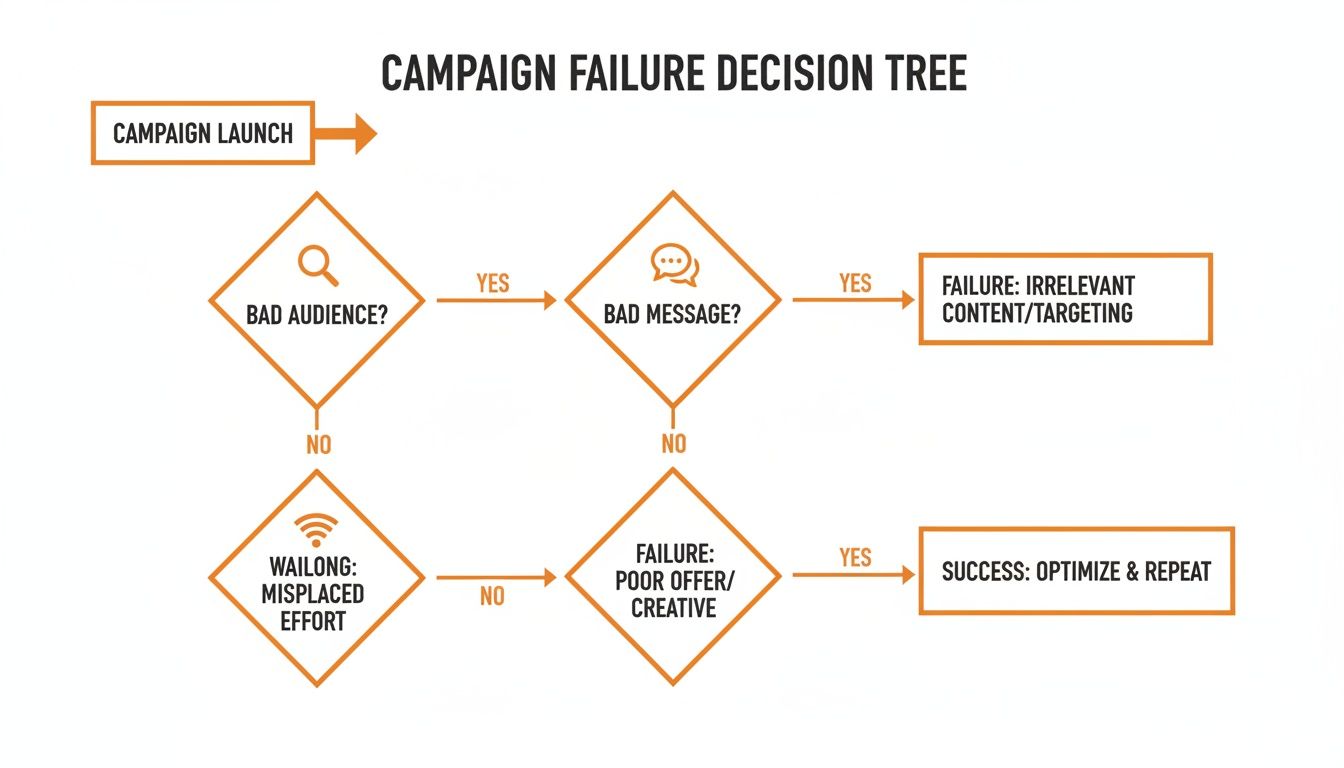
As you can see, getting the audience right is the foundation. Only then can you craft a resonant message and pick the appropriate channel to deliver it.
For instance, a hard-sell B2B ad will almost certainly die a painful death on a community-driven platform like Reddit, where users expect authentic conversation, not a corporate sales pitch. That’s a classic channel mismatch. Likewise, ignoring early feedback is a form of audience deafness. If the first wave of comments and reactions is overwhelmingly negative, doubling down on the same message is a recipe for disaster.
You can get a better sense of how to avoid these traps by studying real-world examples of failed ad campaigns. Learning to spot these mismatches is crucial for building campaigns that feel native and welcome, not intrusive and tone-deaf.
Famous Brand Failures and What They Teach Us
It’s one thing to talk about why campaigns fail in theory, but seeing it happen in the real world—with massive budgets and iconic brands—is where the lessons really stick. Even the biggest players can get it spectacularly wrong. When we pull apart these epic blunders, we find practical truths that are just as relevant for today's SaaS, B2B, and DTC companies.
These stories aren't just business school trivia. They’re cautionary tales that show exactly what happens when the strategic flaws and execution errors we've been discussing go public. Let's dig into two of the most famous marketing disasters and see what they can teach us about really connecting with people.
The Ford Edsel: A Masterclass in Product-Market Mismatch
One of the most legendary face-plants in marketing history belongs to the Ford Motor Company. Back in the mid-1950s, Ford spotted what they thought was a gap in the market and set out to build a groundbreaking car to take on rivals like Oldsmobile and Buick. They called it the Edsel.
Ford’s strategy was simple: build the car first, and figure out how to make people want it later. In 1957, after a year of relentless hype and millions in marketing, Ford launched the Edsel as the "car of the future." They had poured a staggering $250 million into development and promotion—that’s about $2.5 billion today. But when the car actually hit showrooms, sales fell off a cliff. They sold just 63,110 cars in the first year, a brutal miss on their 200,000 unit forecast. The car was a mess mechanically, it was too expensive for an economy sliding into recession, and its unique "horse-collar" grille became a running joke. Two years later, Ford killed the project, taking a $350 million loss. You can get more of the gritty details from Ryan Marketing's analysis of the worst campaigns.
The Edsel is the textbook case of a company falling in love with its own idea while completely ignoring what customers actually wanted.
The fatal flaw was Ford’s assumption that they could tell the market what to want. They were designing in a bubble, running on internal hunches instead of real-world customer insight.
So what's the takeaway here? The lessons apply directly to any modern business, whether you're a scrappy SaaS startup or an established DTC brand.
- Validate Before You Build: The Edsel was a solution looking for a problem. Actionable Insight: Before sinking a fortune into development, create a simple landing page describing your product idea and run $500 in ads to that page. If you can't get people to sign up for a waitlist, you have a problem.
- Read the Room: Ford launched a premium car right as a recession was hitting. You have to pay attention to the economic climate and customer sentiment. A launch date on a calendar doesn't trump reality. Actionable Insight: Monitor industry forums and social media for sentiment. If your target customers are suddenly talking about budget cuts and layoffs, it's a terrible time to launch a premium-priced "nice-to-have" product.
- The Product Has to Deliver: The Edsel looked weird and drove poorly. No amount of slick marketing can cover up a product that doesn't work as promised. The campaign and the product have to be in sync.
New Coke: When Data Blinds You to Emotion
Decades later, another American icon, Coca-Cola, made a similar-sized blunder, but for a totally different reason. It was 1985, and Pepsi was gaining ground with its sweeter flavor. So, Coca-Cola decided to do the unthinkable: change its 99-year-old secret formula.
Unlike Ford, Coca-Cola was swimming in data. They ran over 200,000 blind taste tests, and the results were undeniable—people liked the new, sweeter formula more. Feeling confident, they launched "New Coke" with a massive media blitz and pulled the original off the shelves completely.
The backlash was instant and brutal. The company was buried under thousands of furious phone calls and letters. Loyal fans didn't just dislike the taste; they felt betrayed. For them, Coke wasn't just a drink; it was woven into their memories and personal identity. The taste tests had captured the "what" but completely missed the "why."
Just 79 days later, Coke waved the white flag. They brought back the original formula, cleverly rebranding it "Coca-Cola Classic." People celebrated, and, ironically, the whole disaster ended up making the brand even stronger.
This fiasco is loaded with lessons for marketers today.
- Data Isn't the Whole Story: Numbers from a taste test tell you what people prefer in a sip, not how they feel about a brand. You have to blend quantitative data with qualitative research to get the full picture of what drives your customers. Actionable Insight: Supplement your quantitative surveys with qualitative interviews. Ask 5-10 customers open-ended questions like, "Walk me through the last time you used our product. How did it make you feel?"
- Don't Mess with a Good Thing (Carelessly): Your brand is so much more than your product. It’s a bundle of emotions, memories, and trust. If you're going to make a major change, you have to do it with a deep respect for the relationship you've already built.
- Sometimes, Saying 'We Messed Up' is the Best Marketing: Coca-Cola’s biggest win came from its humility. Admitting they got it wrong and listening to their audience built far more trust than if they had doubled down and pretended the failure never happened.
Both of these stories hammer home the same core truth: great marketing always starts and ends with a deep, honest understanding of your customer. Whether you're selling a car, a soda, or a new SaaS feature, tuning out your audience is a gamble you just can't afford to take.
The Unique Challenges of Reddit Marketing

Marketing on Reddit isn't like anywhere else online. The communities, known as subreddits, are notoriously protective of their spaces, and they can spot a marketer from a mile away.
Trying to use traditional advertising tactics here is like bringing a megaphone to a book club—it’s loud, disruptive, and gets you kicked out fast. Success on Reddit comes from authenticity, subtlety, and genuinely adding to the conversation.
Understanding Subreddit Culture
Every subreddit is its own little world with a unique culture, inside jokes, and unwritten rules. What works in a place like r/gaming will get you absolutely roasted in r/finance.
For instance, just dropping a link to your product without any context is the quickest way to get a flood of downvotes and an outright ban. People on Reddit are highly skeptical of corporate jargon and flashy sales pitches.
Common mistakes that get brands in trouble include:
- Jumping in without reading the community rules (they're usually in the sidebar).
- Using pushy sales language in what's meant to be a discussion forum.
- Ignoring the first few comments that are trying to tell you your approach is off.
The moderators who run these communities enforce the rules with precision. If you ignore the subreddit's wiki, which often lists banned keywords or domains, you're setting yourself up for failure. We once saw a micro-SaaS founder drop their launch link in ten different subreddits at once, only to get shadowbanned everywhere. All that hard-earned credibility? Gone in an instant.
Learning From Infamous Missteps
The infamous Woody Harrelson "Ask Me Anything" (AMA) is a classic cautionary tale. What started as an opportunity for fans to connect with him quickly devolved when he dodged personal questions and tried to steer every answer toward promoting his new movie, Rampart.
Users felt tricked, and the thread turned into a PR nightmare. This perfectly illustrates why 73% of users are on Reddit for genuine conversation, not to be sold to.
The platform's emphasis on genuine connection isn't just about text; it's about emotion. Look at Coca-Cola’s New Coke launch in 1985. On paper, it was a success—55% of participants in blind taste tests preferred the new formula. But the data missed the powerful nostalgia people felt for the original. The public outcry was massive, with over 400,000 complaints. Just 77 days later, they brought back "Coca-Cola Classic," and sales immediately jumped 10%.
Mapping Your Audience Correctly
Smart Reddit marketing begins long before you ever post. It starts with carefully mapping your ideal customer to the right subreddits.
You need to ask some fundamental questions:
- Who are the people already active in this community?
- What are the recurring problems and frustrations they talk about?
- How does what I'm offering genuinely solve one of those problems?
A great tactic is to spend time auditing the top posts and comments to get a feel for the language and sentiment. Think of it like tuning a radio—you have to dial it in just right to get a clear signal.
Native content should feel like it belongs. It's the difference between a fish swimming with the school and a shark crashing the party.
Audience mapping also means understanding when they're actually online. Posting your masterpiece at 3 AM local time is like shouting into an empty room. Use a tool like Later for Reddit to find the best times to post for your target communities.
| Subreddit | Peak Hours (UTC) | Best Content Type |
|---|---|---|
| r/startups | 13:00–16:00 | AMAs and case studies |
| r/Entrepreneur | 18:00–21:00 | Polls and discussions |
| r/SaaS | 08:00–11:00 | Product demos |
Creating Native Content That Builds Trust
The only way to consistently avoid failure on Reddit is to create content that feels like it was made for the community, not just dropped into it.
Instead of a hard pitch, try these approaches:
- Share a detailed case study that directly tackles a pain point you see discussed often. Example: Post a guide titled, "How we reduced our customer churn by 25% using these 3 specific email templates" in r/SaaS.
- Tell a relatable story about a challenge you overcame, rather than just listing product features.
- Host a genuine AMA on a topic you have deep expertise in, not just your product. Example: If you run an SEO agency, host an AMA in r/marketing on "I've analyzed 1,000 SaaS blogs. Ask me anything about content strategy."
To get it right, follow these best practices:
- Engage before you post. Spend a week or two just commenting and contributing to build some credibility.
- Mirror the community's tone. If they use humor and memes, don't be afraid to lean into it.
- Listen to feedback. If the community pushes back, be transparent and willing to adjust.
| Format | Community Response | Best Use Case |
|---|---|---|
| Promotional Post | Usually downvoted into oblivion | Only for dedicated ad subreddits |
| Informative Guide | Highly upvoted and saved | Tutorials, how-to's, and deep dives |
| Open Discussion | Strong, positive engagement | Gathering feedback and validating ideas |
Preventing Tone-Deaf Campaigns
Rushing a promotional post without getting a feel for the community's vibe is a recipe for disaster. One of the best ways to avoid this is to run a "dress rehearsal."
Before you go live, share a draft of your post in a private message with a few active, respected members of the subreddit and ask for their honest feedback.
Here are a few pre-launch checks to run through:
- Have a community insider review your draft for tone and language.
- Double-check that your slang or inside jokes are actually accurate.
- Ensure any visuals you use match the subreddit's aesthetic.
When in doubt, just be a member of the community first. By engaging in conversations for a week or two before you ever post about your brand, you dramatically reduce the risk of being seen as a spammer.
If you're looking for a deeper dive, you might be interested in our guide on Reddit sales strategies. Check out our guide on how to sell on Reddit.
Ultimately, mastering Reddit is about respect and creativity. Treat each subreddit like the unique ecosystem it is, and you can turn casual readers into your biggest advocates.
A Practical Framework for Learning from Failure
Knowing a campaign failed is the easy part. The hard part is figuring out why and making sure it never happens again. Without a system, those hard-won lessons just evaporate. The team moves on, institutional memory fades, and you're doomed to repeat the same mistakes next quarter.
This is where a simple, battle-tested tool called the After-Action Review (AAR) comes in. Borrowed from elite military teams, the AAR is a blame-free process built for one thing: learning quickly and effectively. It forces an honest look at what happened, why it happened, and how to fix it, turning every failure into fuel for future wins.
Adopting the After-Action Review for Marketing
The AAR framework is deceptively simple, built around four direct questions. This structure is its magic—it strips out the emotion and finger-pointing, focusing everyone on solving the problem. A potentially tense post-mortem becomes a productive workshop.
Here's how to adapt the four-step process for your marketing team:
- What did we expect to happen? Get specific. This forces you to revisit your original goals and KPIs. Were you aiming for 1,000 MQLs? A 2% conversion rate? Maybe 50,000 impressions? Put the numbers on the table.
- What actually happened? Now, lay out the cold, hard facts. Pull up the analytics and state what really went down. We only hit 250 MQLs. The conversion rate was 0.4%. We topped out at 15,000 impressions. No sugarcoating allowed.
- Why was there a difference? This is the core of the whole exercise. You dig deep to find the root causes behind the gap between expectation and reality. It's a group effort to uncover what went wrong, not who was wrong.
- What will we do differently next time? This is where insight becomes action. The final step is all about creating a concrete list of changes for the next campaign. No vague promises—just specific, actionable commitments.
By working through these questions in order, your team can systematically pull apart a failed campaign and extract every last drop of value from the experience.
The goal of an AAR is not to find someone to blame for an unsuccessful marketing campaign. It's about identifying weaknesses in the process, strategy, or execution so the entire team can improve.
Putting the Framework into Practice
Let's make this real. Imagine a SaaS company runs a campaign on a tech-focused subreddit, hoping to drive sign-ups for a new feature. The results are a disaster. Here's how the AAR would look:
- Expectation: We projected 500 sign-ups from a series of posts on r/technology, with a landing page conversion rate of 5%.
- Reality: We got 25 sign-ups, and the conversion rate was a dismal 0.8%. Worse, the posts were downvoted into oblivion and flooded with critical comments.
- The Difference: The campaign bombed because our posts were way too salesy for that community (a classic channel mismatch). We also failed to connect our messaging to the actual pain points people were discussing there (a total audience disconnect). Example: Our headline was "Supercharge Your Workflow with Our New AI Tool," but the community was discussing privacy concerns with AI.
- Next Steps: For the next Reddit campaign, our pre-launch checklist will include: 1) Spend a full week just participating in the target subreddit—no promotion, just genuine engagement. 2) Create a long-form guide that delivers real value before we ever ask for a click. 3) Frame the product as a solution to a specific, observed community problem, like privacy.
See? This structured breakdown transforms a vague feeling of "that didn't work" into a clear, documented lesson the whole team can learn from.
Learning from High-Stakes Errors
This isn't just for small-scale campaigns; even global brands can benefit from this kind of rigorous post-mortem. Take Pepsi's infamous 1992 "Number Fever" promotion in the Philippines. A printing error created 800,000 winning bottle caps instead of the planned 20,000. The result was chaos: riots, lawsuits totaling $18 million, and a 20% long-term crash in sales.
The root causes? Sloppy production controls and a complete lack of a crisis plan. It’s a powerful lesson against running gimmicky tactics without operational rigor. You can dive into more stories of major marketing fails and what they teach us.
An AAR on that disaster would have produced painfully obvious action items: implement multi-stage quality control for all promotional materials and develop a crisis communications plan before any large-scale campaign ever goes live. These are the kinds of essential, preventative measures that a structured review of failure brings to the surface.
Frequently Asked Questions
Even with the best frameworks, you're bound to hit some snags when dissecting a campaign that didn't land. Let's tackle some of the most common questions that pop up when you're in the trenches, trying to figure out what went wrong and how to fix it.
How Quickly Can You Really Spot a Failing Campaign?
You can often see the writing on the wall within the first 24 to 72 hours. It's a classic mistake to wait around for lagging indicators like final sales numbers to tell you what the real-time data is already screaming.
Keep a close eye on the immediate metrics. I'm talking about things like abysmal click-through rates (CTR), sky-high bounce rates on your landing page, or a sudden flood of negative comments on social media. These are your canaries in the coal mine.
On a platform like Reddit, the feedback loop is brutally fast. If you see a stream of downvotes or scathing comments within the first hour, that’s your signal. It's a clear sign that your message, tone, or timing is completely off. While you shouldn't panic and pull the plug instantly, these early warnings are your best shot at making quick adjustments before you burn through your budget.
What’s the Single Biggest Mistake That Sinks a Campaign?
Time and time again, the biggest killer is a shallow understanding of the target audience. This is the root cause. Almost every other problem—from weak messaging to picking the wrong channels—stems from this one foundational error.
So many marketing teams lean on broad, generic demographic data instead of doing the hard work of digging for real psychographic insights. They might know who their audience is on paper, but they have no idea why they do what they do, what they truly value, or how they actually talk to each other.
For example, treating all of Reddit as one giant, uniform audience is a guaranteed recipe for failure. Real success comes from deep listening and genuine empathy for the specific communities you're trying to reach, not just a clever idea you cooked up in a conference room.
Can a Brand Actually Recover From a Public Marketing Flop?
Absolutely. A brand can not only bounce back from a public face-plant but sometimes come out even stronger for it. The catch? The recovery has to be built on humility, transparency, and fast, decisive action.
The first, most critical step is to just own the mistake. No excuses. A real, human apology and a clear explanation of what you learned can smooth over a lot of sharp edges.
Here’s how that recovery process usually plays out:
- Acknowledge It Immediately: Don't let the criticism fester in the dark. Address the issue publicly as soon as you realize it's a real problem.
- Apologize Sincerely: A hollow, corporate-speak "we apologize for any inconvenience" will just add fuel to the fire. Be human. Show you get why people are upset.
- Explain What You Learned: This is key. Share how this failure will concretely change your approach moving forward. It shows you’re turning a mistake into a lesson, not just trying to save face.
Coca-Cola's "New Coke" disaster is the textbook example. By listening to the public uproar and quickly bringing back "Coca-Cola Classic," they showed they cared about their customers' emotional connection to the brand. In the end, it actually reinforced loyalty. On a smaller scale, if a Reddit post backfires, a thoughtful, non-defensive comment from the original poster admitting the error can often win over the harshest critics. Ignoring it or deleting the evidence is the worst thing you can do.
How Can I Test Campaign Ideas to Avoid Failure in the First Place?
The best way to de-risk a major campaign is by starting small. Run a series of low-budget experiments to see if your core assumptions actually hold up in the real world. Think of it as building a "minimum viable campaign" before you go all-in.
Before you pour serious time and money into an idea, you can use a few smart tactics to gather data and see if it has legs. This iterative process lets you learn and pivot on a small scale, where the stakes are low.
Try some of these risk-reduction strategies:
- A/B Test Your Creative: Run small, targeted ad sets on platforms like Facebook or Google to test different headlines, images, or value propositions on a slice of your audience. This will tell you which message hits hardest before you scale up your spend.
- "Test the Waters" Organically: For community-driven platforms like Reddit, just show up and participate in relevant conversations without any promotion. Share your point of view, offer value, and see how the community responds. It's a free way to gauge sentiment and learn the local culture.
- Create a Customer Sounding Board: Pull together a small, private group of your most trusted customers or brand advocates. Share your campaign concept with them and ask for their brutally honest feedback. They'll spot blind spots you never would.
When you adopt this experimental mindset, you stop launching massive campaigns based on guesswork and start rolling out data-informed initiatives that have a much higher chance of actually working.
Ready to stop guessing and start winning on one of the internet's most powerful platforms? Reddit Agency helps you craft authentic campaigns that resonate with skeptical communities, turning conversations into conversions. Learn how we can help you build real traction on Reddit.
