
What is ideal customer profile: A Quick Guide to ICP Success
Let’s start with a simple but powerful idea: not all customers are created equal. Some are a perfect fit. They love your product, get immense value from it, and stick around for the long haul. Your Ideal Customer Profile (ICP) is simply a detailed description of that perfect-fit company.
Think of it less as a marketing persona and more as a strategic blueprint. It outlines the specific traits of the companies that benefit most from what you offer and, in turn, provide the most value back to your business.

What Exactly Is an Ideal Customer Profile?
Imagine you’re fishing. You could just cast a huge net into the ocean and hope for the best. You’ll catch something, but you'll waste time and energy dealing with small fish, seaweed, and old boots.
Now, imagine you have a detailed map that shows you exactly where prize tuna school, what specific bait they bite, and the best time of day to catch them. That map is your ICP. It’s a hyper-focused guide that helps you ignore the vast sea of unqualified leads and concentrate all your energy on high-value accounts. An ICP isn't built on guesswork. It's born from analyzing your best existing customers—the ones who are most profitable, loyal, and successful with your solution. You're looking for the common threads that tie them all together.
Key Characteristics of an ICP
A rock-solid ICP is built on hard data points that describe the perfect company for you. These characteristics usually fall into a few key buckets:
- Firmographics: This is the basic company DNA. Think industry, company size (employee count), annual revenue, and geographic location. For example, a practical ICP might be "Series B fintech SaaS companies with 100-500 employees based in North America generating over $10M ARR." This is immediately actionable for a sales team building a prospect list.
- Technographics: This is all about the technology stack a company uses. For instance, knowing your best customers are "companies that use HubSpot for their CRM and Stripe for payments" is a powerful, actionable signal that they're a great fit for your new integration.
- Behavioral Data: This gets into how a company operates. For instance, do your best customers typically have a centralized IT department that makes tech decisions, or do individual department heads have purchasing power? Knowing their buying process helps you understand what triggers a decision and who to talk to.
An effective ICP acts as a compass for your entire organization. It ensures that marketing, sales, and product development are all aligned and rowing in the same direction, targeting accounts that deliver the highest possible lifetime value.
When you have this crystal-clear picture, you stop wasting time and money on prospects who were never going to be great customers anyway. Instead, every bit of effort goes toward finding and winning more of the accounts that truly drive sustainable growth.
Why an ICP Is Your Most Valuable Business Asset
Trying to grow a business without an Ideal Customer Profile is like sailing without a compass. Sure, you're moving, but you're probably not heading toward the right destination, and you're definitely not getting there efficiently. An ICP takes the guesswork out of your strategy and turns it into a focused mission.
With a clear ICP, your marketing efforts become razor-sharp. Instead of casting a wide, expensive net and hoping for the best, you can zero in on the exact channels, messaging, and content that your perfect-fit customers actually care about. This precision is what gets you higher-quality leads and brings down your customer acquisition costs.
Actionable Insight: A B2B SaaS company with a solid ICP ("e-commerce brands using Shopify with over $1M in annual sales") can pinpoint the exact subreddits (like r/ecommerce) or LinkedIn groups where decision-makers are already talking about their problems. Outreach stops being a shot in the dark and starts becoming a high-return activity that builds real connections.
Guiding Product and Sales Alignment
The influence of a good ICP doesn't stop with marketing. It becomes the North Star for your product team, making sure they're building features that solve actual problems for the people who matter most. When your product roadmap is truly aligned with your ideal customer's needs, you'll see satisfaction and retention climb naturally. This kind of alignment is a huge part of achieving a strong product-market fit framework.
Your sales team benefits, too. An ICP is a powerful filter that helps them qualify leads more effectively, focus on high-value accounts, and tailor their pitch to the specific challenges that keep a prospect up at night. For example, if their ICP specifies that their ideal customer struggles with "inventory management across multiple warehouses," the sales rep can lead with a demo of that specific feature instead of giving a generic overview.
A well-defined ICP ensures every department is aiming at the same target. Marketing attracts the right leads, sales closes the right deals, and product builds the right features, creating a powerful cycle of sustainable growth.
A Living Document for Sustained Growth
Here’s the thing, though: an ICP isn't something you create once and then file away. It's a living, breathing asset that has to evolve right alongside your business and the market. The companies that really get this right treat it that way.
In fact, companies that refresh their ICPs every 6-12 months using real behavioral data have seen their profitability jump by 2-3x. This data-first approach, which can also boost lead quality by 35%, starts by looking at your best customers—the ones generating 80% of your revenue from just 20% of your customer base and sticking around for the long haul. Regularly updating your profile keeps you ahead of the curve and ensures you’re putting your resources where they’ll deliver the biggest returns. You can dive deeper into these findings in Simon-Kucher's in-depth analysis.
ICP vs Buyer Persona vs Target Market
Let's clear up some confusion. In marketing, you hear a lot of terms thrown around—Ideal Customer Profile, Buyer Persona, Target Market—and they often get used like they mean the same thing. They don't. While they’re all related, each one plays a very specific role in your strategy.
Getting the distinctions right isn't just about semantics; it's about focusing your effort where it will have the biggest impact.
Think of It This Way
Imagine you're trying to sell high-end athletic gear.
Your Target Market is the entire stadium full of sports fans. It’s a massive, general audience defined by a broad interest—in this case, "people who like sports." This group is way too big to target effectively.
Your Ideal Customer Profile (ICP) zooms in on the professional sports teams within that stadium. These are the organizations that are a perfect fit for your product. You're no longer targeting everyone; you're focused on "professional football teams in the NFL with over $500M in revenue." Your ICP is all about the company.
Your Buyer Persona is the specific person you need to talk to on that team—say, the Head of Player Performance. This is a fictional character sketch based on real data about the decision-makers. You’ll give them a name, like "Coach Alex," and dig into their goals ("reduce player injuries by 15%"), daily frustrations ("sifting through messy performance data"), and what they need to succeed.
ICP vs Buyer Persona vs Target Market at a Glance
To put it all together, these concepts form a funnel, moving from the broadest audience to a single decision-maker. Each one answers a different strategic question, guiding your team from high-level planning down to the nitty-gritty of a sales email.
This table breaks down the core differences in a simple way.
| Attribute | Ideal Customer Profile (ICP) | Buyer Persona | Target Market |
|---|---|---|---|
| Focus | The perfect-fit company or account | A semi-fictional person at that company | A broad group of potential customers |
| Scope | Firmographic (industry, size, revenue) | Psychographic (goals, challenges, motivations) | Demographic (age, location, interest) |
| Used For | Account-based marketing, sales qualification | Content marketing, copywriting, messaging | Market sizing, brand awareness campaigns |
| Practical Example | "US-based SaaS companies with 50-250 employees" | "Marketing Mary, a 35-year-old Marketing Director trying to prove ROI" | "Adults aged 25-55 interested in technology" |
Understanding this hierarchy prevents you from wasting time and money. You start with the right market, filter for the best-fit companies, and then craft messages that truly connect with the people who hold the purse strings.
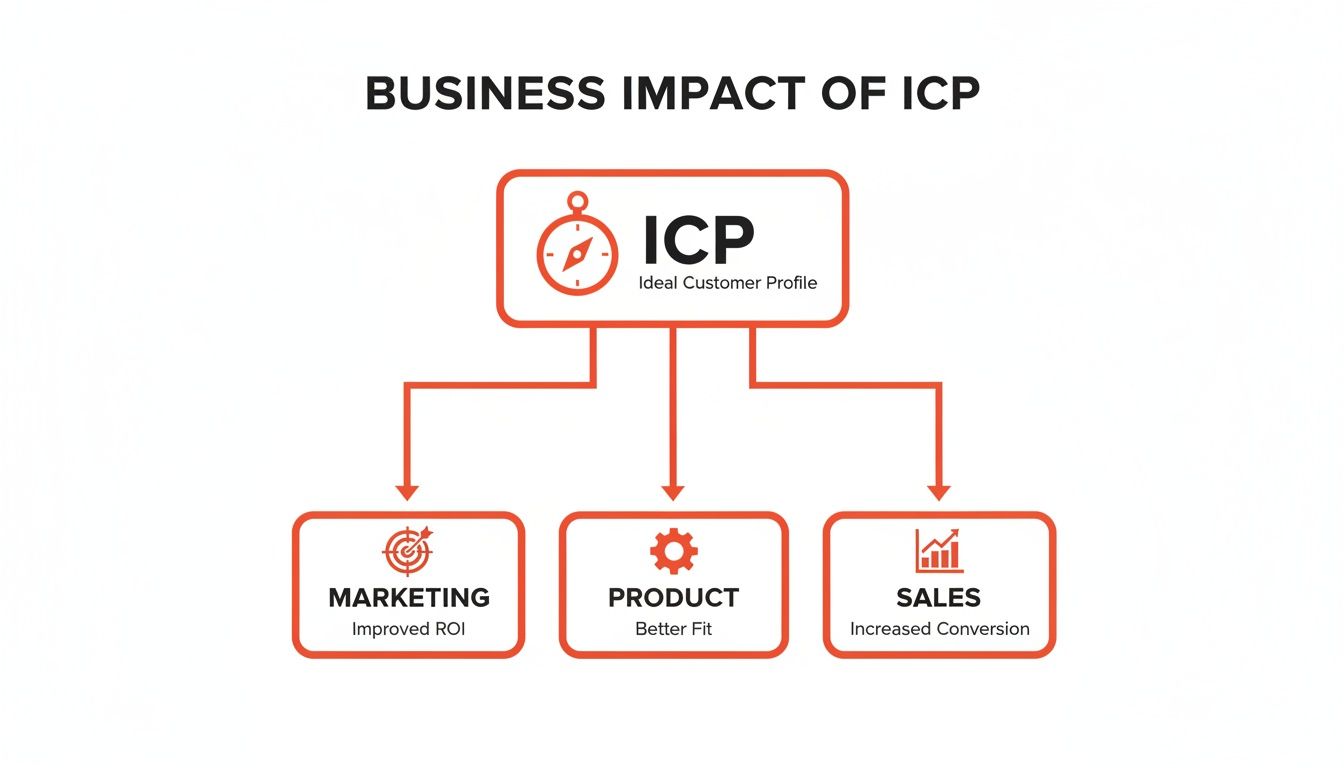
As you can see, a well-defined ICP is the cornerstone. It directly informs the goals and day-to-day work of your sales, marketing, and even product development teams, ensuring everyone is pulling in the same direction.
These three concepts aren’t in competition—they work together. Your Target Market identifies the pond you're fishing in, your ICP points to the biggest, best fish, and your Buyer Persona tells you exactly what kind of bait to use.
When you nail this progression, your entire go-to-market strategy becomes sharper and more efficient. If you want to get even more granular on this, it's worth learning how to create B2B buyer personas that complement your ICP.
The Core Components of a Powerful ICP
A truly powerful Ideal Customer Profile is built on hard data, not just a hunch or a vague description of who you think you should be selling to. Forget a rough sketch; think of this as an architectural blueprint for the perfect-fit company. To get there, you need to collect the right information.
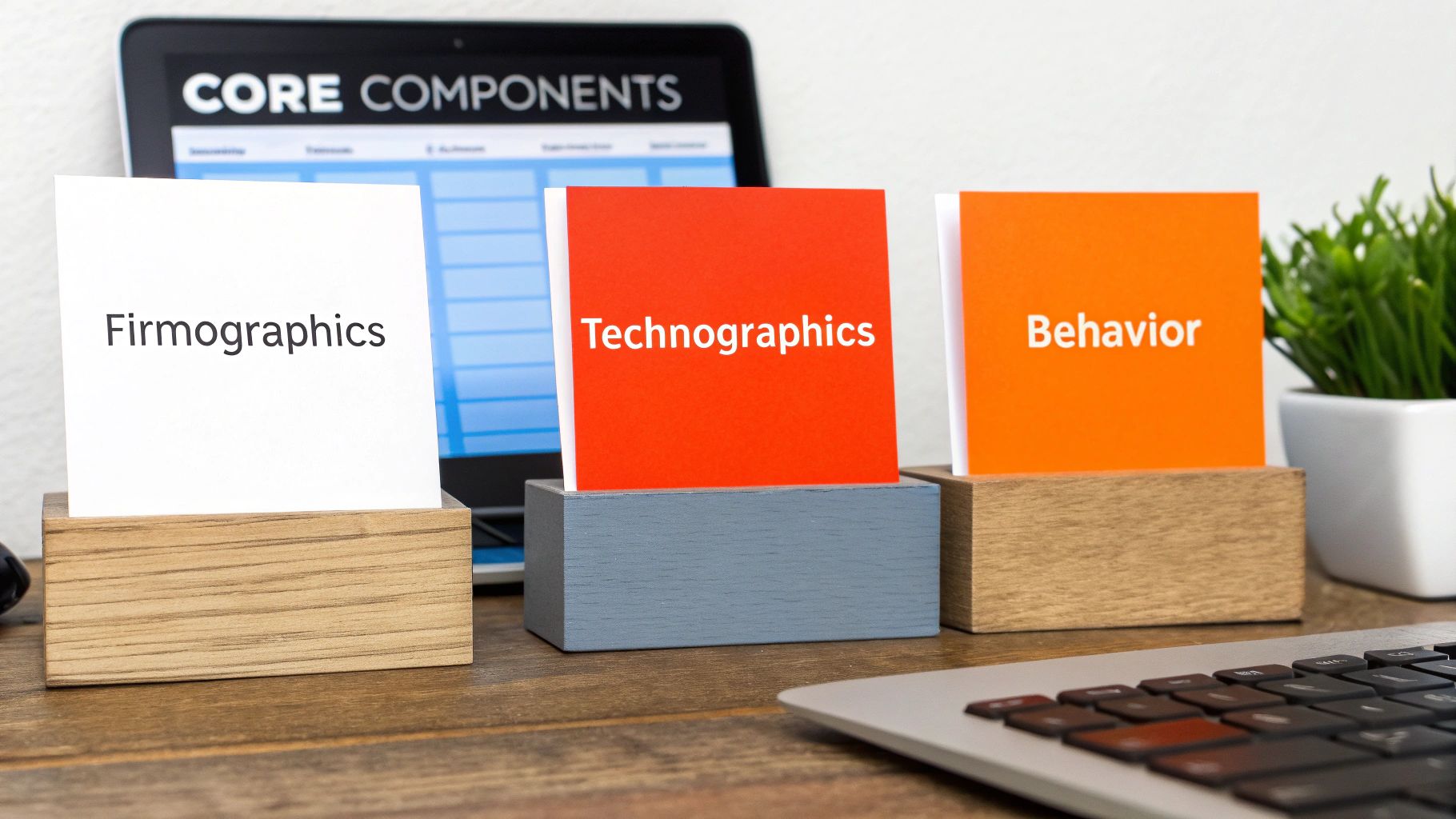
This blueprint is really built from three core pillars of data. Each one adds another layer of detail, and when you put them all together, you get a crystal-clear, actionable picture of the companies you should be going after.
Pillar 1: Firmographics
Let’s start with the basics: firmographics. These are the foundational, verifiable facts about a company. Think of it as the company's vital statistics—the kind of stuff you could dig up in a business directory, but organized with purpose. This data tells you who the company is on paper.
Practical Example: A cybersecurity firm's ICP might include firmographics like:
- Industry: Healthcare or Finance (due to high regulation).
- Company Size: 200-1000 employees (large enough to have a budget, small enough not to have a massive in-house security team).
- Annual Revenue: Over $50M (indicating ability to invest in security).
- Geographic Location: United States (due to specific data privacy laws like HIPAA).
This firmographic profile immediately tells the sales team to focus their efforts on mid-sized American hospitals and regional banks, rather than small startups or overseas companies.
Pillar 2: Technographics
Next up, we have technographics, which is a fancy way of saying "the technology stack a company uses." This data is a goldmine because a company’s software choices tell you so much about their maturity, their priorities, and where they might have gaps.
Practical Example: A marketing automation tool's ICP could specify technographics such as:
- CRM: Uses Salesforce (suggesting a mature sales process).
- CMS: Built on WordPress (meaning they likely need marketing plugins).
- Cloud Infrastructure: Runs on AWS (signaling technical sophistication).
If a lead comes in that uses Salesforce, the marketing team can automatically send them a case study about Salesforce integration, making the outreach far more relevant and effective.
Pillar 3: Behavioral Data
Finally, there’s behavioral data. This is where you look at how your ideal customers actually act. This layer goes beyond static numbers to uncover their habits, challenges, and what makes them finally decide to buy. It’s all about understanding their journey and what drives their decisions.
Practical Example: A project management software company might identify these behaviors in their ICP:
- Pain Points: They frequently mention "missed deadlines" and "poor cross-team visibility" in sales calls.
- Buying Triggers: A recent funding round or hiring a new "Head of Operations" often precedes their search for a solution.
- Content Consumption: They download the "Ultimate Guide to Remote Team Collaboration" before requesting a demo.
These behavioral insights are key indicators for successful organic marketing strategies. For example, the marketing team can now run targeted ads at companies that just announced a Series A funding round.
How to Build Your Ideal Customer Profile Step by Step
Alright, let's get our hands dirty. Creating an Ideal Customer Profile isn't just a thought exercise; it's a practical, data-first process. The goal here is to transform all that customer insight into a concrete action plan your entire team can actually use.
We’ll walk through this using a running example. Imagine we're a B2B project management software company that feels like its marketing is all over the place. They need to get focused, fast.

Step 1: Identify Your Best Customers
Your best customers are the bedrock of your ICP. The truth is, not all customers are created equal. Your first job is to pinpoint the absolute gems in your current client list.
Actionable Insight: Don't just go with your gut. Pull a report from your CRM or billing system. Create a simple spreadsheet listing all your customers and add columns for:
- Lifetime Value (LTV)
- Renewal Rate
- Number of Support Tickets (lower is better)
- Referrals Made
Sort this list by LTV. The companies at the top that also have high renewal rates and low support loads are your starting point. Our project management tool does this and finds their top 20 accounts are consistently generating 75% of their expansion revenue.
Step 2: Interview Your Top Clients
Once you know who your best customers are, it’s time to find out why. The data in your CRM tells you what they are, but hopping on a call will reveal the human story behind their success with your product.
Actionable Insight: Reach out with a simple, honest email: "Hi [Name], we're doing some research to better serve customers like you, and your perspective would be invaluable. Would you be open to a 15-minute chat next week? As a thank you, we'll send a $50 gift card."
During the call, ask open-ended questions like:
- "Walk me through the day before you started using our tool. What was most frustrating?"
- "What was the 'Aha!' moment when you knew our product was working for you?"
- "If our product disappeared tomorrow, what would be the biggest problem for you?"
Following our example, the software company interviews five clients. A powerful theme emerges: their best customers were all wrestling with chaotic cross-departmental communication right as they grew past 50 employees. That's a game-changing insight.
Step 3: Consolidate and Analyze the Data
Now it's time to bring it all together. You've got the hard data from Step 1 and the rich, qualitative stories from Step 2. Start looking for the common threads that connect all your best customers.
Actionable Insight: Create a simple table or use a whiteboard. List your top customers down one side. Across the top, list attributes like Industry, Employee Count, Revenue, Key Pain Point, and Buying Trigger. Fill it out. Patterns will jump out at you.
Our project management tool discovers a clear pattern. Their ideal clients are almost all B2B tech companies with 50-200 employees and $5M-$20M in revenue. They also find that nearly every single one uses Slack and has a dedicated project manager on their team.
Step 4: Draft Your ICP Document
With your research complete, you can finally create the ICP document. This should be a clear, simple profile that anyone—from sales to marketing to product—can pick up and understand immediately.
Actionable Insight: Don't write a novel. Use bullet points and clear headings. A clean, one-page summary is almost always the most effective format. If you need a starting point, using a SaaS Ideal Customer Profile template can help structure your findings. For our example company, the summary looks like this:
- Industry: B2B Tech/SaaS
- Company Size: 50-200 employees
- Revenue: $5M - $20M ARR
- Key Pain Point: Communication breaks down during rapid growth.
- Tech Stack: Uses Slack, Google Workspace.
- Buying Trigger: Recently hired a dedicated Project or Operations Manager.
Step 5: Validate and Refine
An ICP is a living document, not a stone tablet. It needs to be tested in the real world. The final step is to validate your work by running targeted campaigns aimed squarely at companies that fit your new profile.
Actionable Insight: Create a pilot sales campaign targeting a list of 50 companies that perfectly match your newly drafted ICP. Track the results meticulously: open rates, reply rates, meetings booked, and deal velocity. Compare these metrics against your previous, broader outreach efforts. If the results are significantly better, you've validated your ICP. If not, go back to your interviews and data to see what you missed.
This feedback loop is what separates good from great. In fact, companies that continuously refine their ICPs using real-world data see a 2.8x higher probability of upselling. Tying your ICP to actual product usage data can even slash Customer Acquisition Costs (CAC) by up to 19%. Use this data to constantly sharpen your definition of the perfect customer.
Common Questions About Ideal Customer Profiles
Once you start thinking about building an Ideal Customer Profile, a few practical questions almost always pop up. It's one thing to understand the concept, but it's another to put it into practice.
Let's walk through a few of the most common hurdles people face when they start getting serious about their ICP.
How Often Should I Update My Ideal Customer Profile?
Think of your ICP as a living document, not a "set it and forget it" project. Markets change, your product gets better, and your customers' needs evolve. Sticking with an outdated profile is like using an old map to navigate a new city.
As a general rule, you should plan on a formal review and tune-up every 6 to 12 months.
Actionable Insight: Set a recurring calendar event for your leadership team titled "ICP Review." In preparation, have your team pull a fresh report of your top 20% of customers and compare their attributes to your current ICP document. Has the average customer size increased? Is a new industry emerging as a top performer? These questions will guide your update.
Also, trigger an immediate revisit if:
- You launch a major new product or feature set.
- You enter a new geographic or industry market.
- Your win/loss analysis shows you're consistently losing to a specific competitor in a certain segment.
What If My Business Has No Customers Yet?
This is the classic "chicken-and-egg" situation for every new venture, but it’s not a showstopper. If you don't have customer data, you have to start with a hypothetical ICP. It’s your best-educated guess.
Actionable Insight: Start with the problem you solve. Write it down in one sentence. Now, brainstorm a list of companies that feel this pain most acutely. For example, if your software automates legal document creation, your hypothetical ICP would logically start with "small law firms" or "in-house legal teams at startups" because they lack the resources of large corporations.
Next, find 10-15 people on LinkedIn who work at these types of companies and offer them a gift card for 20 minutes of their time to discuss their daily challenges. This early "problem discovery" is crucial for shaping your first ICP.
Your first ICP is a starting hypothesis. The whole point of your early sales and marketing is to go out and test that hypothesis against the real world. Be ready to learn and pivot quickly as the first bits of real data come in.
Can a Business Have More Than One ICP?
Absolutely. In fact, many successful businesses need more than one. If you serve different types of customers with distinct needs, trying to fit them all into a single profile will just muddy the waters.
For instance, a cybersecurity firm could have two completely different ICPs:
- ICP #1: The Mid-Market Tech Company. Firmographics: 200-1000 employees, SaaS industry. Pain Point: Needs to achieve SOC 2 compliance to close enterprise deals. Buying Trigger: A major client is demanding a security audit.
- ICP #2: The Regional Hospital. Firmographics: 100-500 employees, Healthcare industry. Pain Point: Needs to protect patient data and ensure HIPAA compliance. Buying Trigger: Facing a government audit or a recent data breach in their industry.
These two groups have different problems, different budgets, and entirely different ways of making purchasing decisions. The key is to create a unique, detailed profile for each segment. This lets you sharpen your messaging and tailor your entire approach to resonate with each group, making your efforts far more effective.
Ready to stop guessing and start targeting the right customers on Reddit? The team at Reddit Agency specializes in mapping your Ideal Customer Profile to the subreddits where your future champions are already talking. We turn authentic conversations into measurable traffic, leads, and growth. Learn more about how we can help you win on Reddit.
