
Digital Marketing for a Startup: A Practical Guide to Fast Growth
For a startup, digital marketing isn't about blanketing the internet with ads. It's about making smart, surgical choices to find your first customers without burning through cash. The whole game is about pinpointing a very specific audience, finding them in their natural online habitats, and talking to them like a real person to build early momentum.
This means prioritizing high-impact, low-cost moves over flashy, expensive campaigns. Every dollar, every hour has to count. An actionable insight here is to focus on one channel, like Reddit, and become a trusted voice in a relevant subreddit before even thinking about paid ads. This costs you time, not cash, and builds a foundation of trust.
Building Your Startup Marketing Foundation
Before you even think about spending money on ads, you need to pour a solid foundation. I’ve seen countless startups fail not because the product was bad, but because they were shouting their message at the wrong people in the wrong places. Getting this foundational work right from the start saves you a fortune in wasted ad spend and makes sure every marketing move you make is guided by a clear, data-backed strategy.
The digital marketing world is huge and only getting bigger. It was valued at $531 billion in 2022 and is on track to hit $807 billion by 2026. What this means for startups is that smart digital investments can deliver an outsized return compared to old-school channels. Startups that are clever enough to get in early on emerging platforms like Reddit can grab customer attention for a fraction of what their competitors are paying on oversaturated channels like Google or Facebook.
Define Your Ideal Customer Profile
First things first, forget those vague, fluffy buyer personas. As a startup, you need a laser-focused Ideal Customer Profile (ICP). This isn't just a sketch of demographics; it's a crystal-clear picture of the exact person or company feeling the most intense pain that your product solves. A truly powerful ICP is built from real-world problems and observable online behavior, not just guesswork.
If you want to dig deeper, you can check out our guide on what an Ideal Customer Profile is and why it's so critical for hitting your targets.
To start building your ICP, you need to answer some very practical questions:
- What specific, urgent problem are they trying to solve? Go deeper than the surface-level stuff. For a SaaS tool, the problem isn't just "managing projects." It's "stopping our remote team from constantly missing deadlines on critical client work." See the difference? A practical example: a startup with a project management tool might discover their ICP isn't just 'project managers', but 'project managers at marketing agencies with 10-50 employees who are struggling to manage client feedback.'
- What have they already tried that didn't work? Knowing their past failures tells you everything about their frustrations and what they truly value in a fix. For example, they might have tried Trello but found it too simplistic, or Jira but found it too complex for their non-technical team members. This is gold for your messaging.
- Where do they actually go online for advice? This might be the most important question of all. Do they religiously read certain industry blogs, follow specific influencers, or, more likely, ask for genuine recommendations in niche Reddit communities? An actionable insight: spend a week lurking in subreddits like
r/projectmanagementand note the exact language people use when they complain about their current tools.
A core step in any marketing plan is figuring out how to find your target audience. This process is what turns all that customer research into a plan you can actually execute.
Map Your ICP to Digital Channels
Once you have that sharp ICP, the next logical step is to find out where these people hang out online. This isn't about being everywhere; it's about being on the right platforms, where your presence will have the most impact.
The goal is to discover where your customers have authentic conversations. Your marketing should start there, adding value to those discussions long before you ever try to sell.
For instance, if your ICP is a micro-SaaS founder, they're almost certainly lurking in subreddits like r/SaaS, r/microSaaS, and r/startups. They probably listen to a few specific podcasts and follow a handful of developers on X (formerly Twitter). A practical example: search for "best CRM for small business" on Reddit and see which communities pop up. Those are your starting points.
By identifying these digital watering holes, you're essentially creating a treasure map. This map will guide your entire go-to-market strategy, ensuring your message lands right in front of the people who genuinely need what you've built.
How to Select Your First Marketing Channels
Okay, you’ve mapped out your Ideal Customer Profile. Now it’s time to decide where to actually find them. For a startup, this isn't about being everywhere; it's about being in the right one or two places with intense, overwhelming focus.
Picking the wrong channels is like trying to sell ice to Eskimos. You can have the best product in the world, but if you're talking to the wrong audience in the wrong place, you're just shouting into the void.
The goal here is to build a Minimum Viable Marketing stack. That means picking just one to three channels that offer the highest potential return for your specific product and budget. Spreading yourself too thin is a classic startup mistake that guarantees you'll be mediocre everywhere and an expert nowhere. Real traction comes from dominating a single channel before you even think about expanding.
This decision tree gives you a bird's-eye view of the whole process, from understanding your customer to picking a channel and launching a strategy.
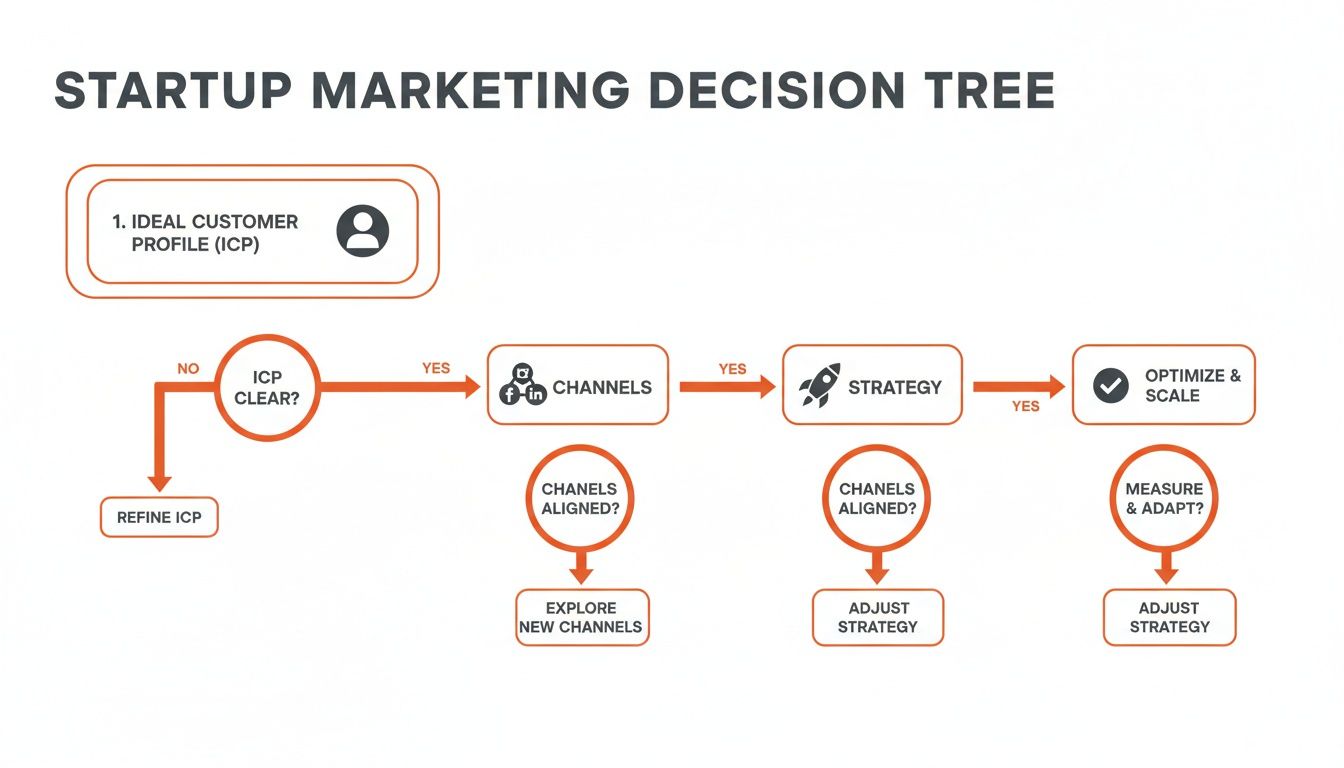
As you can see, every strategic choice flows directly from a deep understanding of your customer. This is what stops you from just "doing random acts of marketing" and hoping for the best.
Prioritizing Channels by Startup Type
Your business model is the best filter you have for choosing a channel. What works wonders for a direct-to-consumer (DTC) brand might be a complete money pit for a B2B SaaS company.
Here’s a practical way to think about it:
- For SaaS Startups: Your main focus should be on channels where people are actively looking for solutions or geeking out about industry problems. This makes SEO/Content Marketing and Community Marketing (like on Reddit) incredibly powerful. Answering a niche technical question in
r/devopsor writing a definitive blog post on "How to Solve X" instantly positions you as an expert and pulls in high-intent traffic. Practical example: A DevOps tool startup could create a detailed tutorial on "Automating CI/CD Pipelines with Kubernetes" and share it inr/devops, focusing on solving the problem, not pitching the product. - For DTC Brands: Marketing for you needs to be visual, inspiring, and packed with personality. This puts Paid Social (think Instagram and TikTok) at the top of your list. These platforms let you show your product in a real-world, lifestyle context and use user-generated content to build social proof almost overnight. Practical example: A sustainable sneaker brand could run TikTok ads featuring real customers unboxing their shoes and talking about the comfort and eco-friendly materials.
- For B2B Startups: Here, the sales cycle is longer, and decisions are built on a foundation of logic and trust. Channels like LinkedIn (for professional networking and content) and SEO (for capturing decision-makers who are researching solutions) are your bread and butter. The game is to educate and build relationships over time, not go for the quick sale. Practical example: A B2B cybersecurity startup could publish a whitepaper on "The Top 5 Security Threats for SMBs in 2024" and promote it through targeted LinkedIn posts to IT managers.
To make this even clearer, I've put together a simple framework to help you weigh the pros and cons of the most common startup channels.
Startup Marketing Channel Prioritization Framework
| Channel | Typical Cost | Time to ROI | Best For (Startup Type) | Key Metric |
|---|---|---|---|---|
| SEO/Content | Low-Medium | 6-12 months | SaaS, B2B | Organic Traffic, Keyword Rankings |
| Paid Social | Medium-High | 1-3 months | DTC, B2B (niche) | Cost Per Acquisition (CPA), ROAS |
| Community (Reddit) | Low | 1-4 months | SaaS, DTC, B2B (niche) | Sign-ups, Qualified Leads |
| Paid Search (PPC) | Medium-High | <1 month | SaaS, DTC | Cost Per Click (CPC), Conversion Rate |
| Low-Medium | 3-6 months | B2B | Lead Quality, Engagement Rate |
This table isn't gospel, but it's a solid starting point for figuring out where your limited time and money will have the biggest impact early on.
The Power of Channel Synergy
While intense focus is key, the really smart move is to find channel pairings that create a compounding effect. For instance, combining SEO with paid search can give you a serious boost. Some great digital marketing statistics show that companies running both PPC and SEO see 25% more clicks and 27% higher profits compared to those using just one.
It's not just about ads, either. For B2B companies, 71% of marketers say content has become more critical, with consistent publishers seeing 3-4 times more qualified inquiries. This all points to a lean, thoughtful multi-channel approach rather than just betting the farm on a single platform.
Don't just pick channels; pick a system. Your channels should feed each other. Content from your blog (SEO) can be chopped up and repurposed for Reddit posts (Community), which then sparks discussions that give you fresh ideas for more blog content. That's a growth loop.
Testing and Validating Your Chosen Channels
Once you've made your initial picks, you need to test them—quickly and cheaply. The whole point is to find early signs of life before you commit a serious budget.
- Set a Small Test Budget: This could be financial (e.g., $500 for a test ad campaign) or time-based (e.g., 20 hours dedicated to organic Reddit engagement). The key is to cap your initial investment so you can afford to be wrong. Actionable insight: Your first $500 in ads isn't to get sales; it's to buy data. Your goal is to learn which ad copy gets the best click-through rate.
- Define a Single Success Metric: Don't get lost in vanity metrics. For a Reddit test, it might be "10 qualified sign-ups from comments." For a TikTok campaign, it could be "a cost per click under $1.50." Get specific.
- Run the Test and Analyze: Execute your small-scale experiment for a short, defined period—say, two to four weeks. When it's over, look at the data. Did you hit your metric? Was the feedback positive? Was it a total flop?
Based on those results, you have a clear decision: double down on what’s working, tweak your approach, or kill it and pivot to a different channel. This iterative process is the absolute core of effective startup marketing. It ensures every move you make is backed by real-world data, not just assumptions.
Creating Your First 90-Day Marketing Plan
A brilliant strategy is just a document until you attach a timeline and a budget to it. For a startup, those first 90 days of digital marketing are everything; they set the pace for all that follows. This isn't about chasing huge vanity metrics—it's about building real momentum, learning as fast as you can, and proving your concept in the wild.
The goal is to lay out a realistic roadmap that front-loads high-impact, low-cost activities. By chasing those early wins, you start building a sustainable marketing engine that can actually scale as your startup finds its footing.
Structuring Your 90-Day Sprint
Think of your first three months as a series of sprints, each with a crystal-clear focus. This phased approach keeps you from getting overwhelmed and makes sure your efforts build on one another. You start by learning, move to careful execution, and then start tweaking for growth.
Here’s a practical, phased breakdown you can adapt for your own startup:
Month 1 (Days 1-30): The Foundation Phase
The entire first month is for research and setup. Seriously. The single most common mistake I see startups make is rushing this step. Getting the foundation right means you're not just throwing spaghetti at the wall when you finally start spending time and money.
- Weeks 1-2: Subreddit and Community Analysis: Time for a deep dive into the communities you already identified. Map out the top subreddits, pinpoint the real influencers (not just the loudest voices), and start documenting the common questions, pain points, and lingo your ICP uses every day. Practical example: Create a spreadsheet listing 5-10 target subreddits. For each one, log the top 3 pain points mentioned in the last month and the exact phrasing used.
- Weeks 3-4: Content and Engagement Planning: With that research in hand, outline your first 5-10 value-driven Reddit posts and comments. The key here? Don't sell anything. Plan to answer questions, share a genuinely helpful resource, or offer a unique take on a problem everyone is complaining about. Actionable insight: Your first posts should be questions to the community, such as, "What's the most frustrating part of [X problem] for you all?" This builds karma and provides market research.
Month 2 (Days 31-60): The Execution Phase
Alright, pencils down. Now it's time to act. This month is all about putting your content out there, engaging like a real human, and gathering your first precious data points from the real world.
- Weeks 5-6: Launch First Organic Reddit Campaign: Start posting and commenting based on your plan. Remember, the goal is not to go viral. The goal is to start genuine conversations and establish yourself as a helpful, contributing member of the community. Practical example: If you see a question you can answer, write a detailed, helpful comment. At the end, you can say, "I've thought a lot about this while building a tool for [problem space]." No link, just a hint.
- Weeks 7-8: Measure Initial Engagement: Track everything. How many upvotes did your posts get? More importantly, how many meaningful back-and-forths did you have in the comments? Are people actually clicking the links in your profile?
Month 3 (Days 61-90): The Optimization Phase
With a month of data under your belt, you can finally start making smarter decisions. This is where you figure out what worked, what bombed, and begin to scale your efforts intelligently.
- Weeks 9-10: Analyze and Refine: Take a hard look at your best-performing posts and comments. What did they have in common? Was it the topic? The tone? The format? Double down on whatever that is. Actionable insight: If a comment where you shared a mini-framework got a lot of upvotes, turn that framework into a full blog post or a visual guide.
- Weeks 11-12: Introduce a Small Paid Test: Now that you have some learnings from your organic work, you can run a highly targeted, low-budget ad campaign without just guessing. A great starting point is to promote your most helpful organic post to a lookalike audience.
Allocating a Lean Startup Budget
When cash is tight, every single dollar has to pull double duty. The biggest pitfall is spreading a small budget too thin across too many channels. Don't do it. Instead, focus your funds on proving that one or two channels can really work for you.
For a startup, the initial marketing budget isn't for scaling—it's for learning. You're buying data and insights that will tell you where to invest your next round of funding or revenue.
Here’s how a startup might realistically allocate a hypothetical $1,000/month budget:
- Community Management & Content Tools ($150): This could go toward tools that help with social scheduling or analytics to make your organic efforts more efficient. Practical example: A subscription to a tool like Buffer or a keyword research tool like Ahrefs' free Webmaster Tools.
- Small-Scale Paid Ads ($500): A dedicated budget for dipping your toes into platforms like Reddit Ads or Google Ads. This is purely for gathering data on which messages connect and what your cost per click (CPC) actually looks like.
- Content Creation ($350): This could be a small stipend for a freelance writer, a subscription to simple design software, or even a small budget to boost your highest-performing organic content. Practical example: Use Canva for creating simple graphics or pay a freelancer on Upwork to turn your blog post into a shareable infographic.
This focused allocation ensures your spending is tied directly to learning and validation. By following this 90-day plan, you’ll move from theory to action, building a data-backed foundation for your startup’s long-term growth.
So, You Want to Market on Reddit? Here's How to Actually Do It Right.
Forget everything you think you know about social media marketing. Reddit is a different beast entirely. It's not one big platform; it's a massive collection of thousands of super-focused, highly engaged niche communities. If you try to just blast your startup's promos here, you'll get eaten alive.
The secret to winning on Reddit is to stop thinking like a marketer and start acting like the most helpful, knowledgeable person in the room. You have to genuinely solve problems, answer questions, and share real insights without asking for a single thing in return. Do that consistently, and you'll build something far more valuable than clicks: trust. That trust is what turns skeptical Redditors into your first, most passionate users.

When you nail this, you get unfiltered access to the very people you built your product for. That’s an absolute goldmine for any startup.
First, Find Your People (The Right Subreddits)
Your first job is to figure out where your ideal customers are hanging out. These communities, or "subreddits," can be anything from r/SaaS for software founders to r/SkincareAddiction for beauty junkies. Don't just target the biggest ones; the real magic is often in the smaller, more dedicated subreddits.
Hop on Reddit and start searching for keywords tied to your industry, your product, and the problems it solves. As you explore, keep an eye out for a few key signals:
- Real Conversations: Look for subreddits with daily posts and, more importantly, a good number of comments on each one. A tight-knit community of 10,000 members with lively discussions is way better than a ghost town of 500,000.
- The Vibe: Every subreddit has its own personality. Is it cynical? Genuinely helpful? Full of memes? Read the rules, lurk for a bit, and get a feel for the tone. Your posts have to match it perfectly.
- Pain Points on Display: The best subreddits are filled with people openly discussing the exact problems you solve. These posts are your roadmap for what content to create and how to engage directly. Actionable insight: Use the search bar within a specific subreddit to look for terms like "frustrated with," "alternative to," or "how do I." This will surface the most urgent problems.
Once you have a shortlist, your real work begins. If you're just getting started, our complete guide on https://redditagency.com/blog/using-reddit-for-marketing is a great place to build your foundation.
Ditch the Sales Pitch. Create Real Value.
Redditors can smell a sales pitch from a mile away. If your post feels like an ad, it's going to get downvoted into oblivion before anyone even sees it. Your entire focus should be on helping, teaching, or entertaining.
A simple rule of thumb for Reddit: Give, give, give 90% of the time. Only after you've built a reputation for being genuinely helpful can you ask for something 10% of the time. Earn the right to promote.
In a world of text-heavy posts, video can really make you stand out. Learning how to create viral Reddit AI video content can give you a massive edge in grabbing attention and communicating your value quickly.
Sample Reddit Campaign Blueprints for Startups
The right tactic depends entirely on your startup and your goals. To get you started, here are a few practical blueprints you can steal and adapt for your own campaigns.
| Startup Type | Campaign Goal | Example Subreddits | Post Type/Angle | Success Metric |
|---|---|---|---|---|
| SaaS | Get product feedback | r/SaaS, r/microSaaS |
"Show Reddit: I built a tool to solve [specific problem]. Seeking honest feedback." | 20+ insightful comments |
| DTC Brand | Drive launch traffic | r/malefashionadvice |
"I spent 6 months designing the perfect [product]. Here's a deep dive into the process." | 500+ unique site visitors |
| B2B Service | Generate qualified leads | r/sales, r/marketing |
"Here's the exact 5-step framework we used to achieve [specific result]. Free template inside." | 25+ qualified lead magnet downloads |
| Mobile App | Acquire beta users | r/iosapps, r/androidapps |
"Looking for 50 beta testers for my new [app category] app. Free lifetime access for feedback." | Beta sign-up goal met |
These are just starting points, of course. The key is to always frame your activity around the community's needs, not your own.
The Real Work Happens in the Comments
The original post is just the beginning. The comment section is where you build real relationships and prove you’re not just another drive-by marketer. It's your chance to talk to people one-on-one.
Here's how to engage like a pro:
- Be Human: Use "I" and "we." Share a personal story. Admit when you don't know something. Authenticity is everything on Reddit.
- Reply to Everyone: If someone takes the time to comment on your post, respect that by giving them a thoughtful reply.
- Point to Other Resources: Someone asks a follow-up question? Link them to a great article or tool—even if it isn't yours. This proves your goal is to help, not just to sell. Practical example: If someone in
r/webdevasks about hosting and you sell a deployment tool, you can answer their question and link them to a DigitalOcean tutorial. This builds immense trust.
Follow this playbook, and you'll do more than just drive a little traffic. You'll build a loyal community of early adopters who will champion your startup because they believe in the value you provide. That's how Reddit becomes a true engine for growth.
Measuring What Matters to Drive Growth
Let’s be honest: marketing without measurement is just throwing money at a wall and hoping something sticks. As a startup, you can't afford to guess. Every dollar, every hour has to count, and that means tracking data that signals real, sustainable progress—not just numbers that stroke your ego.
This is where you learn to ignore the vanity metrics (like social media likes) and focus on the actionable insights that actually move the needle for your business.

The point isn't just to collect data. It's about understanding the story that data is telling you. That story is what helps you stop doing random marketing tasks and start building a predictable growth engine.
Ditching Vanity for Actionable Metrics
Vanity metrics feel great. They look good on a report. But they tell you almost nothing about the health of your business. An Instagram post getting 1,000 likes is nice, but it doesn't pay your developers or keep the lights on.
Actionable metrics, on the other hand, connect directly to your most important goals, like generating revenue and acquiring customers. Your job is to become obsessed with the numbers that tie your marketing activities to actual results.
- Vanity Metric: A blog post gets 10,000 pageviews. (So what?)
- Actionable Metric: That same blog post generated 50 new email subscribers, and 5 of them requested a demo. (Now we're talking!)
See the difference? The second metric tells you exactly what kind of content attracts real, potential customers. It gives you a roadmap for what to create next.
Building Your Simple Startup Marketing Dashboard
You don’t need a complicated, expensive analytics platform when you're starting out. A simple spreadsheet is more than enough to build a powerful dashboard that tracks the handful of metrics that truly matter. This approach keeps you focused and saves you from drowning in a sea of useless data.
At a glance, your dashboard should answer one simple question: "Is our marketing working?" If it takes you more than 30 seconds to figure that out, it's too complicated.
Here’s a basic template for what you could track for each of your main channels:
| Channel | Key Actionable Metric | Secondary Metric | Monthly Goal |
|---|---|---|---|
| Reddit (Organic) | Demo Requests from Comments | High-Quality Conversations | 10 Requests |
| SEO/Content | New Email Subscribers | Organic Traffic Growth | 150 Subscribers |
| Paid Social (Test) | Cost Per Acquisition (CPA) | Click-Through Rate (CTR) | CPA under $50 |
This simple table forces you to prioritize outcomes (requests, subscribers, acquisitions) over outputs (posts, clicks). As you scale, you can get more sophisticated by digging deeper into measuring your return on marketing investment and understanding the long-term impact.
Creating Powerful Growth Loops
Measurement becomes a superpower when you use it to create growth loops. Think of it as a self-reinforcing system where the output of one cycle feeds the input for the next, creating compounding momentum. This is how you shift from a linear, one-and-done marketing process to an exponential one.
It’s all about connecting the dots between what you hear from your audience (qualitative feedback) and what your analytics show you (quantitative data).
Here’s how that plays out in the real world:
- Qualitative Insight: You hang out in
r/productmanagementand post a thread asking about common frustrations. A bunch of people mention how hard it is to integrate user feedback into their product roadmaps. Boom—you just found a key pain point. - Action: You change the headline on your landing page. Instead of the generic "The Best Product Roadmap Tool," you switch to "Finally, a Roadmap Tool That Integrates User Feedback Instantly."
- Quantitative Measurement: You watch your landing page conversion rate for the next two weeks and see it jump from 2% to 4.5%.
- Loop and Reinforce: The data confirms your hunch—the new messaging works. You now double down on that "user feedback" angle in your Reddit comments, your blog posts, and maybe even a small paid ad campaign.
This simple loop—listen, act, measure, reinforce—is the engine of smart startup marketing. Each cycle makes your efforts more effective, turning your initial work into a sustainable system that builds on itself to drive predictable, scalable growth.
Startup Marketing FAQs
Trying to figure out digital marketing for your startup can feel like you're staring at a puzzle with half the pieces missing. Founders often have a fantastic product but hit a wall when it comes to getting it in front of the right people, especially without a bottomless budget.
This section answers the most common questions I hear, cutting through the fluff to give you clear, practical advice. The goal here is to demystify the process and give you the confidence to make smart marketing moves right from the start.
How Much Should a Startup Spend on Digital Marketing?
Forget the generic advice you've heard. While some people will tell you to earmark 10-20% of your budget for marketing, that percentage is pretty meaningless without context. A much better way to think about it is to shift your mindset from "How much do I spend?" to "How much can I invest to get a predictable return?"
Start small. I'm talking $500 to $1,000 a month dedicated to one, maybe two, of the channels you identified earlier. Your goal isn't to go big; it's to learn. You're on a mission to find a repeatable, scalable Customer Acquisition Cost (CAC).
The real win for a startup isn't closing one massive deal. It's proving that for every $1 you put into a channel, you get more than $1 back in Customer Lifetime Value (LTV). Once you crack that code, you can pour money into the budget with confidence. It's no longer an expense—it's a growth investment.
If you're bootstrapping and cash is tight, your "budget" is your time. In that case, you need to go all-in on sweat-equity channels—things like organic Reddit marketing, foundational SEO, and creating genuinely helpful content. A practical example: Dedicate 5 hours per week to finding relevant questions on Reddit and Quora and writing the most helpful answers possible. Track how many clicks your profile link gets from these answers.
What Is the Best Marketing Tactic for a New Startup?
The most powerful tactic for any new startup isn't a specific channel or a clever hack. It's a process: deep customer discovery. You have to find out where your ideal customers are already talking about their problems and looking for solutions. For so many modern SaaS, DTC, and B2B startups, that journey leads straight to community-led platforms like Reddit.
Why does this work so well? Because you're joining a conversation that's already happening, not interrupting someone's day with an ad. This has some massive upsides:
- It’s incredibly high-leverage: You're investing your time and expertise, not burning through cash.
- It validates your product: You get raw, unfiltered feedback directly from your target audience, which is gold for refining your messaging and features.
- It builds real social proof: When you genuinely help people in a community, you build a foundation of trust that makes all your other marketing efforts work better.
Sure, long-term plays like SEO are essential for sustainable growth, but mastering community engagement gives you the early traction and customer insights you need to survive.
Should a Startup Hire an Agency or Build a Team?
Ah, the classic startup dilemma. The right answer really comes down to what you need most right now: speed, expertise, or control. This isn't just a question of money; it's about opportunity cost.
Hire a specialized marketing agency when:
- You need deep expertise, fast. A dedicated Reddit marketing agency, for example, has platform knowledge that would take an in-house person months or even years to build. They can get high-impact campaigns running immediately.
- You want to test channels before committing. An agency can run lean, expert-level experiments on platforms like Reddit or LinkedIn to prove they're worth your investment, saving you from making a bad full-time hire.
- Your team is already at capacity. Bringing in an agency frees up your core team to focus on the product and other critical business functions while someone else builds the marketing engine.
Build an in-house team when:
- You have found product-market fit. Once you know exactly who your customer is and how to reach them, it makes sense to bring that knowledge inside.
- Marketing has become a core, daily function. An in-house marketer will live and breathe your product and culture in a way an outsider can't.
- You're ready to scale proven channels. After an agency has validated a channel and built a playbook, an in-house hire can take the reins and focus on optimization and growth.
Honestly, a hybrid approach is often the smartest play. Use an agency to get the ball rolling and prove what works. Then, gradually build your internal team to take over and scale those winning strategies. You get the best of both worlds: immediate expert execution followed by long-term, sustainable management.
Ready to stop guessing and start winning on one of the most powerful platforms for startup growth? At Reddit Agency, we help brands turn authentic conversations into measurable traffic, leads, and customers.
