A Complete Digital Marketing for Startup Playbook
Before you spend a single dollar on marketing, you need to build a solid foundation. This isn't about jumping straight into tactics; it's about deeply understanding your ideal customer, nailing the exact value you offer them, and setting up the right tools to measure what actually works.
Getting this groundwork right from the start is what separates startups that gain traction from those that just burn cash. It ensures every piece of content, every ad, and every email is strategic and built for real, sustainable growth.
Building Your Startup Marketing Foundation
It's tempting to dive right into running ads or firing off social media posts. I've seen countless startups make this mistake, and it's always a costly one. It’s like trying to build a house without a blueprint—you end up wasting a ton of time and money on activities that don't connect with the right people or drive any meaningful results.
So, before launching a single campaign, we need to lay a rock-solid foundation. This initial planning is all about deep-seated strategy, not fleeting tactics. It's where you get crystal clear on who you’re serving and how you uniquely solve their problems. Get this right, and you're already miles ahead of the competition.
Pinpoint Your Ideal Customer Profile
You can't hit a target you can't see. A vague idea of your audience—"we sell to small businesses"—leads to generic messaging that resonates with absolutely no one. You have to go deeper and build a razor-sharp Ideal Customer Profile (ICP).
- Move Beyond Demographics: Don't just stop at "millennial male." Think more like, "a 32-year-old product manager at a Series B tech company who's completely overwhelmed trying to consolidate user feedback from Slack, Intercom, and email."
- Uncover Their Core Pains: What's the specific, nagging problem that keeps them up at night? For our product manager, it's the fear that critical customer feedback is getting lost, leading to building the wrong features.
- Find Their Digital Hangouts: Where do they actually go for information and community? Sure, maybe LinkedIn, but more likely it's niche subreddits like r/SaaS, private Slack communities like "Mind the Product," or specific industry newsletters they genuinely trust.
Actionable Insight: Conduct five "problem-discovery" interviews with people who fit your early ICP hypothesis. Ask them: "What's the hardest part about [the problem you solve]?" and "What tools are you using now to deal with it?" Their exact language is your future marketing copy.
If you need a hand with this, we've put together a full guide on how to create a detailed ICP.
Craft a Value Proposition That Resonates
Once you know exactly who you're talking to, you need to perfect what you're going to say. Your Unique Value Proposition (UVP) has one job: to answer the question, "What's in it for me?" in less than five seconds. This isn't just a catchy slogan; it's a clear, simple statement about the tangible results a customer gets from using your product.
A weak UVP sounds like, "The best collaboration software." A strong UVP is, "The only project management tool that syncs client feedback directly into your Figma files, saving you 5 hours a week." See the difference? The second one speaks directly to the ICP's biggest pain point.
Your marketing foundation isn’t just about your brand; it’s about creating a consistent and unified message for your audience. A unified approach through integrated marketing communications ensures all your messaging works together effectively across channels.
Set Up Analytics That Matter
You can't improve what you don't measure. Seriously, setting up analytics from day one is non-negotiable. While Google Analytics 4 (GA4) is the standard, just installing the tracking code isn't enough. You have to configure conversion tracking for the actions that actually signal business value.
Forget vanity metrics like page views. You need to focus on tracking meaningful actions like:
- Sign-ups for a free trial or demo
- Newsletter subscriptions
- Downloads of a lead magnet (e.g., an ebook or checklist)
Actionable Insight: In GA4, go to Admin > Events > Create Event and set up a custom event for your most important conversion. For a free trial signup, you could create an event named trial_signup that triggers when a user lands on your "/thank-you" page. This makes tracking your primary goal incredibly simple.
Choosing Your Channels Without Wasting Your Budget
As a startup, you're constantly fighting a two-front war against time and money. It’s tempting to think you need to be everywhere at once, but that's a classic rookie mistake that torches your budget and your morale. Spreading your resources thinly across a dozen channels is a surefire way to get zero meaningful results from any of them.
The real key to early-stage growth is making smart, concentrated bets. You need to deliberately pick just a few channels where you know your Ideal Customer Profile (ICP) hangs out and where you can actually make some noise. Forget the "spray and pray" method. Your mission is to find the most direct path to your first real customers.
Slow Burn vs. Quick Wins
Your channel strategy needs a healthy mix of long-term investments and short-term tactics. Understanding the role each plays is critical for managing your cash flow and your expectations.
Slow-Burn (High-Value): Think of channels like SEO and content marketing as long-term assets. They won't deliver a flood of leads overnight, but the work you put in today builds compounding value over months. Eventually, they become a source of high-quality, "free" traffic. For example, a B2B SaaS startup could write a detailed guide on "How to Calculate Customer Lifetime Value for a SaaS Business." It might take 6 months to rank, but it will attract high-quality leads for years.
Quick-Wins (High-Cost): Paid ads on platforms like Google, LinkedIn, or even Reddit can get you traffic and leads almost instantly. The catch? The moment you stop paying, the traffic disappears. For example, a DTC brand could run a targeted Instagram ad campaign for a weekend flash sale to quickly validate a new product design and generate immediate revenue.
This decision tree helps visualize how to approach your marketing efforts based on where you are in your startup journey.
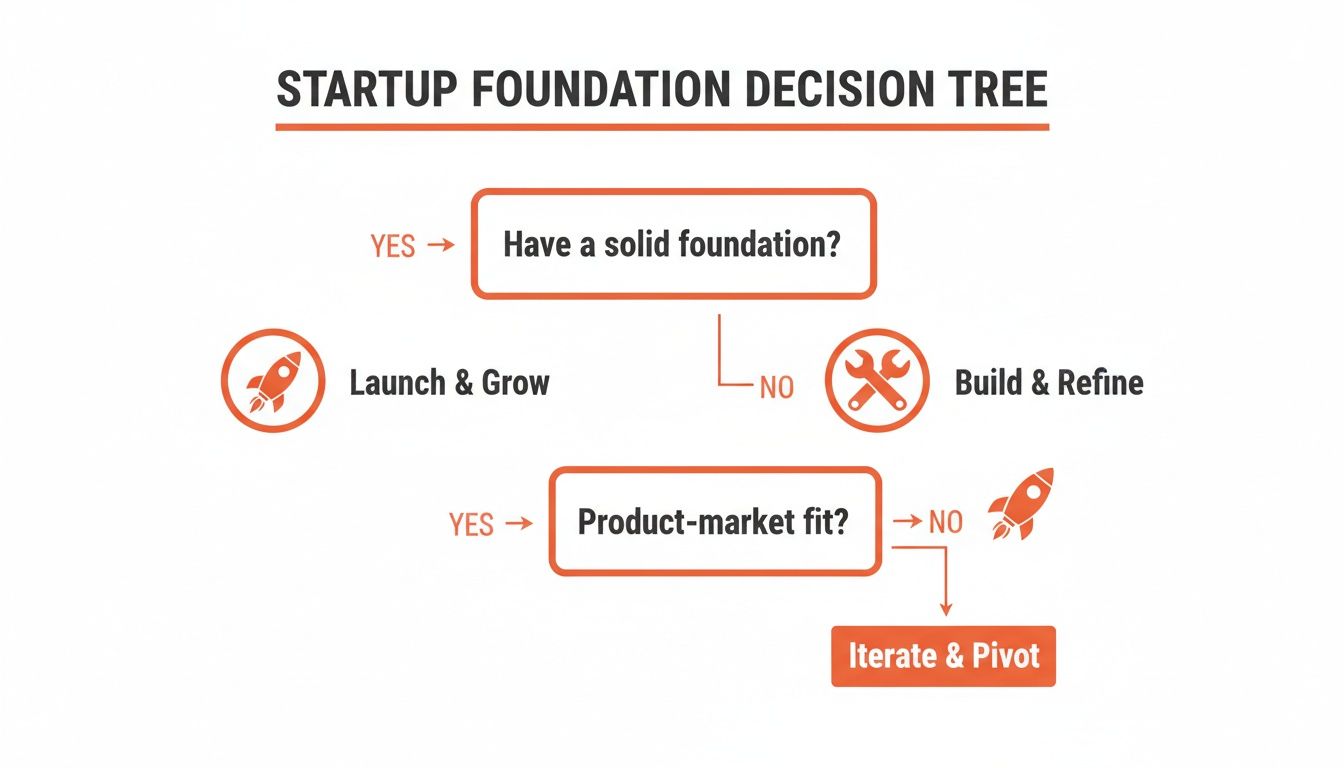
Use this as a quick gut-check to see if you should be focused on building foundational pieces or if you're truly ready to hit the accelerator.
Startup Marketing Channel Prioritization Matrix
To help you decide where to start, I've put together a simple matrix. It breaks down the most common channels by what they'll likely cost you in terms of budget, effort, and time before you see a real return.
| Channel | Typical Budget | Effort Level | Time to ROI |
|---|---|---|---|
| SEO | Low to Medium | High | 6-12 Months |
| Content Marketing | Low to Medium | High | 6-9 Months |
| Paid Social (Meta, TikTok) | Medium to High | Medium | 1-3 Months |
| Paid Search (Google) | High | Medium | < 1 Month |
| Email Marketing | Low | Low to Medium | 1-3 Months |
| Partnerships/Affiliates | Low | High | 3-6 Months |
| Reddit Marketing | Low to Medium | High | 1-3 Months |
This isn't an exact science, but it gives you a realistic snapshot. A channel like paid search can bring in leads this week, but it demands a constant cash infusion. On the other hand, SEO takes serious patience and hard work upfront but can become your most profitable channel down the road.
Matching Channels to Your Business Model
The "right" channels aren't universal—they depend entirely on what you're selling and who you're selling it to. A strategy that crushes it for a B2C app will almost certainly flop for an enterprise software company.
Here’s how I’d approach it for different business models:
- For B2B SaaS: Your customers are professionals hunting for solutions to specific business problems. You need to be on channels where they do their research. Practical example: Run a LinkedIn ad campaign targeting "Directors of Marketing" at companies with 50-200 employees, offering a free template for "Building a 2024 Marketing Budget."
- For DTC eCommerce: Here, your customer is often driven by visual appeal, social proof, and trends. Practical example: Collaborate with a micro-influencer on TikTok to create an "unboxing" video of your product, then boost the post to a lookalike audience of their followers.
- For Mobile Apps: Discovery is everything. Your game plan must include App Store Optimization (ASO). Practical example: Research the top 5 keywords your main competitor ranks for in the App Store and integrate them naturally into your app's title and description.
Don’t fall into the trap of choosing a channel just because it's popular. Choose the channel where you can have the most meaningful conversations with your specific audience. Authenticity on one relevant platform beats mediocrity on five.
Ultimately, your first goal is to find the most efficient way to get your first 100 true fans. Pick one primary channel and focus all your energy there until you see repeatable results. Once that channel is working like a well-oiled machine, you can thoughtfully expand to a second. This focused approach is how you build real momentum without burning out.
If you're still weighing the pros and cons of different traffic sources, our guide on organic vs. paid traffic breaks it down even further.
Putting Organic Growth into Practice

Paid ads are like a shot of adrenaline—they get you moving fast. But organic marketing? That's the steady, powerful engine that will drive your startup forward for years to come. It’s about building real assets that gain value over time, pulling in customers who are already out there looking for exactly what you offer.
Let's be clear: this isn't a "set it and forget it" game. It requires real, consistent effort. But getting that organic flywheel spinning early is one of the smartest long-term bets you can make. The two pillars of this engine are Search Engine Optimization (SEO) and Content Marketing, and they’re at their best when they work together.
Nailing the SEO Fundamentals
SEO can feel like a mountain of technical jargon, but for a startup, you can safely ignore 90% of it. Your job is to focus on the core fundamentals that get you found by the right people.
Think of your website as a new shop in a huge city. Technical SEO paves the roads and puts up clear street signs so people can find you. On-page SEO is what makes your storefront look inviting enough for them to walk in.
- The Technical Must-Haves: First things first, make sure Google can actually find and understand your site. Submitting your sitemap through Google Search Console is non-negotiable. It’s like sending a formal announcement to Google saying, "I'm open for business, and here's a map."
- Smart On-Page Tweaks: Next, give your most important pages—your homepage and core product pages—some love. Weave your main keywords into the title tag, meta description, and the main H1 heading.
- Don't Be Slow: Your site has to load fast, especially on phones. A slow website is a conversion killer, plain and simple. Use Google's PageSpeed Insights to see where you stand and what you need to fix.
Actionable Insight: Go to your homepage. Is the H1 heading something vague like "Welcome to Our Site"? Change it to your Unique Value Proposition that includes your primary keyword. For example, "The Easiest Time Tracking Software for Freelancers."
Your goal isn't just to rank, but to rank for what matters. This means finding the specific problems your customers are trying to solve. For organic growth, mastering keyword strategy is paramount. A particularly effective approach involves understanding and leveraging long-tail keywords. You can learn more by unlocking SEO success with long-tail keywords.
Creating Content That Genuinely Helps
For a startup, content marketing isn't about pumping out generic blog posts. It’s about becoming the single most helpful resource for your target customer. Every piece of content you create should directly tackle their frustrations and answer the questions they're already typing into Google.
The real aim here is to build trust long before they're even thinking about buying. Each article, guide, or template you publish becomes an asset that works for you 24/7, attracting the right kind of traffic and establishing you as the go-to expert.
A No-Nonsense Content Playbook
Here’s a simple process I’ve used time and again to create content that pulls its weight.
Start with Pain Points: Go back to your customer research. What are their top three frustrations that your product helps solve? Frame each one as a "How to..." or "What is..." question. For a project management tool, a customer might be struggling with "how to manage scope creep with clients."
Find High-Intent Keywords: Use a tool like AnswerThePublic or just look at Google's own search suggestions to find long-tail keywords related to those pain points. These longer phrases are gold—they signal that a user is actively looking for a solution.
Outline a Solution-First Article: Structure your content to be intensely practical. Don't waste time defining the problem they already know they have. Jump straight into a clear, step-by-step solution. Use headings, bullet points, and images to make it easy to scan.
Practical Example: For an email marketing tool, a great article would be "A Founder's Guide to Writing Your First Welcome Email Series (With Templates)." This solves a real problem, shows off your product's value, and the templates make it instantly actionable.
Earning Your First Few Quality Backlinks
Backlinks—links pointing to your site from other websites—are Google’s version of a vote of confidence. As a new startup, you don't need hundreds of them. You just need to get the ball rolling with a few high-quality, relevant links.
Here are two realistic ways to do that:
- Guest Posting on Niche Blogs: Find the blogs your ideal customers already read and trust. Pitch them a genuinely helpful article idea, not a sales pitch. Actionable Tip: Instead of a generic "I'd like to write for you," pitch a specific title like "3 Common Mistakes Startups Make When Choosing a CRM, and How to Avoid Them."
- Podcast Appearances: Hunt down podcasts in your industry that feature guests. Pitch yourself as an expert on a very specific topic. Most shows will link to your website in their show notes, which is a fantastic and highly relevant backlink.
These strategies take persistence, but the long-term payoff is huge. Our deep dive into startup content marketing has more templates and real-world examples to help you get started.
How to Win with Paid Ads and Community Marketing
While your organic channels are quietly building your foundation, sometimes you just need to get in front of your ideal customer right now. This is exactly where paid ads and smart community marketing come into play.
They aren't just for massive companies with deep pockets. When you're smart about it, they can be a powerful accelerator for any startup trying to make an immediate splash.
The trick is to be surgical. Forget about blasting generic ads across the internet. We're talking about small-budget, highly targeted campaigns designed to do one thing: generate leads and prove your offer works without torching your cash reserves.
Running Lean and Mean Paid Ad Campaigns
Paid ads can feel like a money pit if you don’t have a rock-solid strategy. For a startup, the key to making them work is a ruthless focus on efficiency. You're not trying to outspend the competition; you're trying to outsmart them with relevance.
This means starting small and getting incredibly specific with who you're talking to. Before you even think about hitting "launch," you need concrete answers to these questions:
- Who is my hyper-specific audience? Don't settle for "small businesses." Get granular. Think: "HR managers at US-based tech companies with 50-100 employees who have recently posted about 'employee burnout' on LinkedIn."
- What is the one action I want them to take? Stop sending traffic to your homepage. Instead, drive them to a dedicated landing page built for a single purpose, like signing up for a free trial or downloading a specific guide.
- What's my absolute maximum cost per acquisition (CPA)? You have to know exactly how much you can afford to pay for a new customer. This number becomes your north star for judging whether a campaign is a success or a failure.
Your First Paid Ad Test Run
Let's say you're running a SaaS startup that helps remote teams wrangle their project documentation. A perfect first paid campaign would be a small-budget test on LinkedIn.
- Audience Targeting: Use LinkedIn's Campaign Manager to target users with job titles like "Project Manager" or "Head of Operations" at companies in the software industry with under 200 employees.
- Ad Copy: Your ad needs to speak directly to their pain point. Ditch the generic "The Best Doc Management Tool" and try something like, "Tired of digging through 5 different apps for one document? Get a single source of truth for your team."
- Offer and Landing Page: The ad should point to a simple landing page offering a 14-day free trial—no credit card required. The page itself needs to be clean, highlighting just 2-3 key benefits and a big, obvious call-to-action button.
Actionable Insight: Start with a tiny budget of just $20-30 per day. After 3-5 days, check your Click-Through Rate (CTR). If it's below 1% on LinkedIn, your ad copy or image isn't resonating. Pause the campaign, change one variable (like the headline), and test again. This iterative process is key.
Tapping into Reddit: The Untapped Goldmine
Paid ads give you direct access, but community marketing builds something more valuable in the long run: genuine brand affinity. And when it comes to raw, authentic conversation, there's no place like Reddit. For startups, it's a goldmine for customer insights, lead generation, and building a real community.
Reddit isn't just another social media site; it's a network of thousands of incredibly specific niche communities. The key is to stop thinking like a marketer and start acting like a helpful member. Authentic engagement will always, always win over a sales pitch.
The platform's user base is huge and deeply engaged. In fact, the global digital ad spend exploded to $601.8 billion in 2023, making up a staggering 67% of all media spending worldwide. For startups, this trend means you have to lean into cost-effective tactics, and platforms like Reddit are a perfect fit. Organic engagement in the right subreddit can mirror the impact of a big ad spend at a tiny fraction of the cost. You can see more digital marketing industry trends and understand why this community-led approach is so powerful.
A Reddit-Native Strategy That Actually Works
Trying to succeed on Reddit by spamming links to your product is a death wish. Redditors can spot a sales pitch from a mile away and will downvote you into oblivion. Your entire strategy has to be built on providing real value.
Here’s a simple playbook to get you started:
- Find High-Value Subreddits: First, identify the communities where your ideal customers are already hanging out and asking questions your startup can answer. For our documentation SaaS, that might be places like r/projectmanagement, r/SaaS, or r/remotework.
- Contribute Value, No Strings Attached: Spend 15 minutes a day genuinely answering questions and offering helpful advice without ever mentioning your product. Share your expertise freely. This builds your credibility and your "karma," which is basically Reddit's trust score.
- Spark Relevant Conversations: Instead of a direct promo, create a post that starts a discussion around the problem you solve. For example: "What's everyone's most frustrating tool for managing remote team documents? I've been struggling with..."
This approach creates a natural opening. As people chime in with their own frustrations, you can subtly introduce your solution as a helpful suggestion, not a hard sell. This is how you generate millions of impressions and high-quality leads—by turning real conversations into your most powerful acquisition channel.
Your First 90-Day Digital Marketing Sprint

A brilliant strategy is just a document until you put it to work. This is where the rubber meets the road—turning plans into action and getting real, measurable wins. For a startup, a 90-day sprint is the perfect timeframe to build momentum without getting completely overwhelmed.
This approach forces you to be ruthless with your priorities, focusing only on what creates tangible results. Each month builds on the last, creating a flywheel effect: you start with a solid foundation, move to targeted testing, and then scale what works.
Here’s a realistic roadmap that a solo founder or small team can actually pull off.
Month 1: The Foundation Phase
The first 30 days are all about getting your house in order. The goal here isn't to open the floodgates on leads, but to build the core infrastructure you'll need for everything that comes next. I've seen too many startups rush this part, and it almost always leads to wasted ad spend and misguided efforts down the line.
Your primary focus is clarity and setup. You need to know exactly who you're talking to and be able to track every single interaction they have with your brand.
- Finalize Your ICP and Messaging: Turn your Ideal Customer Profile from a theoretical document into a practical tool. Actionable Step: Create a one-page summary of your ICP and pin it above your desk. Every marketing decision should pass the "Would this resonate with [ICP Name]?" test.
- Set Up and Test Analytics: Get Google Analytics 4 installed and, more importantly, configure conversion goals for the actions that actually matter—like a trial sign-up or a demo request. Don't just slap the code on your site; test it to make sure it’s tracking accurately.
- Launch Your Primary Organic Channel: Based on your earlier analysis, pick one organic platform and go all-in. If it's SEO, publish your first two problem-solving blog posts. If it's Reddit, start genuinely participating in three target subreddits every day—no pitching, just adding value.
Month 1 is about preparation, not performance. You're building the engine and filling it with fuel. By the end of this month, you should have a crystal-clear picture of your target customer and the tools to measure what happens next.
Month 2: The Testing and Learning Phase
With a solid foundation in place, Month 2 is all about dipping your toes in the water and gathering real-world data. We’re shifting from planning to active experimentation. The goal is to learn as much as possible, as cheaply as possible.
You'll introduce a small, controlled paid component to speed up the feedback loop and get into a content rhythm. This is your first real test to see how the market reacts to your messaging.
This month is about consistency and analysis. Here’s what that looks like:
- Run a Small Paid Ad Experiment: Launch a single, hyper-targeted ad campaign with a tiny budget (think $20/day). The goal isn't profit; it's data. You want to test your core value prop and see what messaging actually gets people to click and convert.
- Publish Content Consistently: Double down on your chosen organic channel. Publish 2-4 more blog posts or keep up your daily, value-driven engagement on Reddit. This consistency is what builds authority and trust over time.
- Analyze the First Wave of Data: At the end of the month, dig into your analytics. Where did those trial sign-ups come from? Which ad headline had the best click-through rate? This early data, no matter how small, is pure gold.
This whole process of testing and learning is getting faster, by the way. AI is changing the game for startups, promising +32% productivity boosts and automating 85% of tasks by 2026. This lets founders stay focused on the core product. With 45% of B2B marketers planning to invest more in AI tools, early-stage companies that embrace this tech can skip months of trial-and-error, turning insights into action way faster. You can find more on this in these digital marketing statistics.
Month 3: The Scaling and Optimization Phase
In Month 3, you start to see the pieces click together. Armed with a month's worth of real data, you can now make smart decisions about where to put your time and money. The goal is to amplify what's working and add layers to nurture the leads you're generating.
This is when you shift from pure experimentation to early-stage growth. You’ll double down on successful tactics, expand your community presence, and start building long-term relationships with your audience.
- Double Down on What Works: Did your small paid ad experiment show promise? Increase the budget a little or test a lookalike audience. Is one of your blog posts starting to get some organic search traffic? Write another post on a similar topic.
- Expand Community Engagement: Now that you've built some credibility on Reddit, you can start to subtly mention your solution when it's genuinely helpful to the conversation. The key is to be a problem-solver first, not a salesperson.
- Build a Simple Email Nurture Sequence: For everyone who signed up for a trial or downloaded a resource, set up a simple 3-email automated sequence. Practical Example: Email 1: Delivers the resource. Email 2 (2 days later): Shares a quick tip related to the resource. Email 3 (4 days later): Presents a case study of how a similar company succeeded.
Common Questions About Startup Digital Marketing
Even with the best playbook in hand, a few big questions always seem to pop up when founders get serious about digital marketing. Let's tackle them head-on, because getting these right from the start can make all the difference.
How Much Should a Startup Spend on Marketing?
There’s no magic formula here, but a common rule of thumb for growth-stage companies is to set aside 10-20% of your projected revenue for marketing. But let's be real—if you're pre-revenue or just starting out, that percentage is meaningless.
A much smarter way to think about it is to tie your budget directly to your goals.
- Work backward from your target. Want your first 100 customers in six months? Do some quick research on your target channels to estimate a realistic Cost Per Acquisition (CPA). For example, if you estimate your CPA on Google Ads will be $50, you need a budget of at least $5,000 to get those 100 customers.
- Start small and test everything. You don't need a huge war chest to get started. Allocate a small, fixed budget (even just $500/month on some test ads) to see what works. Once you have data showing a positive return, you can confidently invest more.
The most important shift is to see marketing as an investment, not an expense. Get obsessed with tracking metrics like your return on ad spend (ROAS) and customer acquisition cost (CAC).
Which Marketing Channel Is Best for a Startup?
This is the classic "it depends" question, but the answer is simpler than you think. It depends entirely on where your ideal customers already are. The biggest mistake startups make is trying to be everywhere at once. Spreading yourself thin across five different platforms is a surefire way to get zero results.
Pick one channel and own it.
The best channel isn't the trendiest one. It's the one where your target audience is actively discussing the exact problems your product solves. Your job is to find that watering hole and join the conversation.
Actionable Insight: Go to Reddit and search for the problem your startup solves. For example, if you have a meal-planning app, search for "struggle with meal prep." The subreddits where these conversations are happening (e.g., r/MealPrepSunday, r/EatCheapAndHealthy) are your prime channels.
When Should a Startup Hire a Marketer?
Bringing on your first marketing hire is a huge milestone. Pull the trigger too early, and they'll be sitting around with no clear product-market fit to work with. Wait too long, and you become the bottleneck, choking off potential growth.
So, what's the sweet spot? It's usually right after you've found early product-market fit and the founder can no longer juggle marketing tasks without dropping other critical balls. You have a few happy customers, you know the product is solving a real problem, and you're ready to build a repeatable growth engine.
Before you jump to a full-time hire, think about bringing in a freelancer or a specialized agency for specific needs like running paid ads or writing content. This gives you access to top-tier expertise without the long-term commitment of a salary—a very savvy move for an early-stage startup.
Ready to turn Reddit's engaged communities into a reliable source of traffic, leads, and customers? Reddit Agency specializes in crafting authentic, value-driven campaigns that build your brand and your bottom line. Find out how we can help you win on Reddit.
