Organic Traffic vs Paid Traffic A Guide for Sustainable Growth
The real difference between organic vs paid traffic boils down to one simple question: are you earning your visitors or buying them?
Think of it this way. Organic traffic is earned. It’s the result of consistently creating high-quality content and optimizing your website, slowly building a valuable, long-term asset. It's like owning a home—the equity you build is yours. On the other hand, paid traffic is bought. You pay for ads to get immediate visibility, which is more like renting an apartment. The moment you stop paying the rent, the traffic disappears.
Defining Organic vs Paid Traffic
Before you can build a solid growth strategy, you have to understand the mechanics of each traffic source. They aren't mutually exclusive; they’re just different tools meant for different jobs.
What Is Organic Traffic?
Organic traffic is anyone who lands on your website from unpaid sources. This usually means they found you through a search engine like Google, but it can also include people discovering your content naturally on platforms like Reddit. At its core, organic traffic is the byproduct of building authority, relevance, and genuine trust over time.
This type of traffic is typically driven by a few key activities:
- Search Engine Optimization (SEO): The technical and creative work of optimizing your site and content to rank higher for your target keywords. For example, ensuring your SaaS company's pricing page title tag is
<title>Simple, Transparent Pricing | YourBrand</title>to attract users searching for "YourBrand pricing." - Content Marketing: Creating genuinely helpful blog posts, guides, or videos that answer a specific question or solve a user's problem. A practical example is a fitness app publishing an article on "10-minute home workouts for beginners," which attracts users searching for that exact solution.
- Community Engagement: Becoming an authentic participant in relevant online communities, which can naturally lead people back to your site. For instance, a developer tool founder could helpfully answer questions in r/webdev and include a link to their tool in their profile, driving relevant traffic without direct advertising.
A great first step to understanding your organic performance is to dig into your Google Analytics organic search data. And if you want to explore this strategy further, we have a complete guide on https://redditagency.com/blog/what-is-organic-marketing.
What Is Paid Traffic?
Paid traffic, as the name implies, comes from users who click on an advertisement you've paid to place. This strategy relies on auction-based platforms like Google Ads or Reddit Ads to put your content directly in front of a highly specific audience. It's a straightforward transaction: you pay for clicks and visibility.
The real power of paid traffic lies in its speed and predictability. You can launch a campaign and start getting visitors in a matter of minutes, making it perfect for testing new offers, promoting product launches, or driving sales right now.
To make this distinction even clearer, let's break down the core differences at a high level.
Organic vs Paid Traffic At a Glance
Here’s a quick summary of the key characteristics that set these two powerful traffic channels apart.
| Attribute | Organic Traffic (SEO & Content) | Paid Traffic (PPC & Ads) |
|---|---|---|
| Cost Model | Indirect (investment in time, content) | Direct (pay-per-click or impressions) |
| Speed to Results | Slow and gradual (months to build) | Immediate (can see traffic in minutes) |
| Sustainability | Long-term asset; traffic can be stable | Short-term; traffic stops when you stop paying |
| Audience Trust | Generally higher (seen as more credible) | Lower (users are aware it's an ad) |
While this table gives you the big picture, the best strategy often involves a smart blend of both. Organic builds the foundation, while paid provides the targeted bursts of growth when you need them most.
Speed to Market vs. Long-Term Sustainability: A Core Trade-Off

When it comes to the classic organic vs. paid traffic debate, the conversation always circles back to one fundamental choice: do you need results now, or are you building something that lasts? These two channels operate on entirely different clocks. Your decision here will shape how fast you can test ideas and just how resilient your business will be down the road.
There's no contest when it comes to speed—paid traffic wins, hands down. It's built for instant gratification. You can launch a campaign and see clicks, data, and even sales roll in almost immediately. While it takes months to earn organic rankings, paid campaigns can start delivering traffic within minutes. You can get a deeper dive into the mechanics of paid traffic speeds in this informative article from PropellerAds.
This near-instant impact makes paid traffic an essential tool for any time-sensitive goal.
Paid Traffic: Your Go-To for Immediate Feedback
Let’s say you’re a SaaS company rolling out a new feature. You can't afford to wait to see if it's a hit. By launching a targeted Reddit Ads campaign, you can start funneling potential users to your landing page the very same day.
This approach gives you a powerful, immediate feedback loop:
- Quickly validate demand: Are people actually interested in what you've built? You'll know in days, not months.
- Collect valuable user data: See who's signing up and how they're using the new tool right away.
- A/B test your messaging: Pit different headlines and calls-to-action against each other to find out what truly connects with your audience. For example, test "Automate Your Workflow" vs. "Save 10 Hours a Week" to see which message drives more sign-ups.
In a situation like this, waiting for organic traffic to mature is simply not an option. Paid traffic lets you make smart, data-backed decisions on the fly.
Organic Traffic: Building an Asset That Compounds
On the other side of the coin, organic traffic is all about the long game. Think of it less like a faucet and more like planting a tree. The work you put in today might not look like much at first, but it compounds over time, delivering more and more value without you having to constantly feed it money.
Here’s the critical distinction: the moment you turn off your ad spend, paid traffic vanishes. A strong organic presence, however, becomes a durable business asset that works for you 24/7, much like a dividend-paying stock.
Imagine a B2B marketer who writes a comprehensive guide on "How to Choose the Right CRM for a Small Business." The initial traffic might just be a trickle. But as that content starts to rank on search engines and gain authority, it attracts a steady flow of high-intent visitors. That one article can evolve into a reliable lead-generation engine, bringing in qualified prospects month after month with zero ongoing ad spend. It's a patient strategy, but it builds a competitive moat that's incredibly difficult for others to replicate.
Analyzing Cost Efficiency and Return on Investment
Let's clear up one of the biggest myths floating around: the idea that organic traffic is "free." Sure, you don't pay for every click, but it demands a serious investment in time, expertise, and resources. To build a growth strategy that actually works, you have to get real about the true cost and return on investment (ROI) for both paid and organic channels.
With paid traffic, the costs are straightforward. You know exactly what you're spending on each click (Cost Per Click or CPC) or impression (Cost Per Mille or CPM), which makes budgeting a breeze. If you have a $1,000 budget and your average CPC is $2, you know you're getting 500 visits. Simple as that.
Organic traffic costs are a different beast entirely—they're indirect investments. This includes things like:
- Content Creation: All the hours that go into researching, writing, and designing genuinely helpful blog posts and guides. For example, a 2,000-word guide could take 10-15 hours of an expert's time.
- Technical SEO: The technical know-how needed to make sure your site is fast, well-structured, and easy for search engines to crawl. This might involve hiring a developer to improve page load speed or implement schema markup.
- Community Management: The time spent genuinely participating in online communities, like niche subreddits, to build trust and authority. This could be 5 hours per week of dedicated, non-promotional engagement.
Calculating Long-Term Value
The real difference in ROI starts to show up over the long haul. Paid traffic gets you results right away, but the moment you stop paying, the traffic stops. Organic traffic, on the other hand, is like planting a tree. It takes time to grow, but eventually, it becomes an asset that generates value on its own, driving down your Customer Acquisition Cost (CAC) as your reputation solidifies.
Imagine a direct-to-consumer (DTC) brand. They could drop $5,000 a month on ads to stay visible for a competitive keyword like "vegan leather handbag." This will drive sales now, but there’s no compounding effect—that cost isn't going anywhere.
Or, they could put that same budget into creating foundational content like "The Ultimate Guide to Caring for Vegan Leather" and building a real presence in a relevant community. It might take a few months, but eventually, that content could hit the first page of Google, bringing in steady traffic without any ongoing ad spend. That initial investment keeps paying off long after the work is done. If you want to get into the weeds, you can find a solid framework for measuring your return on marketing investment to keep track of these long-term gains.
The key takeaway here is that organic traffic builds equity. Every article you publish and every backlink you earn adds to your site's authority, making it progressively easier and cheaper to attract customers down the road.
This is exactly why organic strategies often win out when it comes to long-term cost efficiency and scale, even with the instant gratification of paid search. You're not just buying clicks; you're building a market presence that matures and strengthens over time.
A Practical Scenario for Founders
For founders watching every penny, this distinction is huge. An upfront investment in building an authentic community on Reddit can deliver a much higher long-term ROI than a never-ending ad budget. By engaging in the right subreddits, you build trust and attract high-intent traffic that is more likely to convert.
Of course, if you are going the paid route, you need to know what you're doing to avoid burning cash. Understanding the nuances of different platforms and ad formats, like effective Facebook Video Ads, is non-negotiable for maximizing your investment. In the end, the most cost-effective strategy really comes down to your timeline and goals—balancing your immediate needs with the power of sustainable, long-term growth.
Audience Trust and Conversion Quality: It's Not Just About the Numbers
Let's be honest: not all traffic is the same. Once you look past the raw visitor counts, you'll see a massive difference in quality between the people who find you organically and those who click on an ad. It all boils down to user psychology.
The visitor's mindset when they land on your site is everything. It shapes how they interact with your content, how long they stick around, and whether they'll ever become a real, high-value customer.
The Trust Factor: Earning vs. Buying Attention
The biggest split between organic and paid traffic comes down to one word: trust. People are naturally more inclined to trust organic search results or a recommendation from a community they're part of. It’s the digital equivalent of a friend suggesting a great restaurant versus seeing a flashy billboard for one on the highway. One feels like a genuine tip, the other is an obvious pitch.
This perception of trust has a direct impact on how people behave.
Authentic Discovery in Action
Think about the user's journey. Organic traffic often comes from people who are actively on a mission. They have a problem, they're hunting for a solution, and that makes them incredibly receptive to content that actually helps them.
Here's a real-world example for anyone in the B2B space:
- The Organic Win: You write an incredibly detailed guide solving a common industry problem and share it on the r/SaaS subreddit. The community loves it, upvotes it, and you start getting highly qualified leads from people who see you as an expert. They found you through a trusted, peer-vetted source.
- The Paid Approach: You run a standard Reddit ad in that same subreddit. Sure, people will see it, but it’s immediately flagged in their minds as an advertisement. You might get some clicks, but their guard is already up.
This fundamental difference in how they find you affects everything. That’s why organic results and genuine community shares feel more credible, leading to better engagement and lower bounce rates. You can dig deeper into how user trust impacts paid campaigns to see just how critical this is.
The trust you build through organic channels isn't some soft, fuzzy metric. It translates directly into higher-quality engagement, more time spent on your site, and a much better long-term fit between your solution and the customer's needs.
Measuring What Really Matters: Conversion Quality
When you're weighing organic vs. paid traffic, you have to look beyond just the number of conversions. The quality of those conversions is what drives sustainable growth. An organic visitor often shows up pre-qualified because they’ve already done their homework.
This initial research on their part gives you a huge advantage:
- Higher Conversion Rates: Since they arrive with a clear goal in mind, organic visitors are often far more likely to take that next step, whether it's signing up for a trial or requesting a demo. For example, someone searching "Hubspot vs Salesforce for startups" is a very high-intent lead.
- Longer Time on Page: Someone who trusts the source of information is willing to invest more time. They’ll actually read your articles, check out your case studies, and try to understand what you're all about.
- A Better Lead-to-Customer Rate: For B2B businesses, this is huge. A lead that comes from an in-depth blog post is almost always more qualified and easier for the sales team to close than a lead who clicked on a generic display ad. An actionable insight is to track this metric separately in your CRM for organic vs. paid leads to prove the value of your content efforts.
Paid traffic is fantastic for generating volume and getting in front of people quickly. But organic traffic is where you build a foundation of high-quality, loyal customers. For any marketer playing the long game, that superior quality is worth its weight in gold.
Choosing the Right Traffic Strategy for Your Goals
When it comes to the organic vs. paid traffic debate, the real question isn't "Which one is better?" It's "Which one is better for what I need to accomplish right now?" This shifts the conversation from a simple comparison to a strategic, goal-oriented decision that serves your immediate business needs while supporting your long-term vision.
Your choice should hinge entirely on your current objective. Are you trying to validate a new product idea, build an authoritative brand, or just drive a ton of sales for a weekend promotion? Each of these goals calls for a completely different playbook.
Aligning Your Strategy with Business Scenarios
Let's walk through a few real-world situations to see how this works in practice. This will help you move from theory to actual application.
Scenario 1: The Startup Launching an MVP
A startup getting a Minimum Viable Product (MVP) off the ground needs two things, fast: validation and honest feedback. For this, a hybrid approach is non-negotiable.
- Paid Action: Run highly targeted Reddit ads in niche subreddits like r/solopreneur or r/sideproject to get those first sign-ups. This gives you immediate, hard data on whether your messaging is hitting the mark.
- Organic Action: At the same time, become an active member of those same communities. Don't just post ads; ask for feedback, answer questions, and build a reputation as a founder who's there to help. Share your journey and ask for advice.
This dual strategy gives you the speed of paid ads to test your assumptions and the rich, qualitative insights from organic community building to truly understand what your first users want.
Scenario 2: The DTC Brand Testing a Promotion
Imagine a Direct-to-Consumer (DTC) brand running a flash sale. They need to get in front of the right people, and they need to do it now. The window of opportunity is tiny, which makes paid traffic the obvious choice.
The precision targeting of paid ads lets the brand run quick A/B tests on everything—ad copy, images, audience segments. For example, they can target ads to "past purchasers" on Facebook with a "25% Off - 48 Hours Only!" message to maximize immediate sales from a warm audience. This is all about maximizing return on ad spend (ROAS) in a very short timeframe, something that's just not possible with the slower burn of organic channels.
The core principle is simple: when your timeline is measured in hours or days, not months, paid traffic is your most effective tool for generating immediate action.
This decision tree helps visualize how user intent often dictates whether organic or paid is the better fit.
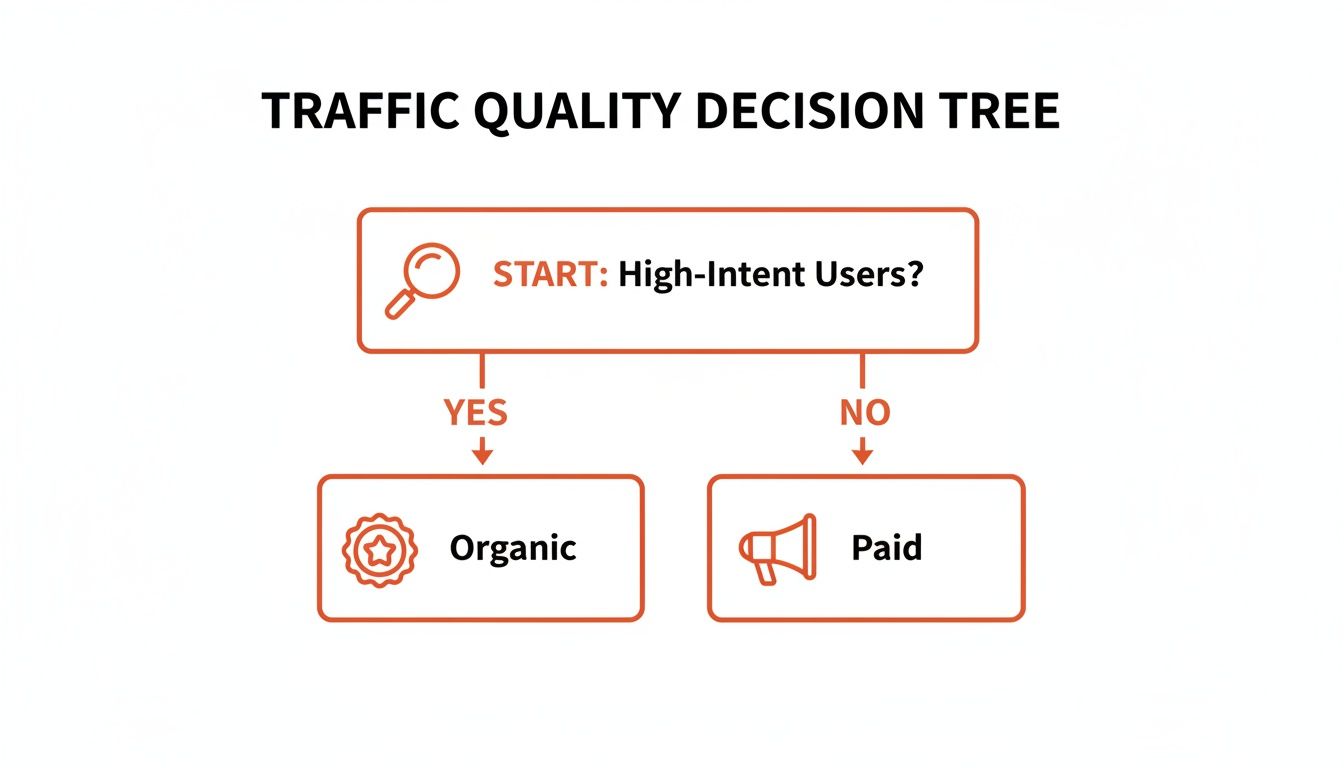
As the diagram shows, organic strategies are fantastic for capturing users with high intent—people who are actively looking for solutions—and building a foundation of trust while doing it.
Scenario 3: The B2B SaaS Building Thought Leadership
On the flip side, a B2B SaaS company that wants to be seen as an industry leader needs to lean heavily into an organic strategy. Their goal isn't just about generating leads today; it's about building a rock-solid reputation and becoming the go-to resource in their niche for years to come.
This means committing to creating high-value, evergreen content—think comprehensive guides, original research reports, and detailed tutorials. A practical example is creating a "State of the Industry 2024" report, filled with unique data, and then promoting it to journalists and bloggers for backlinks. It’s a slow burn, for sure. But over time, it builds a powerful asset that consistently attracts high-quality leads and establishes deep credibility in the market. That's a level of trust paid ads simply can't buy.
Ultimately, choosing between organic and paid traffic isn't a one-and-done decision. It's a fluid, strategic choice that should adapt as your business goals change, allowing you to build a growth plan that is both agile and sustainable.
Building a Hybrid Strategy for Maximum Impact
The debate over organic traffic vs paid traffic often misses the point. It's not about picking a winner. The smartest marketers I know treat them as two sides of the same coin, building a powerful model where each channel strengthens the other.
This integrated approach moves beyond running isolated campaigns. Instead, you build a resilient growth engine where the speed and precision of paid traffic meet the trust and staying power of organic. When you get this right, you create a powerful feedback loop that accelerates your results across the board.
Amplify Proven Organic Content with Paid Ads
One of the most effective ways to merge these strategies is to put ad spend behind your top-performing organic content. You've already done the heavy lifting to create something that your audience loves—now it’s time to give it a bigger stage.
Imagine a B2B SaaS company sees a specific blog post generating a steady stream of qualified organic leads. An actionable step is to create a LinkedIn ad campaign targeting job titles like "Marketing Manager" and driving them to that exact blog post. This pushes a proven asset in front of a much wider, highly relevant audience almost instantly. It completely removes the guesswork from ad creative because you're promoting content you already know works.
A successful hybrid strategy uses paid channels not just for direct conversions, but as a powerful distribution tool for your most valuable organic assets. It’s about getting the right content in front of more of the right people, faster.
Use Paid Campaign Data to Sharpen SEO
The data you get from your paid campaigns is pure gold for your organic strategy. Paid search gives you immediate, granular insights into which keywords, headlines, and calls-to-action actually drive conversions. This isn't theoretical—it's real-world data you can use to inform your entire SEO and content plan.
Let's say you're running a Google Ads campaign and notice a specific long-tail keyword has a surprisingly high conversion rate. That's the market giving you a massive hint. Your next move? Create a comprehensive, in-depth article targeting that exact keyword, knowing you’re focusing on a topic with proven commercial intent. For example, if "project management software for remote teams" converts well in ads, that's your cue to write the definitive guide on that topic. For a closer look at structuring these campaigns, you can explore the fundamentals of PPC ad campaign management.
By weaving organic and paid traffic together, you're building a smarter, more efficient marketing machine. Your paid ads figure out what works right now, and your organic strategy builds on those insights to create lasting value.
Frequently Asked Questions
When it comes to the organic traffic vs paid traffic debate, a lot of questions pop up. Here are some straight-up answers to the things we hear most often from SaaS, B2B, and DTC brands figuring out their growth plans.
How Long Until I See Results From Organic Traffic?
Patience is key with organic growth. While paid ads give you that instant gratification of immediate visibility, building a real organic presence is more of a long game. Realistically, you should expect to see significant movement from your SEO and content efforts in about 3 to 6 months.
On a platform like Reddit, you might see some initial wins within a few weeks if you focus on genuine engagement and building credibility. But the kind of traffic that really moves the needle takes several months to build. The great thing is, the effort you put in now compounds, delivering bigger and bigger returns over time.
Can My Business Grow With Only Organic Traffic?
Absolutely, it’s possible. But is it optimal? Rarely. A smart mix of both paid and organic is almost always the better bet. Relying only on organic traffic builds a strong, long-lasting foundation, but you completely miss out on the speed and laser-focused targeting that paid ads offer.
Think about it: for a huge product launch or a Black Friday sale, you need immediate eyeballs and quick feedback. Organic channels just can't deliver that kind of velocity on demand.
A balanced strategy uses organic for that steady, foundational growth and pulls in paid ads for those strategic pushes that need speed and predictable results. A practical approach is to allocate 70% of your effort to long-term organic growth and 30% to short-term paid campaigns to test and accelerate.
Which Is More Cost-Effective in the Long Run?
Hands down, organic traffic wins the cost-effectiveness marathon. It definitely requires a heavier lift upfront in terms of time, effort, and resources. But once you get a well-oiled organic machine going, it brings in high-quality traffic for years to come, all without you paying for every single click.
Paid traffic, on the other hand, is a tap you have to keep running. The moment you turn off the budget, the traffic stops cold.
Here’s a simple way to look at it:
- Paid Traffic: Your Customer Acquisition Cost (CAC) tends to stay pretty flat. You pay to play, and the cost per customer doesn't change much.
- Organic Traffic: Your CAC actually goes down over time. As your content ranks and your authority grows, you acquire more customers from the same initial investment.
That long-term efficiency is precisely what makes organic traffic such a powerful investment for building a business that's not just scalable, but also resilient.
Ready to build a powerful community and drive measurable results on Reddit? The team at Reddit Agency crafts authentic organic and paid strategies that turn conversations into customers. Learn how we can help you win on Reddit.
