How to Build Brand Awareness That Actually Converts
Building real brand awareness is about more than just getting your name out there. It’s a deliberate strategy built on consistency, delivering real value, and genuine community engagement. The goal is simple: when a potential customer has a problem you can solve, your brand should be the first one that pops into their head. This way, you're not just another option—you're the go-to solution.
What Is Brand Awareness And Why It Matters For Growth

Too many founders dismiss brand awareness as a "vanity metric." They see it as a nice number for a slide deck but something that doesn't really move the needle on revenue. This is a huge mistake. Brand awareness is the foundation upon which every other marketing activity stands. It's simply the measure of how familiar your target audience is with your business.
When people recognize your brand, they are a staggering 73% more likely to trust you enough to make a purchase. That trust isn't just a feeling; it drives real business growth.
The Real-World Impact on Your Business
Think of your brand as a mental shortcut. When a customer is overwhelmed with choices, they'll almost always gravitate toward the name they know and trust. This familiarity creates some powerful business advantages.
- Lower Customer Acquisition Costs (CAC): Brands that people recognize don't have to claw for every single click. Their paid ads work better, their content gets shared organically, and their sales teams encounter far less resistance. For example, a well-known B2B software company might see a 30% lower cost-per-click on their search ads for competitive terms simply because users recognize and trust their name in the search results.
- Increased Customer Lifetime Value (LTV): The trust you build through awareness creates loyalty. Customers who feel connected to your brand come back for more and, even better, start telling their friends about you. A practical example is how Apple customers often buy iPhones, MacBooks, and AirPods, creating a high LTV driven by deep brand loyalty.
- Greater Market Share: When your brand becomes the definitive solution for a specific problem, you naturally own more of the market. Just look at how the SaaS company Gong became synonymous with "revenue intelligence." They went from a relative unknown to an industry titan by relentlessly building their brand presence through podcasts, content, and data-driven reports.
Before we get into the tactical side of things, it helps to see the big picture. Here are the core pillars that support any successful brand awareness strategy today.
Core Pillars of a Modern Brand Awareness Strategy
| Pillar | Primary Channels | Key Objective |
|---|---|---|
| Content Marketing | Blog, YouTube, Podcasts, Webinars | Establish expertise and provide genuine value to the audience. |
| Social Media Presence | LinkedIn, X (Twitter), Instagram | Engage in conversations and build a visible brand personality. |
| Community Engagement | Reddit, Slack/Discord Communities, Forums | Build trust and credibility through authentic interaction. |
| Public Relations | Media Mentions, Guest Posts, Industry Awards | Gain third-party validation and reach new audiences. |
| Paid Amplification | Social Ads, Search Ads, Content Sponsorships | Accelerate reach and target specific demographic segments. |
This framework shows how different channels work together to create a cohesive brand identity that resonates with your ideal customers.
Shifting From Nice-To-Have To Essential
It’s time to stop thinking of brand awareness as a passive side effect of marketing and start treating it as a core, active strategy. This means showing up where authentic conversations are happening. For example, Reddit's growth has been explosive, hitting 1.1 billion monthly active users by January 2025, with a 51.6% jump in daily actives from 2023. That scale offers a massive opportunity to connect with highly specific communities in a way that feels natural, not forced.
If you're ready to dig into more growth strategies, this guide on How to Increase Brand Awareness is a great next step.
Ultimately, brand awareness isn't about being the loudest voice in the room. It’s about being remembered for the right reasons. It's the silent force that makes customers choose you, even when a competitor is cheaper or has more features.
Weaving Your Brand Into The Web With Content and SEO

While you can always rent attention with paid ads, a smart content and SEO engine builds something far more valuable: owned, long-term brand awareness.
This isn't about just churning out blog posts. It's about becoming the go-to, trusted answer whenever your ideal customer asks a question. The goal is to create such a strong digital footprint that your brand shows up as the obvious, most helpful solution.
To pull this off, you need a mental shift. Stop thinking about what you want to sell and start obsessing over what your audience desperately needs to know. Great content marketing intercepts people at their exact moment of need, building trust long before they're even thinking about a purchase.
Start By Targeting Real Pain Points
The most powerful content always starts by understanding the genuine problems your audience is trying to solve. For a moment, forget the broad, hyper-competitive keywords. Instead, zoom in on pain point keywords.
These are the phrases people type into Google when they're stuck, frustrated, or searching for a very specific fix.
Imagine you're a B2B SaaS company with a project management tool that has a cool new AI scheduling feature. Targeting "project management software" is a long, expensive battle. The real gold is in the specific problems your feature solves.
- Broad Keyword: "AI project management"
- Pain Point Keywords: "how to stop project scope creep," "best way to manage team capacity," or "tools to automate task delegation."
These longer, more detailed search queries show real intent and are far less competitive. This makes them the perfect ground for building your initial authority. Actionable Insight: Use tools like Ahrefs or Semrush to find these, or simply type a core topic into Google and look at the "People Also Ask" section for instant ideas.
When you target the questions your customers are already asking, you position your brand as an expert problem-solver, not just another vendor. That’s how you build the kind of trust that fuels authentic brand awareness.
Build Authority With The Topic Cluster Model
Once you've zeroed in on these pain points, the next move is to prove your expertise with a topic cluster model. Think of it as a hub-and-spoke system for your content.
A topic cluster is a collection of interlinked articles that all revolve around a single, core "pillar" topic. This structure does more than just organize your content; it sends a powerful signal to search engines that you are a genuine authority on that subject.
Let's stick with our B2B SaaS example.
The main pillar page could be a massive, in-depth guide called "The Ultimate Guide to Agile Project Management." This central hub would then link out to smaller, more focused "cluster" articles that tackle individual pain points we found earlier.
An Example Topic Cluster:
- Pillar Page: "The Ultimate Guide to Agile Project Management"
- Cluster Content:
- "5 Proven Strategies to Prevent Scope Creep in Agile Projects"
- "How to Accurately Forecast Sprint Timelines for Your Dev Team"
- "A Founder's Guide to Choosing the Right Project Management Tool"
This approach makes your site incredibly easy for users to navigate and dramatically boosts your SEO performance for your most important topics. These foundational growth tactics are at the heart of what organic marketing is and how it creates sustainable, long-term visibility.
Get More Mileage By Repurposing Your Content
Creating a single, high-quality piece of pillar content is a heavy lift. So, don't just hit "publish" and cross your fingers. The secret to maximizing its brand-building power is to repurpose it across every channel you can.
Slice it, dice it, and reformat your core ideas for different platforms.
A single, well-researched guide can be spun into a whole suite of assets, each designed to grab attention in its native environment. Here's an actionable plan:
- Video Script: Turn the main takeaways into a snappy 5-minute YouTube video. Example: Film a tutorial on "3 Ways to Stop Scope Creep in 3 Minutes."
- Infographic: Visualize the key stats and steps from your article into a slick, shareable infographic for Pinterest and LinkedIn. Example: Create a graphic showing the "5 Stages of an Agile Sprint."
- Social Media Thread: Break down the core argument into a compelling 10-part thread for X (formerly Twitter) or a carousel post for LinkedIn. Example: Start with a hook like, "90% of software projects fail. Here's the framework to ensure yours doesn't."
- Webinar Outline: Use the article as the backbone for a live 30-minute webinar where you can engage your audience directly and answer their questions in real-time.
This multi-channel approach guarantees your message reaches a far wider audience. It constantly reinforces your brand's expertise and funnels traffic back to your core content, turning one big effort into a powerful, ongoing brand awareness campaign.
Let Your Community Build Your Brand
You can’t build brand awareness just by shouting into the void. The real magic happens when you stop broadcasting and start participating. You need to join the conversations your ideal customers are already having, in the places they already hang out.
This isn't about hijacking discussions; it's about building genuine relationships. When you create a sense of belonging, you turn passive observers into active advocates for your brand. That kind of authentic buzz is something money just can't buy.
Get Your Customers to Create for You
One of the most powerful assets you can have is user-generated content (UGC). Think photos, videos, reviews, or any posts made by your actual customers. Why is this so effective? Because people trust other people far more than they trust slick marketing campaigns. It's real, it's authentic, and it works.
A simple way to get this going is with a branded hashtag. Imagine a DTC coffee brand creating #MyMorningMugshot and encouraging customers to post pictures of their first cup of the day. Suddenly, you have a stream of authentic, relatable content promoting your product.
Here’s how to kickstart it with actionable steps:
- Run a contest. Example: "Share a photo with #MyMorningMugshot for a chance to win a year's supply of coffee." This provides a clear incentive and makes participation fun.
- Feature your customers. When you see great UGC, share it on your own social media channels (always ask for permission first!). Actionable Insight: Create a weekly "Fan Friday" post on Instagram Stories to consistently highlight your best customer content.
- Keep it simple. Be crystal clear about what you’re looking for. Example: Include a small card in your packaging that says, "Love our coffee? Share your setup with #MyMorningMugshot!"
This isn't just about getting free marketing material. You're building a living gallery of real people who genuinely love what you do.
Partner with Micro-Influencers for Real Clout
Forget about chasing massive celebrity endorsements for a moment. The real action is often with micro-influencers—creators who typically have between 10,000 and 100,000 followers. They might not have millions of fans, but their audiences are often incredibly engaged and view their recommendations as advice from a trusted friend.
The trick is finding the right people. You need creators whose values, content style, and audience are a perfect match for your brand. For example, if you sell a productivity tool for writers, partnering with a respected writing blogger with 20,000 Substack subscribers will get you much further than a generic tech influencer with a huge but irrelevant following.
The power of micro-influencers isn't just in their numbers—it's in the trust they've cultivated. An endorsement from them is a shortcut to credibility, introducing your brand to a niche audience in a way that feels completely natural.
Become an Active Member of Niche Communities
Your most dedicated future customers are already out there, gathered in online communities talking about their passions and problems. Places like Reddit, Facebook Groups, and niche forums are absolute goldmines if you know how to approach them. The golden rule? Participate, don't pitch.
Let's say you've launched a new brand of sustainable running shoes. Instead of spamming ads in a community like Reddit's r/running or r/sustainability, you could take these actionable steps:
- Answer questions. Jump into threads and offer genuine advice on running techniques or the pros and cons of different sustainable materials. Example: Find a post asking "What's the best way to train for a first marathon?" and provide a detailed, helpful response without mentioning your product.
- Share your knowledge. Post something genuinely useful that isn't a direct sales pitch, like a short guide on how runners can lower their carbon footprint.
- Ask for feedback. Before you even launch, you could post, "Hey
r/running, we're designing a shoe made from recycled materials. What's the one feature you've always wanted in a running shoe?"
By consistently providing value, you build a reputation as a helpful expert, not a salesperson. When you finally do mention your product, it lands as a helpful suggestion from a trusted source. This is the foundation of so many powerful word-of-mouth marketing strategies and builds the kind of deep brand loyalty that paid advertising can only dream of.
Tapping Into Reddit: The Unfiltered Engine of Awareness
First things first: Forget everything you think you know about social media marketing. Reddit is a completely different world. It’s not a place for glossy, perfectly polished brand messages. It’s a massive network of communities, or "subreddits," built on raw, unfiltered conversation and real expertise.
If you try to show up and broadcast your message like you do on other platforms, you'll fail. Hard. On Reddit, you build brand awareness not by shouting the loudest, but by rolling up your sleeves and becoming a genuinely valuable member of a community.
Find Your People in Niche Subreddits
Your first job is to figure out where your ideal customers are actually spending their time. Reddit is carved up into thousands of these topic-specific subreddits, each with its own unique culture, inside jokes, and strict set of rules.
Don't just look for the obvious. If you're a micro-SaaS founder, you won't just be hanging out in r/SaaS. You’ll likely find your people asking tough questions in r/startups, venting about challenges in r/smallbusiness, or getting deep in the weeds in a coding-specific community. Similarly, a DTC brand selling eco-friendly soap should look beyond r/ecommerce and dive into places like r/ZeroWaste or r/sustainability.
Here’s an actionable plan to find your subreddits:
- Start with keywords: Use Reddit's search bar to look for terms related to your product or industry.
- Look for related communities: Once you find one good subreddit, check its sidebar for a list of "Related Subreddits." This is a goldmine.
- Analyze the audience: Spend time in each potential community. Are these your people? Do they talk about problems you can solve?
Skipping this research is the fastest way to get downvoted into oblivion. Showing up in the wrong place with the wrong message is a fatal mistake here.
Master the Unspoken Rules of Engagement
Every single subreddit has its own personality. Some are dead serious, strictly for academic-level discussion. Others are packed with memes and sarcastic humor. Before you even think about writing a post, you need to lurk.
Seriously, spend a few days just reading. Read the top posts. Analyze the comments. Get a feel for the rhythm of the community. What kind of content consistently gets upvoted? What sparks a real debate? And, most importantly, what do the users absolutely despise? The answer is almost always blatant self-promotion.
On Reddit, you earn the right to be heard by first being a good listener. The platform’s users have a finely tuned radar for inauthentic marketing. Your goal is to contribute, not to advertise.
This takes patience, but it’s the only way to build the credibility you need for people to actually pay attention to you. You can get a solid foundation by checking out some core techniques in our guide on community engagement best practices, which apply perfectly to the Reddit ecosystem.
Craft Posts That Give Way More Than They Take
Okay, so you've done your homework and understand the community. Now it’s time to contribute. Your number one goal should be to provide an overwhelming amount of value. This is how you go from being a complete stranger to a trusted resource.
Instead of a post titled, "Check Out Our New SaaS Tool," a smart founder would post something in r/startups like, "I spent 100 hours analyzing churn rates in early-stage companies. Here are the 5 biggest mistakes I found." See the difference? It provides immediate, actionable value and naturally positions the founder as an expert. The tool might get a subtle mention later, but only after trust has been firmly established.
Here are a few actionable post ideas to get you started:
- Share a brutally honest case study: "How we got our first 100 users by doing things that don't scale (and what we learned)."
- Create a detailed "how-to" guide: "A step-by-step guide to validating your SaaS idea for under $100."
- Ask for genuine, no-holds-barred feedback: "Roast my landing page. We're launching our new project management tool and need your honest feedback on the copy."
The opportunity here is massive. As of March 2025, Reddit clocked an incredible 834 million visits worldwide, ranking for 100 million keywords and drawing links from 2 million websites. It's an absolute powerhouse for organic awareness.
With 97.2 million daily users and 42 million app downloads in 2024, Reddit isn't just a forum—it's a global conversation hub where 22% of US adults engage daily. For SaaS founders and DTC brands, this is a direct line to highly qualified traffic from top markets like the US, UK, Canada, and Australia. You can dig deeper into Reddit's huge reach in this research from Sprout Social.
This simple flow shows how to approach building social proof on a platform like Reddit.
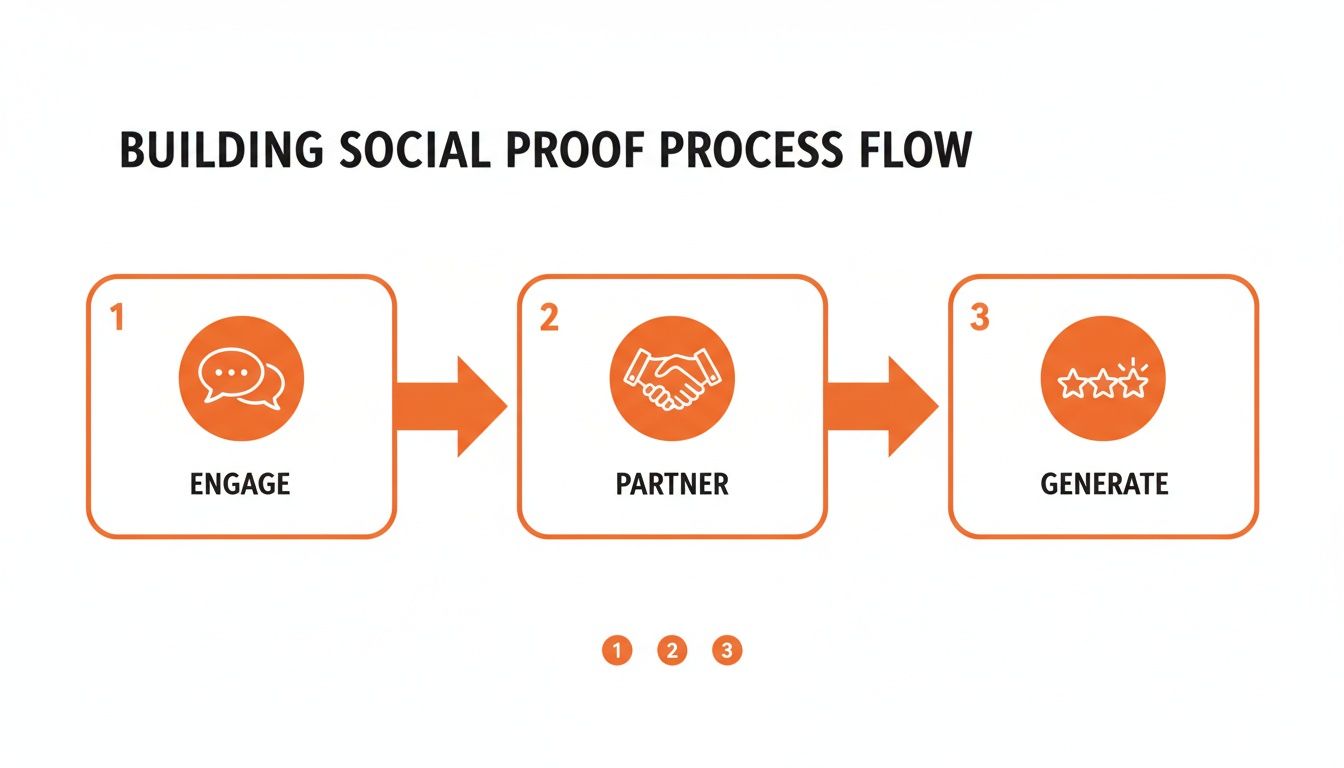
It all starts with genuine engagement. That engagement builds trust, which can lead to valuable feedback or partnerships, ultimately generating the powerful social proof that drives brand growth.
Turn Conversations Into Customers
The real magic on Reddit often happens down in the comment section. This is where you cement your reputation as that helpful, knowledgeable person who always shows up with a great answer.
A winning strategy combines making your own high-value posts with what I call external comment outreach. This means you're actively seeking out relevant conversations happening in other threads and jumping in with helpful, non-promotional advice.
Actionable Example: If a user in r/ecommerce is asking for tips on reducing cart abandonment, a DTC brand owner can share three specific tactics that worked for their own store—"1. We implemented a one-click checkout, 2. We added trust badges like Norton Security, and 3. We offered a small discount for first-time buyers who started to exit the page." This is pure value and builds immense credibility, all without dropping a link or mentioning the brand name. Over time, people will start recognizing your username, getting curious, and checking out your profile to see who you are.
That's how you do it. This is the authentic engagement that turns anonymous usernames into recognizable brand advocates and, eventually, loyal, paying customers.
Measuring The Unmeasurable: Tracking Brand Awareness ROI

Here comes the question every marketer dreads from stakeholders: "What's the ROI on this?" Building brand awareness can feel fuzzy, and you can't always draw a straight line from a helpful Reddit comment to a signed contract.
But that doesn't mean it's impossible. You absolutely can connect top-of-funnel activities to bottom-of-funnel results. The trick is to stop obsessing over direct attribution and start measuring influence. You're trying to show how your awareness efforts create a better environment for conversions, making every other marketing and sales touchpoint that much more effective.
Move Beyond Vanity Metrics
First things first, let's get past the easy-to-track but mostly meaningless numbers. Impressions and follower counts look nice on a slide, but they tell you very little about whether your brand is actually sticking in your customers' minds.
We need to look at metrics that show a real change in audience behavior.
Two of the most telling indicators are direct traffic and branded search traffic. You can pull these right from Google Analytics or a similar platform.
- Direct Traffic: These are the people who typed your URL straight into their browser or used a bookmark. An uptick here is a huge win—it means people are remembering your name without any prompting.
- Branded Search Traffic: This tracks anyone who found you by Googling your company or product names. A steady climb shows your brand is becoming the go-to solution people actively look for.
Imagine a B2B SaaS company starts sharing genuine, non-salesy advice in relevant subreddits. Over the next quarter, they might see a 15-20% lift in direct and branded search traffic. That’s tangible proof that their community engagement is building real brand recall.
Monitor The Conversation
Another huge piece of the puzzle is tracking what people are saying about you online. Social listening and brand monitoring tools are your best friends here. They help you quantify the conversation happening on social media, in forums like Reddit, and across news sites.
You're looking for trends in both the volume and the sentiment of these mentions. A sudden spike in positive mentions after launching a new content piece is a clear indicator that your awareness efforts are hitting the mark.
To really get a sense of where you stand, you need to understand your market presence relative to everyone else. This is where you need to know how to calculate Share of Voice. This metric compares your brand mentions against your main competitors, giving you a clear snapshot of your market penetration.
Connect Awareness To Business Outcomes
Finally, it's time to tie these top-of-funnel metrics to real business results. This is where you build a simple, powerful dashboard that tells a clear story for your stakeholders.
Here’s a breakdown of the key qualitative and quantitative metrics you should be tracking to show the real impact of your awareness campaigns.
Key Metrics for Measuring Brand Awareness
| Metric Type | Metric Example | Tool for Tracking |
|---|---|---|
| Quantitative | Increase in Direct Website Traffic | Google Analytics |
| Quantitative | Growth in Branded Keyword Searches | Google Search Console |
| Qualitative | Positive Sentiment in Social Media Mentions | Brand Monitoring Tools |
| Quantitative | Share of Voice vs. Top 3 Competitors | Social Listening Tools |
| Qualitative | "How did you hear about us?" survey responses | CRM or Survey Software |
By tracking these metrics consistently, you can start to draw some powerful correlations.
Practical example: Maybe you'll notice that a quarter with high brand mention volume from your Reddit activity also had a shorter average sales cycle. Or perhaps a spike in branded search from your podcast sponsorship led to a higher lead-to-customer conversion rate. This is how you prove that brand awareness isn't just a "nice-to-have"—it's a critical investment that makes the entire revenue engine run smoother.
Your Burning Questions About Brand Awareness, Answered
Jumping into a brand awareness strategy can feel like you're navigating without a map. It’s a long game, and it’s totally normal to wonder if what you're doing is actually working. Let's clear up some of the most common questions that pop up for founders and marketers.
How Long Does This Actually Take?
Let's be real: building true brand awareness is a marathon, not a sprint. Sure, a viral video or a perfectly timed ad can give you a nice, quick spike. But for that lasting recognition? That takes time and relentless consistency.
You'll probably start seeing some early signs of life—like more people hitting your website or a bump in social media engagement—within the first 3 to 6 months. But to get to that sweet spot where people think of you first when they have a problem, that often takes 12 months or more of solid, consistent work. We're talking about dedicated content, SEO, and actually talking to people in your community.
The goal isn’t a one-time splash. It's about earning a permanent spot in your customer's mind. That kind of trust is built drop by drop, day by day.
Isn't Brand Awareness Just Lead Gen?
It's easy to mix these two up, but they play very different roles. Think of it as two separate stages of a relationship.
- Brand Awareness is the first introduction. It’s the "get to know you" phase. The whole point is to get on your audience's radar and show them who you are, what you're about, and how you can help. Example: A user sees your helpful comment on Reddit. They don't click anything, but they remember your username. That's awareness.
- Lead Generation is asking for that number. This is where you've built enough trust that someone is willing to give you their contact info in exchange for something valuable, like a webinar, an ebook, or a spot on your newsletter. Example: A week later, that same user sees your post about a free webinar on a topic they care about. Because they recognize you, they sign up. That's lead gen.
A solid brand awareness foundation makes every single lead generation effort easier and cheaper. When people already know and trust you, they're much more likely to say "yes" when you ask for their email.
Can I Do This With a Tiny Budget?
Yes, absolutely. In fact, some of the most powerful brand-building moves don't cost a dime. They just require your time and effort—what we call "sweat equity." When cash is tight, you have to get scrappy and focus on organic activities that build deep connections.
Here are actionable, low-budget examples:
- Solve Problems with Content: Write the definitive blog post that answers a burning question your customer is furiously typing into Google. Example: If you sell camping gear, write "The Ultimate Beginner's Guide to Choosing Your First Tent."
- Show Up Where People Gather: Dive into niche Reddit communities or LinkedIn groups. Don't sell. Just answer questions, share what you know, and be genuinely helpful.
- Let Your Customers Be Your Megaphone: Encourage people who love your product to share their stories. A simple branded hashtag or a little contest can unleash a wave of authentic social proof.
- Connect with Micro-Influencers: Forget the huge celebrity accounts. Build real relationships with smaller creators who have a tight-knit, super-engaged audience that trusts their recommendations. Example: Send your product for free to a YouTuber with 15k subscribers who reviews products in your niche, asking only for their honest feedback.
These methods build a kind of loyalty that a massive ad spend could only dream of.
How is Reddit Different From, Say, Instagram?
This is a great question because the approach is worlds apart. Platforms like Instagram or TikTok are visual and built for broadcasting your message to a wide audience. Reddit, on the other hand, is all about diving deep into conversations within hyper-specific communities.
Think of it this way: on mainstream social media, you're on a stage with a microphone. On Reddit, you're pulling up a chair at a table full of experts and enthusiasts.
Practical Difference:
- On Instagram, a coffee brand might post a beautiful, stylized photo of their latte art with the caption, "Start your day right. #coffee."
- On Reddit's
r/coffee, that same brand would fail. Instead, a winning post would be, "I'm a professional barista. Here are 5 common mistakes people make with their home espresso machine and how to fix them."
Redditors have a finely tuned radar for anything that smells like a sales pitch. They value genuine contribution above all else. Brands that win on Reddit get this. They focus on giving massive value—sharing expertise, answering tough questions, and starting interesting discussions—long before they ever hint at what they sell. It takes more patience, for sure, but the result is a fiercely loyal following that trusts you on a completely different level.
Ready to build authentic brand awareness in the communities that matter most? The team at Reddit Agency specializes in turning conversations into measurable traffic and loyal customers. Learn how we can help you win on Reddit.
