
How to Get Feedback from Customers: A Founder's Guide
Figuring out how to get feedback from your customers isn't just about sending a one-off survey. It’s about creating an ongoing conversation. To truly understand what people need, you need practical, actionable strategies: actively reaching out for one-on-one interviews, digging through social channels like Reddit for unfiltered opinions, and even building feedback tools right into your product.
Why Customer Feedback Is Your Growth Engine

Before we get into the "how," let's be clear about what customer feedback truly is. It's not just a complaint box or a wish list for new features. It's the raw, unfiltered fuel for sustainable growth. Honestly, building in a vacuum is one of the biggest mistakes any founder can make—it leads to wasted engineering hours, marketing campaigns that completely miss the mark, and a product that just doesn't solve a real problem.
Ignoring feedback isn't a passive act; it's a decision that hits your bottom line, hard. Research shows that 77% of customers feel better about brands that actually ask for and listen to their opinions. But here’s the scary part: a massive 56% of unhappy customers will simply leave without a word. That number is up from 46% in 2022. When you actively listen, you're not just fixing problems; you're turning potential churn into loyalty.
Shifting from Silo to Co-Creation
The smartest companies I've seen treat their customers like co-creators. Think about it: a single brutal comment on Reddit could expose a fatal flaw in a new feature, saving you weeks of wasted development time. A pattern you notice in onboarding surveys might reveal a huge market opportunity you never even considered.
Actionable Insight: Your customers are the ultimate experts on their own problems. When you listen to them, you're not just improving your product; you're building a more resilient business that adapts to real-world needs.
To really nail this, you need to get familiar with the voice of the customer concept. It’s a systematic approach to listening that ensures customer input shapes everything you do—from your product roadmap to defining your ideal customer profile.
Building Your Customer Feedback System

If you think a simple "contact us" page is enough, you're missing the bigger picture. A truly effective feedback system is about actively listening across different channels, catching customers at just the right moments to understand their experience.
This isn't just about making people happy; it directly impacts your bottom line. Think about it: 73% of consumers will jump to a competitor after a few bad experiences. On the flip side, 65% of US consumers value a great experience more than flashy advertising. As a founder, you can't afford to ignore this. Reliable feedback channels are your early warning system for churn and your roadmap for growth.
To give you a clearer picture, I've broken down the five core methods I've seen work best for founders. Each has its own strengths and is suited for different situations.
Customer Feedback Methods at a Glance
| Method | Best For | Effort Level | Insight Type |
|---|---|---|---|
| Targeted Surveys | Getting quick, quantitative feedback on specific user actions or events. | Low | Quantitative ("What") |
| NPS & CSAT | Measuring overall customer sentiment and loyalty at a high level. | Low | Quantitative ("How much") |
| Customer Interviews | Deep-diving into the "why" behind user behavior and motivations. | High | Qualitative ("Why") |
| Usability Testing | Identifying specific friction points and UI/UX issues in your product. | Medium | Behavioral ("Where") |
| Social & Reddit | Tapping into raw, unfiltered opinions and market perceptions. | Medium | Qualitative (Unsolicited) |
Each of these methods provides a different piece of the puzzle. The real magic happens when you combine them to get a complete, 360-degree view of your customer's reality.
Crafting Targeted Surveys That Get Responses
Surveys are your go-to for quick, scalable feedback, but timing and relevance are everything. Forget about blasting your entire email list with a 20-question monster. The key is to ask the right question at the right time.
Practical Example: For a SaaS product, use a tool like Typeform to trigger a short, two-question survey 24 hours after a user successfully invites a teammate. You're not asking about their life story, just their initial impression of the collaboration features while it's fresh.
- Post-Onboarding: "On a scale of 1-10, how easy was getting started? What was one thing you hoped to do but couldn't find?"
- Post-Churn: "We're sorry to see you go. What was the main reason you decided to cancel?" This is often your last, best chance to learn from a customer who walked away.
Gauging Sentiment with NPS and CSAT Scores
Net Promoter Score (NPS) and Customer Satisfaction (CSAT) are your high-level health checks. They're perfect for in-app or email deployment right after a key interaction.
Practical Example: A DTC brand could automatically send a CSAT email three days after delivery: "How satisfied were you with your recent purchase?" This covers everything from the checkout flow to the unboxing experience. In a SaaS app, you might trigger an NPS question ("How likely are you to recommend us?") for users who have been active for over 30 days.
Actionable Insight: Don't just obsess over the number. The real gold is in the open-ended follow-up: "What's the main reason for your score?" The comments you get here are often brutally honest and incredibly useful. For instance, a low score might reveal a confusing billing page, a high-impact fix you wouldn't have found otherwise.
Conducting Insightful Customer Interviews
Surveys show you what is happening; interviews tell you why. These one-on-one conversations are where you uncover the deep, nuanced insights that data alone will never give you. Your only job in these calls is to listen.
A great place to start is with your most active users or even brand-new sign-ups. A simple, personal email offering a small gift card for 30 minutes of their time usually does the trick.
Sample Outreach Script:
Hi [Name],
I'm the founder of [Your Company], and I noticed you recently [action they took, e.g., "upgraded to the Pro plan"]. I'm trying to better understand our customers' experiences and would love to hear yours.Would you be open to a 30-minute chat next week? As a small thank you for your time, I'll send you a $25 Amazon gift card.
For a more detailed look at different approaches, this playbook on how to collect feedback from customers is a fantastic resource.
Uncovering Friction with Usability Testing
Usability testing is like putting on your customer’s glasses. You get to watch them interact with your product in real-time. Tools like Loom or Maze make it easy to record a user's screen and audio as they try to complete a task you give them.
Practical Example: Ask a new user to "sign up and create your first project" and then just watch. You’ll be amazed at where people get stuck, confused, or frustrated. These are the UI/UX papercuts—like a poorly labeled button or a confusing form field—that users rarely report but can cause a ton of churn.
Listening to Unfiltered Opinions on Social Media and Reddit
The most honest feedback often comes from places where people are talking about you, not to you. You absolutely need to be monitoring brand mentions on Twitter and lurking in relevant subreddits.
Practical Example: If you sell a DevOps tool, you should be a regular reader of r/devops and r/sysadmin. The goal isn't to jump in and sell. It's to listen for complaints about competitors or discussions about workflow challenges. This is where you'll find the raw, unfiltered truth about your product and market. If you want to get serious about this, our guide on how to build an online community can show you the ropes.
Tapping into the Goldmine of Reddit for Honest Insights
Surveys and user interviews are fantastic, but they give you feedback in a controlled environment. What about the raw, unfiltered opinions? The kind of stuff people only say when they think you aren't listening?
That’s where Reddit comes in. It’s a goldmine for exactly that kind of feedback, but you have to approach it with the right mindset. This isn't a place for a hard sell.
Show up trying to be a marketer, and you'll get downvoted into oblivion. Seriously. The key is to be a genuine member of the community first. Listen, contribute, and then, maybe, ask for feedback.
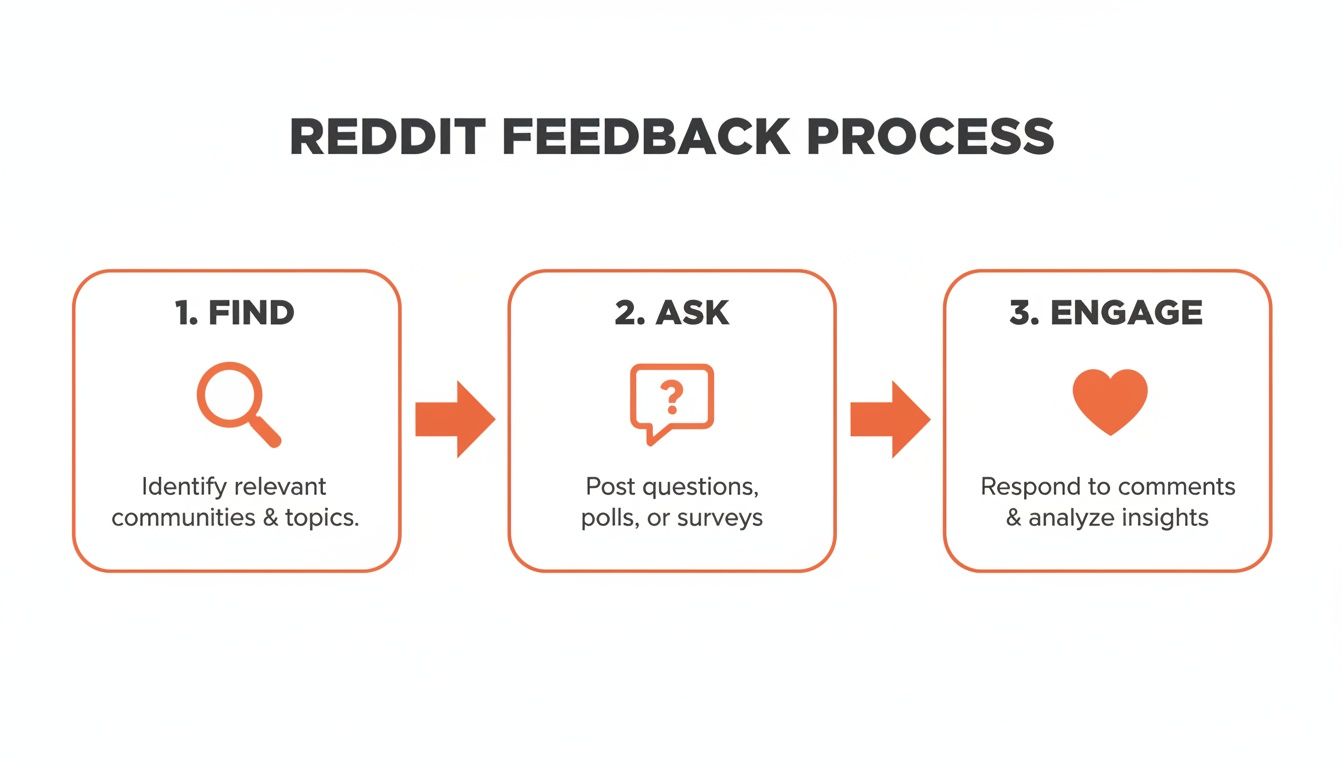
Finding Your People’s Hangouts
First things first, you need to find where your ideal customers are already talking. This isn’t about finding the subreddits with millions of members; it’s about finding the right ones.
Practical Example: If you're building a SaaS tool for founders, you’ll probably find your audience hanging out in places like r/saas, r/startups, or r/growmybusiness. Selling a niche piece of gear for home server enthusiasts? Check out r/homelab or r/selfhosted.
A few ways to track these communities down:
- Search for keywords that describe the problem you solve. Think "project management tool," "CI/CD pipeline," or "skincare routine."
- Check the sidebars of relevant subreddits. They almost always have a list of related communities—a fantastic breadcrumb trail.
- Do some light stalking. Find users who mention your competitors and look at their profile to see which other subreddits they’re active in.
Once you’ve got a shortlist, don't just dive in. Be a fly on the wall for a week or two. Read the posts, learn the inside jokes, and get a feel for the unwritten rules. This is non-negotiable.
How to Ask for Feedback Without Getting Roasted
Your entire approach on Reddit needs to scream humility. You're not there to promote; you're there to ask for help from people who are smarter than you about a particular problem. That simple reframing changes everything.
Here are a couple of post frameworks that actually work.
1. The "Am I Crazy?" Idea Validation Post
This is your go-to when you're in the early stages and just want to know if you're onto something real.
Example Post Title: "Would a tool that automatically generates alt text for images actually be useful for solo bloggers?"
Body: "Hey folks, I've been pulling my hair out trying to keep up with accessibility for my personal blog. I'm thinking of building a simple tool that just plugs into WordPress and handles alt text automatically. Before I go down a rabbit hole for the next six months, I have to ask—is this a problem for anyone else? How are you dealing with it now? Any and all thoughts would be amazing."
2. The "What's the Absolute Worst Part About..." Post
This is perfect when you want to dig deeper into a specific struggle your users have.
Example Post Title: "What's the most infuriating part of managing client invoices for you?"
Body: "I'm doing some digging into how freelancers manage their billing. I know chasing payments is a pain, but I'm curious what everyone here finds most annoying. Is it the time tracking? Creating the invoice? The awkward follow-up emails? Brutal honesty is encouraged!"
This gets you the nitty-gritty details you need to build something people will actually pay for. For a much deeper playbook on these strategies, this guide on using Reddit for marketing is fantastic.
Your Job Isn't Done When You Hit 'Post'
The real magic happens in the comments. This is where you build genuine connections and show you're not just another drive-by marketer.
Actionable Insight: Make it your mission to reply to every single comment. Someone leaves a critical remark? Thank them for their honesty and ask a follow-up question. "That's a really good point, I hadn't thought about that. Could you tell me more about...?" Never, ever get defensive. Show you're there to listen. I've seen this single act of transparency turn the harshest critics into a product's biggest champions.
Turning Raw Feedback Into Actionable Insights
Collecting feedback is one thing, but the real magic happens when you turn that jumble of raw data into a concrete plan. Without a solid system, you're just going to drown in contradictory opinions, get sidetracked by minor feature requests, and lose sight of the truly critical insights. The point isn't just to listen; it's to process, prioritize, and actually do something with what you learn.
Your first move? Create a central feedback hub. Seriously, this is non-negotiable. Just imagine trying to spot trends when your feedback is scattered across a dozen different survey tools, random Reddit threads, interview notes in a Google Doc, and a pile of support tickets. It's a recipe for chaos.
Build a Central Feedback Hub
A simple database in a tool like Airtable or Notion can bring order to the madness. The idea is to log every single piece of feedback in one spot, regardless of where it came from. Each entry should capture the feedback itself, the source (e.g., "NPS Survey," "Reddit Comment"), the customer's name, and a date.
This is what a basic setup can look like—it gives you a single source of truth for every piece of customer input.
When you centralize data this way, you can filter, sort, and search with ease, which is exactly what you need for the next part of the process: finding the patterns.
Tag, Categorize, and Spot Themes
With everything logged in your hub, it's time to start tagging. This is how you go from a list of individual comments to understanding the bigger picture. Come up with a consistent set of tags that make sense for your business.
Practical Example: I find it helpful to categorize in a few different ways:
- By Product Area:
Onboarding,UI/UX,Billing,Integrations - By Feedback Type:
Bug Report,Feature Request,Usability Issue - By Sentiment:
Positive,Negative,Neutral
After a while, you’ll start to see which tags pop up most often. If you notice a ton of comments tagged with "Onboarding" and "Usability Issue," you've just uncovered a major pain point that probably needs your attention, fast. This data-driven approach keeps you from getting swayed by the loudest person in the room.
Prioritize with an Impact/Effort Matrix
Let's be real: you can't act on everything at once. A simple but incredibly effective way to decide what to tackle first is the Impact/Effort Matrix. For every theme or feature request you've identified, ask two key questions:
- Impact: How much will this actually improve the customer experience or help us hit our goals? (High/Medium/Low)
- Effort: How many resources and how much time will this take to build? (High/Medium/Low)
Suddenly, your priorities become crystal clear. You'll want to jump on the High-Impact, Low-Effort items immediately—these are your quick wins. And those Low-Impact, High-Effort ideas? They go straight to the back of the line.
Actionable Insight: Closing the loop is the most overlooked—and most powerful—step in this entire feedback process. When you finally ship a feature or fix a bug based on a suggestion, personally email the customers who asked for it. A simple message saying, "Hey, remember that thing you asked for? We built it," can create a customer for life.
This one small action proves you're not just collecting data into a void. It shows you're listening and that their input genuinely matters, which is the best way to encourage even more high-quality feedback down the road.
Turning Customer Feedback Into Real-World Action
You’ve gathered the feedback and sorted it all out. Now for the most important part: actually doing something with it.
This is where the rubber meets the road. But what you do with a piece of feedback completely depends on where your business is at. The right move for a founder with just an idea is worlds apart from the right move for a mature SaaS company.
Let’s ditch the one-size-fits-all advice. Instead, here are three battle-tested playbooks for turning feedback into growth, tailored for where you are right now.
The Pre-Launch Playbook: From Idea to MVP
Before you’ve even written a line of code, your mission is simple: validation. You aren't tweaking features yet; you're confirming that you've found a problem so painful that people will happily pay you to make it go away.
Your entire focus should be on validating the core idea and finding your first true believers.
- Nail the Problem, Not the Solution: Use what you learned from customer interviews and Reddit deep dives to sharpen your one-sentence value prop. Can you describe the problem in a way that makes people lean in and say, "Tell me more"? If not, keep digging.
- Build an Audience First: Create a dead-simple landing page that mirrors the exact pain points you've uncovered. Don't just talk about features. Talk about their struggles. Then, drive traffic from the very communities you've been learning from and watch your sign-up rate.
- Co-create Your MVP: Don't build in a vacuum. Grab your most enthusiastic waitlist members and show them early mockups or a clickable prototype. The only question that matters is, "Does this look like it would actually solve your problem?" Their answers tell you exactly what to build first.
Actionable Insight: For a pre-launch startup, feedback isn't about your product; it's about the customer's problem. Your job is to become the world's leading expert on their pain and use their language to build the cure.
The Growing SaaS Playbook: Retention and Refinement
Once you have a product and paying customers, your focus shifts. Feedback is no longer just for validation—it's the fuel for your product engine and your best shield against churn. It’s all about continuous improvement.
At this stage, your feedback loop should be wired directly into your company’s DNA.
- Let Users Guide Your Roadmap: That tagged feedback hub we talked about earlier? It's now your roadmap's best friend. Use it to spot the most-requested features and nagging bugs. This data-driven approach ensures your engineering team is always working on what customers actually want, not just what you think they want.
- Fight Churn Before It Starts: When a low NPS or CSAT score comes in, treat it like an emergency alert. A quick, personal email from a real human asking for more detail can work wonders. You'll often uncover a fixable issue and turn a potential churn risk into a loyal advocate.
- Close the Loop, Loudly: When you ship a new feature that came directly from customer requests, shout it from the rooftops. Announce it in your newsletter, on social media, and—most importantly—personally email the users who asked for it. There's nothing more powerful than showing a customer you're listening.
The Major Feature Launch Playbook: De-Risk and Iterate
Launching a big, new feature is always a gamble. Feedback is how you stack the odds in your favor. By gathering it before, during, and after the launch, you can ensure a smooth rollout and make smart improvements fast.
- Before You Launch (Beta Testing): Hand-pick a group of your most trusted power users and give them early access. Run usability tests with them to find all the confusing workflows and hidden bugs before they hit your entire customer base. This is your dress rehearsal.
- During the Launch (The First 48 Hours): Go into high-alert mode. Have someone glued to social media, community forums, and your support desk. You're hunting for those immediate, visceral reactions and any show-stopping bugs that require an emergency hotfix.
- After the Launch (The First 30 Days): Once the dust settles, send a targeted survey to everyone who has used the new feature. Ask them what they love, what’s still missing, and how it’s changing their day-to-day. Their answers are the blueprint for version 1.1.
To make this even more practical, here’s a quick summary table you can use to match your company's current stage with the right actions.
Feedback Implementation Playbook
This table summarizes the core strategies for using feedback effectively at different business stages. It’s a founder’s cheat sheet for applying the right tactics at the right time to drive meaningful growth.
| Business Stage | Primary Goal | Key Action Items |
|---|---|---|
| Pre-Launch Startup | Problem Validation | 1. Refine value prop based on interview insights. 2. Build a waitlist with a problem-focused landing page. 3. Co-create the MVP with early adopters. |
| Growing SaaS Brand | Retention & Improvement | 1. Use tagged feedback to inform the product roadmap. 2. Proactively contact users with low NPS/CSAT scores. 3. Announce updates and credit users who suggested them. |
| Major Feature Launch | De-Risk & Iterate | 1. Run a private beta to find bugs pre-launch. 2. Monitor all channels for immediate reactions post-launch. 3. Survey new feature users for v1 improvements. |
By aligning your actions with your business stage, you ensure that customer feedback isn't just noise—it's a strategic asset that guides every decision you make.
Common Questions About Getting Customer Feedback
Let's be honest, trying to get meaningful feedback from customers can feel like you're shouting into the void, especially when you're just starting out or strapped for resources. Here are some answers to the questions I see pop up most often from founders trying to get this right.
How Do I Get Feedback If I Have Few Customers?
When you only have a handful of users, mass surveys are pointless. This is the time for a personal, high-touch approach. Forget big numbers and focus on quality conversations.
Actionable Insight: Your best bet is to go where your ideal customers already are. Think niche subreddits, private Slack groups, or industry-specific online forums. A simple, direct post offering early access or a small gift card for a 30-minute chat works wonders. You're not trying to boil the ocean here; 5-10 in-depth conversations will give you a wealth of direction for your early product and messaging.
What's the Best Way to Handle Negative Feedback?
First, take a deep breath. Negative feedback isn't an attack—it's a gift. Seriously. The customer who complains is giving you a free roadmap to a better product. The one you should worry about is the one who leaves silently.
Here’s a simple, actionable framework for responding:
- Thank them. "Thank you so much for taking the time to share this. I really appreciate your honesty."
- Get curious, not defensive. Ask follow-up questions to truly understand the core of their frustration. "Could you tell me a bit more about what you were trying to do when that happened?" is your best friend.
- Own it and share the plan. If they have a good point, admit it. Let them know what you're going to do about it, even if the timeline is long. "You're right, that part of the app is confusing. It's on our list to fix in Q3."
Actionable Insight: Closing the loop is your secret weapon. After you ship a fix based on their input, let them know personally. This single action can transform a vocal critic into one of your most loyal advocates.
How Often Should I Ask for Customer Feedback?
Don't think of feedback as a one-off campaign. It's not an event; it's a system. The goal is to build an ongoing conversation, not conduct an occasional interrogation.
Practical Example: For your quantitative data, set up automated touchpoints. A CSAT survey sent 7 days after onboarding or an annual NPS check-in can run on autopilot. For the richer, qualitative stuff, get into a rhythm. Making it a goal to conduct 2-3 customer interviews every single month is a fantastic, sustainable habit. You want listening to become part of your company's DNA.
Ready to tap into the world's largest focus group for honest, unfiltered feedback? Reddit Agency helps you find your ideal customers on Reddit, craft high-signal posts, and turn authentic conversations into measurable growth. Stop building in a silo and start co-creating with your audience. Learn how we do it.
