How to Get More Podcast Listeners and Grow Your Audience
If you want to know how to get more podcast listeners, stop shouting into the void and start a conversation with one specific person. The secret isn't just making great content; it's making content for someone who needs to hear it. This whole process starts long before you ever press record.
Build a Show They Can’t Ignore

Too many podcasters get caught up chasing downloads without ever asking, "Who is this really for?" They work on assumptions, creating episodes they think people will like. But real, sustainable growth happens when you swap guesswork for genuine insight.
You need to build a detailed Ideal Listener Profile—a crystal-clear picture of the one person your show is meant for. This isn't about broad demographics like "women aged 25-40." It's about their inner world: their beliefs, frustrations, burning questions, and daily habits. Once you know this person inside and out, every decision, from your episode titles to your promotional copy, becomes infinitely easier.
Go Beyond Guesswork with Practical Research
So, where do you find this ideal listener? You don't have to invent them. You just have to find where they're already talking and start listening.
Here are a few practical ways to gather intel:
- Mine 3-Star Reviews: Head over to Apple Podcasts or Podchaser and look up similar shows in your niche. Skip the glowing 5-star reviews and the 1-star rants. The 3-star reviews are where the gold is. These are from people who wanted to love the show but felt something was missing. You'll find comments like, "Great topic, but I wish they'd go deeper on X" or "The hosts are knowledgeable, but the audio quality is distracting." That's your content gap and production standard, handed to you on a silver platter.
- Become a Fly on the Wall in Online Communities: Find the subreddits, Facebook Groups, Slack channels, or niche forums where your audience lives. What questions pop up over and over? What advice do they ask for? Actionable insight: If you see three different people in r/personalfinance ask "How do I actually start a Roth IRA?" in one week, that's your next episode topic. Pay close attention to the exact language and slang they use.
- Listen to Social Media Chatter: Use simple hashtag searches on platforms like X or LinkedIn to tune into conversations. What are people complaining about? What articles or ideas are they sharing enthusiastically? For example, searching #ProjectManagement on LinkedIn might reveal that everyone is frustrated with a new software update—that's a potential episode about navigating tool changes.
Key Takeaway: Your future listeners are already telling you exactly what they want to hear. Your job is to listen carefully and build a show that solves a real problem or feeds a genuine curiosity.
Putting the Ideal Listener Profile into Practice
Let’s see how this plays out with two very different shows.
Example 1: The B2B SaaS Podcast
A generic show for SaaS founders might cover broad topics like "marketing." But after doing some digging, a sharper picture emerges.
- Who they are: "Alex," a 32-year-old founder with a tiny team and an even tinier budget.
- Their pain points: Alex doesn't need another high-level strategy talk. They're stuck on the ground floor, trying to figure out how to get their first 100 customers without a marketing department. They're overwhelmed by complex sales funnels.
- Where they hang out: You'll find Alex in subreddits like r/SaaS and r/startups, asking very specific tactical questions.
- The Content Solution: Instead of a vague episode like "How to Market Your SaaS," this podcast creates laser-focused titles: "Three Scrappy Ways to Land Your First 10 Customers" or "How I Turned LinkedIn Comments into Demos." This speaks directly to Alex's immediate reality.
Example 2: The Historical Storytelling Podcast
Now, let's picture a podcast about obscure figures from ancient history. The target audience isn't just "history buffs."
- Who they are: "Sarah," a 45-year-old professional who uses her commute to escape the daily grind.
- Her Desires: She doesn't want a dry, academic lecture. She craves immersive, narrative-driven stories that transport her to another time.
- Where she hangs out: She's probably in Goodreads groups discussing historical fiction or following museum accounts on Instagram for their visual storytelling.
- The Content Solution: The podcast leans into what Sarah wants, producing episodes with rich sound design and compelling hooks, like "The Spy Queen of Ancient Rome." The promotion focuses on the intrigue, not just the facts.
By defining these listeners so clearly, both podcasts can create content that feels like it was made just for them. Getting this foundational step right makes every other growth tactic far more powerful. For more strategies on growing your show, check out these Top Growth Tips for More Podcast Listeners. Remember, it all starts with making a genuine connection.
Make Your Podcast Easy to Find
Look, creating a fantastic show is only half the job. The other, arguably more important half, is making sure people can actually find it. You can't just cross your fingers and hope a few social media posts will do the heavy lifting. You've got to treat every single episode like a valuable asset, one that can keep pulling in new listeners for months or even years. This is where podcast SEO comes in.
It's a little different from traditional website SEO. For podcasters, the real action happens inside listening apps like Apple Podcasts and Spotify. Think of them as search engines for audio. When someone is curious about a topic and types it into that search bar, you want your show to be what pops up. It all starts with getting inside your ideal listener's head and figuring out the exact words they're using.
Find Your Keywords (Without Sounding Like a Robot)
Keywords are simply the bridge between a listener's question and your episode's answer. You don't need fancy, expensive tools to get started. Just think about the main topic of your next episode and ask yourself a simple question: "What would someone type into the search bar to find this content?"
- Start with the big ideas. For a personal finance podcast, maybe your core topic is "investing for beginners."
- Drill down into specifics. This is where the magic happens. Instead of just "investing," think about what someone really wants to know. They're probably searching for things like "how to start investing with little money" or "best index funds for new investors." These longer phrases, or "long-tail keywords," are gold because they're less competitive and attract people who are ready to listen.
- Use the search bar as your crystal ball. Go to Apple Podcasts, Spotify, and even Google. Start typing in your core topics and watch the autocomplete suggestions. Practical example: Type "freelance writer" into Spotify's search bar. You'll see suggestions like "freelance writer tips," "how to find freelance writing clients," and "freelance writer rates." These aren't guesses; they're what real people are actively searching for right now.
A Quick Pro Tip: Don't just stuff your keywords into the title. Weave them naturally into your episode description and the detailed show notes. This gives the listening apps more context, which gives them more reasons to show your episode to the right people.
Getting this right means you have to think like your listener. It's a fundamental principle that applies to any content you create. If you want to go deeper on this, our guide on how to increase organic traffic covers more foundational SEO strategies that work everywhere.
Upgrade Your Episode's First Impression
Once you've got your keywords, it's time to package your episode to turn a casual scroller into a loyal subscriber. It really comes down to three things: your title, your description, and your artwork.
Let's imagine you recorded an episode about getting past creative blocks. Here's how most people would package it versus how you should package it.
Before (Bland and Invisible):
- Title: Episode 27 - Creative Blocks
- Description: In this episode, we talk about creative blocks. We share some ideas on how to get past them. Tune in for more.
Honestly, that's just forgettable. It's not going to show up in search, and it does nothing to spark curiosity.
After (Optimized to Get Clicks):
- Title: Overcoming Creative Block: 5 Practical Steps to Reignite Your Spark
- Description: Feeling stuck? This episode is your step-by-step guide to breaking through creative block for good. We’ll cover the surprising science behind why you feel uninspired and give you five actionable tactics you can use today, including the "10-Minute Idea Dump" and the "Project Scaffolding" technique. Stop waiting for inspiration and start creating.
See the difference? This version is a powerhouse. It uses the target keyword ("overcoming creative block"), promises a clear benefit ("5 Practical Steps"), and creates intrigue with unique names for its techniques. It speaks directly to a listener's pain point and offers a solution.
This isn't just a "nice to have" anymore. The global podcast audience is expected to hit 584.1 million listeners in 2025 and is projected to soar to 651.7 million by 2027. In a market this massive, making your content discoverable is non-negotiable. Discover more insights about podcast audience growth on Backlinko.com.
And one last thing—don't forget your episode art. Your main show cover is important, of course, but creating custom art for your big, important episodes can make them stand out in a crowded feed. It’s a visual cue that says, "Hey, this isn't just another episode. This one is special."
Create a Sustainable Promotion System
So you’ve hit "publish" on your latest episode. That feels like the end, right? It’s not. It’s the starting line for what really grows your show. True, sustainable audience growth comes from a deliberate promotion system, not just a single social media blast on launch day.
The whole point is to shift your mindset. Stop seeing promotion as a last-minute chore and start building a repeatable workflow. This system will keep putting your amazing content in front of fresh ears, long after the initial buzz fades. You don't need to be everywhere at once; you just need to be smart about it.
Build Your Promotion Engine
Think of a single podcast episode as a content goldmine. Your job is to be the miner, chipping away at that core audio to create smaller, platform-native assets. A 30-minute interview can easily fuel a full week of promotional content.
Here’s how you can start breaking down an episode:
- Audiograms: These are your bread and butter. Grab a powerful 30-60 second audio clip, pair it with a branded image and an animated waveform, and you've got a perfect, shareable snippet for Instagram or LinkedIn.
- Quote Graphics: Pull out the most potent, tweetable, or thought-provoking lines. Turn them into clean, eye-catching graphics for Twitter, Instagram Stories, or even Pinterest. They’re quick to consume and highly shareable.
- Short Video Clips: If you record video, this is a must. Isolate a killer 2-minute explanation or a genuinely funny moment. Post it as a native video on LinkedIn, a Reel on Instagram, or a YouTube Short to capture a totally different audience.
- Written Summaries: Never underestimate the power of text. A simple bulleted list of key takeaways can make a fantastic LinkedIn post or a Twitter thread. Actionable insight: Take the 3 main tips from your episode, write a short intro, and post it as a text-only LinkedIn post. This format often gets higher reach than posts with links.
Seeing how these assets guide potential listeners is a core part of understanding the content marketing funnel.
My Pro Tip: The secret to a promotion system that doesn't burn you out is efficiency. Create a handful of templates for your audiograms, quote cards, and video clips in a tool like Canva. This keeps your branding tight and cuts your creation time in half each week.
Your Weekly Promotion Checklist
Consistency will always beat intensity. Instead of frantically trying to promote each new episode, create a simple checklist you can follow every single week. This turns a chaotic, stressful process into a calm, manageable habit.
The journey for a new listener often starts with a search. They discover your show through a keyword, then your title and artwork have a split second to convince them to click.
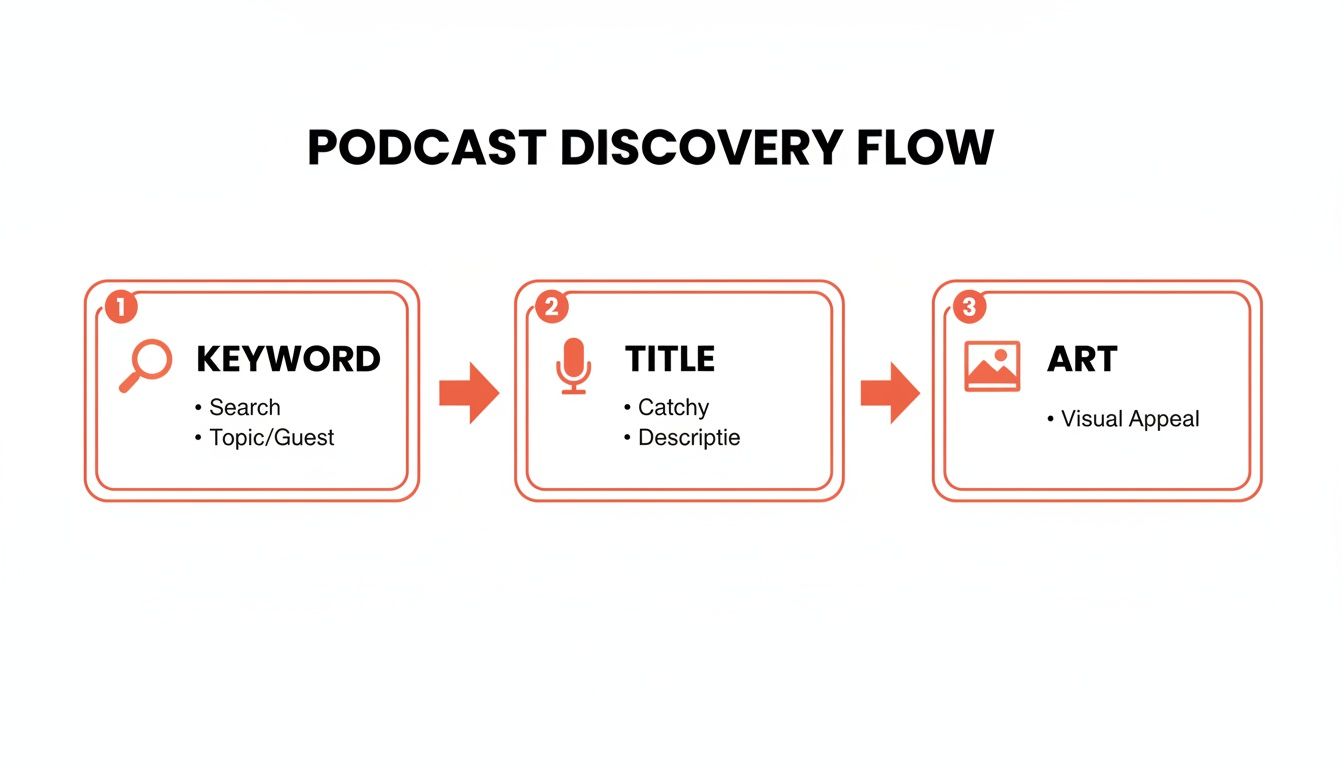
This discovery flow is exactly why your promotional assets need to be visually appealing and optimized to grab attention in a noisy feed.
Now, let’s get practical with a content repurposing plan. A single episode can be spun into multiple pieces of content, each designed for a specific platform's audience and format. This maximizes your reach without requiring you to create entirely new material from scratch.
Podcast Content Repurposing Matrix
| Platform | Recommended Content Format | Key Objective | Example |
|---|---|---|---|
| Instagram/Facebook | Audiogram (30-60s) or Reel | Spark curiosity | A compelling story or a "hot take" from the guest. |
| X (Twitter) | Thread of 3-5 Key Takeaways | Deliver quick value | A bulleted list of actionable tips discussed in the episode. |
| Short Video Clip (1-3 min) or Text Post | Establish authority | A clip of you or a guest explaining a complex topic simply. | |
| YouTube | Full Episode (Video) or Shorts | Attract search traffic | Post the entire video interview or create a vertical clip of a highlight. |
| Pinterest/IG Stories | Quote Graphic | Inspire & engage | A beautifully designed graphic with a powerful quote from the episode. |
| Blog/Newsletter | Written Summary or Transcript | Drive traffic & SEO | A blog post summarizing the episode with show notes and links. |
By following a matrix like this, you ensure every piece of content you create has a clear purpose and destination. This systematic approach ensures you’re not just shouting "new episode!" into the void. You’re consistently offering value in different formats across multiple channels, which is the real secret to finding new listeners who will actually stick around.
Find Your Audience on Reddit
Instagram and other social platforms can feel like shouting into a void. It's crowded, and the content is gone in a flash. Reddit is a different beast entirely. It’s a massive network of small towns—niche communities called subreddits where people get really deep into their passions and problems.
But let me be clear: this isn't a place to just drop a link and run. Redditors have a finely tuned radar for self-promotion, and they are not shy about calling it out.
The secret to Reddit isn't just posting about your podcast. It's about becoming a real, contributing member of a community. When you do that, you build trust. People get curious about who you are and what you're working on, and that’s when they'll actually listen.
Identify Your Ideal Subreddits
First things first, you need to find where your people are hanging out. Whatever your podcast is about, no matter how specific, there's a good chance there's a subreddit for it. You just have to think a little outside the box.
Here’s how I go about finding the right communities:
- Start with the obvious. If your show is about sustainable living, of course you’ll search for things like "sustainability," "zero waste," and "eco-friendly." That's your starting list.
- Drill down to the niche. This is where the magic happens. For that same podcast, the real gold might be in smaller, more engaged communities like
r/simpleliving,r/Anticonsumption, or even a related hobbyist group liker/gardeningwhere your knowledge would be super valuable. - Think about your listener's other interests. What else are they into? Someone who loves your true-crime podcast probably spends time in
r/unresolvedmysteriesor specific show communities liker/makingamurderer.
The whole point is to find subreddits where your content feels like a natural part of the conversation, not an interruption. If it feels forced, it is.
Once you have a list of 5-10 solid-looking subreddits, your real work begins. Don't post a single thing. Just hang out for at least a week. Read the top posts, scroll through the comments, and absorb the rules and the inside jokes. This reconnaissance is crucial—it's what will keep you from making a rookie mistake later.
Become a Valued Community Member First
Before you even think about mentioning your podcast, you have to build some street cred. That means acting like a human being. Upvote good content. Ask interesting questions. And most importantly, share helpful answers and insights when you have them.
Your goal is to become a familiar username that people associate with value. Actionable Insight: Set a goal to leave 3 thoughtful, helpful comments in your target subreddits every day for two weeks before you ever create your own post. This builds your comment karma and establishes you as a genuine member. People are infinitely more likely to check out a show from someone they know and respect than from a random account that just spams a link.
If you want to go deeper on this, check out this guide on subreddits for promoting podcasts—it’s a great resource for matching your show to the right community.
Craft Posts That Offer Genuine Value
Alright, you've put in the time and you're now a recognized member of the community. Now you can start creating posts that subtly connect to your podcast's themes, but the key is to give, not take. Share a core idea, a killer tip, or a great story you covered on a recent episode, but frame it as a standalone piece of value for the community.
Let's walk through an example for a personal finance podcast.
Imagine your latest episode is all about how to negotiate a bigger salary.
- The wrong way (This will get downvoted to oblivion): "Hey r/personalfinance, I just dropped a new podcast episode on how to negotiate your salary! Check it out here: [link]"
- The right way (This will spark a real discussion): "I recently helped a friend prep for a salary negotiation and we used a 3-step framework that landed her a 15% raise. Here's what we did: 1. Researched industry benchmarks... 2. Built a 'brag document'... 3. Practiced the 'confident pause'..."
See the difference? The second post gives away the farm. It's immediately useful and starts a conversation. Then, way down at the end of the post or in the comments, you can casually add, "I actually break this framework down in a lot more detail on my podcast if anyone's interested." It feels like a helpful suggestion, not a sales pitch.
Use Comment Outreach to Solve Problems
Sometimes the biggest wins aren't in making new posts, but in replying to others. Keep an eye on your target subreddits for questions or problems that your podcast has already answered. This is your chance to swoop in and be a hero.
- Find a cry for help: Someone in
r/careerguidanceposts, "I have a job interview tomorrow and I'm terrible at answering the 'tell me about yourself' question." - Give them a direct solution: You jump in with a practical, concise tip. "A great approach is the 'Past, Present, Future' model. Briefly touch on your past experience, connect it to your current role, and explain why this new opportunity is the perfect future step. It gives a clear, compelling narrative."
- Make a soft offer: Once you've delivered that value, you can add, "I actually have a podcast where I broke down this exact interview question in a recent episode. Happy to share the link if it's helpful."
This tactic positions your podcast as a problem-solving tool, not just more content to consume. You're giving someone the exact answer they need at the exact moment they need it. That creates a powerful first impression and is how you turn a casual Redditor into a loyal subscriber.
Use Collaborations to Catapult Your Growth

Here's a hard truth: amazing content isn't enough. You can't just publish episodes and hope people stumble upon them. One of the single most effective ways to grow is to put your show in front of people who are already listening to podcasts just like yours.
Strategic collaborations are your ticket in. By partnering with other creators, you get to tap into their established, engaged audiences. It’s about more than just a shout-out; it's about borrowing trust from a voice they already know, which is a shortcut to getting them to give your show a try.
Master the Art of Being a Great Podcast Guest
Getting yourself featured on other podcasts is a massive growth lever. Think about it: you’re not just getting a promo slot. You're getting a warm, personal introduction from a host their audience already trusts. That endorsement is gold.
The trick is to be surgical with your targeting. Don't just chase the biggest shows in your industry. Instead, find podcasts where the ideal listener is a perfect match for your show.
- Pro Tip: Fire up a tool like Listen Notes or Rephonic and search for keywords in your niche. Here's a great hack: look up where the host of your absolute favorite podcast has been a guest. If they were on a show, that's a huge signal that the audience is a perfect fit for you, too.
Once you have your list, remember your pitch is about the value you can bring to their audience, not what you’re trying to get from them.
A Pitch That Actually Works
Subject: Guest Idea for [Podcast Name]: 3-Step Framework for [Their Audience's Goal]
Hey [Host Name],
Just finished episode [#] on [Specific Topic]—loved how you broke it down. Your point about [Specific Insight] really hit home.
I’ve been following the show for a while and can see your listeners are all about [Audience Goal]. I’ve developed a 3-step framework that helps people achieve [Specific Outcome], and I think it would be a huge win for your audience.
We could dive into things like:
- The common mistake that completely derails [Audience Goal].
- A simple "Brag Document" technique for [Specific Task].
- How to use the "Confident Pause" to sound like an expert.
I host [Your Podcast Name], where we dig into [Your Topic]. Let me know if this sounds interesting!
Cheers,
[Your Name]
Set Up Win-Win Cross-Promotions
Cross-promotion is another fantastic way to collaborate. This is a simple agreement where you and another podcaster promote each other's shows. The key is to find a partner with a similar audience size and theme, but who isn't a direct competitor.
My Two Cents: The best collaborations feel completely natural. The listener shouldn't feel like they're hearing an ad; they should feel like you're genuinely excited to introduce them to another amazing show they'll love.
There are a few solid ways to structure these partnerships.
Proven Cross-Promotion Models
| Promotion Type | How It Works | Perfect For... |
|---|---|---|
| Promo Swap | You run their short, pre-recorded promo at the beginning of your episode, and they do the same for you. | Getting quick, easy exposure to a brand-new audience without a huge time commitment. |
| Feed Drop | You publish one of their very best episodes directly into your podcast feed, and they drop one of yours in theirs. | Giving listeners a full "free sample" so they can experience an entire episode of the other show. |
| Content Collab | You co-host an episode together or interview each other on a topic that’s relevant to both audiences. | Creating unique, high-value content that serves both of your communities at the same time. |
Never forget that the appetite for great audio is massive. Listener engagement is off the charts, with 76% finishing most or all of the episodes they start. On top of that, the average listener in the U.S. follows 9 different shows every week.
This tells you that people are actively looking for new shows to add to their rotation. A trusted recommendation from another host is one of the most powerful discovery engines out there. Discover more podcast engagement statistics on Talks.co. Your next collaboration could easily make you one of those nine shows for a whole new group of dedicated listeners.
Frequently Asked Questions About Growing a Podcast
Even when you have a solid plan, growing a podcast can feel like trying to solve a puzzle where the pieces keep changing shape. You've nailed down your audience, optimized your episodes, and have a promotion strategy in place, but new questions always pop up. Let's tackle some of the most common hurdles I see podcasters run into.
How Long Does It Take to See Real Podcast Growth?
I wish there was a magic number, but the truth is, it depends entirely on your niche, how consistently you promote your show, and the quality of your content. That said, I've found that most podcasters who stick to a dedicated strategy—think solid SEO, consistent promotion, and real community engagement—start to feel some serious momentum within 3-6 months.
The real secret is consistency. Trying to do everything all at once and then burning out won't get you far. Instead, focus on small, sustainable actions every single week. A great starting point is repurposing one episode into three distinct social media posts. This is about building a foundation, not chasing a fleeting viral hit.
Should I Use Paid Ads to Get More Listeners?
Paid ads on platforms like Spotify or social media can definitely give your growth a serious boost, but there’s a catch. They only work if you have the budget and a laser-focused picture of your ideal listener. Before you spend a single dollar, make sure your podcast's "packaging" is top-notch. I'm talking about your cover art, your show description, and your audio quality—it all needs to look and sound professional.
My advice? Start small. Don't go all-in right away. Run a few small, targeted campaigns to see what message resonates and who responds. For instance, you could spend $50 promoting a short audiogram clip of your most compelling episode to a lookalike audience on Facebook of people who like a similar, larger podcast in your niche. This simple test will tell you if you're on the right track before you decide to ramp up your ad spend.
What Are the Most Important Metrics for Tracking Growth?
It's easy to get obsessed with total downloads, but that number is really just a vanity metric. It doesn't tell you if people are actually listening or if they like what they hear. To get a real sense of your show's health, you need to look at the numbers that show loyalty and engagement.
These are the four metrics I always tell my clients to obsess over:
- Downloads Per Episode (After 30 Days): This is your true performance baseline. It cuts through the initial launch hype and shows you how an average episode performs over time.
- Follower/Subscriber Growth: This is the big one. Are casual listeners hitting that "follow" button? A steady climb here is the best indicator that your content is truly connecting with people.
- Audience Retention Charts: Both Spotify and Apple give you this data. It’s gold. If you see a massive listener drop-off at the 2-minute mark every single time, it’s a huge red flag that your intros are probably too long or boring.
- Website Traffic from Show Notes: Are your calls to action actually working? If you mention a free resource in an episode and link to it in the show notes, this metric tells you exactly how many people cared enough to check it out.
Remember, growth isn't just about chasing massive numbers. It's about building a loyal community, one listener at a time. To really appreciate the impact your show can have, it's worth exploring How Podcasters Are Redefining Global Influence. Understanding the bigger picture can spark some brilliant ideas for your own growth strategy.
Ready to tap into one of the most passionate online communities to find your next wave of listeners? At Reddit Agency, we specialize in helping podcasters and content creators build authentic connections in niche subreddits, turning conversations into loyal subscribers. Learn how we can help you grow on Reddit.
