
How to Increase Website Traffic with Proven Growth Tactics
To get more people to your website, you have to start with a solid SEO foundation. This means zeroing in on the right keywords and creating genuinely good content that gives people what they're looking for. Before you do anything else, you must nail on-page optimization and make sure your site is technically sound—these are the things search engines reward above all else.
Build Your Traffic Engine with Foundational SEO
Before you can dream of viral posts or massive social media campaigns, you need to build the engine that will drive consistent, long-term growth. Search Engine Optimization (SEO) isn't a magic trick; it's the strategic process of making your website more visible and appealing to search engines like Google.
Think of it as laying the groundwork for a skyscraper—without a solid foundation, everything else you build on top will eventually crumble.
This foundation is non-negotiable because organic search is still king. With Google handling billions of searches every single day, showing up on that first page is the whole game. The numbers don't lie: professionals who make SEO a priority see an average of 14.6% monthly traffic growth, a massive jump compared to the measly 1.6% seen by those who don't. If you're struggling with low numbers, it's worth exploring these 8 proven solutions to address low website traffic for a more detailed plan.
Uncover What Your Audience Really Wants
The first real step in any SEO plan that actually works is getting inside your audience's head. You have to stop guessing what people are searching for and start using data to find the exact phrases they’re typing into that little search bar. This is the difference between shouting into the void and having a real conversation.
Go Beyond Obvious Terms: Don't just target broad, hyper-competitive keywords like "dog collars." A small e-commerce shop has a much better chance of ranking for a long-tail keyword like "handmade leather dog collar for small breeds." It's specific, targeted, and speaks to a ready-to-buy customer. Actionable insight: Use a free tool like Google's Keyword Planner. Type in a broad term like "project management" and look at the suggestions for longer, more specific phrases like "project management software for small business" or "how to create a project timeline in excel."
Understand User Intent: Ask yourself why someone is searching for that term. Are they just browsing for information ("what is SEO")? Comparing different products ("ahrefs vs semrush")? Or are they ready to pull out their credit card ("buy hiking boots online")? Your content has to match that intent to satisfy visitors and signal your relevance to Google.
Craft Content That Earns Clicks and Trust
Once you know the keywords you're going after, you have to create content that actually deserves to be at the top. This is where Google’s E-E-A-T (Experience, Expertise, Authoritativeness, and Trustworthiness) guidelines are crucial. Your content can't just be relevant; it has to prove you're a credible, trustworthy source.
Your goal isn't just to answer a question, but to provide the best answer on the internet. This means creating comprehensive, well-structured, and genuinely helpful content that leaves the reader with no need to hit the "back" button.
This whole approach is the heart of organic marketing—a strategy focused on attracting customers naturally over time instead of just paying for attention. For a deeper dive, check out our guide explaining what is organic marketing and how it can build a truly sustainable source of traffic.
To get traffic flowing, it's essential to understand how the core pillars of SEO work together. Each one plays a distinct role in signaling quality and relevance to search engines.
Core SEO Pillars for Traffic Growth
Here’s a quick breakdown of the most critical SEO components and the specific actions you need to take for each one to really move the needle on your website traffic.
| SEO Pillar | Key Action | Impact on Traffic |
|---|---|---|
| Technical SEO | Ensure your site is fast, mobile-friendly, and crawlable by search engines. Fix broken links and use a clear URL structure. | A technically sound site gets indexed more easily and provides a better user experience, which Google rewards with higher rankings. |
| On-Page SEO | Optimize individual pages with target keywords in titles, headings, and content. Create compelling meta descriptions to boost click-through rates. | Directly tells search engines what your content is about, making it easier to rank for relevant queries and attract qualified visitors. |
| Content | Produce high-quality, in-depth content that fully answers user questions and aligns with E-E-A-T guidelines. | The #1 driver of organic traffic. Great content earns clicks, shares, and backlinks, establishing your site as an authority. |
| Off-Page SEO | Build high-quality backlinks from reputable websites in your industry. Engage in brand mentions and online reviews. | Backlinks act as "votes of confidence" from other sites, significantly boosting your domain authority and search rankings. |
Mastering these four pillars is the key to creating a powerful, self-sustaining system for attracting the right kind of traffic to your website.
Optimize Your Digital First Impression
In the search results, your title tag and meta description are the first things anyone sees. They're your digital storefront sign, and their job is to convince someone to click on your link instead of the nine others on the page. A boring, generic title can kill your traffic before it even starts, no matter how great your content is.
Let's say you're a blogger writing about baking sourdough bread. A title like "Sourdough Bread Recipe" is weak and uninspired. A much more compelling version would look like this:
Practical Example:
- Title Tag: Easy Sourdough Bread Recipe for Beginners | No-Knead Method
- Meta Description: Bake your first perfect loaf! Our simple, no-knead sourdough recipe guides you step-by-step. Get the foolproof guide for a crispy crust and chewy crumb.
See the difference? This combination immediately speaks to a specific audience (beginners), highlights key benefits (easy, no-knead), and includes a clear promise of value. It’s not just a label; it’s an advertisement.
Create Content That Attracts and Converts
If a solid SEO foundation is your launchpad, then great content is the rocket fuel. You can’t just publish blog posts and hope for the best—that’s not a strategy, it’s a gamble. To really move the needle on website traffic, you need to create content so genuinely useful that it pulls visitors in, builds trust, and nudges them toward becoming customers.
This isn’t about chasing random keywords. It’s about building a cohesive content ecosystem that positions your website as the go-to resource in your field. When you do that, ranking for tough keywords and attracting a loyal audience gets a whole lot easier.
Develop Topic Clusters and Pillar Pages
Stop thinking in terms of one-off articles and start thinking like a librarian organizing an entire section. The topic cluster model is a game-changer here. You create one massive, comprehensive "pillar page" on a broad subject, then support it with a series of more specific "cluster" posts that all link back to that main guide.
Imagine a B2B software company. Their pillar page might be "The Ultimate Guide to Customer Retention." From there, they'd build out cluster posts on closely related subtopics:
- "5 Key Metrics for Measuring Customer Churn"
- "How to Create an Effective Customer Onboarding Process"
- "Using NPS Surveys to Improve Customer Loyalty"
Every single cluster post links back to the pillar guide. This interconnected structure does wonders for SEO. It sends a powerful signal to Google that you have deep authority on the entire subject, which helps lift the rankings for all the pages involved. This strategy perfectly ties together keyword research, content creation, and on-page SEO.
This is how those foundational elements really work together to drive results.
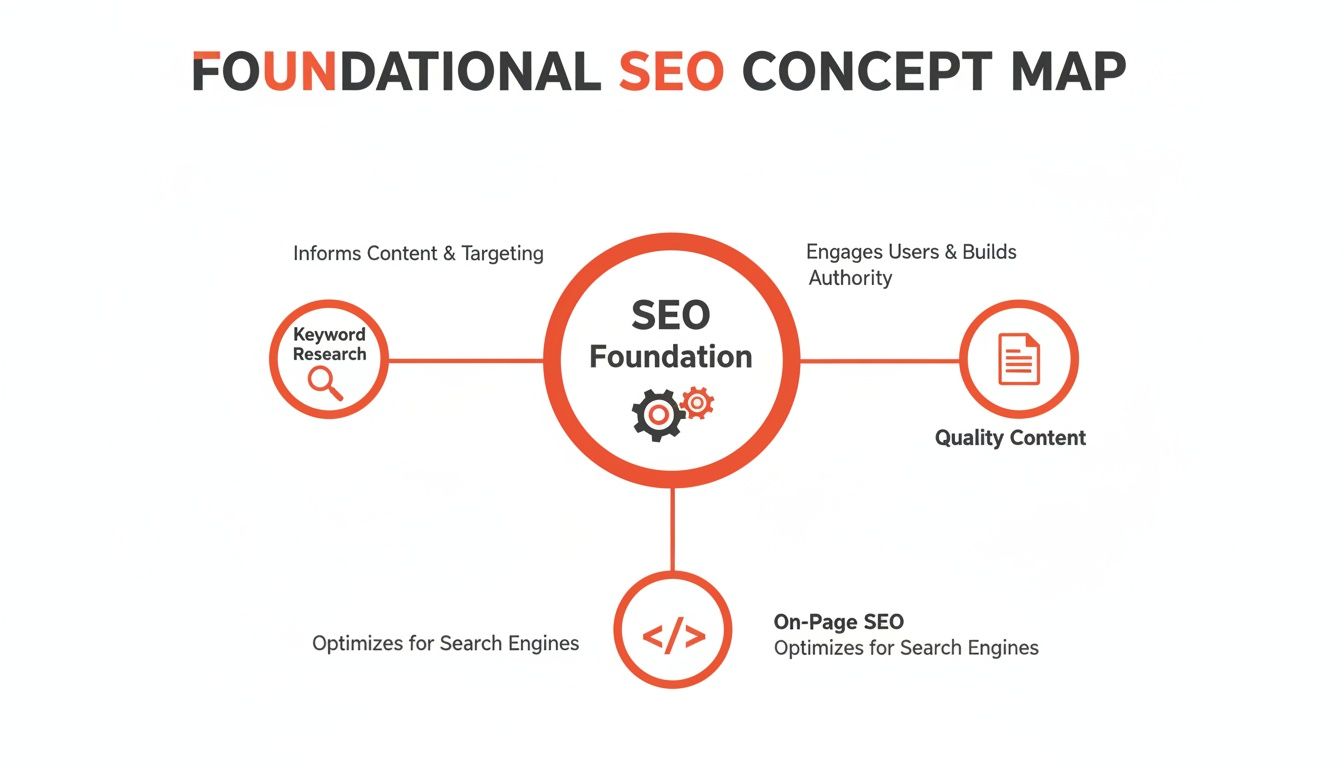
As you can see, quality content sits right at the center, supported by smart keyword research and solid on-page optimization.
Go Beyond Standard Blog Posts
Blog posts are a staple, but if that’s all you’re creating, you're leaving traffic on the table. People absorb information in different ways, so diversifying your content formats is key to capturing a wider audience.
Shake things up with a few of these powerful options:
- Original Research and Data Studies: Run a survey in your industry and publish the results. This kind of content is a natural backlink magnet—other sites will want to cite your findings, sending valuable referral traffic your way.
- In-Depth Guides and Tutorials: Build a comprehensive, step-by-step guide that solves a major pain point for your audience. These evergreen resources can continue to attract traffic for years.
- Video Content: Did you know that articles with video get 83% more traffic than those without? It’s a huge opportunity. Create tutorials, interviews, or product demos to engage the people who’d rather watch than read.
Here's a pro tip: Don't just create once. A single customer success story can be repurposed into a detailed case study, a quick blog post, a set of social media graphics, and even a short video testimonial. This lets you get maximum mileage out of every piece of work.
This multi-format strategy is especially effective for new businesses. To see how you can build a content machine from the ground up, check out our guide on content marketing for startups.
Refresh and Relaunch Old Content
Your archives are a goldmine. Seriously. Over time, even your best articles get stale, and their rankings can start to slip. Instead of letting them fade away, give them a refresh.
Go find posts with declining traffic or outdated stats. You can bring them back to life by:
- Updating Statistics and Facts: Swap out old numbers for the latest available data.
- Adding New Sections: Is there a new angle or update you can add to make the piece more thorough?
- Improving Visuals: Add new images, create a fresh infographic, or embed a relevant video.
- Optimizing for New Keywords: Do some quick research to find new long-tail keywords you can naturally weave in.
Once you’ve beefed it up, republish the post with the current date. This tells Google the content is fresh and relevant again, often leading to a nice little boost in rankings and traffic.
Of course, getting people to your site is only half the battle. To make sure that traffic actually translates into business, check out these actionable conversion rate optimization tips. Pairing fresh content with a site designed to convert is how you build a real system for growth.
Boost Traffic by Optimizing for User Experience
Think of your website as a physical store for a second. If the front door is stuck, the aisles are a total mess, and you can't find what you need, you're not sticking around. You're leaving. A slow, confusing website is the digital version of that awful experience, and it's one of the fastest ways to kill your traffic potential.
Google gets this. That’s why user experience (UX) has become such a massive ranking factor. A site that feels snappy, intuitive, and genuinely helpful doesn't just keep visitors happy—it also climbs higher in search results. This creates a powerful feedback loop that consistently drives more traffic your way.

Speed Is Everything
Nothing sends visitors packing faster than a slow-loading page. We’ve all been there—clicking a link and staring at a blank screen for what feels like an eternity before mashing the back button. This isn't just frustrating for the user; it's a direct signal to Google that your site isn’t delivering.
The data on this is pretty stark. A shocking 88.5% of visitors will bounce if a site loads too slowly, and over half of mobile users are gone if a page takes more than three seconds to appear. This is precisely why Google rolled out Core Web Vitals as a core ranking signal. Top-performing sites now load their main content in under 2.5 seconds. You can dive deeper into the critical impact of site speed on traffic trends to see how you measure up.
So, how do you speed things up without needing a computer science degree? Here are three things you can do right now that make a huge difference.
- Shrink Your Images: I see this all the time—huge, unoptimized images are the number one cause of slow load times. Before you upload anything, run your images through a free tool like TinyPNG or a WordPress plugin like Smush. You can often slash file sizes by over 70% with no visible drop in quality.
- Turn On Browser Caching: Caching is like giving a return visitor's browser a memory. It stores static parts of your site (like your logo and menu), so on their next visit, those elements don't have to be reloaded from scratch. The result is a much faster experience. Most modern hosting providers have a simple, one-click option for this in their settings.
- Minify Your Code: "Minification" sounds technical, but it’s just the process of stripping out unnecessary stuff from your site's code, like extra spaces and comments. Plugins like WP Rocket or Autoptimize do this automatically, tidying up your CSS and JavaScript files to make them leaner and faster.
Make Your Site Easy to Navigate
Once someone lands on your site, can they instantly figure out where to go? If your navigation is a confusing maze, they’ll just click back to the search results. This behavior, known as "pogo-sticking," tells Google your page wasn't the right answer for their search, which can seriously damage your rankings.
Here's a simple rule of thumb: A first-time visitor should be able to find what they're looking for in three clicks or less. Any more than that, and you've overcomplicated things.
Let's say you run an e-commerce store that sells plants. Your main menu needs crystal-clear labels like "Indoor Plants," "Outdoor Plants," "Pots & Tools," and "Plant Care Guides." I've seen sites use clever but vague terms like "Green Friends" or "Our Jungle." Don't do it. When it comes to navigation, clarity will always outperform cleverness.
Guide Visitors with Clear Calls to Action
Every single page on your website needs a job to do. What’s the next step you want your visitor to take? If you don't give them a clear call-to-action (CTA), you’re essentially leading them to a dead end.
A great CTA uses action-oriented words and stands out from the rest of the page. Forget a generic "Click Here"—be specific and focus on the benefit to the user.
Real-World Scenario: A Blog Post CTA
Imagine you wrote a fantastic blog post on "How to Start a Podcast."
- Weak CTA: A tiny text link buried at the bottom saying, "Learn more about our services." It’s passive, irrelevant, and easy to miss.
- Strong CTA: A bright, unmissable button placed midway through the article that says, "Download Your Free Podcast Launch Checklist."
The second one is a clear winner. It’s directly related to the article's topic, offers instant value, and tells the user exactly what to expect. By strategically placing CTAs like this, you guide visitors deeper into your site, which boosts engagement signals that search engines love to see.
Adopt a Mobile-First Mindset to Win More Visitors
Chances are, you're reading this on your phone right now. That single device has completely flipped the script on how we drive website traffic. Mobile phones aren't a secondary screen anymore; for most people, they are the primary way they find and interact with content online.
Ignoring this reality is like building a shop without a front door.
A true mobile-first approach is so much more than a "responsive" design that just shrinks to fit a smaller screen. It's a fundamental shift in thinking. You design, write, and build the entire experience for the thumb-scrolling user first, and then you adapt it for the desktop. This change in perspective is a game-changer for boosting your traffic.

The numbers don't lie. An incredible 59.2% of all website traffic worldwide now comes from mobile devices. What's more, over half of those users will bail if a site takes longer than three seconds to load. Just a two-second delay can cause bounce rates to shoot up by 87%.
Since Google now uses the mobile version of your site for indexing and ranking, a clunky mobile experience isn't just bad for users—it actively sabotages your SEO. For a deeper dive into these numbers, you can discover more insights about mobile website statistics on userguiding.com.
Think About Mobile User Intent
What does someone on their phone actually need in that moment? Their intent is usually more urgent and action-oriented than someone browsing on a laptop. They're not just kicking tires; they're looking for fast answers and easy solutions.
Your job is to get inside their head and remove every single roadblock.
Imagine a local restaurant. A desktop user might be casually planning a dinner for next week, reading every review, and scrolling through the photo gallery. The mobile user is a different story. They're probably on the move and need answers to three key questions, fast:
- Where are you? (They need a tappable address that opens directly in Google Maps).
- Are you open now? (They need your hours front and center, no digging required).
- How do I call? (They need a big, obvious 'click-to-call' button).
A restaurant that prioritizes these three things on its mobile homepage will see more reservations and more customers walking through the door. It's that direct.
Optimize for the Thumb and the Small Screen
Designing for mobile means designing for a completely different physical interaction. People navigate with their thumbs, and every pixel of screen real estate counts.
- Create Thumb-Friendly Navigation: Place your most important buttons and menu items within the "thumb zone"—the arc on the screen a user can easily reach without stretching or shifting their grip. For example, place your main call-to-action button in the bottom center of the screen.
- Keep Forms Simple: Nobody wants to peck out a 15-field form on a tiny screen. Slash your forms down to the absolute essentials. Use larger input fields and buttons that are easy to tap without precision. For a "contact us" form, only ask for a name, email, and message—you can get the rest of the details later.
- Prioritize Vertical Layouts: Mobile users scroll up and down. Period. Design your content in a clean, single-column format that's a breeze to scan. Break up text with clear headings, short paragraphs, and lots of white space.
Your mobile site shouldn't just be a shrunken version of your desktop site. It needs to be a more focused, streamlined, and action-oriented experience. Cut the fluff and get straight to the point.
Mobile Page Speed is Non-Negotiable
We've already mentioned speed, but it's impossible to overstate its importance on mobile. Users on phones are often on spotty cellular networks, making their patience for slow-loading pages razor-thin. A one-second delay can feel like an eternity and is often all it takes to send a potential customer packing.
Use tools like Google's PageSpeed Insights to test your mobile performance specifically. It will give you a clear, actionable punch list. Pay close attention to its mobile recommendations, which usually involve:
- Compressing images even further for mobile.
- Eliminating render-blocking resources.
- Reducing the complexity of your site's code.
By embracing a mobile-first philosophy, you’re not just catering to a niche audience. You're aligning your entire strategy with the majority of internet users and with the very way search engines now rank websites. It's one of the most powerful levers you can pull to increase website traffic today.
Amplify Your Reach With Smart Promotion
Creating great content is a fantastic start, but hitting "publish" is just crossing the starting line. If you don't actively promote your work, you're essentially opening a brilliant shop on a deserted street and hoping customers stumble upon it. To really move the needle on website traffic, you need a smart, active promotion strategy.
It's all about getting your content in front of the right eyeballs, on the platforms where they already live and breathe. For most of us, that means getting serious about social media and building a solid email list. These two channels are powerhouses for building a loyal community and driving reliable traffic back to your site.
Master Social Media for Targeted Traffic
Think of social media as less of a megaphone and more of a conversation starter. It's where you build relationships and gently guide interested people back to your website for the full story. The secret is to stop spraying and praying. Pick your platforms wisely.
Don't stretch yourself thin trying to be everywhere. If you're a freelance photographer, your people are on visually-rich platforms like Instagram and Pinterest. Your whole strategy should revolve around stunning photos, behind-the-scenes Reels, and Stories that link directly to your portfolio.
On the flip side, a B2B consultant will get far more traction on LinkedIn. They can share sharp insights from a recent article, ask their network a thought-provoking question, or jump into industry-specific groups. This builds authority and sends high-quality leads back to their site for deeper content.
A few tips to make your social posts actually work:
- Tailor the Message: Stop copying and pasting the same caption everywhere. Practical Example: For a blog post on "5 Project Management Mistakes," the LinkedIn post could start with a question: "What's the #1 mistake you see new PMs make?" The Instagram post could be a carousel of 5 graphics, each detailing one mistake.
- Use Eye-Catching Visuals: A custom graphic, a quick video, or a great photo is what stops the scroll. It's no secret that posts with images get way more engagement.
- Include a Clear Call to Action: Literally tell people what to do next. "Read the full guide on our blog," or "See the complete case study here" with a direct link. Be direct.
Build Your Most Valuable Asset: An Email List
While social media is fantastic for getting discovered, your email list is your direct line to your biggest fans. These are the people who have willingly said, "Yes, tell me more." It's why email marketing consistently delivers one of the best ROIs out there.
First things first, you need to give people a really good reason to sign up. This is where a great lead magnet comes in—a valuable freebie they get in exchange for their email.
Lead Magnet Ideas That Actually Work:
- A software company could offer a free Project Management Template.
- A fitness coach could create a 7-Day Healthy Meal Plan PDF.
- A marketing agency might provide an exclusive SEO Checklist.
Once your list starts growing, a simple weekly newsletter is a perfect way to drive repeat traffic. A consultant could send out a quick summary of their latest articles, linking back to the blog to keep their name top-of-mind.
Your email list is one of the only marketing channels you truly own. Social media algorithms can change in a heartbeat, but you have direct, unfiltered access to your subscribers. It’s your most reliable traffic source.
Traffic Driving Channel Comparison
Choosing where to focus your promotional energy can feel overwhelming. Each channel has its own quirks, audience, and level of effort required. This table breaks down some of the most common options to help you decide where to invest your time.
| Channel | Primary Strength | Ideal for Reaching | Effort Level |
|---|---|---|---|
| Email Marketing | Direct communication & ownership | Your most engaged followers | Medium |
| Professional networking & B2B | Industry professionals, decision-makers | Medium | |
| Visual storytelling & brand building | Younger demographics (18-34) | High | |
| Discovery & long-term traffic | Users planning purchases, DIYers | Medium | |
| Niche communities & authenticity | Highly specific interest groups | High |
Ultimately, the best channels are the ones where your specific audience spends their time. Start with one or two, master them, and then expand your efforts once you have a system that works.
Effective promotion isn't a one-off task; it's a system. For anyone looking to get more organized with their outreach, a solid strategy is a must. You can dive deeper into this by checking out our guide on planning a promotion, which walks you through the steps of a successful launch.
By marrying targeted social media with a strong email marketing game, you create a powerful, self-sustaining engine that drives quality traffic to your website day in and day out.
Got Questions About Boosting Your Website Traffic? We’ve Got Answers.
You’ve got the playbook, from SEO groundwork to smart content promotion. But let's be real—putting it all into practice brings up a ton of questions. Here are the answers to some of the most common ones I hear from people trying to get more eyes on their site.
How Long Does It Really Take to See Traffic From SEO?
This is always the million-dollar question, isn't it? The most honest answer is: it depends. SEO is definitely a long game, not a quick win. For a brand new site, you're typically looking at three to six months before you start seeing any real, meaningful traffic from search engines.
In the beginning, you'll see small spikes from your social media posts or an email blast. That's normal. But the organic, search-driven traffic takes time to build.
Think of it like getting a new restaurant off the ground. At first, only your friends and family (your social followers) know about it. Then, after a few months of great food and service (quality content and backlinks), the good reviews start coming in, and strangers start finding you on their own. Those first SEO wins might be ranking for a few super-specific, long-tail keywords, but that’s the foundation you build on.
How Can I Get Traffic If I'm on a Shoestring Budget?
You absolutely do not need a massive budget to drive traffic. Some of the most effective methods just cost you your time and effort, not a pile of cash.
Go deep, not wide, with content. Instead of churning out three so-so blog posts a week, focus all your energy on creating one truly exceptional, in-depth article. A single, comprehensive guide that genuinely solves a reader's problem will attract more backlinks and organic traffic over time than a dozen shallow posts ever could.
Become a regular in niche communities. Where do your ideal customers hang out online? Find those subreddits, Facebook groups, or Quora threads. The key is to not just spam your links. Become a trusted voice by answering questions and offering real help. People will naturally click through to your site once they see you as an expert.
Start an email list from day one. Seriously, don't wait. Offer a simple PDF checklist or a short e-book in exchange for an email address. Your email list is the only traffic source you truly own, giving you a direct line to your most loyal followers whenever you have something new to share.
The secret to growing on a small budget is relentless consistency. Showing up week after week with real value will always beat spending a bunch of money on a flashy campaign that fizzles out.
What Are the Biggest Mistakes People Make?
It's easy to get tripped up when you're starting out. I've seen the same few mistakes sink people's efforts time and time again. If you can avoid these, you'll be way ahead of the curve.
One of the most common is being wildly inconsistent. Going hard with five articles one month and then disappearing for the next two just doesn't work. Search engines get confused, and your audience forgets about you. A steady, predictable rhythm—even if it's just one great post per week—is so much more powerful.
Another huge one is flying blind without analytics. If you’re not looking at your data, you’re just guessing. Get comfortable with Google Analytics and Google Search Console. A quick 15-minute check-in each week will show you which pages are winning and which are flopping. That data is your roadmap for what to do next.
Finally, don't let the pursuit of perfection paralyze you. That blog post will never be "perfect." Get it to 80% done, hit publish, and start promoting it. You can always come back and tweak it later based on feedback and performance. Done is always better than perfect.
Ready to turn Reddit's passionate communities into a reliable source of traffic, leads, and customers? At Reddit Agency, we specialize in crafting authentic campaigns that resonate with Redditors. Let's build your Reddit growth strategy together.
