
How to Reduce Bounce Rate: Practical Tips to Boost Engagement
Before you can fix your bounce rate, you have to play detective. The real reason people are leaving your site is almost always a gap between what they expected to find and what you actually showed them. We call this intent mismatch, and it’s the silent killer of conversions.
Why a High Bounce Rate Is a Bigger Problem Than You Think
A high bounce rate isn't just a vanity metric you glance at in Google Analytics. It's a flashing red light signaling a fundamental failure to connect with your audience.
Let’s say you drop a killer post in a subreddit like r/SaaS, highlighting a slick new feature. The post gets tons of upvotes and drives hundreds of clicks. Awesome, right? But then you check your analytics and see that 90% of that traffic disappeared in under 10 seconds.
That’s not “bad traffic.” That’s a broken promise.
The people who clicked did so for a reason. Your post set a clear expectation—maybe a deep dive into the feature, a quick video demo, or an exclusive offer. When your landing page didn't deliver that immediately, they hit the back button.
Think of it this way: a bounce isn't just a lost visitor; it's a failed first impression. It means the conversation you started on Reddit or Google broke down the second they landed on your site.
To fix this, you have to stop thinking like a marketer and start thinking like your visitor. The goal isn't just to lower a number; it's to create a fluid, intuitive journey from that first click all the way to a conversion.
The Hidden Costs of Visitors Bouncing
Losing a potential customer is just the tip of the iceberg. A stubbornly high bounce rate can create some serious downstream problems.
For one, it can tell search engines like Google that your page is a poor answer to a user's query, which can slowly poison your SEO rankings. It also inflates your customer acquisition costs—you're essentially paying for clicks that have zero chance of ever turning into revenue.
What's Really Driving People Away?
So, why are visitors leaving? It usually comes down to one of a few common culprits. You need to figure out which one is sinking your ship.
- Content Disconnect: The landing page's tone, message, or offer feels like it's from a different planet than the Reddit post or ad that brought them there.
- Awful User Experience (UX): The visitor is immediately lost. They can’t find the information they came for because of a confusing layout, a wall of text, or an aggressive pop-up that blocks the whole screen.
- It's Just Too Slow: People, especially Reddit users, have zero patience. If your page takes more than a few seconds to load, they're gone.
- A Mobile Mess: A huge chunk of Reddit traffic is on mobile. If your site looks broken or is hard to navigate on a phone, you're throwing away a massive segment of your visitors.
The Unique Challenge of Reddit Traffic
When it comes to traffic from Reddit, you have to remember that context is everything. A user clicking from a highly technical discussion in r/sysadmin has completely different expectations than someone coming from a business strategy thread in r/ecommerce.
This is where the real diagnostic work begins. You can’t just start changing headlines and button colors randomly. You need to get to the bottom of the disconnect between your Reddit outreach and your on-site experience.
To help you get started, here's a quick look at the most common reasons Reddit users bounce and what you can do about them right now.
Top 5 Reasons Visitors From Reddit Are Bouncing
This table will help you quickly diagnose the most common issues causing Reddit users to leave your site.
| The Culprit | Why It Drives Reddit Users Away | A Practical Fix You Can Implement Today |
|---|---|---|
| Promise vs. Reality Mismatch | Your Reddit post promised a deep-dive, but your landing page is a generic homepage. | Create a dedicated landing page that mirrors the language, tone, and specific offer from your post. |
| Community Tone-Deafness | You used corporate jargon or a hard-sell approach on a community that values authenticity. | Edit your landing page copy to be more conversational and direct. Speak their language. |
| "Where's the Answer?" Syndrome | The user clicked to get a specific piece of information, but it's buried three paragraphs down. | Put the key takeaway or value proposition "above the fold." Use a bold headline that directly answers the user's implied question. |
| The Mobile Experience Fail | The page is a nightmare to navigate on a phone—tiny text, buttons too close together, etc. | Run your page through Google's Mobile-Friendly Test and fix the top one or two issues it flags. |
| No Clear Next Step | The page delivers the info but doesn't guide the user on what to do next, so they just leave. | Add a single, clear Call-to-Action (CTA) that logically follows the content. Examples: "Watch the 2-Min Demo" or "Get the Code Snippet." |
Looking at this table, you can see how specific and tactical the fixes are. The key is to stop guessing and start diagnosing. Once you've identified the most likely culprit, you can move on to implementing a targeted solution.
Getting to the Root of Your Bounce Rate
Before you can fix the leaks, you need a map showing exactly where they are. Jumping into solutions without a solid diagnosis is a classic mistake—you'll end up wasting time and energy on the wrong things. This is where we stop guessing and start using data to find the real source of your high bounce rate.
Think of Google Analytics 4 (GA4) as your diagnostic tool. A high overall bounce rate is just a symptom, not the cause. The real goal is to pinpoint the specific pages, traffic sources, or devices that are bleeding visitors. A vague feeling of "my bounce rate is too high" isn't actionable. But a specific finding like, "mobile visitors from Reddit bounce at 85% on our new product page," gives you a clear, tangible starting point.
This simple flow shows what's usually happening behind the scenes.
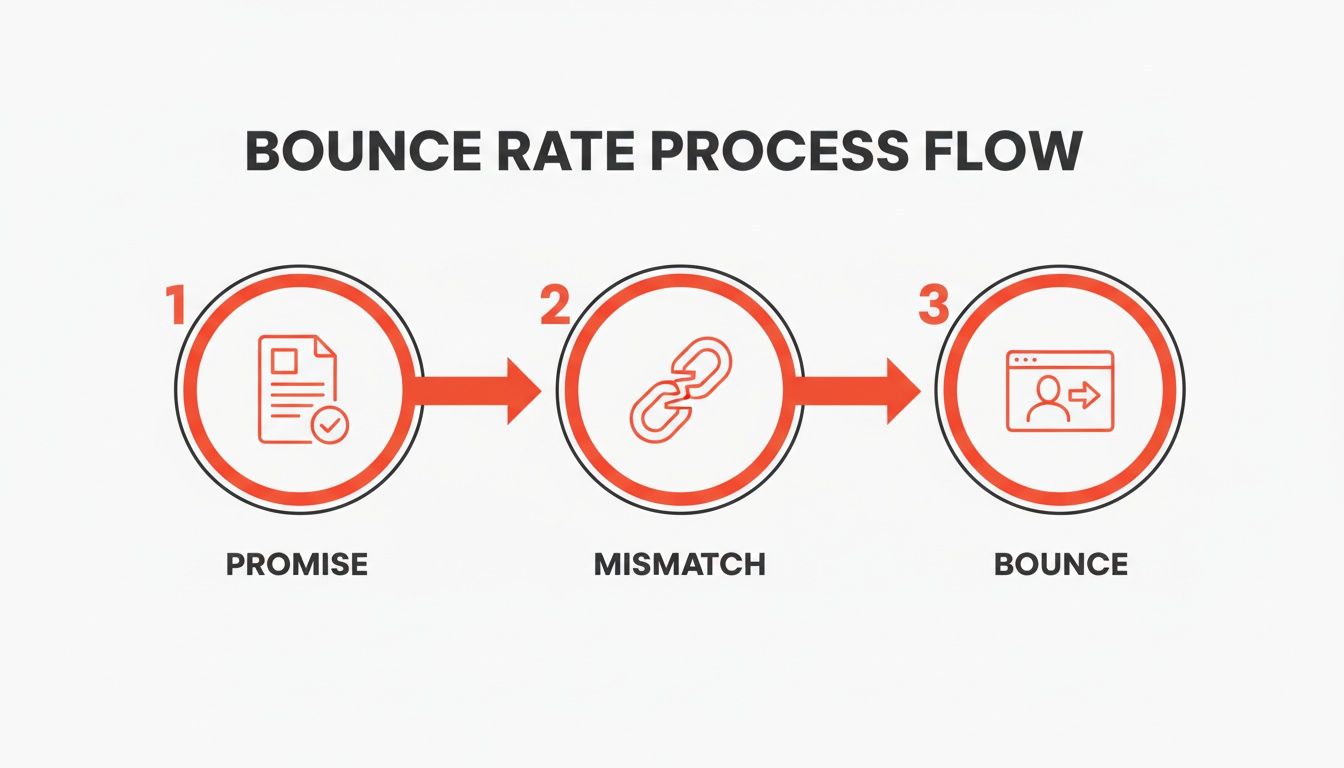
At its core, a bounce happens when there's a disconnect between the promise you made (in the Reddit post, the ad, the search result) and the reality of the landing page. Our job is to find and fix that mismatch.
Segment Your Traffic to Isolate the Problem
Your website’s bounce rate is just an average. The reality is that not all traffic is created equal. A visitor arriving from an organic search has a completely different mindset than someone clicking over from a heated Reddit discussion. So, the first thing we need to do is segment your traffic to compare these groups.
You can do this right in GA4 by heading to Reports > Acquisition > Traffic acquisition. This report lets you compare how different channels perform.
Here’s a practical example of how I’d approach this:
- Set Up a Comparison: In your GA4 report, click the "Add comparison" button at the top.
- Isolate Reddit Traffic: Create a new condition where the "Session source / medium" exactly matches "reddit.com / referral".
- Compare with Organic Search: Create a second condition where the "Session source / medium" contains "google / organic".
You'll now see the bounce rate for your Reddit visitors right next to your organic search traffic. If Reddit traffic shows a 75% bounce rate while organic is a healthy 40%, you’ve just found your first major clue. The problem is specific to your Reddit audience.
This comparison is a game-changer. It immediately tells you the issue isn't a sitewide flaw but a channel-specific one. This allows you to focus your efforts where they'll actually make a difference.
As you audit, it’s also smart to see how bounce rate connects to bigger goals. A handy Conversion Rate Calculator can help you model how reducing bounces might impact your bottom line, linking engagement metrics to real business outcomes.
Drill Down to Specific Pages and Devices
Once you've flagged a high-bouncing channel like Reddit, the next question is which pages are failing? It’s rarely the whole channel; often, a single underperforming landing page is skewing all your metrics.
To find it, stay in that same GA4 report and add a secondary dimension.
- Click the "+" sign next to the primary dimension (which should be "Session source / medium").
- Search for and select "Landing page + query string".
This view is incredibly powerful. It shows you the specific pages visitors from each channel land on first. You might discover that while your homepage performs well, a specific blog post you’ve been sharing on Reddit has a staggering 92% bounce rate. Boom. That's your problem child.
For a deeper dive into connecting these kinds of marketing metrics to business results, our guide on how to measure marketing ROI is a great next read.
The Final Layer: Device Type
Don't stop at the page level. A massive chunk of Reddit users browse on their phones, so a clunky mobile experience is a certified bounce rate killer. Let's add one final layer to our investigation.
In the same report, just change the secondary dimension from "Landing page" to "Device category". It’s common to find that the bounce rate for "mobile" users coming from Reddit is dramatically higher than for "desktop" users.
When you put it all together, you get a precise, data-backed diagnosis. You've gone from a vague "our bounce rate is high" to an actionable insight: "Mobile visitors from Reddit are bouncing at an 85% rate on our '/new-feature-launch' blog post."
Now you know exactly what needs fixing.
Uncovering the Real Reasons Users Are Leaving
Once you’ve pinpointed where your bounce rate is highest in GA4, the real detective work begins. Knowing which page is the problem is just the first step. To actually fix it, you need to understand why people are leaving.
Most of the time, bounces boil down to one of four core problems: a jarring content mismatch, a frustrating user experience, sluggish page speed, or a simple tracking error.
These issues are especially potent when your traffic comes from a place like Reddit. Redditors are famously impatient and have a very low tolerance for anything that feels like a bait-and-switch. Your job is to connect the data you found in your audit to one of these specific, fixable root causes.
Content and Intent Mismatch
This is hands-down the most common reason users from Reddit bounce. A content mismatch happens when your landing page completely fails to deliver on the promise—explicit or implied—made in the original post or comment. It’s a broken link in the user's journey, and it instantly shatters any trust you just built.
Let's say you share a post on r/marketing promising an “ultimate guide to content syndication.” The post takes off, users click through expecting a deep-dive article, but instead, they hit a landing page with a single headline and a form demanding their email to download the guide.
That's a classic mismatch. The user expected immediate value but was met with a barrier. They didn't get what they came for, so they hit the back button without a second thought, sending your bounce rate through the roof.
Here's a practical, actionable example:
- The Promise (Reddit Post): "I broke down the exact 5-step cold email sequence that landed us 10 new B2B clients last month. Here's the full script and analysis."
- The Mismatch (Landing Page): A generic services page about your agency's offerings, with no sign of the promised email sequence.
- The Fix (Landing Page): A dedicated page with the headline "The 5-Step Cold Email Sequence for B2B" that shows the entire sequence immediately. An optional CTA at the bottom can offer a downloadable PDF version. This delivers instant value first.
Poor User Experience and Confusing Design
A confusing or downright frustrating user experience (UX) is another guaranteed bounce-inducer. Visitors need to find what they're looking for intuitively. If they have to work for it, they’ll just leave. Simple as that.
Common UX offenders include things like:
- Intrusive Pop-ups: Nothing screams "I don't respect your time" like a full-screen newsletter signup that appears the second the page loads. Actionable Insight: Use an exit-intent pop-up instead, which only appears when a user's cursor moves towards the back button.
- Confusing Navigation: If your site menu is a maze or the page layout is illogical, users won't know where to go next. Actionable Insight: For a blog post, ensure a clear headline, subheadings, and bullet points guide the eye. For a product page, make sure the "Add to Cart" button is the most prominent element.
- Walls of Text: Huge, unbroken paragraphs are incredibly intimidating, especially on mobile. People scan content online; they don’t read novels. Actionable Insight: Break up text every 2-3 sentences. Use images, blockquotes, and bold text to create visual anchors that make the content skimmable.
The moment a user feels lost or annoyed, you've lost them. For an audience as critical as Reddit's, a clean, straightforward design isn't a luxury—it's a requirement for keeping them on the page.
Slow Page Speed Kills Engagement
In the battle for attention, speed is everything. Slow-loading pages are a massive driver of high bounce rates, especially for mobile users, who make up a huge chunk of Reddit’s audience. If your page takes forever to load, visitors will be gone before your content even has a chance to make an impression.
Data from Google Consumer Insights shows that 53% of mobile users will abandon a site that takes longer than 3 seconds to load. That directly spikes your bounce rate. Anything slower, and you're just bleeding visitors.
Practical Example: A B2B software company noticed their blog had an 85% bounce rate from mobile traffic. They ran a speed test and found their massive, uncompressed blog header images were taking over 5 seconds to load. By compressing the images and enabling browser caching, they cut load time to 1.8 seconds. Their mobile bounce rate dropped by 30% in the following month. You can dig into more data on key website metrics to see just how big the impact is.
A slow page signals poor quality and a lack of respect for the user's time. Optimizing for speed is one of the highest-impact things you can do.
Misconfigured Analytics and Tracking Errors
Finally, sometimes a high bounce rate isn't a user problem at all—it's a technical one. If your analytics tracking is set up incorrectly, it can artificially inflate your bounce rate and send you on a wild goose chase trying to fix problems that don't exist.
Here are a few technical glitches to check for:
- Duplicate Tracking Codes: If the GA4 tracking code is on the page twice by mistake, it can fire two pageview events for a single visit. GA4 then thinks the user visited two pages, resulting in a 0% bounce rate, which is obviously wrong and hides real issues. Actionable Insight: Use the free Google's Tag Assistant Chrome extension to quickly check for duplicate tags on your key pages.
- Incorrect Event Tracking: Imagine a user clicks a "play video" button. You'd consider that an interaction, right? If that click isn't tracked as an engagement event in GA4, the session could still be incorrectly flagged as a bounce. Actionable Insight: Ensure you've enabled "Enhanced measurement" in your GA4 data stream settings to automatically track interactions like video plays and file downloads.
- Cross-Domain Tracking Issues: If a user's journey takes them from
yourblog.comto a subdomain likeshop.yourblog.comand your tracking isn't configured for it, GA4 might see that as two separate sessions. The first one would end in a "bounce," even though the user continued to engage.
Before you start tearing apart your content or redesigning pages, it’s always worth doing a quick technical audit.
Alright, you've figured out why people are bouncing. Now for the fun part: rolling up your sleeves and fixing it. This is where we turn those insights into tangible changes that convince visitors—especially those coming from the unique world of Reddit—to stick around, click around, and ultimately convert.
Let's dive into the practical, battle-tested strategies that work.

Perfectly Align Your Landing Page With Your Post
This is the big one. If you only fix one thing, make it this. Your landing page must be a perfect, seamless continuation of the Reddit post that sent the visitor your way. This concept is called "message match," and for Reddit traffic, it's everything.
Think about it: a Redditor clicks a compelling link because it promised something specific. If they land on a generic homepage, the disconnect is jarring. They're gone in a flash.
Here’s a practical, actionable example of how this plays out:
The Fail (High Bounce Rate):
- Reddit Post Title: "I analyzed 50 SaaS pricing pages. Here are the 3 psychological tricks they all use."
- Landing Page Headline: "Welcome to Growth Consultants Inc."
- Result: Instant bounce. The user expected a deep dive and got a corporate brochure.
The Win (Low Bounce Rate):
- Reddit Post Title: "I analyzed 50 SaaS pricing pages. Here are the 3 psychological tricks they all use."
- Landing Page Headline: "The 3 Psychological Tricks Used by 50 Top SaaS Pricing Pages."
- Result: The user's click is immediately validated. The page uses the same language and delivers on the promise, creating a smooth, trust-building experience.
Create an Irresistible Above-the-Fold Hook
You’ve got about three seconds. That's it. The portion of your page visible without scrolling—the "above the fold" area—is your entire elevator pitch. It has to instantly answer the visitor's unspoken question: "Am I in the right place, and what's in it for me?"
A powerful hook grabs them and proves your page is worth their time. Here are two practical ways to nail it:
- Lead with a Strong Value Proposition: Don't just describe your product; state its benefit. Instead of "Our Advanced SEO Tool," try "The SEO Tool That Finds Keywords Your Competitors Miss." Example: A project management tool could use "Stop Juggling Tabs. Manage Your Entire Project in One Place."
- Use Compelling Social Proof: Nothing builds trust faster. Add a short testimonial, logos of well-known clients, or a punchy stat like "Trusted by over 10,000 founders." Example: "Used by teams at Google, Slack, and Dropbox to ship projects faster."
Your goal above the fold is to make the decision to stay an easy one. If a user has to scroll to understand what your page is about, you’ve already lost most of them.
Optimize Your Calls-to-Action for the Next Step
A visitor might be fascinated by your content, but without a clear next step, they'll just read and leave. Your Call-to-Action (CTA) is the crucial bridge between a passive reader and an active lead.
Forget generic buttons like "Submit" or "Click Here." You need action-oriented language that clearly communicates the value of the click.
Let’s transform some weak CTAs into compelling ones:
| Vague CTA (High Bounce) | Specific CTA (Low Bounce) |
|---|---|
| Download | Get My Free SEO Checklist |
| Learn More | See Pricing and Plans |
| Contact Us | Request a 15-Min Demo |
Actionable Insight: The best CTAs use first-person language ("Get My Checklist") and focus on the benefit. If your page is about improving website speed, a great CTA would be "Analyze My Site Speed for Free" rather than "Run a Test." You can dig deeper into these ideas in our guide on conversion optimization best practices.
Guide Users Deeper With Internal Linking
Not everyone is ready to buy right away, and that's perfectly fine. A smart internal linking strategy can turn a potential bounce into an engaged session. By offering relevant links to other content on your site, you guide curious users deeper into your ecosystem.
The key is to think about the user's journey. What question might they have next?
- If they're reading a post about "choosing a business name," a logical internal link would point to an article on "how to register your new business."
- On a product page explaining a specific feature, link to a case study that shows how a real customer got results with that exact feature.
- Practical Example: In a blog post titled "10 Tips for Better Email Marketing," you can embed links within the text like: "...a compelling subject line is crucial. We cover that in our guide to writing click-worthy headlines." This feels natural and helpful, not pushy.
These links transform a single-page visit into a multi-page discovery session. This directly lowers your bounce rate and builds powerful brand familiarity along the way. For visitors who need immediate help, it's also smart to implement live chat solutions to answer questions in real-time.
Master the Mobile-First Experience
For traffic coming from Reddit, a mobile-first design isn't just a good idea—it's non-negotiable. A poor mobile experience is a bounce rate killer. Just look at the numbers: 53% of SEOs say mobile is the top visitor device. Globally, mobile bounce rates average a painful 78.39%, soaring above desktop's 67.38%.
Agencies have seen bounce rates drop by 12% or more after a dedicated mobile overhaul. For B2B sites specifically, anything over 70% should be a massive red flag pointing to mobile issues.
Here are some quick, high-impact mobile fixes:
- Make Buttons Tappable: Ensure all buttons and links are large enough for a thumb to tap easily. Actionable Insight: Google recommends a minimum tappable area of 48x48 pixels.
- Use Readable Fonts: Text should be legible without any pinching or zooming. A good baseline is 16px.
- Simplify Navigation: A clean "hamburger" menu is your best friend. Keep it tidy.
- Compress Your Images: Large image files are the number one cause of slow mobile load times. Actionable Insight: Use a free tool like TinyPNG to compress your images before uploading them.
Winning Over Reddit Traffic: A Different Ballgame
Let's be honest: generic advice on lowering bounce rates is mostly useless when you're talking about traffic from Reddit. Redditors are a different breed. They're smart, skeptical, and have an almost supernatural ability to sniff out a lazy marketing play. If you want them to stick around, you need to play by their rules.
To succeed, you have to think beyond just optimizing a landing page. The entire experience—from the subreddit thread to your website—needs to feel like one continuous, authentic conversation. Any hint of a bait-and-switch, and they’re gone in a flash.

Nail the "Scent" From Post to Page
The single most effective strategy for keeping Reddit visitors engaged is maintaining a strong "information scent." It’s a simple concept: your landing page must perfectly reflect the promise made in the Reddit post that sent them there. The tone, the language, the core message—it all has to line up.
Here’s what that looks like in practice:
- Your Reddit Post (in r/SaaS): "Just launched a feature that cuts user onboarding time in half. We used a simple psychological trick to do it. Here’s a breakdown..."
- Your Landing Page Headline: "How We Halved Onboarding Time With One Simple Trick."
See how seamless that is? The user clicks and immediately knows they're in the right place. Compare that to a generic headline like, "The Future of User Onboarding." That disconnect creates instant confusion and is a one-way ticket to a bounce.
Use UTMs to See What’s Really Working
You can't fix what you can't see. For Reddit, using UTM parameters is absolutely essential. They let you tag your links with specific data, giving you a crystal-clear picture in Google Analytics of what’s actually driving results.
Forget just seeing "reddit.com" as a source. With UTMs, you can break down performance by:
- Subreddit: Is r/ecommerce sending better traffic than r/startups?
- Post: Which specific thread had the lowest bounce rate?
- Comment: Did the link in your top comment outperform the one in the main post?
Actionable Insight: Create a simple spreadsheet to track your UTM links. For a post in r/SaaS, your link might look like this: yourwebsite.com/feature?utm_source=reddit&utm_medium=social&utm_campaign=onboarding-feature&utm_content=saas-subreddit. This level of detail is a goldmine for optimization. If you're looking for more ways to smooth out the user journey, this conversion rate optimization checklist has some great ideas.
Real-World Win: We had a B2B SaaS client whose Reddit traffic was bouncing at a staggering 85%. We stopped the bleeding by creating dedicated landing pages that mirrored the tone of each subreddit and used UTMs to track everything. The result? We slashed their bounce rate to under 45% in just six weeks. It's about precision, not just pushing volume.
Get Ahead of the Bounce in the Comments
One of the most powerful, and often overlooked, tactics for reducing bounce rate happens before anyone even clicks. The comment section of your own Reddit post is your pre-landing page. It’s your chance to set expectations and warm people up.
When people ask questions, answer them directly and in detail. This does two crucial things for you:
- It Filters Clicks: By clarifying what your link is all about, you help ensure that only the people who are genuinely interested will click through in the first place.
- It Builds Trust: Answering questions transparently proves you’re there to add value, not just to shill your site. That goodwill is priceless and carries over to the landing page experience.
Practical Example: If someone asks, "Is this a free tool or a paid one?" a straightforward answer like, "It's a paid tool with a 14-day free trial, no credit card needed," sets a perfect expectation. The user who clicks after reading that is far less likely to bounce than someone who lands on a pricing page out of the blue. It’s a simple act of clarification that makes a huge difference.
Common Questions About Reducing Bounce Rate
Even with a solid plan in place, some questions always seem to pop up. Let's tackle some of the most common ones I hear from clients, so you can fine-tune your approach and know what to expect.
What Is a Good Bounce Rate Anyway?
This is the million-dollar question, and the honest answer is, it's all relative. There’s no single number that works for everyone. A "good" bounce rate depends entirely on your industry and the specific page you're looking at.
Here are some practical benchmarks to give you context:
- E-commerce Sites: 20-45%
- B2B / SaaS: 25-55%
- Landing Pages: 60-90%
- Blogs / Content Sites: 70-98%
A blog post can have a 90% bounce rate and still be successful. If your article perfectly answers a user's question (e.g., "how to tie a bow tie"), they might find what they need and leave satisfied. That's a win, even if it looks like a bounce. Instead of chasing a universal benchmark, focus on improving your own numbers month over month.
A high bounce rate isn't always a red flag. Imagine someone lands on your contact page, grabs your phone number, and calls you. They got what they came for, but technically, that's a bounce. Always consider the context.
How Long Does It Take to See a Lower Bounce Rate?
This really depends on the kind of fix you implement.
If you're tackling technical issues, the results can be surprisingly fast. Simple things like compressing images to boost your page speed can start lowering your bounce rate within 24-48 hours of going live.
Content and UX changes, however, require more patience. If you've completely overhauled a landing page to better align with what your visitors expect, you'll need to give it some time. I'd recommend waiting at least 2-4 weeks to collect enough meaningful data in Google Analytics. Don't pull the plug on a strategy after just a couple of days.
Does Bounce Rate Directly Affect My SEO Rankings?
Google has always been cagey about this, but the official word is no—bounce rate isn't a direct ranking signal. That said, it’s a crucial diagnostic metric that absolutely has an indirect impact on your SEO performance.
Think of it as a symptom. A stubbornly high bounce rate often points to bigger issues that Google definitely cares about, such as:
- Poor user experience: This tells search engines your page isn’t satisfying visitors.
- Slow page speed: A well-known and confirmed negative ranking factor.
- A mismatch between content and intent: This signals that your page is the wrong answer for a specific search query.
So, while obsessing over the bounce rate number itself for SEO is a mistake, fixing the problems that cause a high bounce rate will almost always improve your search rankings as a byproduct.
Ready to turn your Reddit traffic into loyal customers? At Reddit Agency, we specialize in crafting authentic campaigns that resonate with discerning communities. We'll help you build trust, drive meaningful engagement, and lower your bounce rate for good. Learn more about our approach and start winning on Reddit.
