
How to Validate Startup Idea (how to validate startup idea): A Practical Guide
So, you have a startup idea. That’s the easy part. The hard part is figuring out if it’s an idea anyone actually needs before you pour your heart, soul, and savings into building it. This is what validation is all about: running small, fast experiments to trade your assumptions for real-world evidence. It's about finding out if people will use—and more importantly, pay for—your product.
Why Most Startups Fail (And How You Can Be Different)
Every founder starts with a fire in their belly. You're convinced your idea will change the world. But passion, as powerful as it is, doesn't pay the bills. The cold, hard truth is that a slick product and a cool brand mean absolutely nothing if you can't get people to open their wallets. This is the blind spot where so many startups crash and burn.
The history of tech is littered with beautifully engineered products that solved problems nobody cared about. That’s why learning how to validate a startup idea isn't just a buzzword; it's the core survival skill that separates the success stories from the cautionary tales.
The Real Cost of a Bad Idea
The numbers don't lie. According to the U.S. Bureau of Labor Statistics, 20% of new businesses fail within their first year. By year five, that number jumps to 50%. For venture-backed startups, it's even grimmer—a 90% failure rate. The single biggest reason? A staggering 42% of failures happen because they built something nobody wanted.
This isn’t just about statistics; it's about squandered time, wasted money, and crushing disappointment. Imagine spending a year of your life and your entire savings on a product, only to launch to absolute silence. Validation is your insurance against that very outcome.
“The number one reason that startups fail is they run out of cash. The number two reason is they build something nobody wants.” - Steve Blank, Creator of the Customer Development methodology
This quote gets right to the heart of it. Before you invest a dollar in code, you need to invest in learning.
A Modern Cautionary Tale: Quibi
Remember Quibi? The short-form streaming service was a VC darling, raising an eye-watering $1.75 billion from Hollywood's biggest players. They launched with a Super Bowl ad and celebrity endorsements. Six months later, they were gone.
The entire company was built on a single, massive assumption: that people wanted high-production, bite-sized videos for those "in-between" moments of their day. They bet billions without ever really proving it.
Here’s a breakdown of where they went wrong:
- Wrong Context: Their whole premise was built for a world of commuters and people waiting in line for coffee, right before a global pandemic sent everyone home. Bad timing, to say the least.
- Wrong Format: You couldn't screenshot or share their content. In an age of memes and viral clips, this killed any hope of organic, community-led growth.
- Wrong Competition: They thought they were taking on Netflix. In reality, they were up against TikTok and YouTube—free, established platforms that already owned the short-form video space.
Quibi is the ultimate proof that no amount of funding or star power can save a product that doesn't fit into people's actual lives. They solved a problem they imagined, not one people were desperate to fix. A solid understanding of product-market fit validation could have saved them billions.
This guide is your playbook to avoid becoming the next Quibi. It's about de-risking your idea, focusing your energy, and building a business that actually matters.
Turning Your Idea Into a Testable Hypothesis
That "aha!" moment for a startup idea is electrifying. But an idea, no matter how brilliant it feels, is just a starting point. It’s vague, fuzzy, and impossible to test. To figure out if you're onto something real, you need to translate that spark into a concrete, falsifiable statement.
This is where most founders get stuck. They fall in love with a broad concept—like "an easier way to manage projects"—without ever defining what that actually means. Great businesses are built on specific, proven assumptions, not wishful thinking. A sharp hypothesis gives every experiment a clear purpose and prevents you from wasting time on scattered, useless feedback.
The Founder's Hypothesis Framework
To bring some much-needed structure to your thinking, let's use a simple but powerful framework. It forces you to define the five most critical parts of your business idea before you run a single test.
Here’s the basic formula: [Customer Segment] will [Take a Key Action] because they face [This Specific Problem] and believe our [Solution] delivers [This Quantifiable Value].
Let's break that down into plain English:
- Customer Segment: Who, exactly, are you trying to help? "Everyone" is the fastest path to failure. Get specific.
- Key Action: What will they do that proves they're interested? This needs to be a real commitment, like signing up, paying money, or booking a demo.
- Specific Problem: What is the deep, frustrating pain point you're solving? Go beyond the surface level.
- Solution: In one sentence, what is your product or service?
- Quantifiable Value: What's the measurable outcome for them? Think in terms of saving time, making more money, or reducing stress.
Before you can really nail down your customer segment, you have to do your homework on who these people are. To focus your validation efforts, it's essential to learn how to identify a target audience. This initial research will make your entire hypothesis ten times stronger.
Putting the Framework into Action
Theory is one thing; seeing it work is another. Let's run two different startup ideas through this framework to see how a fuzzy concept becomes a set of core beliefs you can actually go out and test.
Example 1: B2B SaaS Tool
- Vague Idea: An AI tool for project managers.
- Hypothesis: Project managers at mid-sized tech companies (50-250 employees) will sign up for a paid beta because they spend over 5 hours per week manually updating project timelines and reports, and believe our automated reporting tool will reduce their administrative workload by at least 25%.
See the difference? We now have a specific user (project managers at mid-sized tech companies), a high-commitment action (sign up for a paid beta), a painful problem (5+ hours wasted weekly), and a crystal-clear value proposition (reduce admin work by 25%). Every single one of these pieces can now be tested.
By forcing yourself to quantify the problem and the value, you move from wishful thinking to a business case. If project managers don't spend 5 hours on this task, or if a 25% reduction isn't compelling enough, your idea might be dead on arrival—and you'll have found that out before writing a line of code.
Example 2: DTC Subscription Box
- Vague Idea: A subscription box for people who like sustainable products.
- Hypothesis: Eco-conscious millennials living in urban areas will pre-order our quarterly subscription box for $45 because they struggle to find and vet truly plastic-free home and personal care products, and believe our curated box saves them time and ensures their purchases align with their values.
Once again, this structure gives us specific assumptions to validate. Are eco-conscious millennials our actual audience? Is finding plastic-free products a big enough headache for them? And critically, will they part with $45 for a solution? You can also learn more about defining your target market in our complete guide to creating an ideal customer profile.
This hypothesis now becomes your North Star. Every customer interview you conduct, every landing page you build, and every ad you run will be designed to prove or disprove one of these core assumptions.
Alright, you've got a sharp, testable hypothesis. Now it's time to get out of the building (or off the couch) and see if it holds up in the real world. This is where the rubber meets the road—trading your beautiful assumptions for messy, invaluable evidence without burning through cash or coding for months.
The goal here isn’t to find statistically significant data. Not yet. Right now, you're hunting for stories. You want to hear the exact words people use to describe their frustrations. These early qualitative signals are pure gold, and they’ll become the foundation for every piece of copy, every ad, and every feature you build down the line.
Having a clear hypothesis makes this part so much easier. It's your compass, telling you exactly who to talk to and what you need to learn from them.
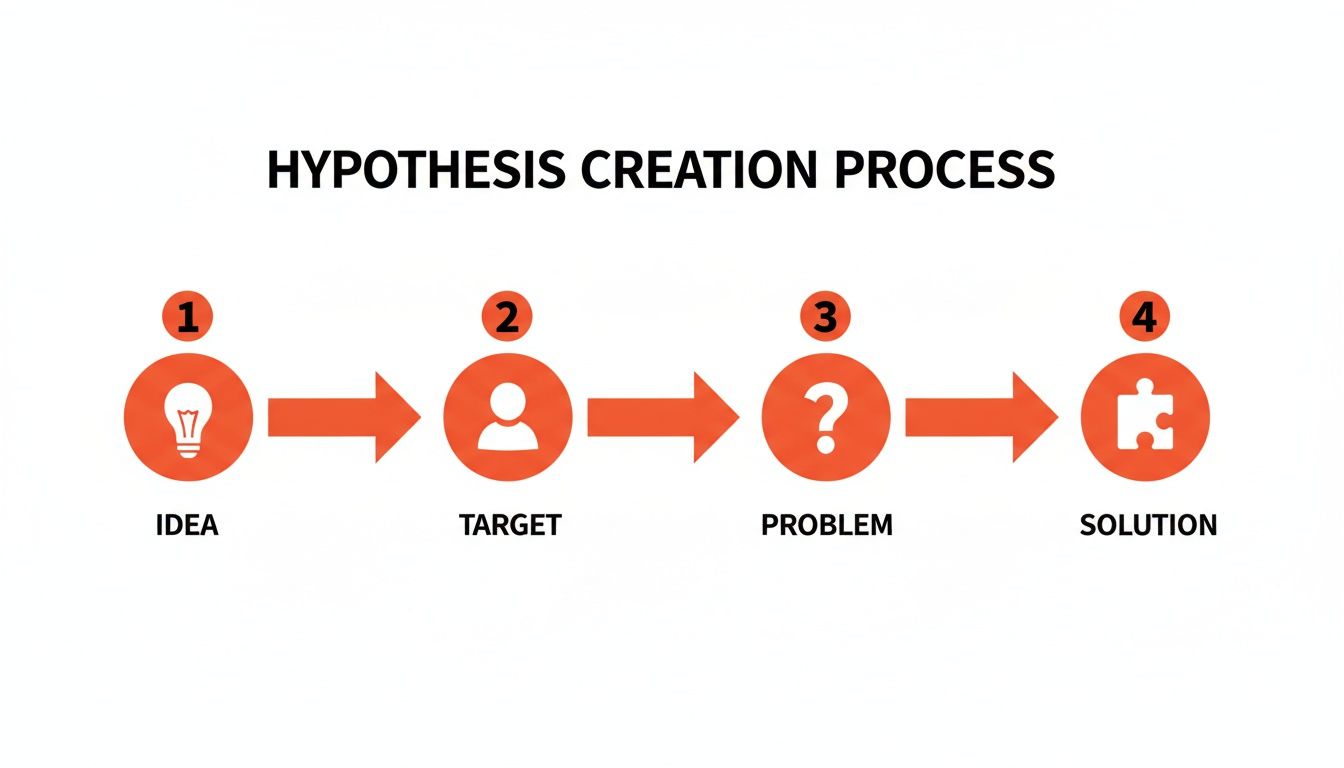
This whole process is a logical chain. You start with an idea, which leads to a target audience, which you believe has a specific problem, which you can solve with your solution. These first experiments are all about testing that chain, one link at a time.
The Art of the Customer Discovery Interview
Hands down, the fastest and most insightful way to start is to just talk to people. I’m serious. A dozen focused conversations with your ideal customer can teach you more than a year of building in isolation. But this isn't just a casual coffee chat; it's a structured mission to uncover deep insights.
The golden rule? Focus on past behavior, not future promises. People are terrible at predicting what they might do, but they're experts on what they have done.
Your job isn't to pitch. It’s to become an expert on their problem. Listen way more than you talk. Get them to tell you stories.
Pull together a short list of open-ended questions designed to get people talking. Your only goal is to see if the problem you defined in your hypothesis is real and painful.
Good Questions to Ask:
- "Can you walk me through the last time you had to deal with [the problem]?"
- "What have you already tried to do about this?" Actionable Insight: If they haven't tried to solve it at all, the problem might not be painful enough to warrant a paid solution.
- "What did you love or hate about the things you tried?"
- "If you had a magic wand and could change anything about this, what would it be?"
Questions to Avoid at All Costs:
- "Would you use a product that did X?" (This is hypothetical bait for polite, useless answers.)
- "How much would you pay for this?" (Too soon. You haven't established any value yet.)
- "Do you think my idea is good?" (This makes it about you, not their problem.)
Finding people to interview feels like a huge hurdle, but it’s easier than you think. Tap into your LinkedIn network and ask for warm introductions. A simple trick is to offer a $25 gift card for 20 minutes of their time—it shows you respect their expertise and gets a much higher response rate.
Unlocking Insights with Reddit Validation
For a lot of founders, especially in tech and SaaS, Reddit is an absolute goldmine for validation. It’s a network of hyper-focused communities where your target audience is already talking about their problems and weird workarounds.
The secret to Reddit is simple: contribute, don’t sell. Drive-by promotional posts get shut down instantly. Your mission is to spark genuine conversations that either prove or disprove your core assumptions.
First, find the right subreddits. Don't just post in massive, generic communities like r/technology. Get specific. If your tool is for freelance writers, you should be living in places like r/freelanceWriters or r/copywriting.
Once you’ve found a few promising spots, craft a post that’s all about the problem, not your brilliant solution.
Effective Reddit Post Angles:
- "How do you all currently handle [specific tedious task]? My current workflow feels so clunky." This invites people to vent and share their own hacks.
- "Is there a tool that integrates [System A] with [System B] for [specific outcome]? Been searching and can't find a thing." This is a direct test to see if a solution exists and how badly people want one.
- "What's the most frustrating part of [a specific process] for you?" This is just a straight-up request for pain points. Invaluable stuff.
The comments and upvotes are your data. A post that blows up with dozens of detailed, frustrated comments is a massive green light. But if all you get are crickets, or worse, comments like "I just use [existing free tool] for that," that's also critical feedback.
For savvy SaaS founders, this is a known playbook. Map your ideal customer to niche subreddits, post questions that probe a curiosity gap (like 'How do I solve X?'), and watch the comments to gauge intent. Seriously, some studies show that ideas validated this way can achieve 50% micro-niche dominance much faster.
Effectively using Reddit for marketing and validation means playing the long game. Become a real member of the community. Comment on other posts, offer helpful advice, and build some karma before you ever ask for feedback. It works.
Testing Real Commitment with High-Fidelity Validation
So, you’ve done your homework. You've run customer interviews and floated the idea on Reddit. You’re getting nods, and people are confirming the problem is real. That’s a fantastic start, but let's be honest: words are cheap.
It's time to shift gears from validating the problem to validating the solution. We need to see if people will give you something more valuable than their opinion—their email, their time, or, the ultimate test, their money.

These next experiments are about testing for real commitment. They close the gap between someone saying "that's a cool idea" and actually pulling out their wallet. This is a make-or-break step because it mimics a real transaction and gives you a much stronger signal of whether you’ve got a real business on your hands.
Crafting a Simple Yet Powerful Landing Page
Your first weapon in this phase is a single, laser-focused landing page. Its only mission is to explain your value proposition and convince a visitor to take one specific action. Don't even think about building a full website. This is a scalpel, not a Swiss Army knife.
A great validation landing page is actually quite simple. It just needs a few key things:
- A Killer Headline: Ditch the jargon. Speak directly to your customer's biggest frustration. Instead of "AI-Powered Project Management," try something like, "Stop Wasting 5 Hours a Week on Manual Project Reports."
- A Clear Value Proposition: In one or two sentences, tell them what you do and what's in it for them. For example: "Our tool automates your status updates, so you can get back to leading, not just reporting."
- Social Proof (Even a Little Bit Helps): Did someone in an interview say something great? Use it! A quote like, "This would be a game-changer for our weekly sprints." - Sarah P., Project Manager can make a huge difference.
- A Single, Unmistakable Call-to-Action (CTA): This is where the magic happens. The button needs to ask for a clear commitment. "Join the Private Beta" or "Request Early Access" are perfect.
The whole point is to measure conversion. If 100 people from your target audience land on this page, how many are willing to hand over their email? That percentage becomes one of your first hard metrics.
Driving Targeted Traffic with Paid Ads
Once your page is live, you need to get the right people to see it. Small-budget ad campaigns on platforms like Google, LinkedIn, or even Reddit are perfect for this. You don't need to break the bank; $100 to $200 is usually enough to get an initial read on things.
Your ad copy should echo the promise on your landing page. Target your ads with surgical precision, focusing on the exact customer you defined in your hypothesis. If you're going after project managers at mid-sized tech companies, use LinkedIn's filters for job titles and company size to get right in front of them.
Here, you're looking at two key metrics: click-through rate (CTR) and landing page conversion rate. A high CTR but low conversion rate probably means your ad is great but your landing page is falling flat. A low CTR could mean the core message just isn't hitting the mark.
To really nail this, you need solid data analysis. It’s worth looking into how experts who explore analytics growth services can help track and make sense of user behavior during these crucial tests.
Gauging Purchase Intent with a Smoke Test
Ready to really turn up the heat? A Smoke Test is where you ask for money for a product that doesn't even exist yet. It’s the ultimate validation of purchase intent because it demands the highest level of commitment from a potential customer.
Here's how it works: your landing page might have a "Buy Now for $29/mo" button. When a visitor clicks it, they land on a page that says something along the lines of:
"Thanks for your interest! We're not quite ready for launch, but you're on the priority list. As a thank you for your early support, you'll get the first month free when we go live."
This simple technique directly measures how many people are willing to pull out a credit card based solely on your value proposition. It's a powerful, crystal-clear signal. If you can get people to try and buy, you're almost certainly solving a very painful problem.
The Ultimate Validation: The Concierge MVP
While a Smoke Test confirms people want to buy, a Concierge MVP proves your solution actually delivers value by doing it all manually. This is my favorite method for service-based ideas or complex software. Instead of building the product, you become the product for your first few customers.
Let's go back to that automated reporting tool. A Concierge MVP would look like this:
- Find 3-5 paying customers who agree to the service (maybe at a discounted rate).
- You manually collect their project data every week through spreadsheets, emails, or a shared Slack channel.
- You personally build the project reports and deliver them, just as the future software would.
Yes, it's a ton of work. But the insights you get are priceless. You learn every tiny nuance of your customers' workflow, discover the real friction points, and build incredibly strong relationships with your first users. Every manual task you perform is a feature you'll eventually need to build.
By manually delivering the value, you're not just validating demand; you're creating the blueprint for your product based on real-world application, not assumptions. This is how you ensure you build something people will actually use, because you've already proven its utility.
Each of these high-fidelity methods gives you a different piece of the validation puzzle. By combining a compelling landing page, targeted ads, and either a Smoke Test or a Concierge MVP, you can gather the hard evidence you need to decide if your startup idea is truly worth the journey.
Making the Call: Validate, Pivot, or Move On
Alright, you've done the hard work. You've run the experiments, and the data from your interviews, landing page, and ads is starting to paint a picture. Now for the moment of truth: making the call. This isn't about gut feelings or wishful thinking; it's about soberly weighing the evidence against your hypothesis and choosing a path forward.
Remember, validation is a learning cycle, not a one-and-done event. The signals you've gathered will lead you to one of three outcomes. Each one is a form of progress, but they point you in very different directions.
What Does Success Actually Look Like?
Before you can make sense of the results, you have to know what you're measuring against. Vague goals like "getting some signups" are a founder's trap. You need hard numbers—real benchmarks that prove or disprove your core assumptions.
Ideally, you set these metrics before you ran a single experiment. If you didn't, do it now before you look at the data. Here are some battle-tested benchmarks I use:
- Landing Page Conversion Rate: For highly targeted traffic, a 5-10% conversion rate (like an email signup for a waitlist) is a genuinely strong signal. If you're struggling to get above 2%, it’s a red flag that your value proposition isn't hitting the mark.
- Customer Interview Feedback: This is more art than science, but a great rule of thumb is that at least 8 out of 10 people you talk to should bring up the core problem unprompted. They need to describe it as a significant, frustrating pain point.
- Letters of Intent (LOIs): If you're in the B2B space, getting 10-15 signed LOIs is a powerful indicator of commercial interest. Sure, they're non-binding, but they show a real intent to buy if you build it.
With these targets defined, you can now look at your results objectively and decide what to do next.
Outcome 1: Validate and Proceed
This is the outcome we all hope for. You've hit or blown past your success metrics, the qualitative feedback is electric, and the evidence strongly supports your core hypothesis. You've found a real signal in the noise.
What this feels like:
- Your landing page is converting at 8%, and your ad spend is surprisingly efficient.
- In interviews, people’s eyes light up. They lean in and ask, "So, when can I actually use this?"
- You have a growing waitlist of early adopters who are genuinely excited, not just lukewarm leads.
This isn’t the finish line, though. Think of it as a green light to hit the accelerator. Validating your idea is an instruction to confidently take the next step, whether that's building a more robust MVP, starting to think about a pre-seed round, or doubling down on your marketing.
Outcome 2: Pivot and Re-Test
A pivot isn't a failure—it's a discovery. This is what happens when your experiments show that you're onto a real problem, but your assumed solution or target customer is off the mark. You've unearthed a crucial insight that points you toward a much better opportunity.
Here’s a classic pivot scenario: Imagine you built a SaaS tool for freelance writers to manage their invoices. Your landing page bombs. But in your customer interviews, writer after writer tells you their real headache isn't invoicing; it's the constant, soul-crushing grind of finding high-quality work.
That's your pivot. Your new hypothesis becomes: "Freelance writers will pay a monthly subscription for a curated platform that matches them with vetted, high-paying clients." You keep the customer but completely change the solution.
Pivoting means you loop back to the hypothesis stage, but this time you’re armed with powerful new intel. You'll rewrite your assumptions and design a fresh set of experiments to test this new angle.
Outcome 3: Invalidate and Move On
This one stings, but it’s arguably the most valuable outcome of all. Invalidation is a clear, unambiguous "no." The evidence shows your core hypothesis was fundamentally flawed. The problem isn't painful enough, the market isn't willing to pay, or a better solution is already entrenched.
What this looks like:
- Your landing page is converting at less than 1%, despite your best efforts.
- You can't get anyone to even consider signing an LOI.
- Interviewees are polite but disengaged. You hear a lot of, "That's neat, but I'm fine with my spreadsheet."
Getting a clear "no" is a massive win. It’s the market giving you priceless information that just saved you years of your life and thousands of dollars chasing a dead end. The point of validation isn't to be proven right; it's to find the truth as quickly and cheaply as possible. A firm invalidation frees you to pursue your next—and likely much better—idea.
Have Questions About Validating Your Startup Idea? You're Not Alone.
Even with the best playbook in hand, you're bound to hit a few roadblocks. It's just part of the process. Founders often get snagged on the same few questions, which can unfortunately bring progress to a grinding halt. Let's walk through the most common ones I hear and get you unstuck.
How Much Validation Is "Enough" Before I Start Building?
This is the big one, isn't it? While there’s no magic number, the goal is simple: gather enough real-world evidence to turn your decision to build from a blind leap of faith into a calculated next step. You're looking for concrete signals, not just a gut feeling.
A strong green light to start building usually looks like a mix of these things:
- You've heard the problem over and over. After doing 15-20 customer interviews, you've heard at least 80% of people bring up the exact problem you're trying to solve—without you prompting them.
- People are actually signing up. You've driven some targeted traffic to a simple landing page, and it’s converting at 5% or higher for a waitlist or early access.
- You've got proof of commitment. For B2B ideas, this could be 10-15 signed Letters of Intent (LOIs). For B2C, maybe you've successfully pre-sold the concept to a small group of founding customers who are willing to pay upfront.
Once you see compelling evidence across these areas, you've probably de-risked the idea enough to justify building an MVP.
But What If Someone Steals My Idea?
I get it. This is probably the number one fear that keeps founders from talking to customers. It's also almost always overblown. Ideas are a dime a dozen; what's rare is the grit and skill to actually execute one.
The risk of building something nobody wants because you kept it a secret is 1000x greater than the risk of someone stealing your idea.
Think of feedback as the oxygen your startup needs to survive. Without it, you’re just building in a vacuum, guided by your own assumptions. An idea only becomes truly valuable after the market has had a chance to punch it in the face a few times.
How Do I Deal with Conflicting Feedback?
One person will tell you your idea is genius, and the very next person will look at you with a blank stare. This is totally normal. The trick is to not overreact to any single piece of feedback. Instead, you need to hunt for patterns.
Start by filtering every comment through the lens of your Ideal Customer Profile (ICP). Franky, the opinion of someone who fits your target demographic perfectly is worth ten times more than feedback from a random person. When you hear the same pain point, the same desire, or the same suggestion from five different people who all match your ICP... that's a signal you can't afford to ignore.
Ready to tap into Reddit's powerful communities to find your first believers? At Reddit Agency, we help you find where your ideal customers hang out, start real conversations, and collect the kind of unfiltered feedback that builds great companies. Let's turn your idea into evidence.
