
A Modern Guide to SaaS Marketing B2B Growth Strategies
Successful B2B SaaS marketing isn't about chasing the latest shiny object or hacking your way to the top. It’s about laying a rock-solid foundation. This whole game really starts with two things: deeply understanding your Ideal Customer Profile (ICP) and cementing your market positioning.
Get these two pieces right, and every dollar you spend will work harder, pulling in the exact customers who desperately need your solution and will stick around for the long haul.
Building Your Foundation for B2B SaaS Success

Think about building a skyscraper. You wouldn't dream of ordering windows or picking out paint before the foundation is poured and the architectural plans are locked in. It’s the same in marketing. Your positioning is that concrete foundation, and your Ideal Customer Profile (ICP) is the detailed blueprint. Without both, your efforts are just a house of cards waiting to collapse.
The B2B SaaS market is absolutely exploding—it's projected to jump from $390 billion in 2025 to a staggering $1,578.2 billion by 2031. While the big enterprises still make up over 60% of that spend, smaller businesses are adopting SaaS tools faster than ever. That means more opportunity, but it also means the competition is getting brutal. A strong foundation isn't just a nice-to-have; it's a must.
Here’s a quick look at the core concepts we're about to unpack. These are the building blocks for any marketing strategy that actually drives business results.
Core Pillars of Your B2B SaaS Marketing Foundation
| Pillar | Core Function | Why It's Critical |
|---|---|---|
| Ideal Customer Profile (ICP) | Defines the perfect-fit company for your product. | Focuses your marketing spend, improves messaging resonance, and attracts high-LTV customers. |
| Market Positioning | Defines how your product is perceived relative to competitors. | Creates a clear, memorable reason for your ICP to choose you over anyone else. |
Getting these two pillars right from the start prevents wasted time, money, and effort down the line.
Defining Your Ideal Customer Profile
Your ICP isn't just a vague description like "tech companies in North America." It's a laser-focused definition of the perfect company to buy your product. A great ICP is so specific it feels like you're describing one real organization. Before you even think about launching a campaign, you have to nail down how to find your target audience—otherwise, you're just burning cash.
A truly useful ICP gets into the nitty-gritty with firmographic, technographic, and behavioral details:
- Industry and Niche: Are you selling to FinTech? Or are you selling to Series B FinTechs in the UK focused on payment processing for e-commerce platforms? The second one is a real target.
- Company Size: Get specific with employee count (e.g., 50-200 people) and annual revenue (e.g., $10M-$50M ARR). This tells you if they can afford you and have the problems you solve.
- Technology Stack: What software do they live in every day? Knowing they use HubSpot, Slack, and Jira could be your way in, especially if you integrate with that ecosystem.
- Pain Points: What's the real, quantifiable problem you solve? For example, "They manually spend 20 hours per month compiling compliance reports, creating a significant risk of human error."
Actionable Insight: Your ICP isn't just about who can use your product; it's about who will get the most value from it. These are the customers who will have the highest lifetime value (LTV), lowest churn, and become your biggest advocates. A practical step is to interview your top 5 happiest customers and build a composite ICP from their shared characteristics.
Solidifying Your Market Positioning
Once you know exactly who you're talking to, your positioning tells them why they should bother listening. It’s the little piece of real estate you own in your customer's mind compared to all the other options out there. At its core, great positioning answers one simple question for your ICP: "Why should I choose you?"
Your positioning statement isn't a clever tagline for your homepage. It’s an internal North Star that guides every single message you create.
Here's a practical example:
- Vague Positioning: "We are an AI-powered project management tool." (So is everyone else.)
- Strong Positioning: "For creative agencies with 20-100 employees using HubSpot, our platform is the only project management tool that automates client reporting directly into the HubSpot timeline, freeing up 10 hours per project manager each week."
The second example is powerful. It names the audience (creative agencies), calls out a unique differentiator (automated client reporting), mentions their tech stack (HubSpot), and promises a tangible result (saving 10 hours a week). That kind of clarity is the bedrock of your entire saas marketing b2b strategy, from your Google Ads copy to your sales discovery calls.
2. Demand Generation vs. Growth Marketing: What's the Difference?

In the B2B SaaS world, you hear "demand generation" and "growth marketing" thrown around all the time, often as if they mean the same thing. They don't. Getting this right is critical because it dictates where your budget and energy go. One is about creating future opportunities, and the other is about converting the opportunities you have right now.
Think of demand generation as being a farmer. You’re not just planting seeds; you're preparing the soil. It's the slow, patient work of making your market aware of problems they might not even realize they have. You do this by educating them and positioning your company as the go-to expert—long before they ever think about buying. It's a long game that builds your brand's reputation and fills the very top of your funnel.
Growth marketing, on the other hand, is like being a scientist in a high-tech greenhouse. Your mission is to find the perfect formula to make things grow faster. This means running rapid, data-driven experiments at every single stage of the customer journey, from the first ad they see to keeping them a happy customer for years. It’s all about optimizing and squeezing more revenue out of the system you've built.
What Demand Generation Looks Like in the Wild
Demand gen is all about giving away value with no strings attached. You create genuinely useful content and experiences that aren't hidden behind a form or a sales pitch. The entire point is to inform, educate, and build trust. This is the bedrock of any solid SaaS marketing B2B plan.
Practical Example: A cybersecurity SaaS company invests in a big, original research report on the "Top 10 Phishing Scams Targeting SMBs in 2024." They don't lock it behind a lead-gen form. Instead, they share key stats as LinkedIn carousels, host a live Q&A webinar with their head of security, and give the data to industry journalists. They instantly become a thought leader, creating a natural pull toward their brand.
Here are some go-to demand generation tactics:
- Thought Leadership: Consistently publishing insightful articles, podcasts, or social media content that actually adds to the conversation in your niche.
- Original Research: Creating your own reports or surveys that give your audience data they can't get anywhere else.
- Community Building: Showing up where your ideal customers hang out online (like Reddit or industry forums) and just being helpful, with no sales agenda.
How Growth Marketing Turns Interest Into Revenue
While demand gen plants the seeds, growth marketing is what makes sure you get a massive harvest. It's a discipline built on constant experimentation and asking one simple question over and over: "How can we make this better?"
Practical Example: A growth marketer at a SaaS company notices many users drop off during the free trial after inviting only one teammate. They hypothesize that teams of 3+ are more likely to convert. They run an experiment: one group gets the standard onboarding, while the other gets an in-app prompt on day 2 that says, "Invite 2 more teammates and get a 7-day trial extension." Finding that the second group has a 5% higher trial-to-paid conversion rate can have a huge impact on monthly recurring revenue (MRR).
The Simple Breakdown: Demand generation asks, "How do we make our ideal customers aware of the problem and our solution?" Growth marketing asks, "How do we get more qualified users to sign up, stick around, and pay us more, faster?"
You can't have one without the other. A great demand generation engine fills your pipeline with well-informed prospects who trust you. Then, a sharp growth marketing team takes that interest and efficiently turns it into revenue and loyal customers.
To get a more detailed look at building that initial awareness, check out our complete demand generation strategy guide.
Choosing the Right Channels for Your B2B SaaS
A winning marketing strategy isn't about being everywhere at once. That's a surefire way to burn through your budget with mediocre results to show for it. It’s about picking the right battlegrounds—the places where your ICP is already looking for answers—and then owning those conversations.
The real key is to build a strategic channel mix that guides potential customers from the moment they realize they have a problem all the way to signing up. Forget casting a wide, expensive net. We're talking about spear fishing, targeting the platforms where your efforts will generate the biggest returns.
Content Marketing as Your Long-Term SEO Engine
Think of content marketing as the foundation of your entire growth strategy. This isn't just about churning out blog posts. It's about creating genuinely valuable assets that solve your ICP's real-world problems, build your authority, and quietly work for you 24/7. You're essentially building a library of expertise that constantly pulls in high-intent prospects from search engines.
Your goal is to become the undeniable go-to resource in your niche. This approach builds a powerful, long-term asset that, unlike paid ads, keeps delivering value long after you've made the initial investment.
To get started, focus on these essential content types:
- In-Depth Blog Posts: Go after "problem-aware" keywords that your ICP is typing into Google. For example, instead of "CRM software," target "how to track sales follow-ups without a CRM."
- Comprehensive Whitepapers: Offer deep dives into complex industry topics. This is how you position your brand as a true thought leader.
- Compelling Case Studies: Nothing beats real-world proof. Show exactly how you helped a customer (who looks just like your ICP) achieve tangible, impressive results.
To truly make this work, you need a plan that connects all your content efforts across different platforms. For a deeper look, this guide on creating A Modern Multi-Channel Content Strategy for B2B SaaS Marketers is a fantastic resource.
Paid Channels for High-Intent Lead Capture
While your content builds a long-term foundation, paid channels are your ticket to immediate, targeted traffic. This is where you can get laser-focused and capture high-intent leads who are actively shopping for a solution right now. It's the perfect complement to your organic efforts, letting you test messaging and fill your pipeline quickly.
For B2B SaaS, LinkedIn and Google Ads are the undisputed heavyweights. Their targeting capabilities are second to none, allowing you to get your message in front of the exact right decision-makers at the exact right time.
Here’s how that looks in practice:
- Google Ads: Target "bottom-of-funnel" keywords like "[your competitor] alternative" or "[your software category] for enterprises." You’re catching people who have their wallets out and are just making a final comparison.
- LinkedIn Ads: Use job title, industry, and company size filters to promote a specific case study or webinar directly to your ICP. For example, you could target "VPs of Marketing" at software companies with 100-500 employees with an ad that reads, "See how [Client Name] cut their reporting time by 50%."
A massive shift is underway in how B2B deals get done. By 2025, a staggering 80% of B2B SaaS sales are expected to happen online, cementing the dominance of digital channels. This trend is backed by real money, with 46% of marketers planning to increase their content marketing spend next year.
Reddit: The Untapped Community Engagement Tool
Beyond the usual suspects lies Reddit, a goldmine for authentic community engagement. But be warned: this is not a place for hard selling or corporate jargon. It's where your ICP goes for honest advice, to vent about their frustrations, and to find solutions recommended by actual peers.
Success on Reddit isn't about being a marketer; it's about being a helpful member of the community. By consistently offering valuable, non-promotional advice in the right subreddits, you build immense credibility and trust. This genuine engagement naturally drives high-quality, warmed-up traffic from people who already see you as an expert.
For a B2B SaaS company, the playbook is simple:
- Identify Niche Subreddits: Find the communities where your ICP hangs out to talk about their work challenges, like
r/sysadminfor IT tools orr/salesfor CRM platforms. - Provide Genuine Value: Jump into conversations. Answer questions, share insights from your own experience, and participate without ever mentioning your product.
- Build Your Reputation: Over time, people will start to recognize you. When the context is perfect, a subtle mention of how your tool could solve a specific problem will be seen as helpful advice, not a cheap sales pitch.
Actionable Marketing Playbooks You Can Use Today
All the theory in the world doesn't mean much without execution. It’s what separates the SaaS companies that skyrocket from those that stall out. Instead of just talking strategy, let’s get our hands dirty with two powerful, step-by-step playbooks you can implement this week to see real saas marketing b2b results.
Think of these as field-tested frameworks, not just abstract ideas. They’re designed to build momentum and bring in high-quality leads. Pick the one that fits your current goals and resources, and give it a solid 90-day run.
The simple flow below shows how different marketing channels—content, paid ads, and community—should work together, not in silos.
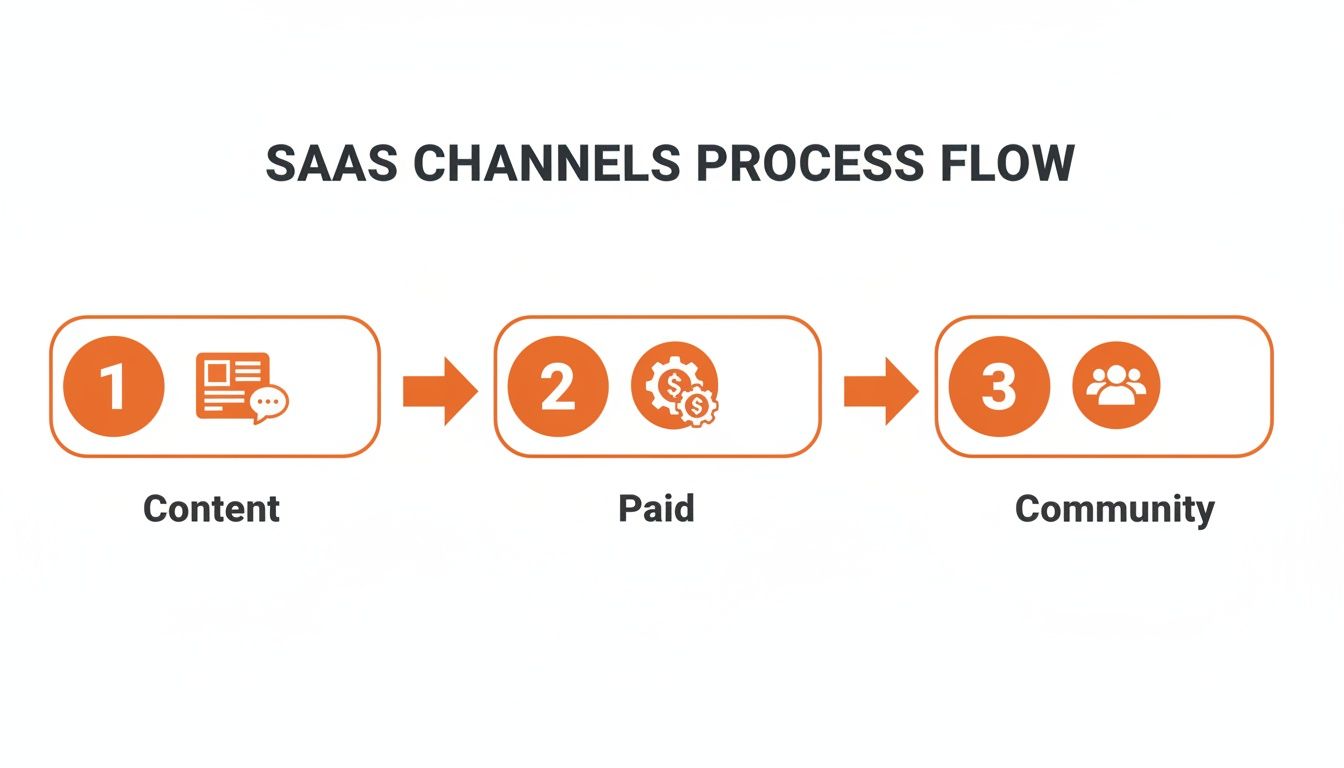
This visual is all about a multi-channel approach. Organic content builds your foundation, paid ads give you that targeted boost, and community work creates those authentic connections that people trust.
Playbook 1: The Content-Led SEO Flywheel
This playbook is all about turning your blog into a lead-generation machine. The goal is simple: become the go-to authority on a specific topic your customers care deeply about. It’s a long-term play, for sure, but it creates a compounding asset that attracts high-intent prospects month after month, almost on autopilot.
Step 1: Find "Problem-Aware" Keywords Your Ideal Customer Profile (ICP) isn't Googling your brand name—at least, not at first. They're Googling their problems. Use a keyword research tool like Ahrefs or Semrush to find long-tail keywords that reveal the exact pain points your software solves.
- Bad Keyword: "project management software" (Way too broad, and the competition is fierce.)
- Good Keyword: "how to reduce scope creep in software projects" (This is specific, shows clear intent, and targets a real problem.)
Step 2: Create a Cornerstone Pillar Page This is where you go big. Write a massive, in-depth guide—I’m talking 3,000+ words—that covers your core topic from every angle. Your goal is to make it the single best, most comprehensive resource on the internet for that subject. Include checklists, templates, and expert quotes to maximize value. This pillar page will become the central hub for all your related content.
Step 3: Build a Topic Cluster with Supporting Content Now, create 8-12 shorter blog posts that dive deeper into specific sub-topics related to your pillar page. Each of these "cluster" posts must link back to your main pillar page. This internal linking structure tells search engines that you have serious expertise on the entire subject, not just one piece of it.
Actionable Example: If your pillar page is "The Ultimate Guide to Remote Team Collaboration," your cluster content could be posts like, "Best Tools for Asynchronous Communication," "How to Run Virtual Meetings That Don't Suck," and "Measuring Productivity in a Remote Workforce." Each post should link back to the main guide with anchor text like "our complete guide to remote collaboration."
Playbook 2: The Reddit Community Growth Loop
This playbook is about building genuine connections and driving qualified traffic from Reddit, a platform that’s incredibly powerful but often misunderstood by B2B marketers. The mission is to become a trusted, helpful member of a community, not a salesperson.
Step 1: Pinpoint Your ICP's Subreddits
First, find the top 3-5 subreddits where your ideal customers hang out to ask for advice and talk about their work challenges. These are almost never product-focused communities. For instance, if you sell a tool for developers, you should be in r/ExperiencedDevs or r/devops, not r/software.
Step 2: Create a High-Value, Non-Promotional Content Calendar Plan out a schedule of posts that offer real value with no strings attached. Your content should never, ever feel like an ad. The goal is to share what you know and start interesting conversations.
- Share a Lesson Learned: Write about a mistake you made and what you took away from it. Vulnerability builds trust.
- Ask an Insightful Question: Spark a discussion around a common industry headache.
- Offer a Free Template: Share a simple spreadsheet or framework that helps people solve a small, nagging problem.
To get you started, here is a simple framework for crafting Reddit posts that people will actually appreciate.
Your Reddit Post Template for B2B Engagement
| Element | Guideline | Example |
|---|---|---|
| Hook | Start with a relatable problem or a surprising insight. Grab their attention immediately. | "I've reviewed 100+ B2B landing pages this month. 90% of them make the same conversion-killing mistake." |
| Value | Provide actionable advice, share data, or tell a compelling story. This is the core of your post. | "It's the headline. Instead of focusing on benefits, they describe features. Here’s a 3-part framework..." |
| Engagement | End with an open-ended question to encourage comments and discussion. | "What's the most effective headline you've ever tested? Curious to hear what's working for others." |
This approach keeps the focus on community and value, which is what builds a positive reputation on the platform.
Step 3: Engage in Comments to Build Your Reputation The real magic on Reddit happens in the comments section. Make it a daily habit to answer questions and offer helpful advice on other people's posts in your target subreddits. For example, if someone asks for advice on a problem your tool solves, explain a manual process to fix it. This positions you as an expert, not a spammer. This is how you build credibility and become a recognized name. Once you've established that trust, you can look into more advanced B2B lead generation tactics on Reddit.
By consistently showing up and being genuinely helpful, you build a reputation that eventually drives high-quality, referral-like traffic back to your site when people want to learn more about who you are.
How to Measure SaaS Marketing Success and ROI

Let’s be honest: without hard numbers, marketing can look like a cost center. To prove your team’s value and justify the budget, you have to speak the language of business outcomes. This means ditching the vanity metrics—like social media impressions or raw website traffic—and zeroing in on the data that directly impacts the bottom line.
A solid measurement framework is what turns your marketing efforts from a series of hopeful experiments into a predictable growth engine. It’s what allows you to make smart, data-driven decisions, double down on what’s actually working, and confidently show the C-suite how your team is fueling the company’s growth.
Key Metrics That Actually Matter
The lifeblood of any subscription business is recurring revenue. So, the metrics you track must reflect the health of that revenue stream. Forget the surface-level stuff and get obsessed with these core drivers.
- Customer Acquisition Cost (CAC): This is your total sales and marketing spend divided by the number of new customers you brought in over a specific period. For example, if you spend $10,000 on marketing and sales in a month and get 10 new customers, your CAC is $1,000.
- Lifetime Value (LTV): LTV is the total revenue you can reasonably expect from a customer. A simple calculation is (Average Revenue Per Account) / (Customer Churn Rate).
- LTV:CAC Ratio: This is the ultimate health check for your B2B SaaS marketing strategy. It pits the value of a customer against the cost to acquire them. A healthy ratio is typically considered 3:1 or higher—for every dollar you spend on acquisition, you should expect to get at least three back over time.
A ratio below 3:1 can be a red flag. It might mean you're overspending to acquire customers or attracting low-value users who churn quickly. On the flip side, a ratio way up at 5:1 or more could signal you’re underinvesting in marketing and leaving growth on the table.
Monitoring Business Health and Stability
Beyond acquiring new customers, you have to keep a close eye on the stability of your existing base. These two metrics will tell you if your business is actually growing or just treading water in a leaky boat.
- Monthly Recurring Revenue (MRR) Growth: This tracks the month-over-month increase in your predictable revenue. It's the primary indicator of your company's momentum and growth trajectory.
- Churn Rate: This is the percentage of customers who cancel their subscriptions in a given period. High churn can cripple even the fastest-growing SaaS company by constantly eroding your revenue base.
For most B2B SaaS companies, marketing spend hovers around 8% of Annual Recurring Revenue (ARR). But high-growth companies play a different game, often investing up to 40% more to fuel their expansion. This is where understanding your metrics becomes your superpower, allowing you to justify a bigger investment. To dig deeper into this, check out our guide on measuring return on marketing investment.
Understanding Marketing Attribution
Attribution is the science of connecting the dots between your marketing activities and actual revenue. It answers the one question every CMO wants to know: "Which of our channels and campaigns are actually working?" Without it, you’re just flying blind.
Attribution models are the frameworks you use to assign credit to the various touchpoints a customer interacts with on their way to signing up.
Common Attribution Models:
- First-Touch Attribution: This model gives 100% of the credit to the very first marketing touchpoint a customer engaged with. It’s great for understanding which channels are best at generating initial awareness. For example, if a user first finds you through an organic blog post, that post gets all the credit.
- Last-Touch Attribution: The opposite of first-touch, this gives all the credit to the final interaction before a conversion. It's simple, but it ignores all the crucial work that got the prospect to that final step.
- Multi-Touch Attribution: This is the most realistic model for the typically long and complex B2B SaaS marketing sales cycle. It distributes credit across multiple touchpoints in the buyer's journey, giving you a much more complete picture of what truly influenced the decision.
By implementing a clear measurement framework, you transform marketing from a mystical art into a predictable science. You gain the clarity you need to optimize your strategy, prove your impact, and build a sustainable, data-backed growth machine.
Your Path to Sustainable B2B SaaS Growth
We've covered a lot of ground together. Think of this guide not just as a collection of tactics, but as a clear roadmap to building a real, sustainable growth engine for your SaaS.
We started by pouring the foundation—getting crystal clear on your Ideal Customer Profile and nailing your market positioning. From there, we moved on to choosing the right channels and diving into proven, actionable playbooks. Each piece was designed to stack on top of the last, creating a system for growth, not just a series of one-off campaigns.
The thread connecting everything is that real success in SaaS marketing comes from a methodical, customer-first process. It’s all about deeply understanding who you’re serving and then showing up where they are with something genuinely valuable, not just another sales pitch.
From Strategy to Action
Random acts of marketing get you random results. It’s a classic trap. The difference between the companies that hit a plateau and the ones that scale consistently is an unwavering commitment to a focused strategy. You don’t need to do everything at once. In fact, you absolutely shouldn't.
The key takeaway is this: Building authentic connections and providing real value is no longer a 'nice-to-have'—it's a powerful and necessary differentiator in a crowded market.
Instead of feeling overwhelmed by all the possibilities, your path forward is actually quite simple. The goal now is to turn what you've learned into tangible momentum.
Your Next Move
Don't let this guide become another browser tab you eventually close and forget. The most important step you can take is the very next one. True, lasting growth is built one focused effort at a time.
Here’s your immediate game plan:
- Choose One Playbook: Go back and look at the Content-Led SEO Flywheel or the Reddit Community Growth Loop. Pick the one that feels like the best fit for your current resources and goals.
- Commit for 90 Days: Give that single playbook a dedicated, focused effort for one full quarter. Don't let yourself get distracted by other shiny objects or the next new marketing trend.
- Measure and Learn: Keep a close eye on the key metrics we talked about. Use that data to see what’s hitting the mark and what needs a tweak.
This kind of focused implementation is exactly how you build the kind of momentum that drives predictable, long-term growth in the competitive world of B2B SaaS.
Frequently Asked Questions
Let's be honest, B2B SaaS marketing can feel like a moving target. New channels pop up, old tactics fade, and it's tough to know where to focus. Here are some of the most common questions I hear, with straightforward answers to help you build a smarter, more effective strategy.
How Is SaaS Marketing Different from Traditional Marketing?
The biggest shift is moving from a "one-and-done" sale to a long-term relationship. Traditional marketing often throws everything at a single transaction—the sale is the finish line. In SaaS, the sale is just the starting line.
Because the entire business model is built on recurring revenue, marketing's job expands beyond just getting that initial sign-up. You have to think about the entire customer journey:
- Acquisition: Getting them in the door.
- Activation: Making sure they see the product's value, fast.
- Retention: Keeping them happy and subscribed month after month.
- Expansion: Turning happy customers into bigger accounts through upgrades and new features.
In short, you’re not just selling a product; you’re selling an ongoing solution and a relationship.
What Are the Most Important Metrics to Track?
Website traffic and social media likes are vanity metrics. They feel good, but they don't tell you if your business is actually healthy. You need to track the numbers that are directly tied to revenue and profitability.
Your north star should always be sustainable growth, not just a flurry of activity. The single most important health check for your entire marketing and sales engine is the LTV:CAC ratio.
Here’s what really matters:
- Customer Acquisition Cost (CAC): The total cost to land one new paying customer.
- Lifetime Value (LTV): The total revenue you can expect from a single customer over their entire time with you.
- LTV to CAC Ratio: The magic number. You should aim for a ratio of at least 3:1—meaning a customer is worth at least three times what you spent to get them.
- Monthly Recurring Revenue (MRR) Growth: The clearest sign that you're heading in the right direction.
- Churn Rate: The percentage of customers who cancel their subscriptions each month. This is the silent killer of many SaaS businesses.
How Much Should a B2B SaaS Company Spend on Marketing?
There’s no perfect, universal answer, but we can look at some solid benchmarks. On average, a private B2B SaaS company invests around 8% of its Annual Recurring Revenue (ARR) back into marketing.
But that's just an average. The real number depends entirely on your growth stage and goals. A scrappy, bootstrapped startup might spend less, while a VC-backed company aiming for market dominance might pour in a lot more—sometimes 40% more than the median—to grow as fast as possible.
The best way to decide is to look at your unit economics. If your LTV:CAC ratio is healthy, you have the green light to spend more aggressively and accelerate your growth.
Ready to turn Reddit into a powerful lead-generation channel? Reddit Agency helps B2B SaaS companies build authentic community connections that drive measurable results. Learn more at https://redditagency.com.
