
Your Modern Demand Generation Strategy Playbook
A modern demand generation strategy is less about chasing leads and more about building a brand that people actively seek out. It's a long-term game focused on creating awareness and genuine interest in what you offer. Instead of just capturing the small slice of the market that's ready to buy right now, you're building a trusted presence so you're the first—and only—choice when they are.
What Is Modern Demand Generation Really

Let's clear the air on something I see all the time: demand generation is not just a fancy, new-age term for lead generation. They couldn't be more different in their philosophy.
Lead gen is purely transactional. It’s a hunt for contact information from people who have already shown some interest. For example, running a LinkedIn Ad campaign that pushes a gated eBook and measures success by the number of email addresses collected. Demand gen, on the other hand, is about creating that interest from scratch. It represents a massive shift in thinking—from "How do we get more form fills today?" to "How do we become the undisputed authority in our space for years to come?"
This modern approach is all about giving value freely, without expecting an immediate return. Think of it as earning your audience’s trust by consistently helping them solve their problems. When you do that well, they naturally turn to you when they're ready to buy.
The Core Pillars of a Modern Approach
The old "gate everything and push for a demo" playbook is broken. Today's buyers are savvy. They do their own research, and they can spot a sales pitch from a mile away. A truly effective demand generation strategy respects that reality by focusing on a few key principles:
- Building Unshakeable Authority: This comes from consistently sharing high-quality, ungated content. Actionable Insight: Instead of a generic "10 Tips" article, publish a detailed, 3,000-word guide on "The Exact Workflow Our Agency Uses to Onboard New Clients," complete with templates. This establishes you as a true expert.
- Educating, Not Selling: Your primary mission is to solve your audience's problems, not to jam your product down their throats. Practical Example: If you sell a cybersecurity tool, create a video series on YouTube explaining how to conduct a basic security audit—using free tools—long before you ever mention your own product.
- Creating a Real Community: Don't just broadcast—engage. Show up where your audience hangs out, whether that's a niche subreddit, a professional LinkedIn group, or an industry Slack channel. Build real relationships and listen to what people are actually saying.
This is how you nurture prospects over the long haul. When someone finally does express interest, they aren't a cold lead; they're a warm prospect who already knows, likes, and trusts your brand. The result? A smoother sales process and way better opportunities.
Key Takeaway: Demand generation is about playing the long game. The goal is to make your brand so well-known and respected for its expertise that you become the default choice. You end up generating inbound interest organically instead of constantly chasing outbound leads.
Modern vs Traditional Marketing Focus
The table below breaks down the fundamental mindset shift from an outdated lead generation focus to a modern demand generation strategy.
| Pillar | Traditional Lead Generation | Modern Demand Generation |
|---|---|---|
| Primary Goal | Capture contact info (MQLs) | Create awareness & educate the market |
| Core Tactic | Gated content (eBooks, whitepapers) | Ungated, high-value content (blogs, videos) |
| Audience Focus | Small % of in-market buyers | 95% of the total addressable market |
| Mindset | Transactional: "What can we get?" | Relational: "What can we give?" |
| Measurement | Cost per lead, MQL volume | Pipeline influence, brand recall, engagement |
As you can see, the entire philosophy is different. One is a short-term hunt, while the other is a long-term investment in building a brand that attracts its own audience. True demand generation makes lead capture a natural byproduct of your efforts, not the sole objective.
Defining Your Ideal Customer and Core Goals
Let's be blunt: a demand generation strategy without a crystal-clear audience and a defined purpose is just a series of expensive guesses. You end up shouting into a void, hoping the right person just happens to be listening. To avoid this, you need to nail your foundation first.
That foundation is built on two things: a deep, almost obsessive understanding of your Ideal Customer Profile (ICP) and a set of real business goals that actually matter. Get these two pieces right, and every ad you run, every article you write, and every post you share will have a purpose.
Moving Beyond Surface-Level Demographics
Your ICP isn't just a job title and a company size. That’s rookie stuff. A truly useful profile gets into the messy, human details that actually drive someone to buy something. You have to see the world through their eyes.
Stop thinking "VP of Marketing at a 500-person tech company." Instead, think "Sarah, a VP of Marketing who's drowning in spreadsheets trying to prove her team's ROI and is constantly getting grilled by the CFO for more budget." See the difference? The second one gives you a real, tangible problem you can solve.
To get to that level of detail, you have to dig for specific psychographics and behaviors:
- Their Daily Grind: What does their day actually look like? Actionable Insight: Ask your sales team for the top 3 most common "day-in-the-life" complaints they hear on discovery calls. This is real-world data.
- The Real Pain Points: Forget the sanitized business challenges. What are their personal career frustrations? Example: They don't just need "better reporting"; they're afraid of looking unprepared in their next board meeting.
- Their Watering Holes: Where do they really go to complain and get advice from people who get it? Hint: It’s rarely on corporate blogs. It’s in niche Slack groups, private forums, and subreddits.
A huge mistake I see all the time is companies building their ICP in a vacuum, based entirely on internal assumptions. The best profiles come from real-world data: interviews with your best (and worst) customers, insights from your sales team’s call notes, and just being a fly on the wall in the online communities where your audience hangs out.
For example, a SaaS company selling project management software might assume their ICP is a "Certified Project Manager." But after digging, they discover their real sweet spot is the "accidental" project manager in a marketing agency—someone who just got handed a massive project with no formal training. That single insight changes everything about their marketing. You can learn more about how to create an incredibly detailed ICP in our guide.
Uncovering Insights on Reddit
Speaking of watering holes, platforms like Reddit are absolute goldmines for understanding what your ICP is thinking when they don't have their professional mask on. It’s anonymous, unfiltered, and brutally honest.
Imagine you're trying to sell to software developers. A quick search through subreddits like r/ExperiencedDevs or r/SysAdmin can instantly show you:
- Common Gripes: You'll find entire threads dedicated to buggy software, clueless management, or inefficient development cycles.
- Tool Debates: You can watch them praise, pan, and compare different products in real-time.
- Their Language: You’ll pick up on the specific jargon, acronyms, and inside jokes they use, which you can then weave into your own copy to sound like you belong.
This is the kind of raw, first-party insight that helps you craft a message that doesn't just describe a problem—it reflects their reality right back at them. That’s how you build an instant connection.
Setting Goals That Drive Business Outcomes
Once you know who you’re talking to, you need to be clear about what "winning" looks like. Vague, fluffy goals like "increase brand awareness" are worthless. Your objectives have to be specific, measurable, and tied directly to the health of the business.
Good demand gen goals track the entire journey, not just the top of the funnel. Here are a few examples of goals that your CFO will actually care about:
- Reduce Customer Acquisition Cost (CAC): "Our goal is to cut CAC by 15% in the next six months by generating more high-intent organic traffic that converts without us having to spend a fortune on ads."
- Increase Pipeline Velocity: "We need to shorten the average sales cycle from 90 days to 75. We’ll do this by creating better middle-of-funnel content that handles the top three sales objections before anyone even talks to a rep."
- Improve Lead-to-Opportunity Rate: "Let's focus on quality, not quantity. The aim is to boost our MQL to SQL conversion rate by 20%, ensuring marketing is only handing off prospects who genuinely fit our ICP."
Goals like these give your strategy a spine. They turn your marketing department from a perceived cost center into a predictable revenue engine, allowing you to clearly demonstrate your impact on the bottom line.
Finding Your Audience in Unexpected Places
Your best customers aren't just sitting around on your website, waiting for a pop-up form. They're scattered all over the internet, living in digital communities where they complain, ask for advice, and talk about the exact problems your product was built to solve. A huge part of any real demand generation strategy is to stop waiting for them to find you and start going to them.
This means looking beyond the usual suspects like LinkedIn ads and SEO. Sure, those channels are great for capturing people who are already looking for a solution. But true demand creation? That happens in the trenches—in the niche communities where your ideal customers feel comfortable enough to be brutally honest.
Uncovering Gold in Niche Communities
Think about it: where do people go when they're really stuck and don't want to talk to a salesperson? They head to forums, Slack channels, and social platforms to get unfiltered advice from their peers. For a huge chunk of B2B and tech audiences, Reddit is the final destination for this kind of conversation.
It's a place where anonymity breeds honesty. You won’t find polished corporate jargon or carefully worded PR statements. What you will find are raw, uncensored discussions about what software people hate, which processes are totally broken, and what they desperately wish existed.
My Pro Tip: Don't just search for your brand name or your direct competitors. That's a rookie mistake. Search for the problem you solve. A founder of a project management tool shouldn't just be looking for mentions of "Asana." They should be digging for phrases like "hate this spreadsheet," "project tracking nightmare," or "how do you manage client requests?" That's where the real pain is.
Your Practical Framework for Reddit Analysis
Finding the right communities on Reddit is more than just typing keywords into a search bar. You have to understand the culture and pinpoint subreddits where your expertise can genuinely add value, not just noise.
Here’s a methodical way to approach it:
- Identify Core Subreddits: Start with the obvious ones. If you sell to marketers, you'll want to check out
r/marketingandr/PPC. But don't stop there. Actionable Step: Brainstorm 3-5 "adjacent" communities. If you sell to cybersecurity pros, look forr/sysadminandr/netsecwhere they discuss broader IT challenges that lead to security issues. - Analyze the Culture and Rules: Every single subreddit has its own personality and a strict set of rules. Before you even think about writing a post, spend some real time lurking. Read the sidebar. See what kind of content gets massively upvoted and what gets instantly downvoted into oblivion. Is the vibe helpful, sarcastic, or highly technical?
- Map Out Conversation Themes: Start looking for patterns and recurring topics. Practical Example: Create a simple spreadsheet with three columns: "Subreddit," "Recurring Problem," and "Content Idea." If you see multiple posts in
r/salesabout bad CRM data, that's a content idea for your data enrichment tool.
This process isn't just for marketing—it's an absolute goldmine for product development. Imagine you're a B2B founder debating a new feature. You could spend months building it, or you could find a thread where users are practically begging for that exact solution. This is how you validate ideas with real, unbiased feedback. For a deeper dive, our guide on how to find your target audience breaks down even more detailed frameworks.
From Lurker to Valued Contributor
Once you’ve found your target subreddits, your goal is not to sell. I'll say it again: do not sell. Your only objective is to become a helpful, respected member of that community. The second you drop a salesy link, you'll get called out and probably banned for life.
Instead, put all your energy into genuine engagement. Answer questions where you have legitimate expertise. If someone is wrestling with a problem your product solves, explain the process of solving it—without ever mentioning your tool. Just share what you know, freely and openly, and build a reputation for being the helpful expert.
A Real-World Scenario
Let’s say you run a SaaS that automates financial reporting for small businesses. You stumble upon a thread in r/smallbusiness where a user is venting about how much time they waste manually creating P&L statements every single month.
- Bad Response (Salesy): "You should check out our tool! It does all this for you automatically. Here's a link to a free trial."
- Good Response (Value-First): "I know that pain well. One thing that saved me a ton of time was setting up a simple template in Google Sheets with formulas that pull directly from my transaction exports. It takes an hour to set up, but it cuts the monthly work down to 15 minutes. Happy to share a basic template if it helps."
See the difference? The second response builds immediate trust and positions you as an authority. Over time, as you consistently provide this kind of value, people will naturally get curious about who you are and what you do. They'll check your profile, see your company link, and you’ll start generating inbound interest from a perfectly qualified audience—all without a single hard sell. This is the heart of building a powerful demand generation engine in places you never thought to look.
Creating Content That Solves Real Problems
Your content is the fuel for your entire demand engine. But here’s the thing—it only works if it solves a real, nagging problem for your audience. Generic, self-serving fluff gets ignored. Genuinely helpful content, on the other hand, builds trust and creates a kind of brand gravity that pulls the right people in.
This means you can't just create content for the sake of it. You have to map it directly to where your audience is in their journey. Are they just realizing they have a problem? Are they actively looking for solutions? Or are they about to pull the trigger on a purchase? Each mindset requires a totally different kind of value from you.
Sparking Interest with Problem-Aware Content
Right at the top of the funnel (TOFU), your audience isn't looking for your product. They might not even know a solution like yours exists. They are simply problem-aware. They're feeling the pain and starting to search for information and relief.
Your job here is to be the most helpful voice in the room, asking for nothing in return. This is where you build trust with high-value, totally ungated content.
- Insightful Articles: Forget posts like "10 Reasons to Buy Our Software." Practical Example: If you sell cybersecurity software, write an article titled "A CISO's Guide to Preventing Burnout from Alert Fatigue." This addresses a real-world headache in their language.
- Helpful Social Media Threads: Break down a complex topic into a digestible thread on LinkedIn or X. Actionable Insight: Share a framework you use internally, tell a personal story about a failure, or offer a checklist that helps people solve a tiny piece of their problem today.
- Community Engagement: Jump into relevant Reddit threads and offer genuine advice. If someone is struggling with a workflow you've mastered, explain your process in detail without ever mentioning your product.
The goal is pure, unadulterated value. You're building positive brand association and establishing yourself as a credible expert. When they eventually become solution-aware, your name will be the first one that pops into their head.
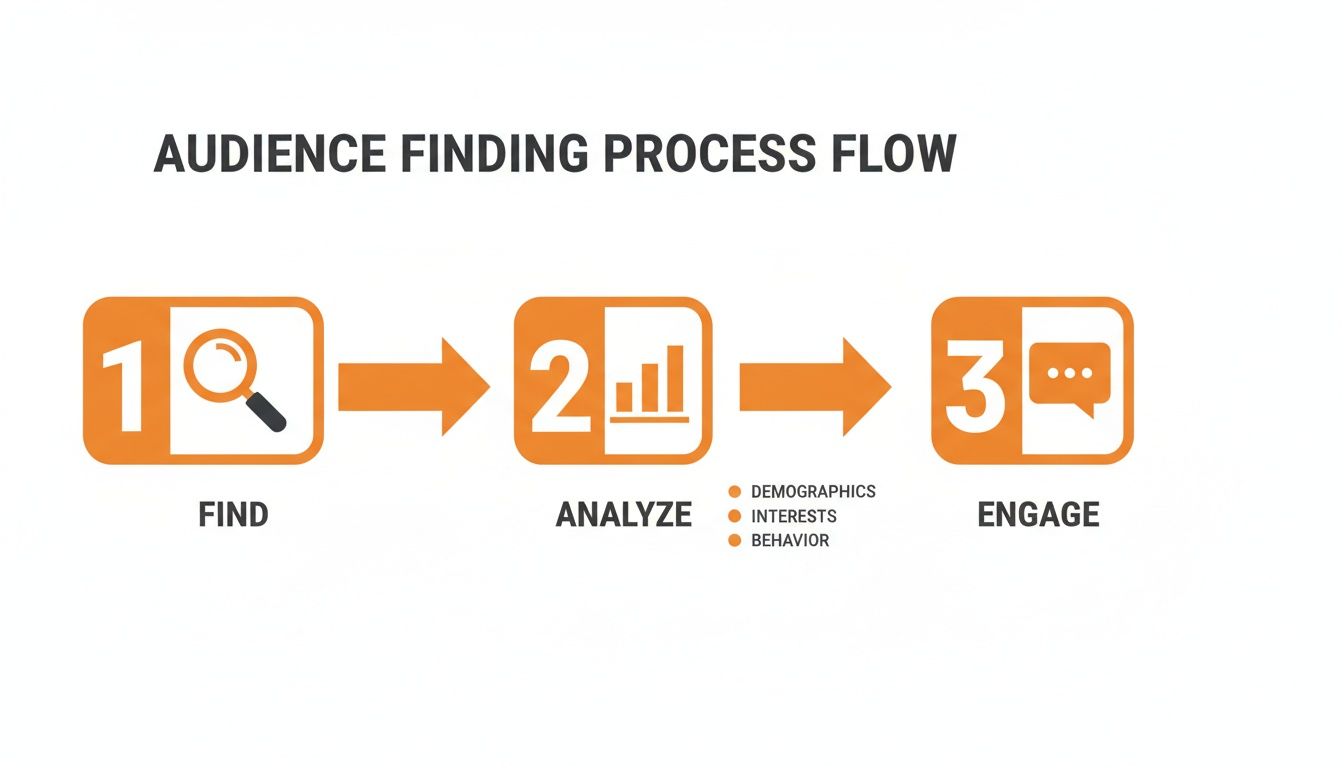
As you can see, effective engagement starts long before you ever write a word. It's rooted in truly understanding what people are talking about and what’s keeping them up at night.
Guiding Prospects with Solution-Aware Assets
Once people know they have a problem and start actively researching ways to fix it, they’ve hit the middle of the funnel (MOFU). They are now solution-aware. Your content needs to shift gears, moving from broad education to more specific, expert guidance that subtly positions your unique approach as the best one.
This is where you can start introducing gated assets, but they have to be incredibly valuable to justify asking for an email address.
Here's my rule of thumb for MOFU content: would someone pay for this if it were a standalone product? If the answer is no, it’s not good enough. Original research, proprietary frameworks, and expert-led webinars are what win at this stage.
Here are a few middle-funnel ideas that actually work:
- Deep-Dive Guides and Original Research: A report on industry benchmarks or a comprehensive guide to implementing a new strategy screams authority. Example: Survey 500 sales leaders about their biggest challenges and publish the results as an exclusive "State of Sales" report.
- Expert Webinars: Host a live session with a respected industry expert (not just a product pitch) that teaches a specific skill or framework. This delivers massive value and lets you interact directly with potential customers.
- Toolkits and Templates: Give them something practical they can download and use immediately. Practical Example: If you sell a project management tool, offer a downloadable, pre-built project plan template for a specific industry, like "The Ultimate Agency Client Onboarding Template."
This type of content nurtures the interest you've already sparked, guiding prospects toward your way of thinking. To get the most mileage out of these bigger assets, it's smart to repurpose content into smaller snippets for social media, blog posts, and newsletters.
Closing the Deal with Decision-Stage Content
Finally, at the bottom of the funnel (BOFU), your prospects are product-aware. They're ready to make a choice, actively comparing their options. They need content that crushes their final hesitations and makes them feel confident that choosing you is the right move.
Forget ambiguity; clarity and confidence are what convert here.
- Customer Stories and Case Studies: Ditch the sterile PDFs. Create compelling video testimonials or in-depth articles that tell a relatable story of transformation. Actionable Insight: Focus on the real business results, like "How Company X Reduced Churn by 25% in 6 Months."
- Clear Comparison Pages: Don't be afraid to compare your product to the competition. An honest, fair comparison page that highlights your unique strengths builds incredible trust and, just as importantly, keeps prospects on your site.
- Implementation Guides and Demo Videos: Show them exactly how your product solves their specific problem. A short, on-demand demo video is often way more effective than trying to schedule a live call, as it gives the buyer control.
By thoughtfully creating content for each stage, you turn your demand generation strategy into a cohesive journey. It’s a system that builds trust, proves your expertise, and naturally guides the right customers straight to your door.
Weaving Organic and Paid Tactics Together

Here’s a hard truth: the most powerful demand generation strategies don't live in silos. Treating your organic content and paid advertising as two separate worlds is a surefire way to burn cash and miss out on massive opportunities. The real magic happens when you build a system where they feed each other, creating a growth loop that’s far stronger than the sum of its parts.
Think of it this way: your organic efforts are about building a long-term, sustainable asset. You're earning trust, establishing authority, and creating a brand that people actually want to seek out.
Paid ads? They’re the accelerator. They're how you pour gas on what’s already working, capture high-intent prospects at just the right moment, and get your best content in front of a perfectly targeted audience. This integrated approach ensures you’re not just renting attention but building a brand that truly owns its audience.
Using Organic Insights to Fuel Paid Campaigns
Your organic channels—especially community hubs like Reddit and LinkedIn—are incredible listening posts. They offer a direct, unfiltered pipeline into the minds of your ideal customers. The exact language they use, the problems that keep them up at night, and the solutions they’re praising are all goldmines of data for making your paid campaigns hit harder.
Instead of just guessing at ad copy, you can literally lift entire phrases from a popular Reddit thread where your target users are airing their frustrations. This isn't just a clever tactic; it's about reflecting your audience's own words back at them. It creates an instant connection and a feeling of, "Wow, this brand just gets me."
Here’s how you can put this into action:
- Mine Reddit for Ad Copy Gold: Practical Example: Find a thread in
r/sysadminwith the title "I'm so tired of our buggy backup software." Your ad headline could be "Tired of Buggy Backup Software?" It's simple, direct, and speaks their language. - Identify Your Organic Winners: Take a look at your analytics. Which blog posts or LinkedIn updates are getting the most engagement and driving the most traffic? These are your proven winners. Actionable Step: Put $100 behind your top-performing LinkedIn post from last month, targeting a lookalike audience of the people who engaged with it.
- Use SEO Data for Paid Search: Dig into Google Search Console and analyze which keywords are bringing the most qualified organic traffic to your site. These are high-intent terms your audience is already using to find solutions. Target these exact keywords with your paid search ads to dominate the SERP and capture users who are actively looking to buy.
A classic mistake is to keep the organic social team and the paid media team completely separate. When these two groups are in constant communication, sharing insights and data, the entire demand generation machine gets smarter and way more efficient.
Amplifying Success with Targeted Ads
Once your organic engine is humming and feeding you rich audience insights, you can wield paid advertising with surgical precision. This is where you move beyond simple brand awareness and start capturing demand from prospects who are much further down the funnel.
Paid tactics let you get in front of people who have already shown interest, ensuring your marketing dollars are spent on the audiences most likely to convert. Research from B2B marketing experts backs this up, showing just how crucial a multichannel approach is. Projections show that by 2026, a mix of channels led by LinkedIn and organic search will drive 80% of all B2B leads.
This really highlights how platforms like LinkedIn, which is already responsible for about 80% of B2B social media leads, become even more of a powerhouse when paired with a strong SEO foundation. You can dig deeper into these B2B demand generation findings on Blueprintdemand.com.
Smart Retargeting and Lookalike Audiences
This is where the synergy between organic and paid truly comes to life. You can build incredibly effective paid campaigns based directly on the engagement you’re already getting from your organic content.
Retargeting Engaged Audiences
It's time to set up campaigns that specifically target users who have already interacted with your brand in a meaningful way.
- Website Visitors: Actionable Example: Create a custom audience of everyone who visited your pricing page but didn't book a demo in the last 30 days. Show them an ad featuring a customer testimonial.
- Video Viewers: Target users on platforms like LinkedIn or YouTube who have watched a significant chunk of your educational videos.
- Content Downloaders: Got a few gated assets? Retarget users who have downloaded them with compelling bottom-of-funnel offers.
Building Lookalike Audiences
This tactic is all about finding new people who are just like your best customers.
- First, upload a list of your existing customers to a platform like LinkedIn or Facebook.
- The platform’s algorithm then analyzes the shared characteristics of those users.
- From there, it creates a brand new, much larger audience of people who "look like" your current customers, giving you a fresh pool of highly relevant prospects to target.
By weaving these organic and paid tactics together, you create a robust, self-reinforcing system for growth. You use organic channels to build your brand and gather intelligence, then use paid channels to amplify your message and turn that interest into real, measurable business outcomes.
Measuring What Matters for Your Business
As the old saying goes, if you can't measure it, you can't improve it. Running a demand generation campaign without clear metrics is like flying blind—you're definitely busy, but you have no idea if you're actually getting closer to your destination.
It’s time to stop chasing vanity metrics. Things like likes, raw impressions, and follower counts feel good on a report, but they don't pay the bills. Real success is measured in business outcomes, plain and simple. We need to focus on the key performance indicators (KPIs) that connect directly to revenue growth and prove your marketing is more than just a cost center. This is how you build a predictable revenue engine.
Moving Beyond Vanity Metrics
The first step is a simple but critical shift in mindset. Stop asking, "How many people saw our content?" and start asking, "How did our content influence the sales pipeline?" This change forces you to tie every marketing activity back to tangible business results.
Here are the core metrics that genuinely matter for any demand generation strategy:
- Pipeline Generated: This is the big one. It's the total dollar value of every sales opportunity your marketing efforts have influenced or sourced. There's no clearer link between your campaigns and potential revenue.
- Sales Cycle Length: How long does it take for someone to go from their first touchpoint to a signed contract? Actionable Insight: If your sales cycle drops by 10% after launching a new series of case studies, that content is working.
- Customer Lifetime Value (CLV): This tells you the total revenue you can expect from a single customer over their entire relationship with you. Well-educated customers who are a perfect fit for your solution tend to stick around longer, spend more, and become your best advocates.
Tracking these KPIs helps you build a rock-solid case for your marketing's impact. If you want to dive deeper, we've put together a complete guide on measuring return on marketing investment.
The ultimate goal isn't just to generate a list of leads; it's to create a predictable flow of high-quality opportunities that convert efficiently. Tracking pipeline velocity and CLV is how you prove you're doing exactly that.
This focus on revenue is where the entire industry is heading. For example, by 2026, Account-Based Marketing (ABM) will have fully evolved from a niche tactic to a core revenue strategy. It's no longer just a marketing-led effort but a unified front with sales and customer success, all centered on a dynamic Target Account List that updates in real-time. You can get more insights on these evolving demand generation trends over at Dealfront.com.
Building a Simple Performance Dashboard
You don’t need an overly complex analytics suite to get started. A simple dashboard, even one in a spreadsheet, can give you a clear view of your performance and help you spot bottlenecks across the entire customer journey.
Think about structuring your dashboard around the funnel:
| Funnel Stage | Key Metric to Track | What It Tells You |
|---|---|---|
| Top of Funnel (TOFU) | Brand Keyword Search Volume | Are more people searching for your company name directly? This is a great indicator of growing awareness. |
| Middle of Funnel (MOFU) | Content-Sourced Pipeline | How many sales opportunities started with a specific guide, webinar, or article? This connects content to cash. |
| Bottom of Funnel (BOFU) | Lead-to-Opportunity Rate | What percentage of your leads are qualified enough to become actual sales opportunities? This measures lead quality. |
This structure makes it easy to see what's working and what isn't. Practical Example: If your brand keyword search volume is soaring but your lead-to-opportunity rate is low, it might mean your top-of-funnel content is attracting the wrong audience or your messaging isn't clear enough on your site.
A Feedback Loop for Continuous Growth
Finally, measurement is what fuels optimization. The data you collect should feed directly back into your strategy through a process of continuous testing and refinement. A/B testing isn't just for landing pages anymore; it's a powerful tool for sharpening every part of your demand generation machine.
Set up small, controlled experiments to create a feedback loop that drives predictable growth:
- Test Headlines: Run A/B tests on blog post titles and social media updates. See which versions drive the most clicks from your ideal audience.
- Experiment with CTAs: Try out different calls-to-action. Does "Get a Demo" perform better than "See it in Action"? The only way to know is to test.
- Vary Your Ad Creative: Run two versions of the same ad with different images or copy. This helps you figure out what truly resonates with different segments.
This data-driven approach takes the guesswork out of your strategy. By making small, incremental improvements that compound over time, you can turn your marketing into a finely tuned engine for creating predictable, sustainable business growth.
Are you ready to turn Reddit's engaged communities into a reliable source of traffic and customers? Reddit Agency specializes in creating and executing demand generation strategies that build your brand's authority and drive real business results. Learn how we can help you win on Reddit.
