Social Listening Tools Comparison: Using Actionable Insights for Growth
Picking the right social listening tool isn't just about buying software. It's a strategic move that separates brands that merely react from those that actually lead. When you put the major social listening tools comparison side-by-side, you'll see the best ones go way beyond just tracking brand mentions. They dig up raw, unsolicited customer insights from the places that matter—like Reddit—giving SaaS, B2B, and DTC brands a real competitive edge.
Why Proactive Social Listening Is a Growth Engine
Old-school social monitoring was all about reputation management—jumping on tagged posts and handling customer service fires. Proactive social listening is a totally different game. It’s about finding the opportunities you’d otherwise never see by tapping into authentic conversations happening in niche communities, especially on platforms like Reddit.
This is where your audience talks about their real problems. They praise your competitor's new feature or complain about a solution that doesn't exist yet. For any growing business, that kind of chatter is pure gold. It’s the unfiltered feedback you need for smarter product development, sharper competitive analysis, and more effective customer acquisition.
From Mentions to Market Intelligence
The true value of a modern social listening tool is its ability to turn scattered online noise into structured market intelligence. Instead of just counting brand mentions, you start identifying broad trends and specific customer pain points.
- For SaaS Founders: This means discovering feature requests or integration needs. For example, you can track conversations in r/saas where users mention your competitor's name alongside terms like "wish it could integrate with Slack" or "if only it had a Zapier connection." This is a direct signal to prioritize that integration on your roadmap.
- For B2B Marketers: You can spot buying signals when a professional asks for software recommendations. A practical example is seeing a post in r/projectmanagement asking, "What's the best tool for a remote team of 50?" Your sales team can then provide a helpful, non-salesy reply, positioning your product as the solution.
- For DTC Brands: It's a way to find user-generated content and track sentiment. For instance, a skincare brand can monitor r/SkincareAddiction for posts showing "before and after" results using their products, then reach out to those users for permission to feature the content in an ad campaign.
This strategic shift is fueling the market's explosive growth. The global social listening tools market is on track to hit USD 2,208.1 million by 2035, a massive jump that shows just how badly brands need to keep a pulse on genuine online buzz. It makes sense, considering 93% of consumers expect brands to understand online culture. These tools are no longer optional; they're essential for turning community engagement into measurable results.
Key Takeaway: Proactive listening isn't about managing your existing online footprint. It's about exploring uncharted territory to find your next customers, your next big product idea, and your next competitive advantage.
This guide dives deep into a social listening tools comparison to help you choose a platform that truly supports these growth goals. Whether you're trying to figure out which subreddits your customers frequent or just need a better way to get feedback from customers, we’ll give you everything you need to make a confident decision.
Figuring Out What Really Matters in a Social Listening Tool
Picking the right social listening platform isn't about finding the one with the longest feature list. It’s about zeroing in on the capabilities that actually tie back to your business goals. Before you even look at a side-by-side comparison, you need to build your own evaluation checklist. This becomes your scorecard, making sure you choose based on potential ROI, not just a slick-looking dashboard.
A smart evaluation always starts with the data. It's the foundation for everything else, and this is where so many companies trip up. While almost every tool can track the big social networks, the real magic happens when you can listen in on niche communities.
Data Sources and, Crucially, Reddit Coverage
The quality of your insights is a direct result of the tool's data sources. A platform that only gives you a surface-level view of Twitter and Facebook is leaving out the raw, unfiltered conversations happening on places like Reddit. For SaaS, B2B, and DTC brands, Reddit isn’t just some other channel; it’s a goldmine of honest product feedback, competitor intel, and clear buying signals.
When you're evaluating a tool, get specific with your questions:
- Does it monitor all of Reddit, or just a hand-picked list of subreddits?
- Can you track the niche subreddits where your ideal customers hang out (like r/saas or r/skincareaddiction)?
- How far back does the historical data go for these specific communities?
Actionable Insight: A tool with solid Reddit coverage lets a B2B marketer see exactly what system admins in r/sysadmin are complaining about with a competitor's software. They can then feed this intelligence directly to their sales team to use as a talking point, such as, "I've heard some users struggle with [competitor's] slow backup speeds; our solution is designed to be twice as fast."
A social listening tool without deep Reddit integration is like a search engine that ignores the first page of results. You're missing the most valuable, context-rich conversations where purchase decisions are actually influenced.
How Accurate Is the Sentiment Analysis?
It's not enough to just collect mentions—a great tool has to understand what they actually mean. This is where sentiment analysis comes in, classifying posts as positive, negative, or neutral. The problem is, basic sentiment analysis is easily confused by sarcasm, slang, and industry jargon, which can completely skew your reports.
For instance, someone posting, "Great, another software update that broke my workflow," might get flagged as positive simply because of the word "Great." The better tools use Natural Language Processing (NLP) to pick up on context and nuance, giving you a much truer read on your brand's health.
Actionable Insight: During your comparison, test each platform by searching for a phrase like "[Your Brand] is sick" or "[Your Brand] is the bomb." A basic tool might flag these as negative due to the words "sick" or "bomb." An advanced tool with accurate NLP will correctly interpret them as positive slang, preventing your team from chasing down false alarms. To really nail this down, check out our guide on how to measure community engagement.
With a clear checklist covering data sources and sentiment accuracy, you're ready to start looking at how a tool will fit into your day-to-day work and whether it can grow alongside your business.
A Head-to-Head Comparison of Social Listening Tools
Choosing the right social listening platform isn't about picking the one with the most bells and whistles. It's about finding the tool whose strengths directly map to your goals. Are you a B2B company digging for leads on Reddit? A DTC brand trying to keep a finger on the pulse of customer sentiment? Or a SaaS startup hunting for feature gaps?
This guide moves past the typical feature lists. We’re going to get into the nitty-gritty of what sets these tools apart, using real-world scenarios to show you not just what they do, but how they can become a serious engine for growth.
To get started, it helps to know what to look for. The best tools balance three critical areas: the breadth of their data, the accuracy of their analysis, and how well they plug into your existing workflow.
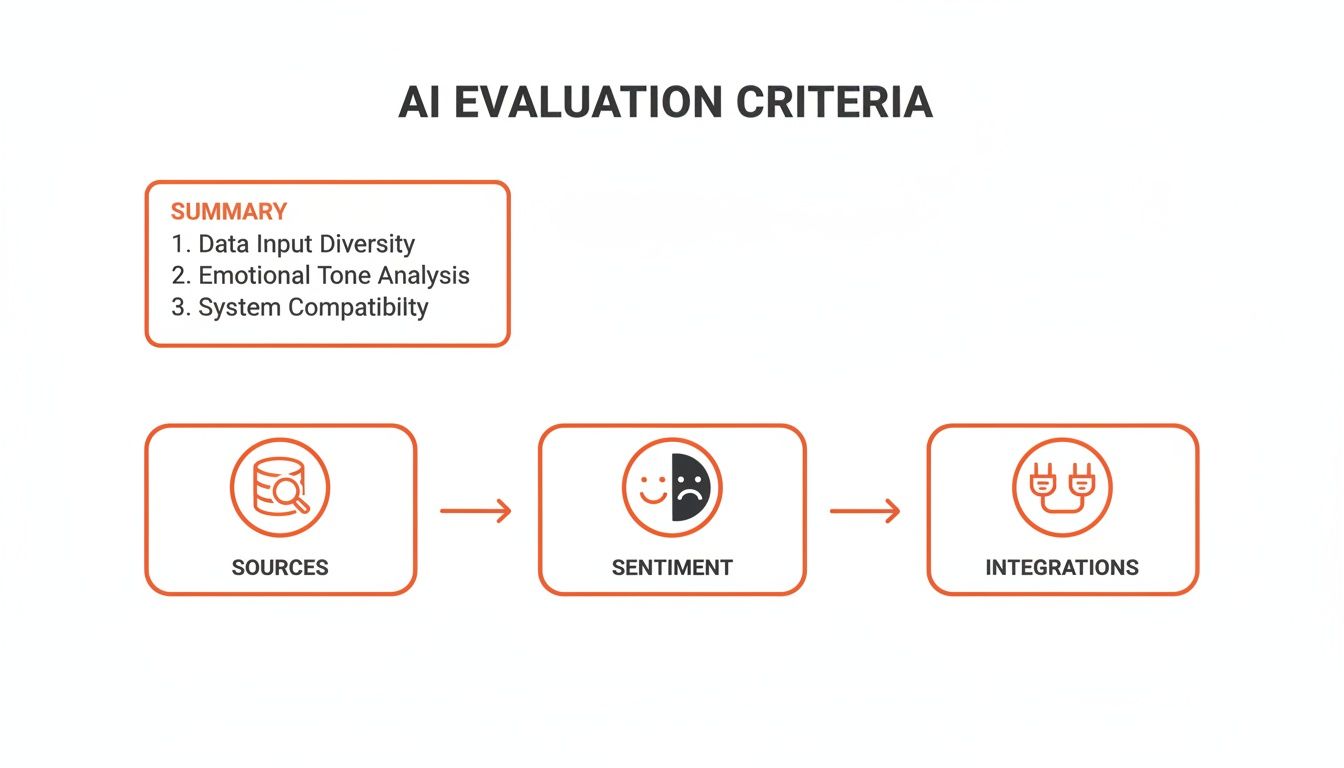
This visual breaks it down perfectly. A powerful tool needs to pull from a wide variety of sources, correctly interpret the sentiment behind those conversations, and integrate smoothly with the other systems you rely on. Mastering these three pillars is what separates a simple monitoring tool from a strategic powerhouse.
At-a-Glance Social Listening Tool Feature Comparison
Before we dive deep, here's a quick overview of the top contenders. This table will give you a high-level look at where each tool shines, especially for SaaS, B2B, and DTC brands that need to keep a close eye on Reddit.
| Tool | Best For | Reddit Monitoring | Key Feature | Starting Price |
|---|---|---|---|---|
| Brandwatch | Enterprise-level consumer research | Excellent | Iris AI-driven insights & historical data | Custom (Enterprise) |
| Sprout Social | Mid-sized teams needing an all-in-one | Good | Integrated publishing & engagement | ~$249/month |
| Talkwalker | Crisis management & brand protection | Excellent | Real-time alerts & visual listening | Custom (Enterprise) |
| Awario | Startups & Reddit-focused growth | Very Good | Lead generation & accessible pricing | ~$39/month |
This snapshot helps frame the conversation, but the real value is in the details. Let's explore what makes each of these platforms tick.
Brandwatch: The Deep Research Powerhouse
When people talk about enterprise-grade consumer intelligence, Brandwatch is often the first name that comes up, and for good reason. Its superpower is its absolutely massive historical data archive, which goes back more than a decade and pulls from over 100 million sites. This makes it an incredible machine for deep-dive research and spotting long-term trends.
Forget just tracking the latest buzz. A B2B marketer could use Brandwatch to sift through years of conversations on niche industry forums. You could map out a competitor's product launch cadence or spot subtle shifts in customer pain points over time. It’s less about real-time chatter and more about strategic foresight.
But the real game-changer for many is Iris AI, its built-in AI analyst that automatically surfaces insights you might otherwise miss.
Practical Example: B2B Competitive Analysis
Imagine you're in the crowded project management SaaS space. With Brandwatch, you could monitor specific subreddits not just for mentions of your competitors, but for broader phrases like "workflow automation pain points" or "collaboration software frustrations." Iris AI then crunches this data to highlight recurring themes—maybe users constantly complain about a rival's clunky UI. That’s not just data; it's an actionable insight you can take to your product team and say, "Our competitor's UI is their biggest weakness; let's double down on making ours the most intuitive on the market."
Brandwatch isn't for quick mention tracking. It's for uncovering the 'why' behind market trends. Its strength is turning a vast ocean of historical data into a predictive tool for strategic planning.
Sprout Social: The All-in-One for Mid-Sized Teams
Sprout Social takes a different path. It bakes social listening directly into a comprehensive social media management platform. The whole idea is efficiency—letting teams monitor conversations, schedule content, and handle engagement from one clean, user-friendly dashboard.
This makes it a fantastic pick for mid-sized DTC brands or B2B companies where one person or a small team wears multiple hats. The workflow is incredibly smooth. You can spot a negative comment through the listening tool and, in two clicks, assign it to a customer service rep as a task without ever leaving the platform.
While it doesn't have the same research depth as Brandwatch, its listening features are more than enough for tracking brand health, checking on campaign performance, and keeping an eye on top-level competitor activity.
Practical Example: DTC Campaign Monitoring
A DTC clothing brand just dropped a new collection. Using Sprout Social, they set up a listening topic to track their campaign hashtag, brand mentions, and keywords tied to the new products. The platform’s sentiment analysis gives them a quick read on public perception. If negative sentiment starts to tick up, they can instantly drill down into the mentions, find the root cause (e.g., "The sizing on the new jeans is way off"), and take actionable steps. This could mean immediately publishing a sizing guide on Instagram and assigning the support team to proactively reach out to customers who have complained.
Talkwalker: The Crisis Management Specialist
Talkwalker is built for speed and vigilance, making it a go-to for brands obsessed with protecting their reputation. It covers a staggering amount of ground—over 30 social networks and 150 million websites—but its killer features are its hyper-responsive alerting system and image recognition tech.
You can set up "Smart Alerts" that ping your team the second there's an unusual spike in negative mentions. More impressively, Talkwalker can spot your brand's logo in images and videos even if your company name isn't in the text. This is a massive advantage for catching potential PR headaches that text-only tools would completely miss.
Practical Example: Reputation Management
Think of a major fast-food chain trying to stay ahead of health and safety concerns. They set up Talkwalker to fire off an immediate alert to their PR team if a cluster of negative posts emerges from a specific city. Even better, they use visual listening to scan for images of their stores or food posted with keywords like "dirty" or "unsafe." This provides an actionable insight, allowing them to immediately contact the specific franchise manager to investigate before a photo goes viral and turns into a national crisis.
Finding the Right Fit for Your Budget and Needs
As this social listening tools comparison shows, there’s an option for just about every business size and objective, but the capabilities and price tags vary wildly. The big players like Brandwatch, Sprinklr, and Talkwalker lead the pack, offering between 21-37 data sources and sophisticated AI for enterprise-level demands. Brandwatch shines with its Iris AI for deep consumer research, while Talkwalker's 37 data sources make it a leader in crisis monitoring. Of course, that kind of power comes with a serious price tag. For a broader look at the market, some guides offer a solid roundup of the 6 best social media monitoring tools.
The pricing spectrum is huge. You can find entry-level tools like Awario starting around $39/month, while mid-market B2B solutions often land in the $5,000-$30,000 per year range. Enterprise platforms? They can easily top $100,000. Then you have flexible models, like pay-as-you-go options, which are perfect for a micro-SaaS founder who just wants to test the waters on Reddit without a huge commitment.
Awario: The Entry Point for Reddit-Driven Growth
For startups and small businesses, the enterprise tools are often overkill. This is where Awario shines. It packs powerful listening features—including fantastic Reddit monitoring—into a package that’s actually affordable. It’s the perfect launchpad for businesses focused on finding product-market fit or generating early leads from online communities.
Unlike the more complex platforms, Awario is refreshingly simple to set up. A founder can quickly create a project to monitor specific subreddits where their target customers are talking about problems their product solves. The "Leads" feature is especially handy, as it proactively hunts for posts where people are asking for recommendations or signaling that they're ready to buy.
Practical Example: Micro-SaaS Lead Generation
The founder of a new developer productivity app needs to find her first users. She sets up Awario to watch subreddits like r/programming and r/webdev. She creates alerts for keywords like "any tool for," "how do you manage," and "recommend a solution for." Within hours, Awario flags a post where a user asks, "Does anyone know a good tool for organizing code snippets?" The founder can then take direct action: jump into that conversation with a genuinely helpful reply and subtly introduce her app. That’s a highly qualified lead, generated without a big marketing budget.
Matching Social Listening Tools to Your Business Model

Let's be honest: the "best" social listening tool doesn't exist. The best one is the one that solves your specific problems. A powerful enterprise platform is total overkill for a startup, but a basic mention tracker will leave a global brand completely in the dark. A smart social listening tools comparison comes down to one thing: translating a tool's features directly into your business goals.
This is your playbook for doing just that. We'll connect specific platform capabilities to the real-world growth challenges that SaaS founders, B2B marketers, and DTC brands face every day. You'll see exactly how these tools stop being an expense and start driving results.
For SaaS Founders Discovering Product-Market Fit
If you're an early-stage SaaS founder, you live and die by user feedback. Your main goal isn't just finding any customer; it's about finding the right customers and understanding their pain so deeply that your product becomes essential. For this, Reddit is the ultimate focus group—an unfiltered stream of honest conversations about software frustrations and feature wish lists.
Your social listening tool needs to be a product development scout. Forget vanity metrics. You need excellent, granular Reddit monitoring that lets you zoom in on the niche subreddits where your ideal users are venting, brainstorming, and seeking advice.
Actionable Use Case: Identifying Feature Gaps
- Objective: Pinpoint the exact features users are begging for in your competitor’s software.
- Tool of Choice: Awario. Its sweet spot is affordable, powerful keyword monitoring with a knack for finding leads in communities like Reddit.
- Implementation: In Awario, set up alerts for your main competitor’s brand name paired with keywords like "wish it had," "missing," "frustrating," or "can't do."
- Example in Action: You're building a new CRM. You monitor r/sales for posts like, "I love HubSpot, but I wish it had a better way to automate follow-up sequences." This isn't just a complaint. It's a direct feature request you can inject into your roadmap to build a real competitive edge.
A SaaS founder doesn't use social listening to track brand health; you use it for raw market research. The mission is to find pain points you can solve, recruit beta testers, and learn the exact language customers use to describe their problems.
For B2B Marketers Generating Qualified Leads
B2B sales cycles are longer and the stakes are much higher. You can't just run a few ads and hope for the best. Here, social listening has to be finely tuned to detect buying signals—clear signs that a person or company is actively searching for a solution you provide.
This requires a tool that can cut through the noise and surface high-intent conversations. You'll need sophisticated Boolean search to build hyper-specific queries and, crucially, real-time alerts so your sales team can jump on an opportunity the moment it appears.
Actionable Use Case: Monitoring for Buying Intent
- Objective: Find professionals in target subreddits who are actively asking for software recommendations or complaining about their current provider.
- Tool of Choice: Brandwatch or a mid-tier tool with a strong query builder. Brandwatch's robust data and AI are brilliant at surfacing nuanced conversations that simpler tools would likely miss.
- Implementation: Create a complex query like
(recommend OR suggestion OR alternative) AND ("project management software" OR "collaboration tool") -[Your Brand Name]. Then, filter these results to only show posts from professional hubs like r/projectmanagement. - Example in Action: Your team gets an alert for a post in r/sysadmin titled, "Our current data backup solution is a nightmare. What are you all using?" This is a five-alarm-fire buying signal. A sales rep can then join the conversation with genuine, helpful advice, subtly positioning your product as the answer to their headache.
For DTC Brands Building Community and Trust
Direct-to-consumer brands run on authenticity and user-generated content (UGC). Your audience doesn't want a hard sell; they want to feel like they're part of something. Your social listening tool should be your eyes and ears on the ground, helping you find true brand advocates and keep a pulse on customer sentiment.
This is where visual listening becomes a massive asset. It can spot your products in photos even when your brand isn't tagged, helping you discover and amplify authentic UGC that’s often far more powerful than your own branded content.
Actionable Use Case: Tracking Sentiment and Finding UGC
- Objective: Monitor brand sentiment right after a product launch and find high-quality, organic customer photos to repurpose in your marketing.
- Tool of Choice: Talkwalker. Its best-in-class image recognition and real-time sentiment alerts make it perfect for protecting your reputation and capitalizing on positive buzz.
- Implementation: Set up alerts for your new product name and any campaign hashtags. At the same time, enable visual listening to scan social media for images containing your product's packaging or logo.
- Example in Action: A skincare brand launches a new vitamin C serum. Talkwalker detects a spike in positive chatter and flags an Instagram post from a micro-influencer showing off their glowing skin after using your product. Your team can immediately reach out, ask for permission to share the photo, and feature it on your product page as powerful, undeniable social proof.
How to Make Your Final Decision
Alright, you've done the hard work of comparing features and seeing which tools fit your business. Now it’s time to move from spreadsheets to real-world tests. This last phase is all about getting your hands dirty with trials and building a rock-solid case for your chosen tool.
The best way to do this? Free trials. But don't just sign up and click around aimlessly. You need a plan. Treat the trial period like a focused sprint with one goal: proving this tool can actually deliver the insights you need to grow.
Running an Effective Trial
A good trial isn't about testing every bell and whistle. It’s about stress-testing the features that directly solve your problems. I recommend creating a simple checklist to keep you on track.
- Set Up Smart Queries: Go deeper than just your brand name. Track your top two competitors, a major customer pain point in your industry, and a niche subreddit where your audience hangs out (like
r/b2bif you're in B2B tech). - Check Sentiment Accuracy: Find a few posts dripping with sarcasm or industry-specific slang. For example, search for "[Competitor's name] sucks" versus "I miss when [Competitor's name] didn't suck." Does the tool correctly identify the negative sentiment in both?
- Test the Real-World Workflow: How easy is it to pull a report for your boss or share an important mention with the sales team? Can you tag conversations or assign them for follow-up without a headache?
This focused approach helps you judge the tool based on your day-to-day needs, not just what the marketing site promises.
Preparing for the Sales Demo
The sales demo is your opportunity to dig for answers you won’t find online. Don't let them drive; you should be in the driver's seat. Show up with specific, pointed questions tied directly to your use case.
A great sales demo is a conversation, not a presentation. You're there to confirm the tool solves your unique challenges, not to sit through a generic feature tour. Make them show you exactly how it addresses your specific pain points.
This is critical in such a packed market. North America currently leads the social media monitoring space, accounting for over 39.9% of global revenue in 2024. This fierce competition, fueled by the explosive growth of platforms like Reddit and TikTok, means providers are all fighting for an edge. Push them on what truly makes their platform different. You can discover more insights about the social listening market from Grand View Research.
Building Your Business Case and Getting Started
Once you've made your pick, the final step is getting the sign-off from your team. To do that, you have to connect the dots between the tool and real business outcomes. I suggest putting together a simple one-page business case that lays it all out.
- The Problem: "We're blind to competitor conversations on Reddit, which means we're missing out on potential leads."
- The Solution: "Tool X will let us monitor three key subreddits for buying signals and send real-time alerts to our sales team."
- The Expected ROI: "If we land just two new enterprise clients per quarter from these leads, the tool will deliver a 10x return."
Framing the investment this way makes it a no-brainer. If you need more help with this, our guide on measuring return on marketing investment breaks it down further.
As soon as you get the green light, get your initial dashboards set up to track brand health, competitor activity, and key industry trends. This final step in your social listening tools comparison ensures you not only picked the right software but are ready to start delivering measurable results from day one.
A Few Lingering Questions
Diving into the world of social listening tools can definitely bring up a few questions. To wrap up our comparison guide, let's tackle some of the most common ones I hear from clients. My goal here is to give you straight, practical answers so you can feel confident in your decision.
What’s the Real Difference Between Social Listening and Social Monitoring?
It's easy to use these terms interchangeably, but they're really two sides of the same coin, representing very different mindsets.
Social monitoring is reactive. It's all about catching and responding to direct mentions of your brand, specific hashtags, or customer service inquiries. Think of it as your digital customer service desk—managing the conversations that are already happening at you.
Social listening, on the other hand, is proactive and strategic. You’re not just looking at your own brand; you're zooming out to understand the entire conversation landscape. This means analyzing trends in your industry, tracking what your competitors are doing, and identifying unspoken customer pain points before they become support tickets.
In short, monitoring is about managing your brand's current conversations. Listening is about discovering the opportunities hidden within the conversations happening all around you.
How Can I Actually Measure the ROI of a Social Listening Tool?
This is the big one. To get a real measure of return on investment, you have to connect the tool's output to tangible business goals. Vague metrics like "engagement" won't cut it when you're talking to your CFO.
Here’s how to do it right:
- For Lead Generation: Track how many qualified leads came directly from conversations you spotted with the tool. For example, create a specific UTM link for your sales reps to use when they reply to leads found on Reddit. This lets you track conversions directly in your analytics platform.
- For Brand Health: Don't just track mentions. Measure the shift in your brand's sentiment score over a specific period, or see if your share of voice has grown against your top 3 competitors.
- For Customer Service: Look for a real drop in your average response time. You can also measure if customer satisfaction scores (CSAT) have improved since you started proactively addressing issues found through listening.
The bottom line: A good ROI calculation isn't about counting mentions. It's about proving how those conversations led to a specific, positive business outcome—fewer support tickets, more demo requests, or a better product roadmap.
Are Free Social Listening Tools Good Enough to Get Started?
Honestly, it depends on what "get started" means to you. Free tools like Google Alerts are fine for basic keyword tracking if you have absolutely no budget. They’ll tell you when your brand is mentioned, and that’s about it.
But they have serious limitations. You won't get any meaningful sentiment analysis, no deep demographic data, and certainly no comprehensive Reddit coverage. The insights are shallow, and you'll spend more time sifting through noise than finding anything useful.
For a solo founder who just wants to see if their name pops up online, a free tool is a start. But any business that genuinely wants to use social data to find leads, understand customers, and outsmart competitors will outgrow a free tool in a matter of weeks. You'll need to invest in a real platform to get real, actionable intelligence.
Ready to stop guessing and start winning on Reddit? Reddit Agency helps you tap into authentic conversations to generate measurable traffic, qualified leads, and loyal customers. Book a call with us today and see how we turn Reddit into your most powerful growth channel.
