Modern User Acquisition Strategies for Mobile Apps
When it comes to getting users for your mobile app, you need a mix of strategies—some you earn, some you pay for, and some you build through community. A winning game plan isn't about chasing the highest download numbers. It’s about building a balanced approach that combines the slow-burn success of long-term organic growth with the immediate impact of scalable paid campaigns.
Your Modern Mobile App Acquisition Playbook
Let's be honest: the app market is incredibly crowded. The old tactic of just throwing money at ads to get as many downloads as possible is a recipe for failure. Winning today means acquiring the right users—the ones who will actually stick around, use your app, and ultimately drive your business forward.
This guide is your playbook for building that kind of sustainable growth. We'll skip the vanity metrics and dive straight into the strategies you need to master.
The Three Pillars of Sustainable Growth
A truly effective acquisition engine never puts all its eggs in one basket. Instead, it weaves together several different efforts that feed into each other, creating a powerful growth loop that gets stronger over time.
- Organic Foundation: Think of this as the bedrock of your entire strategy. It includes things like App Store Optimization (ASO) to make sure you show up when people search, and content marketing to pull users in before they even hit the app store.
- Paid Acceleration: Once your foundation is solid, paid channels are the fuel you pour on the fire. Ads on platforms like Meta, Google, or TikTok let you scale up quickly and predictably, putting your app in front of very specific audiences.
- Community-Led Growth: This is where you get personal. It’s about engaging with niche groups on platforms like Reddit, building real trust, and attracting die-hard fans who are actively searching for what you offer.
At the end of the day, a huge part of a modern acquisition playbook is constantly figuring out how to reduce customer acquisition cost. This isn't just about spending less; it's about focusing on channels that bring in profitable users who will be with you for the long haul.
The opportunity here is massive, but so is the competition. In 2025, the world saw a mind-boggling 300 billion app downloads. But that growth is starting to slow down, which tells us the market is getting saturated. This shift makes smart, quality-focused strategies more important than ever. You can find more mobile app usage statistics on appinventiv.com.
Ultimately, you can't afford to ignore any of these pillars. Relying only on paid ads gets expensive fast and isn't sustainable. On the other hand, relying only on organic growth can be painfully slow. By blending all three, you build a resilient acquisition machine that drives consistent, high-quality growth.
Key User Acquisition Pillars at a Glance
To make this crystal clear, here’s a simple breakdown of how these core strategies fit together. Think of this as your cheat sheet for deciding where to focus your energy based on your goals.
| Strategy Pillar | Primary Goal | Best For | Key Channels |
|---|---|---|---|
| Organic Foundation | Build long-term, compounding growth and brand authority. | Establishing a sustainable baseline of high-intent users. | ASO, SEO, Content Marketing (Blogs, Video) |
| Paid Acceleration | Drive immediate, scalable, and predictable user volume. | Rapidly testing audiences, scaling quickly, and targeting specific demographics. | Meta Ads, Google Ads, TikTok Ads, Apple Search Ads |
| Community-Led Growth | Cultivate authentic advocacy and attract passionate early adopters. | Niche apps, building a strong brand identity, and getting direct user feedback. | Reddit, Discord, Slack, Online Forums, Influencers |
Each pillar serves a distinct purpose, but their real power is unlocked when they work in concert to create a robust and diversified acquisition funnel.
Building Your Organic Growth Engine
Before you even think about dropping a dollar on paid ads, you need to build a solid foundation that brings users to you for free. This is your organic growth engine—a system that works 24/7 to attract people who are actively looking for an app like yours.
Think of it this way: paid ads are like handing out flyers on a street corner, but organic growth is like setting up a killer storefront on the busiest street in town. You want to make it so visible and inviting that people can't help but walk in.
The heart and soul of this engine is App Store Optimization (ASO). It's basically SEO, but for the Apple App Store and Google Play. When you consider that a whopping 65-75% of all app installs come directly from people searching inside these stores, you realize that ASO isn't just a "nice to have"—it's the absolute bedrock of getting discovered. Good ASO turns your app page from a simple product listing into a high-performance conversion machine.
Optimizing Your Digital Storefront with ASO
Great ASO is a mix of art and science. It’s part technical optimization to get the algorithms to notice you, and part persuasive marketing to convince a real person to tap "Install."
It all starts with deep keyword research. You have to get inside your ideal user’s head and figure out the exact words they're typing into that search bar.
- Brainstorm Seed Keywords: Start with the obvious. If you have a meditation app, you’re thinking "meditation," "mindfulness," or "stress relief."
- Analyze Competitors: See what your top competitors are ranking for. Tools like Sensor Tower or App Annie are goldmines for this kind of intel.
- Identify Long-Tail Keywords: Go after the more specific, less crowded phrases. Think "guided meditation for sleep" or "5-minute mindfulness exercises." The search volume is lower, but the user's intent is crystal clear, making them much more likely to convert.
Once you’ve got your keywords, it’s all about strategic placement.
The app title and subtitle are the heavyweight champions of ASO. Putting your most important keyword here is the clearest signal you can send to the store’s algorithm about what your app does. It directly impacts where you show up in search.
Actionable Example: Imagine you have a photo editing app. A generic title like "PicPerfect" is forgettable. But "PicPerfect: AI Photo Editor & Collage Maker" instantly targets high-intent keywords and tells the user exactly what they're getting, increasing the chances of both discovery and download.
Creating Visuals That Drive Downloads
Keywords get you found, but your visuals close the deal. Your icon, screenshots, and preview video are your chance to make a killer first impression, and you only get a few seconds.
Your app icon is the first thing people see. It needs to be simple, bold, and easy to remember. Skip the text and focus on a clean design that communicates what your brand is all about.
Your screenshots shouldn't be random screen grabs. They need to tell a story. Use them to walk users through your app's best features and benefits. Add short, punchy text overlays on each image. A fitness app, for instance, could have a series of screenshots with captions like "Personalized Workout Plans," "Track Your Progress," and "Join Community Challenges."
Expanding Beyond the App Store with Content
A truly powerful organic engine doesn’t just live inside the app stores. Content marketing helps you find future users before they even start searching for an app. By creating genuinely helpful content, you build trust and open up completely new ways for people to discover you.
Think about the problems your app solves, then create content around those solutions.
- A budgeting app could run a blog with articles like "How to Save for a Down Payment" or "Tricks for Slashing Your Monthly Subscriptions."
- A photo-editing app could create YouTube tutorials on "Taking Better Sunset Photos with Your Phone."
- A language-learning app could publish guides on "Common Phrases You Actually Need for Traveling in Spain."
This strategy positions you as an expert, not just another app begging for a download. When someone finds your helpful article through a Google search, you can naturally guide them to your app as the tool that solves their problem. It's a fundamental part of learning how to increase organic traffic from all angles.
When you build this organic foundation first, you create a durable, cost-effective machine for acquiring users that only gets stronger over time.
Scaling Growth with Paid User Acquisition
Once you've built a solid organic foundation that brings in a steady trickle of users, it's time to open the floodgates. Paid user acquisition is the rocket fuel for your mobile app, giving you a predictable and scalable way to reach very specific audiences and kickstart rapid growth.
Think of it this way: your organic strategy is like building a fantastic neighborhood restaurant that slowly builds a following through word-of-mouth. Paid acquisition is like buying billboards on every major highway leading into town, directing thousands of hungry customers straight to your door. It's an incredibly powerful tool, but you need a smart budget and a clear plan to avoid just burning cash.
The world of paid UA can seem complicated, but it all comes down to a simple idea: paying to put your app in front of the right people, at the right moment. This is where you stop hoping users find you and start actively hunting them down.

Choosing Your Paid Acquisition Channels
Not all ad platforms are created equal. The real key to success is figuring out where your ideal users actually spend their time online. For most apps, the decision comes down to three titans of the paid acquisition world, each with its own unique strengths.
- Meta Ads (Facebook & Instagram): Nothing beats Meta for its incredibly deep demographic and interest-based targeting. If your app caters to a specific lifestyle or hobby—say, a vegan recipe app or a marketplace for vintage clothes—Meta's granular targeting can be a goldmine.
- Google App Campaigns: This is the absolute powerhouse for capturing user intent. Google puts its entire network to work for you—Search, Google Play, YouTube, and the Display Network—to find people who are already looking for an app just like yours. It’s pretty much an essential channel for any app.
- TikTok Ads: If you're going after younger demographics like Gen Z and Millennials, this is your playground. TikTok is all about visually driven, entertaining content. If your app has a strong creative element, like a video editor or a gamified language app, its short-form video format is the perfect fit.
The amount of money flowing into this space is staggering. Global user acquisition spend hit a massive $78 billion in 2025, which was a 13% jump from the year before. Digging into the numbers, we see that iOS paid installs shot up in Western markets while Android's growth stayed flat, which shows you exactly where the big budgets are going. You can get a deeper look at these trends in mobile app marketing from AppsFlyer.
Designing Ad Creative That Converts
Your ad creative has one job: stop a user from scrolling. That’s it. Whether it's a static image or a quick video, you have a split second to grab their attention and show them why they should care.
A huge shortcut here is to see what's already working for your competitors. Using the best Facebook Ads spy tools to analyze winning ad creatives can save you a ton of time and money by showing you what resonates with your target audience.
Actionable Insight: A common mistake is focusing your ad creative on features instead of outcomes. For a fitness app, don't just show a screenshot of your calorie tracker. Show a short, energetic video of someone successfully completing a workout, looking tired but proud. Sell the feeling of accomplishment, not the tool that gets them there.
Tracking the Metrics That Actually Matter
Jumping into paid acquisition without proper tracking is like flying blind. It's way too easy to get distracted by "vanity metrics" like impressions or even the total number of installs. Real, profitable growth comes down to one thing: understanding your unit economics.
To do that, you need to obsess over these three metrics:
- Cost Per Install (CPI): This is the baseline. It tells you exactly how much you're paying for every single user who installs your app from an ad. Simple.
- Cost Per Action (CPA): This is where things get interesting. Instead of just tracking the install, you measure the cost to get a user to do something valuable after installing—like finishing the tutorial, starting a free trial, or making their first purchase.
- Return On Ad Spend (ROAS): This is the ultimate report card for your ad campaigns. It calculates how much revenue you earn for every single dollar you spend on ads. If your ROAS is above 100%, you're profitable.
Focusing on CPA and ROAS is what separates the apps that scale successfully from the ones that just burn through venture capital. It forces you to shift your mindset from just buying installs to acquiring high-value users who will actually contribute to your bottom line. That's how you build a paid acquisition strategy that's not just powerful, but sustainable.
Unlocking Niche Audiences on Reddit
What if you stopped shouting at potential users with ads and started joining their conversations instead? That's the heart of community-led growth. It's a user acquisition strategy built on authenticity, not interruption. While a paid ad blasts a message to a wide audience, genuine community engagement whispers a helpful solution directly to the people who need it most.
And there's no better place for this than Reddit. With over 430 million monthly active users scattered across more than 100,000 active communities (called subreddits), it's a goldmine. Think of it as a massive network of super-specific forums where your ideal customers are already hanging out, talking about their exact problems and needs. Tapping into these conversations is like getting a direct line to your best user personas.
Finding Your App's Home on Reddit
First things first: you have to find where your people are. This means going beyond the obvious and really thinking about the problems your app solves from a user's point of view. The goal is to discover communities where your app feels like the natural answer to a conversation that's already happening.
Start by brainstorming keywords around your app's main function, its benefits, and the pain points it addresses. Then, use Reddit's own search bar to start exploring.
- Got a productivity app? Don't just camp out in r/productivity. Check out niche spots like r/getdisciplined, r/ADHD, or r/solopreneur, where people are actively hunting for tools to improve their focus.
- Built a photo-editing app? Skip the generic r/photography and dive deeper. Communities like r/itookapicture, r/postprocessing, and even device-specific groups like r/iPhoneography are filled with passionate users looking to level up their photos.
- Have a fitness app? Instead of the massive r/fitness, get specific. Look at subreddits focused on goals, like r/bodyweightfitness, r/C25K (for the Couch to 5K program), or the women's community at r/xxfitness.
Your mission is to build a list of 10-15 promising subreddits. For each one, lurk for a bit. Check its activity, read the rules (especially on self-promotion!), and get a feel for the vibe to make sure it’s the right fit.
The Art of Engaging Without Selling
Redditors have a finely tuned radar for traditional marketing. If you show up with a sales pitch, you'll get downvoted into oblivion or booted by the moderators. Success on Reddit is all about earning trust by providing real value. You have to give way more than you take.
The golden rule of Reddit marketing is to become a valued member of the community first and a marketer second. Your primary goal should be to help, educate, and contribute. User acquisition is the natural byproduct of building that credibility.
This means your strategy should be about 90% contribution and only 10% promotion. Before you even think about mentioning your app, plan to spend weeks—or even months—just being a helpful, authentic member.
- Answer Questions: Find threads where people are asking for advice that you (and your app) can solve. Give them a thoughtful, detailed answer without ever mentioning your product.
- Share Valuable Content: Create things that the community will genuinely appreciate. This could be a handy template, a helpful guide, a quick tutorial, or a unique insight related to their interests.
- Participate in Discussions: Be part of the conversation! Upvote good posts, leave insightful comments, and become a familiar, trusted username.
This slow-burn approach builds social proof and establishes you as an expert. When the time comes to finally talk about your app, you'll be speaking to an audience that already trusts you.
From Contribution to Conversion
Once you've put in the time and built up some credibility, you can start to carefully introduce your app. The key is to frame it as a solution to a problem, not as a product for sale. This works best when you wrap it in a personal story.
Actionable Example: A Meal-Planning App
Let's say you've been active in r/MealPrepSunday for a month, sharing recipes and tips. You could post something titled, "After years of chaotic grocery runs, I finally built a system to plan a week of healthy meals in 20 minutes. Here it is."
In the post, you share your actual process and maybe a free Google Sheets template. You deliver pure value upfront. Then, at the end, add a soft call-to-action: "P.S. I got tired of the spreadsheet and built this process into a simple app to make it even faster. Happy to share a link if anyone's interested."
This strategy delivers immediate value, builds goodwill, and creates a natural "pull" from users who are genuinely interested. You'll get a stream of high-quality installs from people who are already sold on your solution. And for those who want to add a paid boost, learning how to advertise on Reddit can be a great way to amplify these organic efforts by targeting those same niche communities.
Turn Your Users Into a Marketing Team
Some of the most powerful ways to get new users have nothing to do with ad spend or fancy algorithms. Think about it: the most convincing recommendation you ever get is usually from a trusted friend or a creator you genuinely follow. When you can bottle that kind of word-of-mouth and scale it up, you effectively turn your happiest users into a volunteer marketing force.
This is where two channels really shine: influencer marketing and in-app referral programs. When you get them right, they create a self-sustaining loop where one great user brings in another, and another, and another. Your acquisition costs plummet, and your growth starts to compound.
Partner with Micro-Influencers for Real Reach
Forget about paying a celebrity millions for a single, staged post. The real magic in influencer marketing today is with micro-influencers. These are creators with smaller, but hyper-engaged, audiences—usually somewhere in the 10,000 to 100,000 follower range. A recommendation from them feels less like a billboard and more like a genuine tip from a friend who’s an expert on the topic.
The data backs this up. Micro-influencers consistently deliver way higher engagement rates than their mega-famous counterparts. Their followers actually trust their niche expertise, so when they recommend something, people listen. Imagine you have a new calisthenics app. You could partner with five dedicated calisthenics micro-influencers for the same price as one generic fitness celebrity and almost certainly see better, more qualified sign-ups.
Finding the right people to work with comes down to authenticity and alignment.
- Audience Fit: Is their audience a dead ringer for your ideal customer? Don't just look at demographics; look at psychographics and interests.
- Engagement Metrics: Ignore the follower count for a second. Are people actually commenting, asking questions, and sharing their posts? That’s the real gold.
- Brand Alignment: Does their vibe match yours? If your app is fun and quirky, a super-serious, academic-style creator isn't the right fit.
The best influencer partnerships feel like true collaborations, not just transactions. It's smart to structure deals with a mix of a flat fee and performance incentives, like a commission for every install. This gets everyone's skin in the game and focused on driving actual results.
Build a Referral Program That People Actually Use
A well-oiled in-app referral program can be one of the most cost-effective growth engines you'll ever build. The idea is simple: give your current users a reward for bringing their friends on board. The execution, however, is all about nailing the psychology of incentives.
The textbook example here is Dropbox. Early on, they offered free storage to users for every friend they referred who actually signed up. Crucially, the friend got a bonus chunk of storage, too. This two-sided incentive was genius. It completely removed the awkwardness of asking for a favor; instead, you felt like you were giving your friend a gift.
To build a referral loop that catches fire, you need three core components:
- A Compelling Incentive: The reward has to be something people actually want. For a productivity app, this could be a discount or premium features. For a mobile game, maybe it's an exclusive character skin or in-game currency.
- Effortless Sharing: Make it dead simple for someone to find and share their unique referral link. One or two taps, max. It should integrate directly with the phone's native share sheet (iMessage, WhatsApp, etc.).
- Clear Visibility: Don't bury the program in a settings menu nobody ever visits. Prompt users to refer friends right after they've had a great experience, like when they complete a level or finish a key task.
How to Measure Your Acquisition Funnel
Trying to run a user acquisition campaign without data is like driving blindfolded. You might be moving, but you have no idea if you're headed for a cliff. To get real, sustainable growth, you have to measure every single step of a user's journey—from the first time they see your ad to how often they come back.
This whole process is about turning guesswork into a clear, actionable roadmap.
Think of your acquisition funnel like a series of gates. Your job is to guide as many high-quality users as possible through each gate, plugging any leaks where people drop off. By tracking the right metrics at each stage, you can spot those leaks instantly and fix them before they drain your entire budget.
Key Funnel Metrics You Must Track
To get started, map out your user's journey and attach a key performance indicator (KPI) to each step. This gives you a powerful diagnostic toolkit for your app's health.
Here are the essentials:
- Click-Through Rate (CTR): This is simple—what percentage of people who see your ad actually click on it? A low CTR is a huge red flag that your creative or targeting is missing the mark.
- Install Rate (IR): Of all the people who landed on your app store page, how many hit "Install"? If your CTR is great but your IR is in the gutter, you've likely got an App Store Optimization problem. Your icon, screenshots, or description just aren't sealing the deal.
- Activation Rate: This tracks the percentage of new users who complete a crucial first action, like creating an account or finishing the tutorial. A low activation rate tells you the first-time user experience is probably confusing or frustrating.
- Retention Rate: Measured at key intervals like Day 1, Day 7, and Day 30, this shows you who's sticking around. Poor retention is the ultimate sign that your app isn't delivering on its promise.
The real magic happens when you connect these dots. For instance, a high install rate paired with a terrible activation rate means your marketing is writing checks your app can't cash. People are buying the promise, but the reality is letting them down.
The Power of A/B Testing and AI
Once you've found a bottleneck in your funnel, the way to fix it is through methodical testing. A/B testing is just a fancy term for showing two different versions of something—an ad, a screenshot, a button color—to different groups of users to see which one works better. It's a systematic way to make small improvements that add up to huge wins over time.
Word-of-mouth is a classic example of a channel that feels hard to measure, but with the right setup, you can track it.
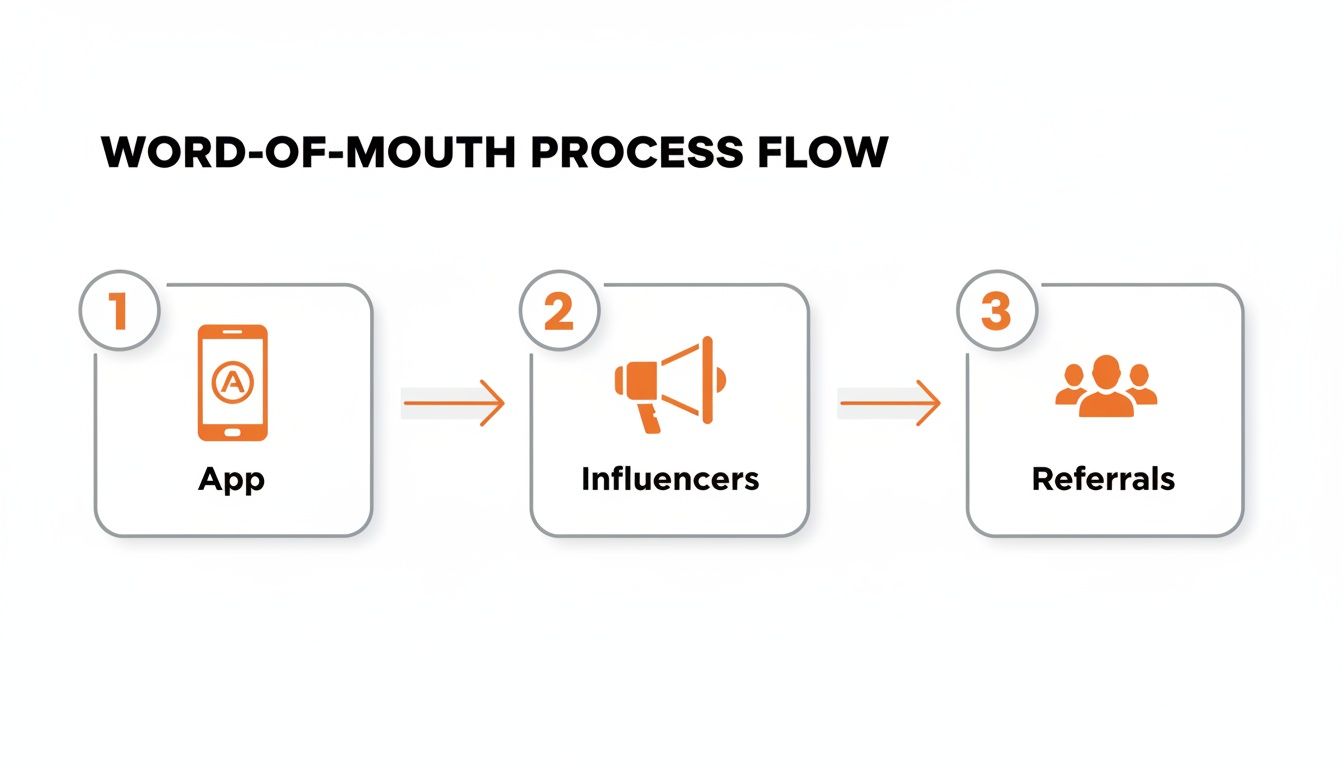
This shows how you can turn influencers and referral programs into a measurable growth loop, transforming passive users into active promoters of your app.
Today, AI is throwing gasoline on this fire. AI-driven acquisition strategies have helped some apps achieve 143% higher user growth than older methods. By crunching hundreds of real-time data points, these platforms can predict a user's Lifetime Value (LTV) and automatically find more people just like them, optimizing your campaigns for long-term profit. You can find more on how AI is shaping UA on zoomd.com.
By focusing on the entire funnel, you shift from simply buying installs to investing in users. This holistic view is the key to building a profitable and sustainable growth engine for your mobile app.
At the end of the day, every metric tells a story about your users and their experience with your app. Listening to that data is the most reliable way to build something people don't just download, but genuinely love to use. For a deeper look at the financial side, check out our guide on how to measure marketing ROI.
Frequently Asked Questions
Jumping into user acquisition for your mobile app can bring up a ton of questions. Let's tackle some of the most common ones that pop up for founders and marketers.
How Much Should I Budget for User Acquisition?
There's no one-size-fits-all answer here, but we can get pretty close with a simple rule: your user acquisition cost has to be less than what a user is worth to you. The key is understanding your app’s Lifetime Value (LTV). If you don't know that number yet, your first job is to figure it out.
When you're just starting out, think small and smart. A test budget of $500 to $2,000 a month is a great starting point. The goal isn't to get thousands of users overnight; it's to learn. You're spending that money on data—finding out which channels work and which don't.
Don't forget, your budget isn't just for ads. Time is a currency, too. Pouring your efforts into organic user acquisition strategies for mobile apps, like ASO and getting active on Reddit, can deliver incredible results without a hefty price tag.
Which User Acquisition Channel Is Best for a New App?
Don't put all your eggs in one basket. The smartest move for a new app is to build a solid organic foundation while running a small, focused paid experiment to get data fast.
Here’s a simple, effective game plan:
- Start with App Store Optimization (ASO) on day one. Seriously. This is your app's digital storefront, and optimizing your title, keywords, and screenshots is the most fundamental thing you can do for long-term, free discovery.
- Find your tribe in 2-3 niche communities. Where do your ideal users hang out online? Find those subreddits or forums. Don't just spam your link—show up, be helpful, and get real feedback. This is how you get your first handful of die-hard fans.
- Run a small, targeted paid test. Once you've got a little momentum, put a small budget behind a platform like Meta or Google. The goal isn't to scale; it's to see if you can buy users profitably and learn who responds to your message.
How Quickly Will I See Results from My UA Efforts?
This really comes down to the channels you're using. Paid ads are the sprinters—they can get you a wave of installs within hours. But figuring out if those users are actually profitable (your Return On Ad Spend, or ROAS) can take weeks, or even months, of tracking their behavior.
Organic channels are the marathon runners. Things like ASO and content marketing are all about slow, steady compounding growth. You should start seeing a real, consistent stream of organic traffic after three to six months of dedicated effort.
Community marketing, especially on places like Reddit, often hits a sweet spot in the middle. If you’re genuinely adding value to the conversation, you can see your first high-quality users trickling in within a few weeks.
Ready to unlock high-intent users from the world's largest collection of communities? Reddit Agency helps brands win on Reddit with authentic organic and paid growth strategies. We turn conversations into measurable traffic, leads, and loyal customers. Learn how we can build your Reddit acquisition engine.
