What Is Native Advertising A Guide to Blending In
Ever seen an ad that didn't feel like an ad? That’s the magic of native advertising.
At its heart, native advertising is paid media designed to match the look, feel, and function of the platform it appears on. It doesn't shout for attention; it earns it by blending in seamlessly with the surrounding content, adding value instead of interrupting your flow.
Think of it like a sponsored article on your favorite news site that’s so interesting, you actually want to click and read it. Or a promoted post in your social feed from a brand that teaches you something useful, making you forget it's an ad.
What Is Native Advertising Really?

Imagine you're at a dinner party. A great native ad is like a guest who tells a fascinating story that captivates everyone. In contrast, a traditional banner ad is like someone barging in halfway through the meal to sell you a vacuum cleaner. One enriches the experience; the other shatters it.
That simple analogy gets right to the core of native advertising. It’s a strategic approach where ads are crafted to feel like a natural part of the user's journey, not a jarring detour.
Blending In to Stand Out
The guiding principle is simple: add value, don't interrupt. Instead of forcing a message on people, native ads offer something genuinely useful, entertaining, or interesting that aligns with what the user is already doing.
This non-disruptive quality is why people actually prefer them. Native ads cleverly sidestep "banner blindness"—our built-in ability to ignore anything that looks like a traditional ad—because they appear as organic, trustworthy content.
Here are a few classic examples:
- Sponsored Articles: An in-depth article on a tech blog about "5 Productivity Hacks for Remote Teams," paid for by a project management software company.
- In-Feed Social Posts: A promoted post on Instagram from a travel brand showcasing a breathtaking destination, styled to look just like a post from a friend you follow.
- Promoted Listings: A sponsored product at the top of an Amazon search for "running shoes" that matches the format of all the other organic results.
This seamless integration is why native advertising has exploded in popularity. The global market was recently valued between USD 103.2 billion and USD 111.13 billion, making up a massive 20-25% of the entire global advertising market. North America alone accounts for over 31% of that share. You can dig deeper into these native advertising market trends on market.us.
Native Ads vs. Other Marketing Channels
To really get what makes native advertising unique, it helps to see how it stacks up against other common strategies. While it borrows elements from both traditional ads and content marketing, its purpose and execution are completely different.
It all boils down to the user experience. Where display ads interrupt, and content marketing requires users to come to you, native advertising meets them where they are. It places valuable content directly in their path on the platforms they already use and trust.
Native advertising works because it prioritizes the user experience. By respecting the context of the platform and the intent of the user, it builds trust and drives engagement in a way that disruptive ads simply cannot.
To make this crystal clear, let's compare these three approaches side-by-side.
Native Advertising vs. Traditional Ads vs. Content Marketing
This table breaks down the core differences in how each one works, what it aims to do, and how your audience experiences it.
| Attribute | Native Advertising | Traditional Display Ads | Content Marketing (Owned) |
|---|---|---|---|
| User Experience | Non-disruptive; integrated into the user's content feed or experience. | Interruptive; clearly separate from the platform's core content. | Destination-focused; users must visit a brand's own channels (e.g., blog). |
| Format | Matches the form and function of the host platform (e.g., sponsored article, in-feed post). | Standardized units like banners, pop-ups, and skyscrapers. | Varies, but lives on owned media (e.g., blog posts, ebooks, videos). |
| Primary Goal | Engagement, brand awareness, and building trust by providing value. | Direct response, immediate clicks, and generating impressions. | Building long-term audience relationships and establishing authority. |
As you can see, each has its place, but native advertising fills a crucial gap—delivering brand-funded value on someone else's turf without alienating the audience.
The Six Core Types of Native Ads
Native advertising isn't just one thing; it's a whole family of ad formats that share a common goal: to fit in. To really get a handle on what is native advertising, you have to see it in its natural habitats. The Interactive Advertising Bureau (IAB) has broken it down into six core types, each one designed to slide seamlessly into a specific user experience.
Think of these formats like different kinds of camouflage. An animal's coat is designed to blend into its specific surroundings—a jungle, a desert, the arctic. In the same way, each native ad type is built to match its digital environment, making it feel like a natural part of the scenery, whether that’s a social feed, a news site, or a search results page.
1 In-Feed Units
This is the one you’ve definitely seen. In-feed units are the promoted or sponsored posts that show up right in your content feeds on platforms like Reddit, Facebook, X (formerly Twitter), or LinkedIn.
They’re designed to look and feel just like the organic posts around them, using the same layout, headlines, and images. The only giveaway is a small disclosure tag, like "Promoted" or "Sponsored."
- Practical Example: A SaaS company writes a genuinely useful article about new industry trends. They then pay to promote that post on LinkedIn, so it appears in the feeds of professionals who fit their target audience. The ad looks and acts just like any other shared article, inviting clicks and comments naturally.
- Best For: Building top-of-funnel awareness, getting eyes on your content, and starting conversations with a specific community or professional network.
2 Paid Search Units
These are the ads you see perched at the very top of a search engine results page (SERP) on Google or Bing. While they're clearly marked as ads, they are native because they perfectly mimic the format of the organic search results below them.
A user is actively searching for something, and these ads present a relevant solution right where they’re already looking. They don't interrupt the experience; they add to it.
Key Insight: Paid search is one of the most effective forms of native advertising because it taps directly into user intent. The ad provides a helpful answer at the exact moment someone is asking a question, which feels useful, not intrusive.
3 Recommendation Widgets
Ever get to the bottom of an article and see a section titled "You Might Also Like" or "From Around the Web"? That's a recommendation widget, another major type of native advertising.
These widgets are typically powered by content discovery platforms like Outbrain or Taboola and are used to promote sponsored articles on other publishers' websites. They feel native because they’re presented as editorial suggestions for further reading, fitting right into the flow of content consumption.
- Practical Example: A direct-to-consumer brand selling eco-friendly cleaning products sponsors an article titled "10 Simple Swaps for a Greener Home." This article is then promoted through recommendation widgets on lifestyle and home decor blogs, reaching people who are already reading about that exact topic.
- Best For: Driving traffic to your blog or editorial content and finding new audiences on third-party publisher sites.
4 Promoted Listings
You'll find promoted listings all over e-commerce and marketplace sites like Amazon, Etsy, and eBay. These ads place products directly within search results or category pages, styled to look identical to the organic product listings.
This allows a seller to pay for a prime spot, making sure their product is seen by shoppers who are ready to buy. A good promoted listing doesn't even feel like an ad—it feels like a helpful product suggestion.
- Practical Example: You search for "noise-canceling headphones" on an electronics site. The first three results, which look identical to all the others but have a small "Sponsored" tag, are promoted listings from brands who paid to appear at the top.
- Best For: Driving immediate sales and conversions for e-commerce products by targeting users with high purchase intent.
5 In-Ad with Native Elements
This format is a bit of a hybrid. It uses a standard ad container, like a banner, that sits outside the main content feed. However, the ad inside that container is contextually relevant to the page you're on.
For instance, an ad for a new grilling cookbook might appear right next to an article about the best BBQ recipes.
6 Custom and Branded Content
This is probably the deepest and most integrated form of native advertising. It covers everything from sponsored articles and branded videos to entire content hubs co-created by a brand and a publisher. The goal here isn't just to blend in, but to create something so good that it stands on its own as valuable editorial content.
A classic example is The New York Times' T Brand Studio, which produces incredible long-form articles and interactive experiences for brands. This content lives on the publisher's site and provides real value to readers. But creating great content is only half the battle; knowing the right content distribution strategies is what ensures it actually gets seen and makes an impact.
Why Your Audience Actually Prefers Native Ads
The explosion of native advertising isn't some happy accident for marketers. It's a direct answer to how we, as humans, have learned to navigate the internet. For years, we’ve been hit with a constant barrage of loud, flashy, and frankly, annoying ads. So, we adapted. We learned to ignore them.
This adaptation has a name: banner blindness. It’s that subconscious skill we've all developed to mentally block out anything on a webpage that even remotely looks like an ad. Those flashing banners and pop-ups? Our brains have basically trained themselves to see right through them, rendering them almost invisible.
Native ads are smart because they work with this behavior, not against it. They slide past our mental ad-blockers because they’re designed to look and feel like part of the platform. Instead of being a jarring interruption, a good native ad feels like just another piece of content you came to see.
It’s All About Trust and Value
Think about the difference here. Traditional ads are interruptive—they shout for your attention. Native ads, on the other hand, try to earn it. They operate on a simple value exchange: they offer you something interesting, helpful, or entertaining first.
This is a game-changer for building a positive relationship with your audience. When someone stumbles upon a genuinely useful article that happens to be sponsored by your brand, they don't feel like they've been ambushed. They feel like they've discovered something valuable.
The core idea is simple: give something of value before you ask for anything. By respecting the user's time and experience, native advertising builds a connection that old-school, disruptive ads just can't match.
It’s no surprise this leads to way better engagement. People are far more likely to click, share, and comment on content that actually interests them, sponsored or not. The trick is making sure the content fits what they were doing on that platform in the first place.
The Numbers Don't Lie
This isn't just a feeling; the data backs it up. People are tired of aggressive advertising, and that fatigue is fueling the growth of the native market. For example, a whopping 73% of consumers say that brand videos on social media—a perfect example of a native format—have influenced a purchase.
And the opportunity is massive. Think about platforms like Instagram Stories, which has over 500 million daily users. The audience is there, waiting for good content. It makes sense, then, that in-feed native ads own the market with a 42.7% share, and sponsored content is the format growing the fastest. You can dive deeper into these trends and discover insights about the native advertising market on futuremarketinsights.com.
At the end of the day, native advertising works because it’s built on respect for the user. It understands that people are on platforms to connect, learn, and be entertained—not to have products pushed on them. By adding to that experience instead of taking away from it, brands can create authentic relationships and see much better results.
Real Examples of Winning and Losing Native Ads
Theory is great, but seeing native advertising in the wild is where the real lessons are learned. The line between a brilliant campaign and a total flop often comes down to one simple question: does it respect the user?
A great native ad adds something valuable to the conversation. It fits in, feels right, and is upfront about what it is. A bad one, on the other hand, feels like a sales pitch in a cheap disguise, and that’s the quickest way to lose someone's trust. Let's look at a few examples to see this in action.
The Win: The New York Times and Netflix
One of the all-time best examples of native advertising done right is the partnership between The New York Times' T Brand Studio and Netflix. To drum up interest for Orange Is the New Black, they didn't just run a banner ad. Instead, they published a stunning, in-depth article: "Women Inmates: Separate But Not Equal."
This piece was pure, high-quality investigative journalism. It dug into the real-world issues facing female prisoners, using data visualizations, expert interviews, and powerful stories. It wasn't about selling the show; it was about providing immense value to the NYT readers, matching the quality they expect from the publication.
Why it worked:
- Audience Alignment: The content was a perfect fit for the intellectually curious NYT reader.
- Genuine Value: It was a top-tier piece of journalism that educated and informed, standing entirely on its own merit.
- Seamless Integration: The format, tone, and quality mirrored the newspaper's own content, making it feel completely natural.
Crucially, it was clearly labeled as a "Paid Post." There was no deception. It succeeded because it gave the audience something they genuinely wanted to read, which then subtly connected the topic back to the themes of the show.
The Loss: Forbes and BrandVoice Missteps
While a pioneer in the space with its BrandVoice platform, Forbes has also been home to some textbook examples of how native advertising can go wrong. Some BrandVoice articles have been called out for being too promotional, lacking any real substance, and blurring the ethical lines of disclosure.
A losing example is any sponsored post that reads like a press release. Picture an article titled "Our Company Just Launched a Groundbreaking New Widget," packed with corporate jargon and self-congratulatory nonsense. It offers zero value to the reader and sticks out like a sore thumb next to articles written by genuine thought leaders.
Why it fails:
- Too Salesy: It's a thinly veiled ad focused on the brand, not the reader's problems or interests.
- Lacks Authenticity: It completely fails to match the tone and quality of the surrounding editorial content. It just feels cheap.
- Breaks Trust: People click expecting an insightful article and get a sales pitch. This creates instant frustration and a negative view of the brand.
A winning native ad serves the audience first and the brand second. A losing ad reverses that priority, and your audience will spot it from a mile away.
Reddit: A Platform of Extreme Wins and Losses
Nowhere is the line between a win and a loss more dramatic than on Reddit. The community treasures authenticity and has a sixth sense for spotting corporate "shilling." Get it right, and they'll love you. Get it wrong, and they'll tear you apart.
A Winning Reddit Example: Adobe Photoshop
Adobe ran a "Promoted" post in subreddits like r/photoshop and r/pics asking a simple, smart question: "What's the one Photoshop feature you can't live without?" Notice what they didn't do. They didn't pitch their software or talk about a new sale. They invited passionate users to geek out.
The post exploded. Hundreds of Redditors jumped in to share their favorite tools, tips, and stories. Adobe's community managers were right there in the thread, having real conversations and answering questions. This is native advertising on Reddit at its best—becoming part of the community, not just shouting at it.
A Losing Reddit Example: The Generic Corporate Meme
Now, imagine the opposite. A massive corporation drops a promoted post in r/funny that's just a stale, generic meme with their logo awkwardly slapped on it. Redditors would see through that in a nanosecond.
The comments would be a dumpster fire of users calling the brand out of touch. The post would be downvoted into oblivion. This approach fails miserably because it shows a fundamental misunderstanding of the platform's culture.
The lesson here is simple. Success isn't about tricking your audience. It's about earning their attention by creating content so good, they’re genuinely glad you paid for them to see it.
How to Build Your First Native Advertising Campaign
Alright, let's get down to brass tacks. Moving from knowing what native advertising is to actually launching your first campaign can feel like a big jump. But it's not as daunting as it seems if you follow a solid game plan. I'll walk you through the essential steps to get a campaign out the door that actually connects with people and gets you results.
Think of it like planning a road trip. You wouldn't just hop in the car and start driving aimlessly, right? You'd need a destination, a map, and a budget for gas and snacks. The same exact logic applies here. A great campaign starts with a clear plan.
Step 1: Define Your Campaign Goals
Before you write a single headline or pick a single platform, you have to answer one crucial question: What does success look like? Seriously, what are you trying to accomplish? Your answer here will steer every other decision you make.
Common goals for native ad campaigns usually fall into one of these buckets:
- Brand Awareness: This is about getting your name out there. You're introducing your brand to a whole new crowd that's never heard of you. Success is measured in reach and creating a positive first impression.
- Lead Generation: The goal here is to get contact info from potential customers. You do this by offering something genuinely valuable in return, like a detailed ebook, a free webinar, or a handy guide.
- Direct Sales: This one's straightforward—you want to send people to a product page and get them to buy something right away. It’s a go-to strategy for e-commerce brands using things like promoted product listings.
- Thought Leadership: You want to be seen as the expert. This involves publishing high-quality, insightful content on reputable platforms to establish your brand as an authority in its field.
Your goal directly impacts the kind of content you'll make and the numbers you'll track. A brand awareness campaign cares about impressions and engagement, while a lead-gen campaign is all about the cost-per-lead.
Step 2: Pinpoint Your Audience and Platform
Okay, you've got your goal. Now, who exactly are you talking to? You need to go deeper than just age and location. What keeps them up at night? What are their biggest pain points? What kind of content do they actually enjoy and find useful?
Building a detailed picture of your ideal customer is like creating a map. It shows you exactly where to find them online. The best platform isn't the most popular one; it's the one where your audience already hangs out.
Key Insight: Don't chase trends. Pick a platform because it’s the right environment for your specific audience. A B2B software company is going to have a much better time on LinkedIn than on TikTok.
For instance, a brand that sells high-end kitchen gadgets would be smart to partner with a popular food blog for a sponsored recipe post. A new project management tool could find its perfect audience in a Reddit community like r/projectmanagement by sharing genuinely helpful productivity tips. If you're new to paid ads on Reddit, getting a handle on the basics of PPC ad campaign management can give you a huge leg up.
This image really drives home the difference between a native ad that people appreciate and one that just gets ignored.
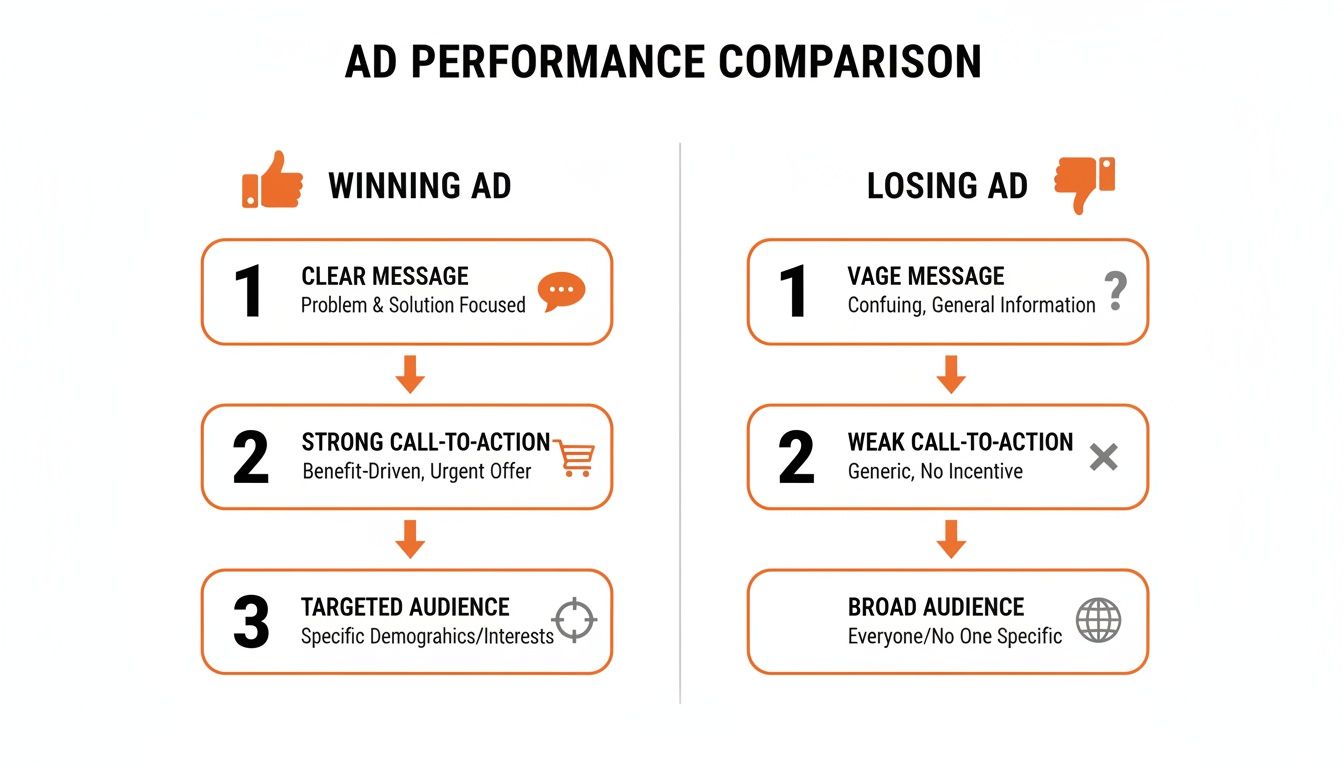
As you can see, the winning ads focus on providing real value and fitting into the conversation. The losing ones just shout a sales pitch that feels completely out of place.
Step 3: Craft Value-Driven Content
This is where the magic happens. If there's one golden rule for native advertising, it's this: create content that educates or entertains, not just sells. Your ad should feel like a natural, welcome part of the user's experience on the site.
Here's a simple framework for creating your content:
- Solve a Problem: Zero in on a real challenge or question your audience has and offer a solution.
- Tell a Story: People connect with stories. Use a narrative to make your message stick and create an emotional connection.
- Be Platform-Specific: This is non-negotiable. You have to tailor your content's tone, style, and format to the culture of the platform. A funny, informal meme that crushes it on Reddit will fall flat in a serious business journal.
- Disclose Clearly: Always, always use the platform's required labels like "Sponsored," "Promoted," or "Ad." Hiding the fact that it's an ad is the fastest way to lose trust. Transparency is everything.
Step 4: Set Your Budget and Metrics
Last but not least, you need a realistic budget and a way to measure your return on investment. If you're just starting out, it’s a good idea to begin with a smaller test budget. This lets you learn what works with your audience before you start spending big.
The metrics you track should tie directly back to the goals you set in Step 1.
- For Brand Awareness: Keep an eye on impressions, reach, click-through rate (CTR), and how often your content is shared.
- For Lead Generation: You'll be watching your conversion rate, cost per lead (CPL), and the quality of the leads you're getting.
- For Sales: The big ones here are return on ad spend (ROAS) and cost per acquisition (CPA).
By nailing down these four steps, you'll turn a fuzzy idea into a clear, actionable plan that's ready to launch.
6. Measuring Success and Avoiding Common Pitfalls
So you've launched your native ad campaign. Now what? Getting your content live is really just the beginning. The real test is proving it actually worked, and that means looking beyond the obvious numbers to see what’s really connecting with your business goals.
It’s incredibly easy to fall for the allure of "vanity metrics"—things like impressions or social media likes. They look great in a report, sure, but they don't tell you much about the actual impact. A truly smart native ad strategy digs way deeper to understand genuine engagement and, most importantly, your return on investment.
Moving Beyond Vanity Metrics
To measure what actually matters, you need to sync your Key Performance Indicators (KPIs) with the goals you laid out from the start. This is the only way to track progress that leads to real, tangible outcomes for your business.
Forget the fluff. Here are some of the metrics that reveal the true story:
- Time Spent on Content: How long are people sticking around to read your sponsored article? A high average time on page is a fantastic sign that your content is hitting the mark and delivering genuine value.
- Share Velocity: This isn't just about the number of shares, but how fast and how often your content is getting passed around. When share velocity is high, it means you've created something that resonates so well, people are doing the marketing for you.
- Comment Quality: Don’t just count comments; you have to read them. Are people asking thoughtful questions? Starting genuine discussions? That's a far better indicator of resonance than a feed full of one-word replies.
- Conversion Rate: This is the bottom line. It tracks the percentage of users who clicked your ad and then took the action you wanted them to, whether that's signing up for a demo or buying a product.
Tracking these deeper signals gives you a much richer, more accurate picture of how your campaign is doing. If you want to get really granular and see how native ads fit into the entire customer journey, it’s worth exploring multi-touch attribution models.
Matching Native Ad KPIs to Your Campaign Goals
Choosing the right KPIs isn't a one-size-fits-all situation. The metrics you prioritize should flow directly from what you're trying to accomplish. This table breaks down how to align your tracking with your specific campaign objectives.
| Campaign Goal | Primary KPIs to Track | What This Tells You |
|---|---|---|
| Brand Awareness | Impressions, Reach, Share Velocity, Branded Search Lift | How many people are seeing your content and how effectively it's spreading your brand's name. |
| Audience Engagement | Time on Page, Scroll Depth, Comment Quality, Likes/Upvotes | Whether your content is truly captivating and resonating with the target audience. |
| Lead Generation | Conversion Rate (Form Fills), Cost Per Lead (CPL), Click-Through Rate (CTR) | How effectively your content is turning readers into potential customers for your sales pipeline. |
| Sales & Revenue | Return on Ad Spend (ROAS), Customer Acquisition Cost (CAC), Sales Conversion Rate | The direct bottom-line impact of your campaign and its profitability. |
By picking KPIs that match your core goal, you move from just collecting data to gathering actionable intelligence that can shape your future strategy.
The Critical Importance of Ethical Advertising
Let's talk about the biggest landmine in native advertising: the blurry line between being clever and being deceptive. Your audience is savvy. They know when they're being marketed to, and they absolutely hate feeling tricked. Betraying that trust is the fastest way to kill your brand’s credibility and spark a backlash.
The Federal Trade Commission (FTC) is crystal clear on this: ads must be identifiable as ads. That means clear, unambiguous disclosure isn't just a good idea—it's the law.
Key Takeaway: The whole point of native advertising is to be non-disruptive, not deceptive. Authenticity and transparency are your best friends. Always use obvious labels like "Sponsored," "Ad," or "Promoted Post."
Tucking a tiny, light-gray disclosure at the very bottom of the page just doesn't cut it. It needs to be placed where an average reader can't miss it. Ignoring these rules won't just tarnish your brand's reputation; it can land you in serious legal hot water.
Avoiding Audience Backlash
The best native ad campaigns manage to be both effective and ethical. They give the audience something genuinely valuable while being completely honest about the fact that they're sponsored.
To strike that perfect balance, steer clear of these common mistakes that almost always backfire:
- Bait-and-Switch Headlines: Nothing infuriates a reader more than a clickbait title that promises a great story but delivers a blunt sales pitch.
- Ignoring Platform Culture: Trying to run a stuffy, corporate-sounding article on a casual platform like Reddit is a recipe for disaster. It will get called out immediately.
- Being Too Salesy: Your first job is to educate or entertain. Let the sales message be a subtle, secondary benefit of the great content you're providing.
When you focus on creating real value and being upfront, you build a campaign that doesn't just perform well—it earns you the respect of your audience. For a more detailed breakdown, have a look at our guide on measuring return on marketing investment.
Common Questions About Native Advertising
Even after getting the basics down, a few questions about native advertising tend to trip people up. Let's clear the air so you can move forward with confidence.
Is Native Advertising the Same as Content Marketing?
Not quite, but they're definitely related. Think of them as two sides of the same coin.
Content marketing is the practice of creating genuinely helpful or entertaining content on your own properties, like your company blog or YouTube channel. Native advertising is when you pay to place that content on someone else's platform, making it look and feel like part of the natural user experience.
So, a native ad can be the vehicle that drives your great content marketing to a much bigger, more targeted audience.
How Much Do Native Advertising Campaigns Cost?
This is the big "it depends" question. The price tag for native advertising is all over the map.
Running a campaign with a major publication like The New York Times could easily run you into the tens of thousands. On the flip side, you could dip your toes in the water with a promoted post on a platform like Reddit for just a few hundred dollars to see what happens.
Your final cost really boils down to the platform, the audience you're trying to reach, and how granular you get with targeting. The key takeaway? Always start with a small, test budget. See what resonates before you even think about scaling up.
What Is the Most Critical Factor for Success?
If I had to boil it down to one word, it would be authenticity.
You have to respect the user and the platform. Your ad can't just be a sales pitch wearing a clever disguise. It needs to offer real value, whether that's through education, entertainment, or a genuinely interesting perspective.
The best native ads never feel like an interruption. They feel like a natural, welcome part of the conversation. When you lead with value, you earn trust—and that's when you start seeing real results.
For more deep dives and ongoing discussions about advertising that actually works, the lunabloomai blog is a great resource.
Ready to turn authentic conversations on Reddit into measurable growth? Reddit Agency builds and manages native campaigns that connect with communities, drive traffic, and generate qualified leads. Start your Reddit growth journey with us today.
