A Modern Guide to Your Launching Product strategy
A solid product launch strategy is your roadmap. It connects you with the right audience and helps you build momentum from day one. Think of it less as a hopeful gamble and more as a calculated plan to de-risk your big day and guarantee you're solving a real, painful problem for the people you want to serve.
Why So Many Product Launches Quietly Fail
Let's be honest—most product launches don't make a big splash. They fizzle out, often because the product was built in a vacuum, completely disconnected from the people it was supposed to help. The "build it and they will come" mindset is a fast track to a quiet, unnoticed release.
This isn't just a hunch; it's a harsh reality backed by some sobering data. A staggering 90% of new product development efforts by startups ultimately fail. This figure drives home why a meticulous launch strategy is non-negotiable. The companies that dig into market research and validation are the ones who see better outcomes, a fact you can see in these product development statistics.
The Mindset Shift from Checklist to De-Risking
Founders who nail their launches see the process not as a finish line, but as a constant cycle of validation. Instead of spending months perfecting a product in isolation, they're embedding themselves in niche communities on platforms like Reddit long before a single line of code is written.
This proactive approach is incredibly powerful. For example, instead of just assuming project managers need another Gantt chart tool, a smart founder would spend a month in r/projectmanagement and notice a recurring complaint: "I spend an hour every Monday manually compiling status updates for leadership." This is a tangible, specific problem. The proactive approach helps you:
- Validate the Problem: You confirm the pain point you think exists is real, urgent, and something people would actually pay to solve.
- Build an Early Audience: By engaging authentically in relevant subreddits, you find your first believers and beta testers before you even have a product.
- Refine Your Messaging: You hear the exact words your target customers use to describe their frustrations, which is pure gold for your marketing copy.
A deliberate launch strategy isn't about ticking boxes on a checklist. It's a fundamental mindset shift focused on de-risking your launch by making absolutely sure you've built something people genuinely want before you ask for their money.
To put this into perspective, let's look at the core pillars of a launch strategy. A weak approach is based on assumptions, while a strong one is built on evidence and customer interaction.
Pillars of a Winning Product Launch Strategy
| Pillar | Weak Strategy (Common Pitfall) | Strong Strategy (Actionable Approach) |
|---|---|---|
| Audience Insight | Guessing who the customer is and what they want. | Deeply embedding in customer communities to understand their exact pain points and language. Example: Monitoring r/sales to learn that reps hate their CRM's mobile app. |
| Problem Validation | Assuming the problem is significant without real-world proof. | Running small tests and gathering feedback to confirm the problem is urgent and worth solving. Example: Posting a mockup of a "one-click report" feature and asking, "Would this save you time?" |
| Product Development | Building the entire product behind closed doors before showing anyone. | Creating a Minimum Viable Product (MVP) and iterating based on continuous user feedback. Example: Building only the one-click report feature first and letting 50 beta users test it. |
| Marketing Message | Using generic marketing language to describe features. | Crafting copy using the exact words and phrases your target audience uses to describe their needs. Example: Changing "Efficient Reporting Suite" to "Stop Wasting Mondays on Status Reports." |
| Launch Day | A "big bang" release, hoping people show up. | A coordinated release to a warmed-up audience of early adopters who are already invested. Example: Giving your beta testers a 24-hour head start and a special "founder's club" discount. |
Ultimately, a strong strategy turns a potential failure into a calculated success by focusing on the customer from day one.
Finding Your First Believers Before You Build
Long before you have a single line of code or a physical prototype, your most important work begins. The secret to a successful launch isn't just about the product; it's about embedding yourself in the communities where your future customers already live and breathe. I'm not talking about spamming them with generic surveys. This is about becoming a trusted, helpful voice in their world.
You need to shift from guessing what people want to actually observing what they need. And today, you don't have to do it all manually. For example, you can find leads on social media with AI to pinpoint relevant conversations and frustrations at scale. It gives you an incredible head start.
Gathering Raw Customer Intelligence
The real objective here is to collect raw, unfiltered language straight from your target audience. This stuff is pure marketing gold.
Think about it. A B2B SaaS founder could spend weeks lurking in Reddit's r/sales subreddit, soaking up all the daily frustrations people have with their current CRM tools. They'd likely find dozens of comments griping about clunky interfaces or integrations that just don't work. On the consumer side, a new beauty brand could track detailed skincare routines in r/AsianBeauty to see if their idea for a new serum actually solves a problem people care about.
This kind of intel pays off in two huge ways:
- Problem Validation: It’s concrete proof that you’re solving a real, painful problem that people are already trying to solve.
- Copywriting Goldmine: It gives you the exact words and phrases your audience uses. You can then mirror that language right back at them in your marketing copy, making it instantly resonate.
The most powerful product validation comes from observing unsolicited complaints and desires in their natural environment. When you find people asking, "Does anyone know a tool that does X?" you've struck gold.
This proactive listening is what helps you build a crystal-clear Ideal Customer Profile (ICP). A well-defined ICP isn't just a basic demographic sketch; it’s a deep, authentic understanding of your customer's motivations, pains, and vocabulary.
We have a whole guide that dives into what an Ideal Customer Profile is and how to build one. By finding your believers first, you're making sure your entire launch strategy is built on a solid foundation of genuine market need, not just a good idea.
Building a Community That Cares
Momentum doesn't just happen—you have to build it. Once you’ve figured out where your people hang out online, the next move is to stop just listening and start actively building your own tribe before the launch. This is the secret to creating real excitement that doesn't feel like spam.
The aim is to nurture a core group of fans who feel like they're part of the team, like co-creators. These are the folks who will be genuinely pumped to shout about your product when it finally goes live.
From Lurker to Leader
First things first, you need to turn those early believers into your most passionate advocates. One of the best ways I’ve seen this done is through a well-organized beta program. This isn’t just about squashing bugs; it’s about making your earliest users feel important and, more importantly, heard.
Imagine a new productivity app made for serious power users. The creators could grant exclusive beta access to the most active people in a subreddit like r/getdisciplined. These users get to try the app first and have a direct line to the founders. In return, the company gets priceless feedback and some killer testimonials.
This trade-off is incredibly powerful. You're not just getting free quality assurance. You're building a loyal base that feels invested in your product's success. They become your champions because you made them part of the story from day one.
Of course, this is more than just sending out a bunch of invites. To really nail it, you should:
- Set up an exclusive channel. A private Discord server or a dedicated subreddit for beta testers creates a real sense of community. Actionable Insight: Create specific channels like
#bug-reports,#feature-requests, and#general-chatto keep feedback organized and actionable. - Acknowledge feedback publicly. When you push a fix for a bug someone reported, give them a shout-out in the channel. It proves you're listening and builds massive trust. Example: "@JaneDoe thanks for flagging the login issue—we just pushed a fix for it!"
- Offer a sneak peek. Share mockups or early ideas for new features. Asking for their input makes them feel like true insiders. Actionable Insight: Use a simple poll feature in Discord or Slack to let them vote on which feature to build next.
Partnering with Trusted Voices
Another smart play is to team up with respected micro-influencers or moderators in the communities you're targeting. These are the people who already have the trust you're trying to earn. Giving them early access or a free lifetime account can transform them into powerful allies.
The value here is huge. Social media content influences purchases for a staggering 76% of users, and that number skyrockets to 90% for Gen Z. This makes genuine collaborations on platforms like Reddit incredibly effective for generating that pre-launch buzz. You can dive deeper into these digital marketing statistics and trends to see just how big the opportunity is.
By putting real effort into these relationships, you create a groundswell of genuine support. For more tips, we've put together a complete guide on how to build an online community that actually cares.
Coordinating Your Launch Day Push Across All Channels
Launch day isn't just about flipping a switch and hoping for the best. Think of it as a well-choreographed performance where every channel—from email to social media to community forums—works together to create a single, powerful moment. It's the culmination of all your pre-launch work, channeled into an event that announces your arrival to the market with a bang.
A smart multi-channel strategy is how you cut through the modern-day noise. The idea is to create a ripple effect. A spark of excitement on one platform should catch fire on another, driving a wave of attention and, most importantly, those crucial first sign-ups.
This is what a coordinated build-up looks like, moving from early access all the way to the big day.
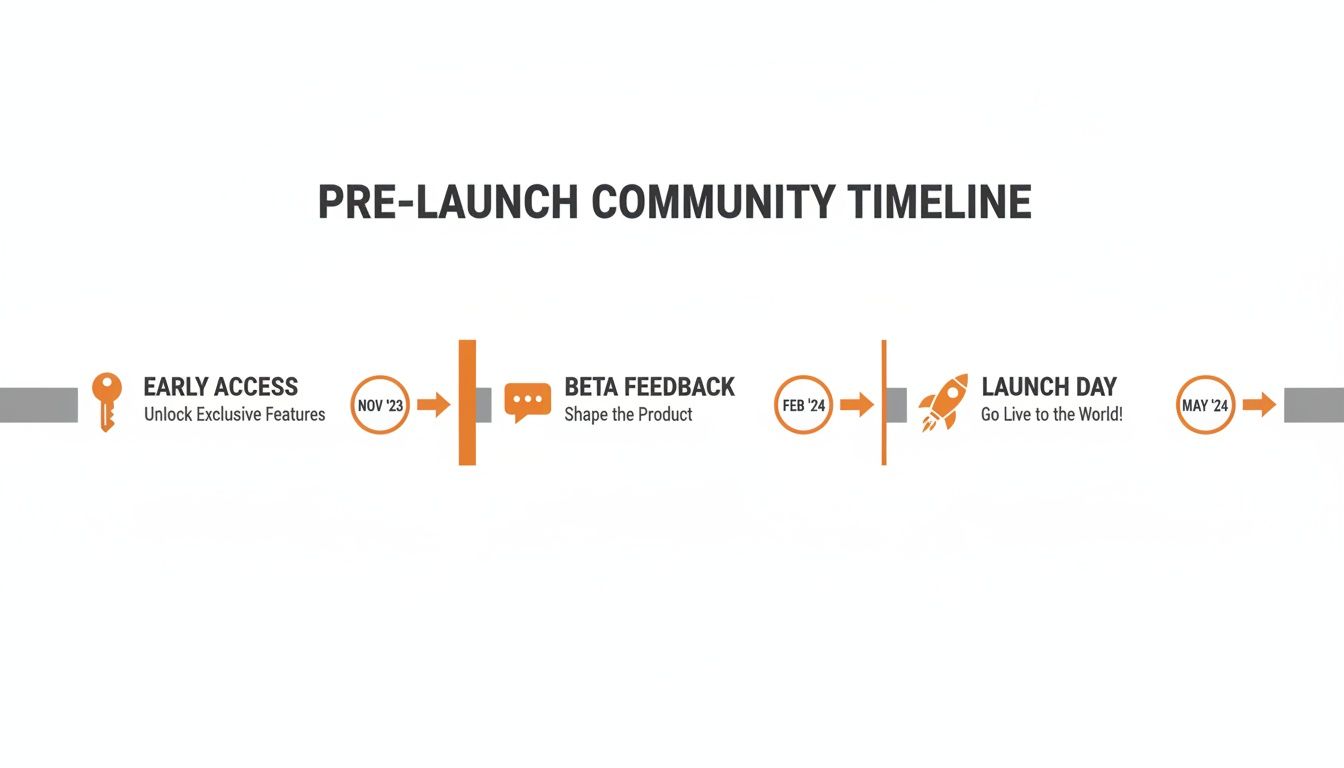
As you can see, each phase sets the stage for the next. The early access phase builds a core group of advocates, their feedback refines the product, and that momentum carries you into a much stronger launch day.
Stagger Your Channels for a Domino Effect
Timing really is everything on launch day. Dropping everything everywhere at the exact same moment is a recipe for a diluted message and a confused audience. Instead, you want to sequence your announcements to build hype and momentum throughout the day.
Let’s walk through a realistic playbook for a SaaS launch:
- 8:00 AM: Give your biggest fans the first look. Post an "exclusive" announcement in a niche subreddit or your private Discord/Slack community. This rewards your loyal followers and starts the flow of genuine, positive feedback. Actionable Insight: Include a special discount code just for this group to thank them and encourage immediate sign-ups.
- 9:00 AM: Send the official announcement email to your waitlist. These are your warmest leads, the people who have been waiting for this moment. Make it easy for them to sign up and get started. Actionable Insight: Use a clear, benefit-driven subject line like, "It's here! Your wait for [Product Name] is over."
- 10:00 AM: Launch on Product Hunt. Now you can lean on your community and email list to provide those critical early upvotes and comments, helping you climb the daily rankings.
- 12:00 PM & Beyond: Begin your broader social media campaign on platforms like X (formerly Twitter) and LinkedIn. By this point, you can share screenshots of positive comments and your progress on Product Hunt to build social proof.
This staggered approach creates a powerful domino effect. The buzz from your core community drives your Product Hunt ranking, which in turn gives your social media posts the credibility and urgency needed to capture a wider audience.
Get Your Launch Day Toolkit Ready
To pull off a seamless, multi-channel launch, you need all your content and assets prepared well in advance. Consistency is everything. Your brand voice, your core message, and your value proposition have to be rock-solid across every single channel. Someone discovering you on LinkedIn should have the exact same clear, compelling experience as someone clicking through from Product Hunt.
Create a "Launch Day" folder and get these essentials finalized and approved ahead of time:
- Demo Videos: Keep them short and sweet. A 90-second video that clearly shows the problem and your solution is far more effective than a long, detailed tutorial.
- Press Kit: Keep it simple. Include your logo files, founder headshots, a one-page summary of what your product does, and a handful of high-quality screenshots.
- Canned Responses: You're going to get a lot of questions. Prepare thoughtful, pre-written answers for the FAQs you anticipate on Reddit, Product Hunt, and social media. This will save you a ton of stress on the day. Example: Pre-write your answer for "How are you different from [Competitor X]?" focusing on your unique value, not just features.
Turning Launch Day Data Into Long-Term Growth
Hitting that "launch" button is a huge milestone, but it's really just the beginning. This is where your strategy pivots from building and shipping to listening and learning. It’s tempting to get caught up in flashy numbers like website visits, but the real gold is buried a little deeper.
Sustainable growth comes from understanding how people are actually using your product, not just that they showed up.
What to Actually Watch After You Launch
Forget vanity metrics for a second. We need to focus on the numbers that tell a story about whether your product is delivering on its promise.
- Activation Rate: Are new users completing the key steps to get value from your product? Example: For a project management tool, activation could be "user creates their first project and invites a team member." This tells you if your onboarding process actually works or if people are getting lost and giving up.
- User Retention: Of the people who signed up in the first week, how many are still around a month later? High retention is probably the single best indicator that you've built something people genuinely need.
- Qualitative Feedback: What are your first 100 users saying? Actionable Insight: Set up a simple feedback form or send a personal email to your first 100 users asking, "What's one thing we could do to make this better for you?" The replies are often more valuable than any spreadsheet.
This initial feedback is priceless. I've seen companies find game-changing insights just by monitoring their launch-day Reddit threads. You get real-time bug reports and brilliant feature ideas straight from the source.
When you see that feedback, jump on it. Publicly thank people for their input. It shows you're paying attention and makes those early adopters feel like part of the team. That's how you build a loyal following, not just a customer base.
A great launch isn’t a one-and-done event. It's the start of a feedback loop: ship, listen, analyze, and improve. This is how you turn a flash of initial buzz into a real, lasting business.
Building this cycle of feedback is essential for refining both your product and your marketing. Those early signals help you sharpen everything from your ad copy to your feature roadmap.
If you're looking for a solid framework to connect these launch activities to your bottom line, our guide on measuring return on marketing investment is a great place to start. It helps you turn all this data into a concrete plan for growth.
Lingering Questions About Product Launch Strategy
Even the most seasoned teams run into a few common questions when mapping out a product launch. Getting clear on these points can mean the difference between a launch that fizzles out and one that truly takes off.
How Far Out Should We Start Planning?
From my experience, you want to give yourself a runway of at least 3-6 months for any serious product launch. It might sound like a long time, but it flies by.
This window gives you the breathing room you need to do proper market research, find the right online communities, build genuine pre-launch excitement, and get all your marketing assets lined up without that last-minute scramble. Think of this extra time as your secret weapon—it’s what allows you to pivot based on early feedback from beta testers and polish your messaging until it shines.
What's the One Mistake Everyone Seems to Make?
The single biggest pitfall I see is launching in a silo. Founders get so wrapped up in their vision that they forget to bring their future customers along for the ride. They build what they think is perfect, only to find out post-launch that the market wanted something slightly different.
A great launch strategy is all about reducing risk. You do that by talking to your target audience from the very beginning. Share mockups, get people into a beta program, and just listen to how they talk about their problems. You're not just validating an idea; you're co-creating the solution.
How Can We Tell if a Reddit Launch is Actually Working?
Success on a platform like Reddit isn't just about one number. You have to look at both the hard data and the softer, more conversational feedback. They really do paint a complete picture together.
A detailed product launch checklist can be a lifesaver here, making sure you don't miss any critical steps in tracking your progress.
- The Hard Numbers (Quantitative ROI): This is where you get specific. Use UTM parameters on every link you share. Actionable Insight: Create unique UTMs for each subreddit post (e.g.,
utm_source=reddit&utm_medium=post&utm_campaign=launch_day&utm_content=r-saas). This allows you to track exactly which communities drive the most sign-ups and sales. - The Community Vibe (Qualitative ROI): Pay close attention to the tone of the conversations. What's the sentiment? Are people excited? Confused? Are you getting insightful feedback that could actually improve your product? These user-generated ideas are pure gold for your roadmap. Practical Example: If multiple comments say, "This looks great, but does it integrate with Salesforce?" that's a direct signal for your next development sprint.
Ultimately, a successful Reddit launch delivers a mix of immediate conversions and priceless market intelligence you simply can’t find anywhere else.
Ready to make your next launch a success? Reddit Agency specializes in building authentic connections that turn conversations into customers. We help you find your first believers and build momentum that lasts. Learn how we can help you win on Reddit by visiting https://redditagency.com.
